More than 40 years ago, Orden and Bradburn (1968) observed that relational happiness derives from two factors—“satisfactions” and “tensions” (or rewards and incompatibilities).
Rewards positively affect relational happiness and incompatibilities negatively affect happiness. However, rewards and incompatibilities do not necessarily associate with each other.
According to Orden and Bradburn, maintaining quality relationships requires the provision of rewards and the reduction of incompatibilities, because the removal of one does not necessarily lead to an increase in the other (p. 715). Couples cannot simply decrease incompatibilities to increase rewards; rewards require behaviors other than eliminating incompatibilities. According to Orden and Bradburn, more current assessments have determined that two processes represent (1) the reduction of antagonism and (2) the increase of nurturance.Recently, researchers have explored how conflict behaviors specifically combine with other contexts and domains of communication to affect relational quality (e.g., Caughlin & Huston, 2006; Ellis & Malamuth, 2000). This research holds that conflict communication does not operate as a monolithic determinant of relational quality. Rather, other forms of communication in the home affect relational quality. This perspective of how conflict affects relational quality and outcomes is known as the “Dual Concerns” approach.
The Dual Concerns view examines conflict and various other domains ofbehav- ior, including playfulness and enthusiasm (Driver & Gottman, 2004), social support, love and responsiveness (Ellis & Malamuth, 2000; Huston, Caughlin, Houts, Smith, & George, 2001), and other proactive behaviors. In addition, positive and negative behaviors function differently as marriages continue (Gottman & Levenson, 2002; Huston et al., 2001; Rogge and Bradbury, 1999). Processes that predict divorce in the early years differ from the processes that predict relational quality and divorce later. Stable and satisfied partners engage in a variety of positive behaviors that affect and reflect how conflict behaviors function in close relationships as well as work relationships (Waldron, 2003).
We focus on how selected relational maintenance behaviors complement conflict strategies to affect relational quality. Positive and proactive maintenance behaviors are strongly associated with quality indicators such as trust, commitment, and satisfaction (Canary, Stafford & Semic, 2002). In this chapter we show how shared activities, social support, and positivity complement conflict management in predicting relational quality. (Elsewhere we review how sharing tasks reduces conflict; Canary & Stafford, 2001.) Figure 3.1 presents the dual process model involving maintenance and conflict strategies.
The key assumptions ofthis model are that (1) managing conflict cooperatively can reduce aversion, whereas (2) promoting the relationship through maintenance behaviors increases relational quality. Relational quality reflects in important factors such as stability, satisfaction, commitment, and so forth. Relational maintenance behaviors promote cooperative conflict communication and change the course of destructive messages. In turn, direct fighting and indirect fighting negatively affect one’s motivation to share activities, show support, and use positivity. Finally, both conflict communication and maintenance behaviors directly affect personal and relational outcomes. See Figure 3.1.
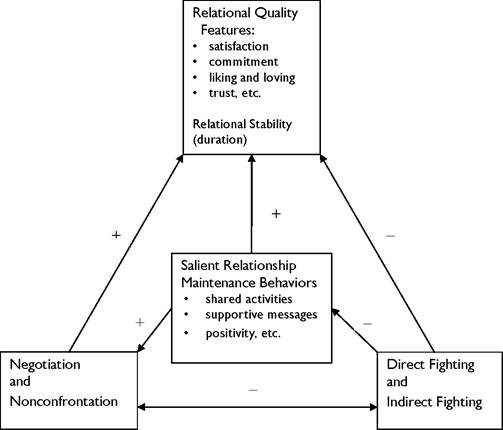
FIGURE 3.1 Links among Cooperative and Competitive Conflict, Relationship Maintenance Behaviors, Stability and Relational Quality Features
Note: A positive sign indicates a positive association between factors; a negative sign indicates an inverse association between factors.
We first discuss how spending activities together during leisure time provides opportunities to develop a nurturing relational environment. Next we examine how participation in shared activities mitigates against aversion, negative conflict behaviors, and potential harms that sometime arise from conflict. Finally, we touch on the roles of positivity and supportiveness as maintenance behaviors.