Narcissism
Once considered a personality disorder, researchers now view narcissism as a trait that varies from person to person. People vary in their level of narcissism, such that narcissism is a personality trait that varies from a baseline of normal narcissism upward (Foster, Shira, & Campbell, 2006).
Two sections imply how you can obtain personal control of narcissism during conflict interactions.The Look of Narcissism
Conceptually, narcissism constitutes a trait regarding people’s thoughts and behaviors that promote their self-esteem and social superiority with little concern for other people (Twenge, Konrath, Foster, Campbell, & Bushman, 2008, p. 877). As a personality trait, narcissism contains several dysfunctional characteristics. These characteristic include (1) belief that they are unique; (2) self-estimated superiority to other people; (3) dreams about gaining power and prestige; (4) need for attention, admiration, and even love from other people; (5) inclinations for showing off; (6) ability to appear charming; (7)) interpersonal behaviors that manipulate and exploit others; (8) inability to empathize with other people; (9) envy of other people’s successes and possessions; and (10) arrogance, defensiveness, and aggressiveness (Campbell, Foster, & Finkel, 2002; Popper, 2002).
Researchers sometimes categorize narcissists according to two types: grandiose and vulnerable. Grandiose narcissism involves flamboyant, dominant, and aggressive behaviors, which might reflect high self-esteem. Vulnerable narcissism involves defensiveness and fragile assertiveness, which reflects low self-esteem and feelings of being ineffectual (Miller & Campbell, 2010). Such distinctions are relatively new, however, and do not lead to a conclusive set of conflict behaviors for each type. Moreover, it is possible for people to have one or both forms of narcissism.
For example, Morf and Rhodewalt (2001) indicated how both grandiosity and vulnerability occur in the narcissist: Narcissists possess a grandiose yet vulnerable view of the self. Given this combination, narcissists attempt to achievecontinuous external self-affirmation. Because narcissists are insensitive to others’ concerns and social constraints and view others as inferior, their self-regulatory efforts often are counterproductive and ultimately prevent the positive feedback that they seek—thus undermining the self that they are trying to create and maintain. (p. 177)
Although narcissism has been traditionally discussed as a personality disorder, all people vary in the extent to which they are narcissistic, or normal narcissism (Foster et al., 2006). Nevertheless, behaviors that reflect higher narcissism are largely maladaptive to interpersonal settings (e.g., lacking in empathy) (Watson, Trumpeter, O’Leary, Morris, & Chulhane, 2006). The connection of narcissism to conflict management can be witnessed in rather general accounts of related variables.
In personal relationships, as mentioned, narcissism positively associates with dominance and aggression. In comparison to people low in narcissism, highly narcissistic people hold an immature view of love, pursue game-playing love, seek physical intimacy for selfish, instrumental reasons, and engage in infidelity (Campbell et al., 2004; Foster et al., 2006; Le, 2005).
Narcissistic people are quite charming when initiating social involvements. However, narcissists face problems in sustaining positive relationships. According to Miller and Campbell (2010), narcissistic individuals “are likeable in initial interactions with strangers because they are viewed as ‘entertaining’ and ‘confident,’ but this likeability decreases and even reverses over a period ofseveral interactions” (pp. 184—5). Behaviors that underlie first impressions ofnarcissists include “attractiveness, from their flashy and neat attire; interpersonal warmth, from their charming glances at strangers; competence, from their self-assured behavior; and humor, from their witty verbal expressions.”
Back and colleagues in fact found that narcissists charm people they have never met before.
Specifically, narcissism was positively associated with being flashy, charming facial expressions, and self-assuredness. These behavioral characteristics, in turn, lead to perceptions of the narcissist’s popularity. Ironically, “People with a sense of entitlement and a tendency to manipulate and exploit others were liked more” when meeting people for the first time (p. 141). In a word, Back et al. found that behaviors that composed being charming, flashy, and self-confident associated with narcissism. However, that first impression of the narcissist evaporates once people learn more about this charming individual.Ongoing relationships exceed narcissists’ ability to impress and enjoy other people. Recall that the narcissist requires that other people affirm their selfconcepts (as unique and special). Close involvements are more difficult to manage because people tire of the narcissist’s increased disagreeableness, hostility, and arrogance, in addition to a need for affirmation. In addition, narcissists do not obtain rewards from long-term friends or romantic partners if they do not attempt to present themselves positively.
Accordingly, turbulence with their partners emerges (Miller & Campbell, 2010). In brief, interpersonal conflicts for narcissists stem from their lack of commitment to relational partners, lack of care about other people, and lack of loving others without concern for self (Campbell & Foster, 2002; Le, 2005). Of direct relevance to conflict behaviors concerns the aggressiveness that narcissistic people levy against other people who do not stroke their egos.
Bushman and Baumeister (1998) conducted two interesting and informative experiments that revealed the selfish orientation of the narcissist. In Study 1, they divided participants into one of two experimental groups, measured trait narcissism, and asked participants to write a brief essay regarding abortion. Each person randomly received from a bogus stranger either very positive ratings and a handwritten comment on their essays (“No suggestions, great essay”) or very negative ratings and a negative handwritten comment (“This is one of the worst essays I have read!”).
Participants could then punish the person who supposedly evaluated them. As expected, the combination of high narcissism and insult led to very high levels of aggression toward the person who made the experimentally induced insult. Bushman and Baumeister interpreted their findings in terms of the narcissist’s perceived threat to their egos: “Thus, our data suggest that aggression by narcissists is an interpersonally meaningful and specific response to ego threat. Narcissists became exceptionally aggressive toward a person who had given them a negative, insulting evaluation” (p. 227). Study 2 validated Study 1 and revealed that narcissistic participants even punished innocent third parties who did not insult the evaluators. Other people naturally did not punish innocent third parties.Trends in Narcissism
College student narcissism has likely increased over the past 50 years. Twenge et al. (2008)'s meta-analysis revealed a 30% increase of narcissism between 1980 and 2006. That is, approximately two thirds of recent college students score above the midpoint that was found in the 1979—85 samples. Figure 7.1 illustrates the increase of college student narcissism over this relatively brief span of time.
One implication of the trends data involves both (1) within-generation problems because new generations have increased narcissism, and (2) between-genera- tion problems because different generations differ in levels of narcissism. Twenge et al. (2008) argued that the linear increase in narcissism leads to direct negative outcomes for partners, other generations, and (eventually) for the narcissist. Increased preoccupation with self can erode relationships with low-narcissistic partners in the process noted above—through diminished desires to present a positive self to one person over time. In relationships that include two narcissists, competition regarding uniqueness, superiority, and lack of regard for the other would lead to aggressive conflicts. Conflicts can occur between generations as well, as older adults likely view younger adults as acting entitled, selfish, and uncaring for other people.
The narcissist would indeed not care about such attributions, leading to a self-serving denial of the older person’s right to criticize and (again) aggressive reactions to such criticism.Research regarding narcissism invites several behavioral prescriptions relevant to conflict management. Here are a few that we deduced:
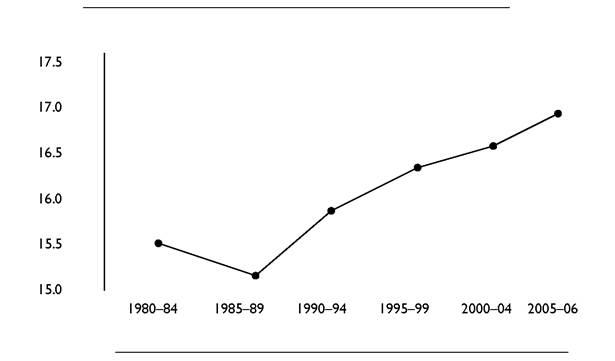
FIGURE 7.1 Average Change in College Student Narcissism 1980-2006
Note: The vertical line represents scores on the Narcissism Personality Inventory.
Adapted From Twenge et al. (2008, p. 883)
Conclusion 7.7: Narcissists believe that they are “unique” and “special.” So show your thoughts about their actions (e.g., you are funny; that was nice).
Conclusion 7.8: Narcissists appear charming at first but then aggressive later when their uniqueness and specialness are not reinforced.
Conclusion 7.9: Over time, narcissists tend to have little empathy for others, rely on communicative tactics that emphasize self-presentation objectives rather than those that reference relationship favors (e.g., you will get more money, prestige, and recognition; do this for me, think about others for a change), and use more direct fighting tactics (Table 2.3).
Suggestion 7.7: Be mindful of the beliefs and behaviors that accompany narcissism (e.g., perceived self-superiority, need for attention, inclinations for showing off; charming behaviors; manipulating others, arrogance, and so forth).
Suggestion 7.8: Do not tell narcissists that they are unique or special. They are not alone.
Suggestion 7.9: Be mindful that generational conflicts can arise due to increased trends in narcissism.