Perceptual Differences and Conflict
As indicated, parties to conflict can hold perceptions so different that they appear to be dealing with two different conflicts. Moreover, differences in perspective and the inability to recognize the other person’s perspective contribute to misunderstanding and lay the groundwork for conflict.
Each person brings into the conflict interaction his/her own ideas about the sources of the conflict, the events leading to the conflict, and the meaning of behaviors. Each party to conflict cannot see the same issues or the same events leading to the conflict (Sillars et al., 2000; Sillars, 1998). Moreover, conflict parties have different information about each other’s motives, intentions, and behaviors (DeDreu, Natua, & van de Vliert, 1995).In addition, conflict parties’ perceptions of situational details differ (Witteman, 1992). Witteman considered frequency of occurrence, goal mutuality, goal-path uncertainty, attribution of cause to the other person, and negative feelings for the other person. He viewed all as perceptions rather than facts because each person knows only his/her own thoughts; additionally, those thoughts are affected by the biases inherent in the perception process. The perceptions, more than the causes of the conflict characteristics, were related to the conflict style and management of the conflict.
At this juncture, we wish to reiterate that your “field ofvision” is largely external to you (Storms, 1973). For example, you do not see your face or even hear your voice accurately when you communicate. You can see your hands gesturing, but that is about it. You hear your voice primarily through the bones in your face and head, which is why you sound so “strange” to yourself when you hear a recording of it. The recording is more accurate than your perceptions of your own behavior. So the other person has much more data regarding your behavior than you.
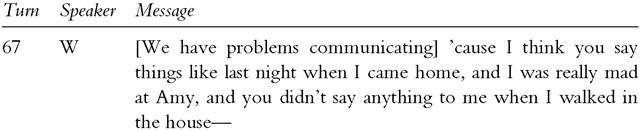
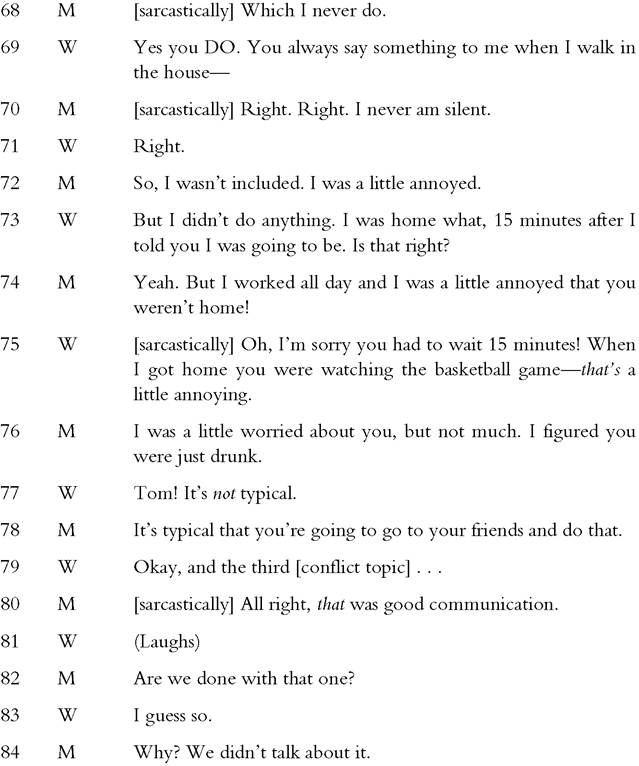
You interpret your behavior as reasonable, making claims to others that “I was very polite and didn’t make any snide remarks.” However, your partner sees your behavior and notices your eyes looking elsewhere and speaking in a sarcastic voice. Likewise, you tend to focus on the other person while, simultaneously, the other person is focussing on you. Thus, two people who have no clue about what they themselves look or sound like, evaluate each other based largely on information that they have selectively retrieved (Sillars, 2001).Based on their perceptual biases and fields of vision, each person punctuates the interaction event so that s/he is seen as reacting to something the other person said or did (Watzlawick et al., 1967). Indeed, Watzlawick et al. identified the punctuation problem as pivotal to understanding relational dysfunction. Consider the following conversation between the young couple we introduced at the top of this chapter. If you look carefully, you will see that their conflict concerns how to punctuate the event. She faults him for not talking to her when she arrives home, while he denies her punctuation (turns 67—70). Rather, he punctuates his silence as a reaction for not being included, which she discredits (turns 72—75). The conflict then shifts but he pursues the topic, leading to the segment we presented in the beginning of the chapter. Clearly, the punctuation of their conflict is biased.
must depend on their perceptions because they provide our only empirical
connection to the real world. And because feelings are very real to them, people use them to predict how their partners feel, not realizing that their conversational partner likely experiences different feelings during conflict (Sillars, 2000; Sillars, Pike, Jones, & Murphy, 1984). As indicated, each person provides different information about details of the conflict including the cause of the conflict, focus of the conflict, and the roles each person played during the conflict. As the conflict continues, differences in perception become even stronger, and at some point communication becomes the most difficult (Sillars, 1998). In a word, differences in perception very well might fuel the escalation of conflict because both people simply become unable to understand the other person and what that person says and does (Sillars, Roberts, Dun, & Leonard, 2001).
Conclusion 9.2: One person’s field of vision radically differs from the other person’s field of vision.
Suggestion 9.2: Be mindful that during interaction your partner has more data about your behavior than you do, so obtain that information to help your cause.