Prisoners’ Dilemma
Prisoners’ Dilemma, the earliest significant attempt at mathematical modeling of conflict, extends risk analysis to decision-making. In the basic scenario (Tucker 1950), the police arrest and separate two suspects.
The district attorney is sure they are guilty but lacks sufficient evidence so needs a confession. He tells each suspect, separately, that he can confess or not. If both refuse, the district attorney will book them on petty charges, and they will receive equal but minor sentences, B. If both confess, they will receive considerably longer sentences, C. If one confesses and the other does not, then the confessor will receive the most lenient sentence of all, A, while the one who refused will get the toughest sentence of all, D. Figure 2.1 summarizes the situation: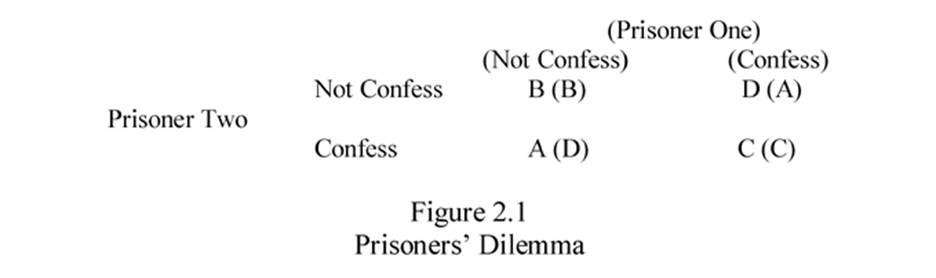
If the prisoners trust one another completely, both will refuse to confess. If they are unsure of one another, how can each prisoner use the information to make the best decision for himself? The solution is for Prisoner One to add the column payoffs and to select the one with the best payoff for himself, and for Prisoner Two to add the row payoffs and do the same. That is, Prisoner One will compare (B) + (D) with (A) + (C) and confess or not based on the smaller total (because prisoners prefer short to long sentences). Prisoner Two will do the same based on B + D and A + C.
Regardless of the actual numbers, a “game” like this with a finite number of players and strategies will produce the same solution no matter how many times it is “played.” John Forbes Nash, made famous in the movie Beautiful Mind, received the 1994 Nobel Prize in Economics for the discovery many years earlier of the existence of these “stabilities.”
Building on the recognition of stabilities, Axelrod (1985) pitted researchers who had studied Prisoners’ Dilemma against one another in repeated games of unknown length (but averaging 151 iterations). Anatol Rapoport obtained the best score by always cooperating on the first round, then imitating his opponent on each subsequent round.
Once opponents figured out what he was doing, they began to cooperate. This Axelrod interprets as providing an insight into how cooperation evolves in nature.Thomas Schelling (1960) used Prisoners’ Dilemma during the Cold War to determine the number of missiles needed to insure that the USSR and the US would continue to choose Cold over Hot War. A similar analysis of the terrorist threat concludes that there simply are too many targets to defend.4 Thus, the best strategy is to go after their training camps and arms caches, choke off their financing, infiltrate their networks, and eliminate their state supporters. Businesses have used Prisoners’ Dilemma to analyze price strategies, sociologists to explain racial prejudice, and sociobiologists to explain the evolution of cooperation. The Internal Revenue Service has used it to set penalties for nonpayment of taxes high enough to maximize compliance and minimize enforcement costs.