WALKING AMONG DEFINITIONS
Despite its increasing use, reconciliation appears as apolysemic concept. So far, there is no consensus about the necessary conditions for it. For some, reconciliation requires above all the establishment of order based on a negotiated settlement or a cease-fire.
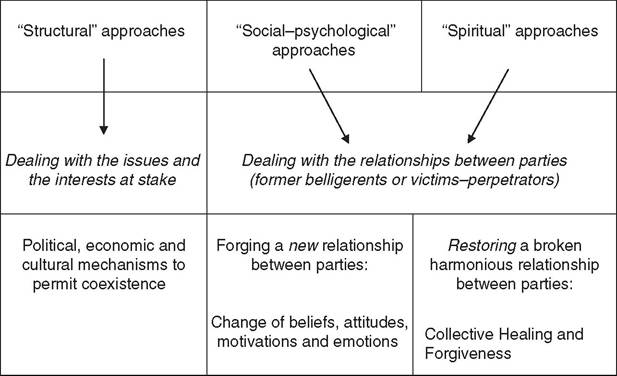
In this view, reconciliation refers to any “mutually conciliatory accommodation between former protagonists” (Long and Brecke, 2003: 1). Beside this pragmatic vision, others call attention to the “transcendent” nature of a far more demanding process requiring truth, mercy, justice and peace (Lederach, 1997). Between these two conceptions, most of the scholars underline different and sometimes competing definitions of the concept. Let us take a couple of examples to illustrate this variety of tones. For some, the core element of reconciliation is trust (Govier and Verwoerd, 2002; Amstutz, 2005; Nadler and Liviatan, 2006). In this line, Marrow suggests that reconciliation “is reestablishment of friendship that can inspire sufficient trust across the traditional split” (1999: 132). For another group of scholars, the key element is truth. In this view, reconciliation allows us to face “unwelcome truths in order to harmonize incommensurable world views so that inevitable and continuing conflicts and differences stand at least within a single universe of comprehensibility” (Asmal et al., 1997: 46). Yet, other voices claim that the essence of reconciliation is a psychological process of transformation leading ultimately to an identity change (Bar-Tal and Bennink, 2004; Kelman, 2004).Beyond this variety, three main approaches to political reconciliation can be distinguished: structural, social-psychological and spiritual ones. The first approach gives priority to security, economic interdependence and political cooperation between parties (Kacowicz, 2000). The second underlines the cognitive and emotional aspects of the process of rapprochement between former adversaries (Bar-Siman-Tov, 2004).
The third one accentuates a process of collective healing based on the rehabilitation of both victims and offenders (Tutu, 1999). The structural approach generally deals with the interests and the issues at stake, whereas the two others concentrate on the relationships between the parties.(1) Structures and Institutions - After the cessation of violent acts, parties in conflict can establish mutually accepted structural and institutional mechanisms to reduce the general perception of threat and to resolve any possible disagreement. When the former belligerents live in different states, these mechanisms can take the form of confidencebuilding measures like exchanging representatives in various political, economic and cultural spheres; maintaining formal and regular channels of communication and consultation between public officials; developing joint institutions and organizations to stimulate economic and political interdependence; reducing tensions by disarmament, demobilization of military forces, demilitarization of territories. The Franco-German case illustrates the effectiveness of such structural measures. Six years after the end of World War II, an economic union for coal and steel production was created; in 1963, Charles de Gaulle and Konrad Adenauer signed the Elysee Treaty which institutionalized regular meetings between foreign, defense and education ministers; in 1988, the Franco- German Council was established and in 1995, joint military units were formed (Ackermann, 1994). When adversaries live together in
one single state, structural measures mainly concern institutional reforms. Their purpose is to integrate all the groups in a democratic system, to restore human and civil rights and to favor a fair redistribution of wealth.
(2) Relationships - Although some structural changes can be implemented relatively quickly after the end of a conflict, the transformation of relationships does not occur in the same way. Studies dedicated to this slow and arduous process are interconnected but their vision of the transformation process is diverging.
Cognitive and social- psychological approaches analyse what they call a “deep change” in the public's psychological repertoire. This evolution results from a reciprocal process of adjustments of beliefs, attitudes, motivations and emotions shared by the majority of society members (Bar- Tal and Bennink, 2004: 17). The so-called spiritual approaches go a step further by asserting that reconciliation attempts to lead to forgiveness for the adversary's misdeeds (Shriver, 1995; Lederach, 1998; Staub, 2000; Philpott, 2006). However, as we will see, there is no consensus about the appropriateness of forgiveness in international relations.This classification could easily be challenged2. The picture to describe is so
rich that there are many ways to do it. Since the aim of this chapter is not to settle the issue from a theoretical point of view, we will not get involved in an academic debate about labels and categorizations. The main point to keep in mind at that stage is that even though structural measures are critical to establish a basic level of trust, they are likely not sufficient to resolve protracted conflicts (Wilmer, 1998: 93). Areconciliation process obviously implies the transformation of relationships between former opponents. The dramatic statement of Egyptian President Anwar al-Sadat before the Israeli Knesset on 29 November 1977 highlights the necessity to reconfigurate relationships between parties: “Yet there remains another wall. This wall constitutes a psychological barrier between us, a barrier of suspicion [...] of rejection [...] of fear [.] of deception [.] a barrier of distorted interpretation of every event and statement. Today, through my visit to you, I ask why don't we stretch out our hands with faith and sincerity so that together we might destroy this barrier?” (quoted by Maoz, 2004: 228). Here is probably the core of the issue. How do you launch a process of “reframing” in order to encompass the majority of individuals affected by the conflict? Or, to put it in a metaphorical way,
how do you “demobilize” the minds (Horne et al., 2002; Pouligny et al., 2007: 5)?