WHAT IS CONFLICT PREVENTION? A DISTINCT PERSPECTIVE
As the idea has come into vogue, ‘conflict prevention' and synonyms such as ‘preventive diplomacy' and ‘crisis prevention' are bandied about more loosely. New government units and non-governmental organizations have sprung up that tout the term in their logos.
To be au courant, established organizations add it to mission statements. But though ‘conflict prevention' may now be heard more often than the previously dominant ‘conflict resolution,' it is not clear whether the activities carried out under this new rubric are actually new. Despite the ambiguity due to the idea's rise to fame, however, close analysts have hammered out a core definition. Knowledge can cumulate when people use the same terms for inquiry.Conflict prevention applies to peaceful situations where substantial physical violence is possible, based on typical indicators of rising hostilities. Everyday spates where no blood is spilled, or public controversies that get so rancorous that social groups stop communicating are socially unhealthy, but much less grievous than states or groups about to kill each other with deadly weapons.8 A coup d'etat is less grave than the genocide of hundreds of thousands of people.9 Though thus narrowed to conflicts with potentially wide lethality (hereafter ‘conflicts' for short), specialists' definitions have varied in two main respects: a) the stage or phase during the emergence of violence when prevention comes into play; and b) its methods of engagement, which are geared to the differing drivers of potential conflicts that preventive efforts address.10
Moments for prevention
Conflict prevention has been distinguished from other approaches to conflict mainly by when it comes into play during a conflict, not how it is done. When UN Secretary General Hammerskjold first coined ‘preventive diplomacy' in 1960, he had in mind the UN keeping superpower proxy wars in third- world countries from escalating into global confrontations.
When the end of the Cold War brought unexpected intra-state wars such as in Yugoslavia, UN Secretary General Boutros- Ghali extended Hammerskjold's term in an upstream direction to mean not simply keeping regional conflicts from going global, but from starting in the first place (UN, 1992). This conceptual breakthrough shifted the moment for taking action back to stages when non-violent disputes were emerging but had not escalated into significant violence or armed conflict.Just how far back in the etiology of conflicts might preventive action go to work? Leaving the pre-violent period open to a possible infinite regress might extend it to to causes as primordial as original sin or as dispersed as child-rearing practices, thus dooming the concept to impracticality.11 To mark a beginning point when preemptive actions Arstbecomepracticable, Peck (1995) usefully delineated early and late prevention. The former seeks to improve the relationship of parties or states that are not actively fighting but deeply estranged. Left unaddressed, such latent animosities might revert to the use of force as soon as a crisis arose.12 Late prevention pertains to when fighting among specific parties appears imminent.
Boutros-Ghali also extended conflict prevention downstream to actions to keep violent conflicts from spreading to more places. But because such ‘horizontal’ escalation seemed to go beyond averting the rise to violence (‘vertical’ escalation) and thus to include containing open warfare, some analysts worried that it implied suppressing physical violence at any subsequent stage in an armed conflict. This would conflate it too easily with actions in the middle of wars (even though Boutros-Ghali offered the separate term ‘peacemaking’ for those). Bringing prevention into the realm of active wars would eclipse its proactive nature behind the conventional interventions that occur late in conflicts, for which terms like conflict management, peace enforcement or peacekeeping were more fitting.
This merging would vitiate the pre-emptive uniqueness of prevention compared to those other concepts (cf. Lund, 1996). It would forego the opportunity to test the central premise that had animated this new post-Cold War notion: that acting before violent conflicts fully breaks out is likely to be more effective than acting on a war in progress. To think of prevention as occurring while wars are already waging not only disregards most people’s connotation of ‘prevention,’ but would relegate the international community to remediating costly war after costly war in a perpetual game of catchup, foregoing the chance to ever get ahead of the game. While some analysts continued to apply prevention to any subsequent level of violent conflict (Leatherman et al. 1999), most now confine it to actions to avoid the eruption of social and political disputes into substantial violence, keeping the emphasis squarely on stages before, rather than during violent conflicts.In particular, the focus of this chapter is ‘primary prevention’ of prospective new or ‘virgin’ conflicts, where a peaceful equilibrium has prevailed for some years, but fundamental social and/or global forces are producing new controversies, tensions and disputes.13 However, imperative later interventions are for minimizing loss of life, they are less humane and likely more difficult because the antagonists are organized, armed, and deeply invested in destroying each other.14 Graph 15.1 locates this particular moment in conditions of unstable peace and distinguishes it from actions at other conflict stages.
Methods of prevention
Notions of prevention have also varied with regard to the means of engagement, but here too a consensus has emerged. The tools used depend on which causes of conflict are targeted, and thus which providers of tools get involved. Boutros-Ghali listed early warning, mediation, confidencebuilding measures, fact-finding, preventive deployment, and peace zones.
But subsequent UN policy papers of the 1990s (e.g., ‘Agenda for Development’) greatly expanded preventive measures to a panoply of policies that address the institutional, socio-economic, and global environment within which conflicting actors operate - as diverse as humanitarian aid, arms control, social welfare, military deployment, and media.15 It can now involve almost any policy sector, whether labeled conflict prevention or not. Recent UN usage of ‘preventive action’ (e.g., Rubin, 2004) is better suited to this range of potentially useful modalities.Direct and structural instruments
To classify its array of methods, intercessory initiatives aimed at particular actors in manifest conflicts are distinguished from efforts to shape underlying socio-economic
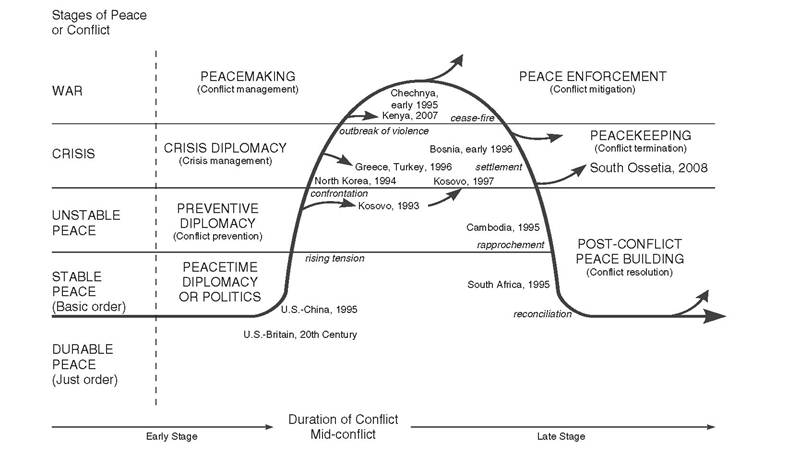
Graph 15.1 Basic life-history of conflicts and the phases of engagement
conditions and political institutions and processes. The former ‘direct,’ ‘operational,’ or ‘light’ prevention (Miall, 2004) is more time-sensitive and actor- or event-focused - for example, diplomatic demarches, mediation, training in non-violence, or military deterrence - and seeks to keep divisive expressions of manifest conflicts from escalating, and thus it targets specific parties and the issues between them.16 Integral also is ‘structural’ or ‘deep’ prevention, meaning actions or policies that address deeper societal conditions that generate conflicts between interests and/or the institutional, procedural and policy deficits or capacities that determine whether competing interests are channeled and mutually adjusted peacefully. These more basic factors make up the environment within which contending actors operate and thus policies toward them can create constraints or opportunities that shape what the actors do. Diverse examples are reducing gross regional disparities in living standards, reforming exploitative agricultural policies, and building effective governing institutions.17 These structural targets make prevention more than simply avoiding violence, or ‘negative peace,’ but rather aspiring to positive peace.
In pragmatic terms, it means being able to meet the inevitable arrival of disruptive social and global forces with the ability to bring about change peaceably (cf. Miall, 2007). In recent years, for example, it conflict prevention has been integral to the larger post-Cold War agenda of creating peaceful democratic states out of societies in transition from authoritarianism and patrimonialism (Lund, 2006).Accordingly, the actors that may be involved in prevention have expanded from official emissaries to a host of third-party governmental and non-governmental actors in social, economic, cultural, and other agencies, such as within the UN system; international financial institutions; regional organizations; and major governments through bi-lateral development and security assistance. Nor is it limited to the governmental world but may include NGOs, the private business sector through trade, finance, and private investment (Ouellete), even celebrities. Preferably, prevention starts through the efforts of the government and other actors in the countries where violent conflicts might emerge. Secretary General Annan deemed this multi-tooled, multi-actored, multi-leveled concept a ‘culture of prevention.'18
Ad hoc and A priori instruments
A less recognized expansion of prevention extends it ‘up' from actions directed at specific countries facing imminent conflicts (ad hoc prevention) to include global- and regional-level legal conventions or other normative standards, such as in human rights and democracy. These regimes seek to influence entire categories of countries or agents, where violations might contribute to conflicts although no signs of conflict have yet appeared (a priori prevention). Whereas the former actions are hands-on ways (either direct or structural) to respond to countryspecific risk factors, the latter are generic international principles agreed on by global and regional organizations as guideposts that whole classes of states are expected to stay within.
There are two varieties: a) supranational normative regimes, such as human rights conventions, and b) international regulations of goods that may fuel or ease conflict such as arms, diamonds, and other trade. Examples of a priori direct prevention are the International Criminal Court and War Crimes Tribunals for Yugoslavia and Rwanda, which are believed effective in deterring future crimes against humanity, not just prosecuting those who have already committed them; the OAS's proscribing of military or executive coups as threats to democracy; and international regulation of arms transfers. Adherence to international standards and rules before any violations occur is conflict prevention where such violations could lead to violent repression, resistance, and conflict.19 This socializing of governments in international expectations has been applied most vigorously in eastern and southern Europe (e.g., Schneider and Weitzman, 1996; 15), where the EU, NATO, OSCE, and Council of Europe uphold similar standards.Analogous compacts are being tried through NEPAD, the USA's partnership for African Development.To illustrate the wide range of possible methods for conflict prevention, Table 15.1 lists illustrative possible prevention instruments under these cross-cutting categories.20
Despite this variety of moments and methods for prevention, a core concept has emerged. Not a specific instrument, conflict prevention is a distinctly pro-active stance that, in principle, many actors could take to respond to unstable, potentially violent situations before violence becomes the way tensions and disputes are pursued. Not a single technique, it is a disposition toward incipient stages of conflict that may draw upon a repertoire of responses that would help to keep tensions and disputes from escalating into significant violence and armed force, to strengthen capabilities of parties to resolve issues peacefully, and to progressively reduce the underlying problems that produce serious disputes.21 The challenges this expansive notion poses for timeliness, coherence, and efficacy are discussed in later sections.
Conflict prevention, management, resolution, transformation
In the context of the school of conflict resolution that emerged in the 1970s, this postCold War concept marked new conceptual ground. Differing stages and intervention tools for conflict were implicit but not theoretically central concepts, and the terms in that field still tend to be used interchangeably for any stage. Founders such as Boulding envisioned a global network of ‘social data stations' to monitor and warn about emerging conflicts, but in the Cold War context of the time, conflict resolution came to mean addressing already-tense international crises, or active internal wars, rather than keeping them from starting in the first place.22 Another founder sought to greatly deepen the causes of conflict to include “basic human needs” (e.g., Burton). Yet, the chief instruments the field has promoted are confined to interactive techniques such as problem-solving workshops or other direct intercession, all of which engage small groups representing parties already tied up in manifest conflicts. Structural and a priori prevention have placed
Table 15.1 Taxonomy of illustrative conflict prevention instruments
| A Priori Measures (Generic norms and regimes for classes of countries) | Ad Hoc Measures ('Hands on' actions targeted to particular places and times) | |
| Structural Measures (Address basic societal, institutional and policy factors affecting conflict/peace) | Standards for human rights, good governance Environmental regimes World Trade Organization negotiations OAS and AU's protocols on protecting democracy International organization membership or affiliations | Economic reforms and assistance Enterprise promotion Natural resource management Decentralization, federalism Long-term observer missions Group assimilation policies Aid for elections, legislatures Human rights and conflict resolution education Aid for police and judiciary Executive power-sharing Security sector reform |
| Direct Measures (Address more immediate behaviors affecting conflict/peace) | International Criminal Court War Crimes Tribunals Special Rapporteurs for Human Rights Arms control treaties Global regulation of illegal trade (e.g., Kimberly Process for 'conflict diamonds') EU Lome and Cotonou processes on democracy, governance, and human rights | Human rights capacity-building Inter-group dialogue, reconciliation Conditional budget support Fact-finding missions Arms embargoes 'Peace radio' Good offices, facilitation, track-two diplomacy 'Muscular' mediation Preventive deployment Economic sanctions Threat of force Rapid reaction forces |
this micro-focus within the macro-focus of the larger processes of nation and state-building, in which interactive techniques are only one among a much larger set of instruments.
Prevention by other names
Table 15.1 reveals also that many de facto direct, structural and generic preventive instruments may not be recognized as such because they operate under aliases. Historically, the Congress of Vienna, League of Nations, the United Nations system of agencies, Marshall Plan, European Union, and NATO and other security alliances were all established to reduce the potential for future inter-state or intra-state conflicts and are thus fundamentally preventive (Lund, 1996a, 1997). During the Cold War, detente and co-existence, arms control treaties, and the CSCE sought to keep the tense superpower relationship from erupting into conventional or nuclear war. Since the Cold War, many other policies and institutions encourage peaceful management of disputes, such democracy-building and as rule of law programs, nuclear non-proliferation, and regional organizations.23 Whether any of these tools explicitly bear the term conflict prevention is immaterial, as long as features are built into them that perform prevention effectively. Conflict prevention is also at stake in current debates over current potential crises, such as Iran's nuclear plans, although those words are not used (Ignatius, 2006). All in all, one answer to our question of why it seems that prevention is not tried more often is that it may actually be operating, but under other labels.