THE CURRENT SITUATION
Even though the process is restrictive, almost all cantons have decided to undertake constitutional change. Indeed, the process has accelerated in the early twenty-first century so that most of them have already created new constitutions for themselves.
As of 1 March 2011, twenty-one cantons out of a total of twenty-six had adopted new constitutions: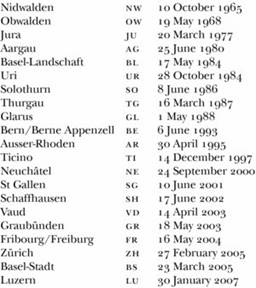
Among the five cantons remaining, two – Schwyz (SZ) and Geneva (GE) – are endeavouring to redraft their constitutions, with a good chance of achieving this goal. On 25 September 2005, it was decided by popular vote of a two-thirds majority to change the Schwyz Constitution.24 Previously, a parliamentary motion of 1 February 2001 had been adopted, aiming at a complete change of the constitution in order to adapt the old text to the new Federal Constitution and to the new cantonal law on municipalities and districts; to modernize the text; to correct and to erase old-fashioned, incomprehensible, superfluous, or even illegal provisions; and to re-draft the Bill of Rights, the list of state’s tasks, and the relation between the three spheres.25
A constitutional committee was set up composed of twenty-seven members elected by the cantonal Parliament, fifteen MPs, and twelve members of civil society. On 20 June 2008, the committee published its constitutional draft, which was submitted for consideration by the citizens for a period lasting until 31 January 2009,26 allowing the committee to take into account the reflections of the civil society on a second draft. After five years of process, the new constitution was adopted by the parliament on 24 November 2010 and submitted to a popular vote on 15 May 2011.
The Geneva Constitution of 24 May 1847 is the oldest in Switzerland.27 For a very long time, any idea of redrafting it has been put aside.
In 2005, a committee called Une nouvelle constitution pour Genève [A New Constitution for Geneva] was formed, uniting people of all ages and tendencies with the unique aim of promoting the idea of a new constitution.28 The committee drafted a law defining all elements of the process leading to one, and the law was endorsed by popular vote on 24 February 2008. The revision process was launched, with the election of a Constituent Assembly on 19 October 2008. The assembly is to submit a new constitution to the voters within four years of its election; if the voters say no, it has one year to submit an alternative document, and if this one is also rejected, the process will be considered to have failed. A pilot study was been drafted on 13 January 2011, with 202 provisions (fifty pages). It was submitted for popular consideration from 5 February to 25 March 2011. A bus with MPs has driven through the canton to present the draft, and five evening meetings were organized at which the population could express itself. This shows how intensive was the consultative process involved in drafting the new constitution.Finally, three cantons – Appenzell Inner-Rhoden (AI), Valais/Wallis (VS), and Zug (ZG) – have thus far postponed any comprehensive change, deciding to preserve their current constitutions.
During the Landsgemeinde (the assembly of the canton’s citizens) of 27 April 2003, several amendments to the Appenzell Inner-Rhoden Constitution of 24 April 1873 were proposed,29 aiming at a formal (but not material) adaptation of its wording to the new circumstances. This took place after an earlier initiative seeking a complete redrafting of the constitution had been withdrawn on 19 January 2001.30
The canton of Valais/Wallis has undertaken several partial revisions of the constitution it adopted on 8 March 1907. The most recent one concerned human rights. Campaigns to promote a total revision, however, have failed: at least two parliamentary initiatives were presented at the cantonal Parliament, but they were never discussed or adopted.31 And a popular initiative aiming for a comprehensive constitutional reform failed to attract enough signatures, indicating only limited popular support.
In Zug a parliamentary initiative from the Socialist Party dated 8 December 2007 asked the cantonal government whether it intended to give the canton a new constitution and – if not – to explain the reasons for its negative decision.32 On 11 March 2008, it rejected the idea of a new constitution or even any formal adaptation of its wording.33 Such a reform was considered too expensive and less important than other cantonal tasks.