IV THE INSTITUTIONAL APPROACH IN INDIA
I will begin with the plain text of the horizontal rights provisions of the Indian Constitution. Article 15(2) stipulates that:
No citizen shall, on grounds only of religion, race, caste, sex, place of birth or any of them, be subject to any disability, liability, restriction or condition with regard to...
access to shops, public restaurants, hotels and palaces of public entertainment; or... the use of wells, tanks, bathing ghats, roads and places of public resort maintained wholly or partly out of state funds or dedicated to the use of the general public.Article 17 provides that ‘“Untouchability” is abolished and its practice in any form is forbidden. The enforcement of any disability arising out of “Untouchability” shall be an offence punishable in accordance with law.’ Article 23, in relevant part, states that ‘Traffic in human beings and begar and other similar forms of forced labour are prohibited and any contravention of this provision shall be an offence punishable in accordance with law’.
The discussion so far enables a few important inferences to be drawn from the text itself. The first is that, compared to its counterparts in South Africa, Kenya and elsewhere, the Indian Constitution’s horizontal rights provisions operate at a greater level of specificity. There is no omnibus clause that allows for the horizontal application of rights where appropriate, leaving the courts to work it out on a case-by-case basis. Rather, the Constitution delineates the specific domains where horizontality shall apply.
Secondly, two out of three provisions refer to social institutions. ‘Untouchability’ is a ‘system’[418] where a class of people in society are treated as ‘permanently and hereditarily impure’,[419] the consequences of which include territorial segregation and social separation.[420] Begar is a system of (often inter- generational) debt-bondage,[421] which was (and in some cases continues to be) widespread in certain parts of India.
Both Articles 17 and 23, after using the specific words ‘untouchability’ and ‘begar’, follow up by prohibiting them in ‘any’ or ‘similar’ forms, suggesting that the core elements of the institution in question manifest themselves in different ways.And thirdly, the terms used are specific to India, suggesting that it was the concrete historical experience of how certain social institutions operated that prompted the framers of the Constitution to subject them to the constraints of horizontal rights application.
The text, therefore, reveals certain important elements of the institutional approach: a focus on social practices (or, as in the case of Article 15(2), as we shall see, a set of acts representative of those practices); and furthermore, specific identification of those practices, based upon a concrete historical understanding of how, in that jurisdiction, they functioned in a manner so as to facilitate or enable the violation of the rights of some individuals by other private parties.
In that context, I will now turn to the judicial interpretation of these provisions, with the following caveat: Indian constitutional jurisprudence on horizontality remains underdeveloped. The three cases that I shall now discuss, therefore, are not reflective of a long-standing or developed judicial tradition, but, rather, are three specific examples of how the Indian Supreme Court has understood and articulated horizontality in its institutional sense.
A. Article 15(2) and Shops
Indian Medical Association v Union of India is a 2011 decision, delivered by a two-judge bench of the Supreme Court of India, dealing with access to educational establishments.[422] The Army College of Medical Science (ACMS) was a formally private educational institution that admitted only children of army personnel, based upon their scores in an entrance examination. The ACMS's admissions policy was challenged before the Supreme Court on numerous grounds. While the factual matrix of the case is extremely complex, the following summary is adequate for our purposes here: it was argued, inter alia, that the government exercised enough control over the ACMS's structure and functioning for it to be classified as an instrumentality of the ‘state', and therefore subject to the fundamental rights chapter of the Indian Constitution.
In any event, it was argued that the ACMS's admissions policy violated the existing statutory and doctrinal framework, which limited the freedom of private educational institutions to restrict admissions in this fashion.The Court accepted the second argument, finding that the ACMS's admissions policy violated the parent statute. However, the ACMS then raised a second argument: the statute in question required private educational institutions to reserve a certain quota of seats for socially and educationally disadvantaged sections of society. This, in turn, traced its validity to Article 15(5) of the Constitution, which authorised the state to introduce legislation of this kind. The ACMS argued, however, that Article 15(5) violated the Indian Constitution's ‘basic structure',[423] and therefore, as it had been introduced into the Constitution as an amendment, it was void. This argument, if accepted, would have implied that the parent statute - which prohibited the ACMS's admissions policy - was also void.
The Supreme Court marshalled a range of arguments to reject the ACMS’s challenge to Article 15(5) of the Constitution. One of the Court’s arguments was that Article 15(5) was consistent with the vision of substantive social justice that was advanced by the Constitution through a number of its provisions, and in the field of education by Article 15(2), whose text we have seen above. Article 15(2), however, made no mention of educational institutions. How, then, did the Court bring colleges within the scope of this horizontal, anti-discrimination provision?
The Supreme Court did so by looking to the Constituent Assembly Debates - the travaux of the Indian Constitution. It found that during those debates, the head of the Constitution’s Drafting Committee, BR Ambedkar, was specifically asked about the meaning of the word ‘shops’. Ambedkar’s response was that Article 15(2) used the word in a ‘generic sense’,[424] referring to any situation where:
[An] owner is prepared to offer his service to anybody who is prepared to go there seeking his services...
the word ‘shop’ used here is not used in the limited sense of permitting entry. It is used in the larger sense of requiring the services if the terms of the service are agreed to.[425]The Court latched upon Ambedkar’s statement to hold that
as education. is a service that is offered for a fee. and is offered to all those amongst the general public, who are otherwise qualified, then such educational institutions would also be subject to the discipline of clause (2) of Article 15.[426]
In doing so, the Court evidently announced a horizontal anti-discrimination of substantial scope: all service providers - in other words, participants in economic transactions - were bound not to discriminate in the provision of services on grounds of caste, race, sex, religion or place of birth.
As a concept, this is not unique: civil rights legislation that accomplishes the same goal has been enacted in many jurisdictions, and often in a sectoral manner (for example, the Fair Housing Act in the USA, discussed above). The Court’s interpretation of Article 15(2) in IMA v Union of India, however, went two steps further: first, it located the horizontal anti-discrimination guarantee within the Constitution, and it was therefore, by implication, directly enforceable at the instance of private parties. Secondly, it did not stop at limiting the scope of the provision to ‘public places’ (or to ‘public accommodations’[427] - the term used in other jurisdictions), which would have implicitly resuscitated the public/ private divide even in the realm of horizontality. Instead, it expanded it to cover economic transactions (provision of services in exchange for consideration) in general. The provision, then, would not cover intimate, non-economic transactions, which I discussed in chapter three. However, the basis for that would not be that such interactions took place in a ‘private domain’, but that they did not involve the provision of services.
To understand the underlying basis of the Court’s interpretation, it is important to go back to the Indian Constituent Assembly Debates.
On the same day (29 November 1948) that BR Ambedkar clarified the ‘generic’ scope of Article 15(2), his close associate, Shri S Nagappa, framed it as a clause that would provide independence to ‘the class’[428] for which it was intended. Nagappa went on to clarify that by ‘independence’ he meant ‘social freedom’[429] (as opposed to ‘political freedom’, which had been secured by formal independence from British rule) and the grant of ‘social rights’.[430] In the discussion that followed, members of the Constituent Assembly highlighted some of the injustices that had prompted the inclusion of the provision. These included the owners of private rest houses refusing accommodation to travellers on the basis of their caste,[431] placing village wells off-limits to members of certain castes[432] and the refusal of eating establishments to serve food on the basis of religion.[433] In Ambedkar’s concluding speech - an extract from which was cited by the Supreme Court in IMA - he clarified that the scope of the provision extended to addressing precisely these kinds of injustices.It is therefore clear that the framing of Article 15(2) of the Constitution was drawn from the concrete historical experience of caste-based subordination in Indian society (which sometimes spilled over into the religious domain as well) and the specific form it took: dominant castes leveraging their economic as well as social power in order to exclude non-dominant castes from equal participation in the economic and social life of the community. Indeed, the framing of Article 15(2) was the culmination of a long period of political activism that asked for legal protection from this kind of subordination.[434] In 1928, the Government of Bombay commissioned a report into the status of what were then known as the ‘Depressed Classes’. In its report, the Government Committee explained the mechanism by which this manner of group subordination was accomplished:
We have heard of numerous instances where the orthodox classes have used their economic power as a weapon against those Depressed Classes in their villages, when the latter have dared to exercise their rights, and have evicted them from their land, and stopped their employment and discontinued their remuneration as village servants.
This boycott is often planned on such an extensive scale as to include the prevention of the Depressed Classes from using the commonly used paths and the stoppage of sale of the necessaries of life by the village Bania. According to the evidence, sometimes small causes suffice for the proclamation of a social boycott against the Depressed Classes. Frequently it follows on the exercise by the Depressed Classes of their right to use the common well, but cases have been by no mean rare where a stringent boycott has been proclaimed simply because a Depressed Class man has put on the sacred thread, has bought a piece of land, has put on good clothes or ornaments, or has carried a marriage procession with a bridegroom on the horse through the public street. (emphasis added)[435]What is striking about this passage is its observations about the manner in which the systematic and structured violation of rights was accomplished. It was accomplished without any visible state intervention, and primarily on the basis of the relative economic and social power of the two sets of private parties. This power flowed from their relative locations within the institutions and structures of caste. It is for this reason that Ambedkar labelled this phenomenon a ‘social boycott’, and originally proposed a detailed constitutional clause (borrowed from existing legislation in Burma) that would have outlawed it:
A person shall be deemed to boycott another who -
(a) Refuses to let or use or occupy any house or land, or to deal with, work for hire, or do business with another person, or to render to him or receive from him any service, or refuses to do any of the said things on the terms on which such things should commonly be done in the ordinary course of business, or
(b) Abstains from such social, professional or business relations as he would, having regard to such existing customs in the community which are not inconsistent with any fundamental right or other rights of citizenship declared in the Constitution, ordinarily maintain with such person, or
(c) In any way injures, annoys or interferes with such other person in the exercise of his lawful rights.[436]
While the final constitutional provision - Article 15(2) - did not go into the issue with this level of detail, the discussion above makes it clear that its underlying basis remained the same.
I can now use IMA v Union of India, and its interpretation of Article 15(2) of the Indian Constitution, to flesh out the contours of the institutional approach and address the questions that I spelt out in section I. First, IMA’s interpretation of Article 15(2) rested upon identifying an ‘institution’: this was the institution of caste, comprising a range of practices, patterns of behaviour and social norms. Secondly, an individual’s relative location within the institution of caste brought with it relative economic and social power, or the lack thereof.
Thirdly, this difference in economic and social power was utilised to enforce ‘social boycotts’, through which dominant castes excluded others from participation in economic and social life, through physical segregation, deprivation of the use of facilities, and exclusion from commerce and economic transactions. And finally, the remedy was a constitutional provision that, applied horizontally, would prohibit the practices that were characteristic of this institutional violation of rights. In the case of Article 15(2), this took the form of an enforceable, non-discrimination guarantee.
B. Article 17 and ‘Untouchability’
In Indian Young Lawyers Association v State of Kerala, a constitutional challenge was mounted to the Sabarimala Temple’s practice of excluding women between the ages of 10 and 50 from accessing the temple’s precincts.[437] As in IMA v Union of India, the constitutional and statutory framework was complex, and an added layer of complexity was added by the Indian Supreme Court’s intricate and complicated religious freedom jurisprudence. The exclusion of women was justified on the basis that it was part of an ancient temple custom, and that such a custom was specifically authorised by rules framed by the government under the Kerala Hindu Places of Worship (Authorisation of Entry) Act. While there was - and still remains - deep controversy over the precise basis of the custom, two arguments were advanced in court: the ‘celibate’ character of the temple deity and that the 10-to-50 age cap was a necessarily blunt instrument to keep out menstruating women.[438]
The petitioners argued, however, that the disputed statutory rule was ultra vires the parent enactment, which guaranteed equality of entry to all ‘classes’ (and that gender constituted a ‘class’ under the meaning of the Act). A straightforward acceptance of the petitioner’s argument would have limited the case to a pure question of statutory interpretation; if the answer was ‘no’, however, it would require the Court to consider the question of what the Constitution had to say about the matter. This entailed reading together, and reconciling, a number of constitutional provisions, such as the freedom of religion (Article 25(1)), the rights of religious ‘denominations’ to manage their own affairs (Article 26(b)) and the rights to equality and non-discrimination (Articles 14 and 15).
By a 4:1 majority, the Supreme Court held that the exclusion of women was unconstitutional. The majority judges wrote separately, and employed different, albeit overlapping, reasoning. For the purpose of the institutional
approach, however, I will limit myself here to one concurring opinion - that of Chandrachud J - and one specific argument in his opinion, ie the invocation of Article 17 of the Constitution.
As we have seen above, Article 17 is directly horizontally applicable, and prohibits ‘untouchability’. In the concrete historical context of India, ‘untouchability’, as also noted above, refers to a caste-based practice of subordination, accomplished through social exclusion and permanent physical segregation, founded upon ritual ideas of purity and pollution. Now, how exactly did Chandrachud J extend this concept of ‘untouchability’ to cover the situation of the exclusion of women from the Sabarimala Temple? Much like the Supreme Court did in IMA v Union of India, he held, on the basis of the Constituent Assembly Debates, that the scope of the provision was meant to be broader than what its concrete wording indicated at first blush. It also included situations that bore a ‘family resemblance’ to classic, caste-based untouchability: ie situations where ritual ideas of purity and pollution were employed in service of maintaining an abiding and permanent institutional hierarchy (in this case, based on gender). This hierarchy was characterised by excluding the subordinated individuals from full and equal participation in social life, and banning their access to cultural goods.
Chandrachud J began with the text of the Constitution, noting that what was prohibited was ‘untouchability’ ‘in any form’.[439] He then progressed to the Constituent Assembly Debates, observing that the framers deliberately refrained from specifically defining or further concretising the meaning of ‘untouchability’.[440] Surveying the writings of the most prominent anti-untouchability activists in the years leading up to the framing of the Indian Constitution, Chandrachud J concluded that the purpose of Article 17 was to combat ‘social norms, which subjugated individuals into stigmatized hierarchies’.[441] As the caste system, and caste-based untouchability, enforced these hierarchies through a ritual ‘order of purity and pollution’,[442] the prohibition under Article 17 could be extended to other situations where ‘social exclusion of the worst kind has been practiced and legitimized on notions of purity and pollution’ (emphasis added).[443]
This framing of the meaning of ‘untouchability’ allowed Chandrachud J to take the crucial next step, which was the heart of his argument: applying Article 17 to the exclusion of menstruating-age women from the Sabarimala Temple. Chandrachud J noted:
The notion of ‘purity and pollution’ stigmatizes the menstruation of women in Indian society. In the ancient religious texts and customs, menstruating women have been considered as polluting the surroundings. Irrespective of the status of a woman, menstruation has been equated with impurity, and the idea of impurity is then used to justify their exclusion from key social activities. (emphasis added)[444]
These ‘key social activities’ included the freedom of movement, the right to education, the right to entry into places of worship and ‘eventually... access to the public sphere’,[445] which together constituted ‘systemic humiliation, exclusion and subjugation faced by women’.[446]
As Chandrachud J was careful to note, the argument did not turn upon the finding that women had a pre-existing constitutional right to enter religious spaces that was being denied to them.[447] This was not, therefore, akin to cases that have arisen in other jurisdictions where courts have deferred to the internal autonomy of religious groups.[448] Rather, what attracted the horizontal constitutional right against ‘untouchability’ in this case was that the invocation of menstruation in order to exclude women from equal access to social and cultural goods (in this case, access to religious spaces) was just one instance nestled in a set of practices that sought to establish and reinforce gendered social hierarchies by invoking ideas of purity and pollution. This point was driven home with particular clarity by KM Pannikar, a member of the Constituent Assembly, during the debates on ‘untouchability’, in a passage that was also cited by Chandrachud J in his judgment:
If somebody says that he is not going to touch me, that is not a civil right which I can enforce in a court of law. [But] there are certain complex of disabilities that arise from the practice of untouchability in India. (emphasis added)[449]
In line with the institutional model, the point that Pannikar and Chandrachud J were making was that the ‘private acts’ at issue - the refusal by one person to touch another, or the refusal to allow a class of people access into a temple - attained constitutional salience when they could be understood to be integral, or constitutive, elements of practices of social subordination that served to exclude people from basic social goods.
Like I did with IMA v Union of India, I will now go back and examine how Chandrachud J’s interpretation of Article 17 fits within the institutional approach, whilst also illuminating it.[450] In IMA, the institution identified by the Supreme Court was that of caste. In the Sabarimala Case, although Chandrachud J did not spell it out in so many words, it is clear that the institution in question was that of patriarchy: which, in its simplest terms, is defined as ‘a system of society... in which men hold the power and women are largely excluded from it’.[451] Secondly, as the definition itself suggests, patriarchy mediates an abiding and pervasive difference of power, where gender determines one’s location within the institution.
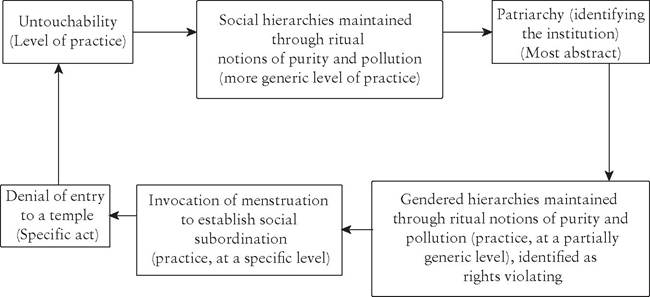
Like ‘caste’, however, ‘patriarchy’ in itself is too abstract a concept to be meaningful in the context of constitutional adjudication. As the third prong of the institutional approach, therefore, what was needed was an indication of the ‘range of practices, patterns of behaviour, and social norms’ that constituted the institution. This was provided by the text and drafting history of Article 17: at the core of Article 17 was caste-based untouchability, where ritual ideas of purity and pollution were employed to create and sustain social hierarchies. The extended understanding of Article 17 moved beyond the core of caste to encompass gender as well in cases where an analogous set of practices prevailed. Concretely speaking, the arguments employed to justify the exclusion of women from the Sabarimala Temple exemplified this set of practices in two crucial respects: in the invocation of menstruation, which was used across the board to deny women equal moral status in society, and in women’s exclusion from a basic cultural good (access to a religious place of worship). This brought the specific practice of exclusion within the ambit of Article 17. Therefore, and lastly, the Court fashioned the appropriate remedy: striking down the practice as unconstitutional and issuing a declaration that women could not be denied entry to the Sabarimala Temple.
A reading of Chandrachud J’s concurring opinion reveals one further point about the institutional approach. By its very nature - dealing with how institutions interact with specific relationships and acts, and how those relations and acts are shaped by institutional locations - it must move between different levels of the abstract and the concrete, and bring them into reflective equilibrium (this, incidentally, addresses the worry about the threshold for triggering the institutional approach being too low, by virtue of the breadth of ‘institutions’: in practice, as we can see, this is just the beginning of the enquiry).
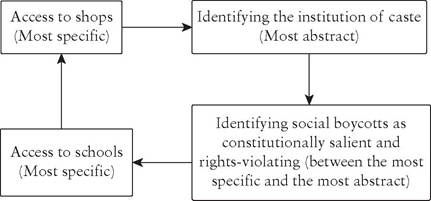
In IMA, the Supreme Court was faced with the concrete and specific language of Article 15(2) (‘access to shops...’). It read this language as identifying the institution of caste (at its highest level of abstraction), and proscribing a set of practices revolving around the social boycott (more concrete than simply identifying caste, but more abstract then ‘access to shops’). It then used this logic to cover the example of access to schools (back to the concrete). This is shown diagrammatically in Figure 1.
In the Sabarimala case, the process of reasoning was somewhat more complex (Figure 2).
Figure 2 Reasoning with the institutional approach in the Sabarimala Case
C. PUDR and ‘Forced Labour’
In the context of the institutional approach towards horizontal rights, both IMA and Sabarimala were relatively easy cases. This is because, at their root, they both involved issues of discrimination: the one area of law where (as we have seen above) the role of institutions has been the subject of detailed and longstanding scrutiny, both by courts and by scholars. Furthermore, and much like race, how caste and gender operate as institutions in the manner discussed at the beginning of this chapter (convergence of practices, a unique identity and the existence of hierarchies) has been studied intensively within the context of discrimination law. In terms of both rights and remedies, therefore, these cases, despite their creative reasoning and reference to institutions, to some extent followed a known path.
Consequently, if the reach of the institutional approach was confined to the domain of discrimination law, its contribution would be limited: it would only justify taking rights-conferring legal provisions that already exist in the form of statute law in many countries, and are widely accepted as legitimate, and constitutionalising them under a direct horizontality model. This is why the third case on the list is particularly important, as it takes us away from the familiar territory of discrimination law and theory, and demonstrates the potential of the institutional approach.
PUDR v Union of India involved allegations of multiple labour law violations during the construction of a Games Village for the 1982 New Delhi Asian Games.[452] As the petition was filed to enforce fundamental rights under Part III of the Indian Constitution, the state raised a preliminary objection that it was not maintainable. It argued that the claim involved violations of specific statutory provisions, and not constitutional rights.[453] The Supreme Court rejected this argument, finding, for example, that the treatment of contract and migrant workers violated Article 21 of the Indian Constitution (the right to life and personal liberty).[454] With respect to one claim, however, there did not seem to be any applicable constitutional provision: this was the claim for payment of minimum wages. The Supreme Court, nonetheless, was not deterred. It turned to Article 23, which, as we have seen above, prohibits the practice of forced labour.
The Court began by (correctly) noting that Article 23 was among those rights in the Fundamental Rights chapter that were designed ‘to protect the individual not only against the state but also against other private citizens'.[455] It then turned to the text of the provision, observing - akin to (future) observations in IMA and Sabarimala - that the scope of the provision was very wide, as it prohibited ‘traffic in human beings and begar and other similar forms of forced labour' (emphasis added).[456] More specifically, the Court pointed out that ‘begar' was a word of Indian origin, which referred to a compulsion to work without remuneration.[457]
Considering, then, the question of what constituted ‘other similar forms' of forced labour, the Supreme Court observed that at the heart of the provision was the idea of ‘exploitation': in particular, the exploitation practised by ‘socially or economically powerful sections of the community' (emphasis added)[458] upon those not so powerful. And the vehicle of this exploitation, according to the Court, was the labour contract:
in a country like India where there is so much poverty and unemployment and there is no equality of bargaining power, a contract of service may appear on its face voluntary but it may, in reality, be involuntary, because while entering into the contract, the employee, by reason of his economically helpless condition, may have been faced with Hobson's choice, either to starve or to submit to the exploitative terms dictated by the powerful employer. (emphasis added)[459]
This structural difference of bargaining power, the Court held, was the difference between labour being genuinely ‘free' or ‘forced':
It is not unoften that in capitalist society economic circumstance exert much greater pressure on an individual in driving him to a particular course of action than physical compulsion or force of legislative provision. The word ‘force' must therefore be constructed to include not only physical or legal force but also force arising from the compulsion of economic circumstance which leaves no choice of alternatives to a person in want and compels him to provide labour or service even though the remuneration received for it is less than the minimum wage of course, if a person provides labour or service to another against receipt of the minimum wage, it would not be possible to say that the labour or service provided by him is ‘forced labour' because he gets what he is entitled under law to receive.[460]
Now, the problem of structurally unequal power between the owners of capital on the one hand and labour on the other is not a new one (see section II of this chapter). Nor is the argument that the formal freedom of contract masks a deeper, social unfreedom.11"[461] What was new, however, was that the Supreme Court elected to constitutionalise this relationship through the language of ‘freedom' and ‘compulsion', both of which were institutionally mediated. This explained the Court's reference to the ‘compulsion of economic circumstances' in a ‘capitalist society' - two phrases that together constitute a reference to the market/contract mechanism for distributing rights and liabilities. Until now, the issue had been framed in one of two dominant ways: first, as not involving a rights violation, since both parties to the contract were formally free - even though one party was too weak to make effective use of its freedom; or secondly, by carving out a set of exceptional circumstances where an individual relationship between the two parties was so evidently unequal that the formal equality between the parties could be overridden by their actual inequality.[462] In PUDR, however, the Court articulated a different approach: the institutional location of the parties did define the ‘freedom' (or, in Shri Nagappa's words, the ‘social freedom') that they had to set the terms of their contracts. Furthermore, this relative difference in power between the parties, in terms of their institutional location within the marketplace, was a constitutive feature of such relationships.
It is particularly important to note how the Court's analysis here directly takes issue with two of the three assumptions of default verticality that I discussed in chapter one: abstract freedom and individual responsibility. The Court’s articulation of a different - institutionally grounded - understanding of freedom,[463] the infringement of which triggered the application of horizontal rights, demonstrates how the institutional approach departs from default verticality. I shall discuss this in greater detail in section V of this chapter.
Now, of course, it may be immediately objected that not all contractual relationships involve institutionally salient differences in power. There are many contracts between parties with equal power, and there are employment contracts in highly specialised professions where it is the employee who has the greater power to dictate the terms of the contract. How, then, does one identify that this specific contract merits the application of the rights framework? The Supreme Court’s answer was: the existence of the minimum wage. In other words, if one party to the contract was unable even to negotiate the statutorily determined minimum wage, then it was evidence of an institutionally asymmetric contract, which ought to attract constitutional scrutiny. In other words, the minimum wage played two roles in the Court’s analysis: one, as a heuristic device to identify situations where institutional power structures were at work; and two, as a remedy: it was the instrument of the minimum wage that ultimately mitigated that inequality of power, at least to a small extent. Consequently, the nonpayment of minimum wage was a direct horizontal rights violation, because it could be presumed that in such a contract one party had violated the freedom of the other.
It may further be objected that in PUDR the Court effectively took a position on one side of a long-standing and controversial economic debate; and that it did so without even acknowledging that a controversy existed, let alone engaging with it in any satisfactory manner. The effect of legal intervention in the marketplace upon employment - especially through mechanisms such as wagefixation - has been debated for two centuries, and continues to be debated today.[464] There are those who argue that the inevitable consequence of wagefixation is a depression of employment in the long-term, thus ensuring that even on PUDR’s substantive understanding of ‘freedom’, reading an enforceable right to a minimum wage into Article 23 of the Indian Constitution would have the long-term effect of decreasing freedom rather than increasing it (by erasing jobs). This distinction between ‘static’ and ‘dynamic’ efficiency is familiar across multiple legal domains (such as that of intellectual property). Advocates of rights-based approaches have had to contend with the objection that the (relatively) unregulated market - as opposed to enforceable obligations upon market actors - is the most efficient, long-term guarantor of rights. How, then, could PUDR apply the institutional approach to the market and to the labour contract in such a facile manner?
A close reading of PUDR reveals, however, that the Supreme Court believed that this decision had already been made in the Constitution itself. In particular, the Court pointed to Part IV of the Indian Constitution, titled the Directive Principles of State Policy (the DPSPs). The DPSPs are not directly enforceable in court, but are ‘fundamental to the governance’[465] of the country and have been held, over time, to act as interpretive aids to determining the content of enforceable fundamental rights. And the DPSPs include a host of social- democratic labour rights that envisage intervention in the marketplace based upon the same underlying principles as the institutional approach. Thus, even though those labour rights themselves are not enforceable, they are meant to inform the interpretation of the rights that are - one of which is the right against forced labour under Article 23. Indeed, provisions against the concentration of economic wealth and the means of production, for a living wage and for industrial democracy (for example) all signal recognition that imbalances of power within the institution of the market are constitutionally salient in the Indian context. And it was these provisions that the Court used to inform its argument about the institutionally determined meaning of the word ‘forced’ in ‘forced labour’ (and therefore, by extension, the meaning of ‘freedom’).
The Court’s view was buttressed, once again, by the framing debates. In a striking document that set out a blueprint for the fundamental rights chapter of the Constitution, BR Ambedkar made it clear that the Indian Constitution was not going to be a market-agnostic document, and that it would recognise the ‘connection between individual liberty and the shape and form of the economic structure of society’ (emphasis added).[466] More specifically, Ambedkar then noted that a market economy effectively facilitated the abdication of state power to ‘private persons to govern others’ (emphasis added)[467] (he later referred categorically to ‘private employers’[468]). Consequently, discarding the structure of ‘existing Constitutions’,[469] which sought to limit state power constitutionally and regulate labour relations legislatively, Ambedkar proposed instead a constitutional plan to constrain:
more powerful individuals or to be more precise to eliminate the possibility of the more powerful having the power to impose arbitrary restraints on the less powerful by withdrawing from the control he has over the economic life of the people. (emphasis added)130
Ambedkar freely admitted that this was a new understanding of constitutional law, one that sought a deeper democratisation of both political and economic life, which would prevent the ‘economic structure [from] tak[ing] the shape given to it by those who are in a position to mould it’ (emphasis added).131
Close attention to Ambedkar’s words, which are strikingly similar to his closing speech in the Constituent Assembly summarising the final version of the draft Constitution,132 reveals a nuanced articulation of the institutional approach, as applied to the market. Ambedkar identified a specific problem: the ability of private persons - private employers - to ‘govern’ others (the use of a term that so strongly suggested the individual-state relationship was not accidental133). This ability, or power, flowed from the employer’s relative location within the (market-based) economic structure, facilitating their ‘control’ over economic life and the capacity to (unilaterally) ‘mould’ it, ie to set and change the terms and conditions of market relationships. And the remedy for this was to be constitutionally encoded. Although Ambedkar began with a far more ambitious plan for mandating state socialism within the Constitution, he, and the constitutional framers, eventually settled for enshrining this vision in the form of horizontal rights and the Directive Principles of State Policy.
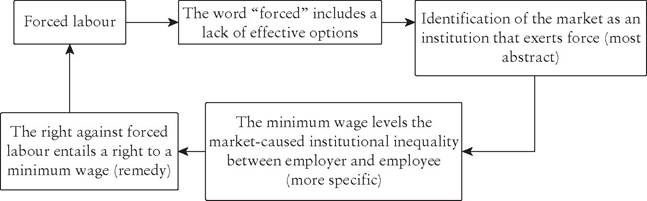
A summary of the interpretive structure of PUDR’s approach to Article 23 is provided in Figure 3.
Figure 3 Reasoning with the institutional approach in PUDR
130ibid.
131ibid 101.
132 Parliament of India, Constituent Assembly Debates, vol XI, 25 November 1949, https://indiankanoon. org/doc/792941/.
133 For a more recent iteration of this, see E Anderson, Private Government: How Employers Rule Our Lives (and Why We Don’t Talk about It) (Princeton University Press, 2017).
In short, the institution identified was that of the labour market. It was constituted by a convergence of individual practices (ie contracts between employers and employees). Individuals’ relative location within the marketplace (in terms of access to and control over capital) generated abiding and pervasive differences of power. These differences were leveraged through the mechanism of the labour contract, which denied to one set of parties any effective freedom to participate in the setting of the terms and conditions of their relationship with the dominant parties. The remedy for this was a constitutionalisation of the right to a minimum wage, which was deemed to be an (admittedly imperfect) substitute for this deprivation of freedom.
The last part of the reasoning is particularly important because it demonstrates the manner in which the institutional approach travels beyond the otherwise similar reasoning process employed by the German Constitutional Court in Handelsverter. Both courts arrived at the conclusion that existing market conditions subordinated one class of individuals to another, at an institutional level. However, as the German Constitutional Court was constrained by the framework of indirect horizontality, it was compelled to find a remedy within the structures of contract law (in this case, setting aside the relevant contractual clause). The Indian Supreme Court, on the other hand, was employing direct horizontality, and was therefore not required to limit itself to contractual remedies. It was, instead, able to speak the language of enforceable rights (in this case, the right to a minimum wage).
There remains a final point to be noted. In all of the above cases - but particularly so in PUDR - there existed a background legal structure that provided the framework within which the institution existed and took its specific form. For example, in the case of PUDR, the institutional power exercised by employers flowed from their control over capital, which itself is enforced by property law. The point that I discussed in chapter three, therefore - that even in practices and relationship that seem purely ‘private’, there is always the presence of the state (even if it is through non-intervention) - remains valid. The shape and form of the institutions that I have discussed in this chapter is non-trivially influenced by the background legal framework. That framework, therefore, cannot be ignored in the analysis.
D. The Mechanics of the Institutional Approach
What do the above three examples reveal about the mechanics of the institutional approach, as it might be deployed in practice? I wish to make a few points, in light of some of the issues that were raised at the beginning of this chapter.
First, at the beginning of the chapter, for ease of understanding, I set out the institutional approach in somewhat schematic terms: the analysis began with teasing out the concept of an ‘institution’, then went on to discuss institutional power differences, before finally ending with the question of remedies. This raised the question of whether the first ‘step’ - the identification of the ‘institution’ - was doing any meaningful substantive work, given the broad articulation of the concept and the correspondingly low threshold for triggering the approach.
I responded to this question on its own terms at the beginning of the chapter. Having now examined the workings of this approach, here is a further response: as we have seen, in a concrete case, the analysis does not follow the clean-cut chronology of first identifying an institution (the ‘low’ threshold) and then looking at power differences, followed by the remedy. Rather, as we have seen, there is an ongoing, reflexive process where the Court, when faced with a situation where a private party has putatively violated the rights of another, asks whether the violation is embedded within an institutional relationship, and within a hierarchy of power flowing from that relationship. This, in turn, is not a one-step process, but requires the Court to go back and forth between the private relationship and the institution, refining its understanding of both the relationship (and the rights violation) in question and the level of abstraction at which the institution is understood. Once the two are brought into a form of reflective equilibrium, the Court is in a position to consider the question of remedies. It is this process of reasoning that distinguishes the institutional approach from other approaches towards horizontality.
In effect, therefore, the concept of the institution plays the role of situating the structural analysis of power. In that sense, we will find that the questions of power and the existence of the institution are not always cleanly separable, even though they play distinctive roles. Take, for example, the most straightforward example of racially restrictive covenants. A court, when faced with a refusal to sell or loan property and asked to find a violation of horizontal rights, will ask whether the refusal has taken place in an institutional context (such as that of race). Identifying the institution (race) and the power differences (racial hierarchies) that together justify an application of the institutional approach will be a connected enquiry. On the other hand, the court may find that there is a power difference (stemming, for example, from the fact that one of the parties is a property owner and the other is not), but that it is not embedded within the institution of race (for example, consider a situation where an individual refuses to sell their property to a personal rival). Thus, even though the analysis does not necessarily proceed in the clean-cut chronology of first identifying an institution and then examining power differences, one can still see that the existence of the institution is not irrelevant (of course, there may be examples where there is no power difference at all, such as an owner of multiple properties seeking to add another to his collection).
It may finally be asked: does this approach ask the courts to do too much? Indeed, does it amount to an expansion of judicial power in an arena where courts have often demonstrated problematic tendencies: ie the analysis and consideration of structural power relations? There is force to this critique. While a full response is not possible within the scope of this book, I suggest that the Indian example discussed above provides some instruction: horizontality that is articulated through specific constitutional rights - and where the analysis of power is, to an extent, already present in the constitutional text - sets constraints upon the interpretive discretion that is granted to courts, and also provides valuable signposts. This is opposed to broad and open-ended horizontal rights provisions (some of which I shall consider in the concluding chapter) that leave it entirely up to the courts to determine when, where and how horizontality will apply. The Indian constitutional text, thus, might provide something of an answer to scepticism about the ability and willingness of judiciaries to deploy the institutional approach.