Do All Rational Disagreements about the Vague Boil Down to Disagreements about the Precise?
Our primary concern in this chapter has been whether all classical accounts of vagueness collapse into views that, like epistemicism, accept a stark form of realism about vague matters.
So a natural question to ask, given our previous discussion, is whether vague beliefs rationally supervene on precise beliefs in the way outlined above. If the supervenience thesis held, it could serve as a partial articulation of the idea that vague truths are not as substantial as precise truths.The kind of supervenience thesis I prefer can be formulated as a constraint on which probability functions are ‘conceptually coherent’ where, very roughly, a probability function is conceptually coherent if adopting it doesn’t involve making any conceptual confusions (a notion I’ll elaborate on shortly). It is a straightforward variant of the corresponding supervenience principle for conditionals: 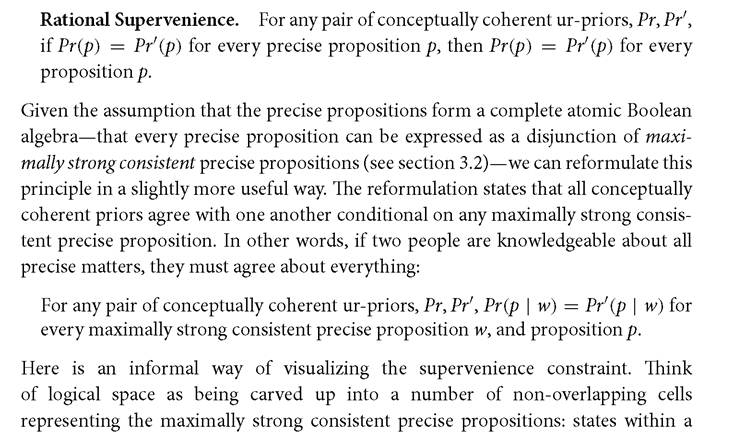
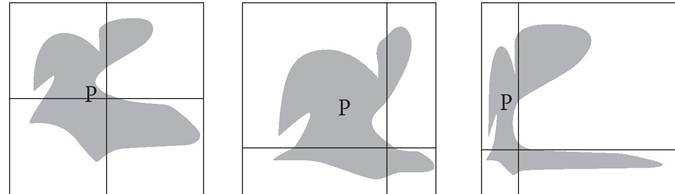
Figure 8.1. Three different priors assigning different probabilities to four maximally strong consistent precise propositions—‘cells'—but agreeing on the proportion of each cell that the vague proposition P takes up. In this diagram, a proposition is represented by a subregion of each square, and the probability is represented by the magnitude of its area.
given cell will describe states of affairs that agree about all precise matters and differ from one another about things such as whether Harry is bald and the like.
Different coherent priors will typically disagree with one another about the sizes of these cells— some will regard certain cells as probable and others as less so. (It helps to think in terms of a Venn diagram where the areas of the cells correspond to their probabilities: see Figure 8.1.) However, if the supervenience principle is true, then all priors must agree with one another about what proportion of each cell each proposition takes up. If the proposition p takes up three quarters of a cell according to at least one prior, it must take up three quarters of that cell according to all priors. Intuitively, although you can change the sizes of the cells as you move from prior to prior, these changes must only come about by ‘stretching out’ each cell uniformly, so that their contents scale proportionally. (To make the intuition even more vivid, you can think of each cell being like a separate sheet of rubber. A proposition is some portion of rubber, possibly spanning across multiple sheets. You can change the ‘area’ of a proposition, but only by making uniform stretches or shrinkages to each sheet individually.)Say that a precise truth is relevant to p for an agent if their conditional credence in p on that truth is different from their unconditional credences. The supervenience constraint entails that two people who are knowledgeable about all the precise matters that are relevant to p must agree about p. For if they disagree about p, then since the supervenience principle states that they must agree conditional on the strongest precise truth, at least one of their credences must be different conditional on that truth and so at least one of them is not knowledgeable of all the relevant precise facts.
On the face of it, however, this principle falls short of a general principle stating that disagreements in the vague are rooted in disagreements about the precise. Indeed, this is no accident: it is at least theoretically possible that two people agreeing about the precise could have differing credences in the vague if (i) they have different evidence and (ii) at least one of them has evidence which is inexact—i.e.
is such that their total evidence is vague. Since we argued in chapter 6 that one’s total evidence could be vague, this is a live possibility. One must therefore be careful about how we formulate the disagreement thesis: in our framework no two people with the same evidence can agree about the precise and disagree about the vague. It should be noted that a similar qualification would need to be made for the other forms of expressivism we have considered if similar theses about evidence were accepted. Once the expressivist has acknowledged the existence of conditional propositions, for example, the question naturally arises as to whether one's total evidence could be a conditional proposition. If the answer is ‘yes' then the principle that there can be no disagreements about the conditional without disagreements about the categorical must be similarly qualified.Of course, in order for our thesis about disagreement to have any potency at all, we must accept a mild form of epistemic permissivism. According to the opposing view— an extreme form of anti-permissivism—there is only one correct doxastic attitude to make in response to any evidence, so that any two people with the same evidence must agree about everything. Under this assumption, the thesis that no two people with the same evidence can rationally agree about the precise but disagree about the vague would be true for uninteresting reasons, and would not succeed in singling out anything distinctive of vagueness.
In the Bayesian framework we have been using, the permissivist idea can be formulated as a question of whether there are many conceptually coherent ur-priors. According to the alternative ‘neo-Carnapian' view there is only one true ur-prior (see Williamson [160]) and the supervenience principle is vacuously true—the ur-priors always agree with each other conditional on each maximally strong consistent precise proposition because there is only one ur-prior.
If, however, the set of ur-priors is assumed to be sufficiently rich then it states a substantial thesis about the nature of vagueness and vagueness-related uncertainty. Indeed the supervenience thesis is consistent with a maximally permissive attitude towards the precise matters: one can have any initial credences one likes about the precise (provided you are probabilistically coherent); the only constraint is that once you have made your mind up about the precise, you distribute your credences over the vague according to the supervenience principle.Even if one were tempted toward a neo-Carnapian theory, in which only one probability function satisfies all the constraints of all-things-considered rationality, there are weaker notions you might be interested in. For example, even if not all members of a jury respond in the maximally good way to the evidence in a complicated court case, their sin seems to be a lesser one than that of someone who remains pretty confident that a particular fox is male after learning that it's a vixen. In the latter case the agent seems to be conceptually confused. In Rational Supervenience I theorized in terms of the notion of a ‘conceptually coherent prior': a class of initial credence functions that aren't conceptually confused in this kind of way—such confusions will include, but will not be limited to, failures to believe conceptual truths. On the picture I am endorsing, one can have pretty much any opinions about the precise you like without committing a conceptual confusion, although once those opinions about the precise are determined, deviation in your credences about the vague would involve a conceptual confusion of some sort: it would be confused, for example, to be almost certain that a glass is pretty full after learning it is two thirds full—as confused as, say, having some credence that Sally is a male cat after learning that she's a vixen.
The supervenience principle is distinctive to the kind of picture of vague propositions I have defended and, moreover, serves to distinguish that view from competing theories such as epistemicism.
But is the principle true? To evaluate the principle, let us focus on the status of a particular collection of vague propositions in a situation in which all the precise truths that are relevant to those propositions are known. Imagine that we have a sorites sequence of individuals ranging from someone who has 0 hairs and ending with someone who has millions. Suppose also that the only precise truths that are probabilistically relevant to the baldness of these individuals are propositions about the hair number of the individuals, and suppose that we know all of the hair number facts. Assuming all this, what kinds of credences is it permissible—or, at least, not conceptually confused—to have about the baldness of each individual in our sorites? According to the supervenience principle, there isn't much leeway: if two people are knowledgeable about all of the relevant precise facts, then they must agree about the probability that each member of the sorites is bald; someone who denies the principle, by contrast, maintains that two people could be knowledgeable in this way and yet disagree.Let us start by considering the first member of the sequence: the individual who has 0 hairs—call him John. Presumablyit is a conceptual truth that if John has 0 hairs he is bald. This can be cashed out in the present framework in terms of conceptually coherent ur-priors: for every conceptually coherent probability function Cr(John is bald | John has no hairs) = 1. This of course reflects the fact that the notion of conceptual coherence was introduced as a generalization of the idea that one should be certain in conceptual truths. For example, it would be conceptually confused to be less than certain that a thing is red conditional on it being scarlet, a fox conditional on it being a vixen, unmarried conditional on being a bachelor, and so on. Thus, at least in this special case, the supervenience principle delivers the correct results: any two people who know that John has 0 hairs ought to agree about whether John is bald.
Indeed, they ought both to be certain he's bald—if there was any disagreement here, then at least one person has committed some kind of conceptual confusion. (Similar considerations presumably also apply to the individuals that have millions of hairs—in these cases everyone is required to have no credence that they are bald, in accordance with the supervenience principle.)We know, by familiar soritical reasoning, that there is a last number N such that it's a conceptual truth that someone with N hairs is bald. Consider next the N + 1th person in the sorites—call him Bob. What kinds of credences is it permissible to have about whether Bob is bald, given that we know he has N + 1 hairs?
We have already considered the extreme anti-permissivist neo-Carnapian approach. Here it is natural to also compare our answer to a view at the other end of the spectrum: a common (extremely permissive) version of Bayesianism, in which any probability function whatsoever is a rational prior. Whereas the neo-Carnapian view makes the supervenience principle trivial, the Bayesian permissivist violates the supervenience principle. Bayesian permissivism requires certainty in a proposition p on the supposition of other propositions that logically or conceptually entail p. But when neither p nor —p is logically or conceptually entailed by a supposition, then any credence in p on that supposition is permissible. It is here that the notion of conceptual coherence, as I am understanding it, is more general than the requirement that one be certain in conceptual truths: bearing in mind that all agree that it would be in some sense conceptually confused to be less than certain that the Nth person is bald (because it is a conceptual truth that people with N hairs are bald), it is similarly conceptually required that one have a high credence that Bob (the N + 1th person) is bald. Although it is permissible to be less than certain that the N + 1th person is bald, if I'm right, then having a very low credence in his baldness would be to commit a similar kind of conceptual confusion. Intuitively, it is not merely having a low credence that is incoherent: one should have a credence pretty close to your credence that the Nth guy is bald (namely, a credence of 1). So already you can see how the prediction that there is a particular credence that you ought to have that Bob is bald, given you are knowledgeable about all the relevant precise facts, seems to accord with intuition.
Finally, consider an individual towards the middle of the sequence that is borderline bald—call this guy Harry. Given that you know that Harry is in the borderline region for baldness, it would seem somewhat careless to be almost certain that he is bald, or almost certain that he's not bald: one should have a middling credence. This is in accordance with the supervenience principle, but contradicts a completely permissive version of Bayesianism. Again this brings out a quirk of this kind of Bayesian picture. To take an analogy, insofar as it is a conceptual truth, one is required to be certain that a particular ball is red conditional on it being scarlet (that all scarlet things are red is a paradigm example of a conceptual truth). However, it also seems that one is required for very similar reasons to have a middling credence (around 1) that the ball is red conditional on it being auburn (or some other specific shade that puts the ball in the borderline region for redness). The standard way of articulating these constraints, using the probability calculus, treats these two cases very differently—the former is imposed by the probability calculus, assuming that the proposition that the ball is scarlet entails the proposition that the ball is red, whereas the latter is not.
Intuitively, if we were to plot rational credences in the proposition that the Nth person is bald against N, for a rational agent who knows all the relevant precise facts, we should get a smooth curve starting at 1 and smoothly decreasing until it hits 0 for high N. By contrast, the permissivist will require that for low N we assign credence 1 and for high N we assign credence 0 (because we must respect entailments), but will allow pretty much anything to happen in between: there could be a very steep and sudden drop between the 245th member of the sorites and the 246th, it could
N
id="Picutre 26" class="lazyload" data-src="/files/uch_group76/uch_pgroup299/uch_uch7182/image/image026.jpg">
Figure 8.2. Possible credence distributions, given permissivism about ur-priors.
go up and down in a sine wave, and so on (Figure 8.2). So, at least in comparison to full-blown permissivism, the supervenience principle seems to get things right. One could go for a more moderate version of permissivism: one that requires that any two people who are knowledgeable about the relevant precise facts have a smooth distribution, with no steep drops, that decreases as N increases, but in which there are two or more distributions which are permitted. Note that to be smooth, decreasing, and to avoid steep drops, these distributions must, at best, be only slight variants of one another. The supervenience thesis is inconsistent with this kind of permissivism as well.
I do not have any direct arguments against this restricted form of permissivism, except to say that it is ad hoc: it feels like a doctored version of Bayesian permissivism, tailored specifically to account for very specific intuitions about the way our credences ought to be distributed over sorites sequences.[129] The supervenience thesis, by contrast, also gives us a natural restriction of full Bayesian permissivism, but is a simple powerful theory arising from more general considerations to do with vagueness.
It should be noted that the supervenience thesis says that there's a particular smooth distribution that all rational people are required to have when they know all the relevant precise facts. However, this does not entail that there is a particular smooth distribution that rational people are determinately required to have. The idea that one could discover that the credence that Harry is bald in the above scenario should be exactly 0.53184, for example, seems wild—it is not the kind of thing you could discover because it is itself, presumably, borderline. Thus it should be noted that insofar as the restricted permissivist is motivated by the idea that there aren't unique objective numbers like this which we can discover, nothing in that thought rules out the alternative view which accepts supervenience. Indeed my picture has much in common with the restricted permissivist: both agree that there are several distributions, all very slight variants of one another, which are not determinately irrational in this situation (the permissivist, in virtue of thinking, simply, that they are not irrational).
Vagueness concerning which credences we should have in this situation could have several sources. It could be due to vagueness concerning the notion of a rational or conceptually coherent credence. But it is also important not to discount the existence of vagueness that arises due to vagueness about which propositions are precise (i.e. higher-order vagueness). Given the existence of higher-order vagueness, it could be that w is a maximally strong consistent precise proposition but not determinately so. In which case one might in fact be required to have a certain credence in the proposition that Harry is bald conditional on w but, since it is borderline whether w is a maximally strong consistent precise proposition, it might be borderline whether we are required to have that credence in the proposition that Harry is bald. It’s important to note that the existence of vagueness concerning which propositions are the maximally strong consistent precise propositions does not prevent Rational Supervenience, or indeed the principle Plenitude from chapter 6, from being determinately true. The Rational Supervenience entails that for every maximally strong consistent precise proposition, w, and vague proposition, p, there is some credence that conceptually coherent agents must assign to p conditional on w. Even if we assume that this principle is determinately true, we cannot infer from it that there is some credence that determinately all conceptually coherent agents must assign to p conditional on w, for that would be akin to inferring ‘something is determinately F from ‘determinately, something is F. This is a fallacy (for example, it’s determinate that some number is the last small number, but no number is determinately the last small number).
Let us briefly relate Rational Supervenience back to the theory of vague propositions outlined in chapter 6. The Principle of Plenitude there told us that for every evidential role (roughly, an assignment of proportions to cells), there is a vague proposition that has that role (takes up the assigned proportion of each cell, according to each prior). Propositions generated by the Principle of Plenitude satisfy Rational Supervenience: they will take up the same proportion of each cell relative to any prior. What Rational Supervenience adds to this is a sort of completeness condition—all propositions have an evidential role, and so in a sense every proposition is generated by the Principle of Plenitude.
Although Rational Supervenience fits naturally with the theory of vague propositions endorsed in chapter 6, we have seen it to be a powerful principle in its own right. Rational Supervenience tells us that rational disagreements about the vague ultimately boil down to disagreements about the precise. For someone who wished to maintain that vagueness was merely a matter of ignorance or uncertainty, this sort of connection between the precise and the vague would be hard to explain. The theory is therefore more closely aligned with some of the ideas that have motivated recent expressivists. In this chapter we have primarily focused on the credal question— how vague beliefs are determined by precise beliefs—but there is a related question concerning desires: is agreement about how much you value the precise enough to ensure agreement in how much you value the vague? In order to answer this question we will need to develop a decision theory that can be applied in a setting with vague propositions. We turn to this now.