BorderlinenessasPrimitive
We are seeking a characterization of propositional vagueness and precision.[158] The distinction between a vague proposition or property and a precise one is importantly different from the distinction between a proposition that is borderline and a proposition that is definitely true or false, or the distinction between properties that have borderline cases and those that have no borderline cases.
To illustrate the difference, consider the property of being a blue swan. This property is vague, not precise— one can imagine a sorites sequence of swans, beginning with a clearly green swan and ending with a clearly blue swan, without much trouble. However, the property of being a being a blue swan has no borderline cases because, as it turns out, it is a determinate fact that there are no blue swans. A completely analogous point can be made about propositions. The proposition that I am bald and the proposition that I have less than twenty hairs differ in a theoretically important way—one is a vague proposition, the other is precise. However, since I am, as of writing, definitely not bald, neither proposition is borderline.It is clear that there are two types of properties that propositions can have— borderlineness and vagueness—and that they are related. Indeed, it is commonly assumed that one type can be reduced to the other. According to the standard line, vagueness can be defined in terms of the notion of being borderline. Alternatively one could maintain, as I do, that borderlineness can be reduced to the vague/precise distinction. But at any rate, given that we have this distinction between vague and precise propositions, it is perfectly acceptable to theorize in terms of it without yet taking sides on the direction of reduction.
The first thing to point out in this regard is that the distinction between precise and vague propositions is not itself a precise one.
To see this, it is sufficient to note that one can construct a sorites sequence of propositions starting with propositions that are clearly precise and gradually changing until we have propositions that are clearly not precise. One such sorites consists of the sequence of conjunctive propositions that includes, for each natural number n, the proposition that Harry is bald and has n hairs. Note that the first proposition (when n = 0) is precise: it is plausibly a conceptual truth that someone with no hairs is bald, so the proposition that Harry has 0 hairs entails that Harry is bald, and, thus, the proposition that Harry has 0 hairs and is bald is equivalent to the proposition that Harry has 0 hairs (for a supervaluationist, for example, they correspond to the same set of world-precisification pairs). The latter proposition is precise and thus, given the sense of equivalence is sufficiently demanding, it follows that the former proposition is precise too. Yet as n increases we eventually arrive at propositions that are vague. This is, of course, intimately tied to the phenomenon of higher-order vagueness.Given only what we have said so far, we can lay out a number of formal conditions that govern the behaviour of precise propositions. For example, it is obvious that the tautologous proposition is precise. Furthermore, it seems clear that if a proposition is precise, then so is its negation and, similarly, that conjunctions and disjunctions of precise propositions are also precise. For example, if the proposition that there are electrons is precise, then the proposition that there are no electrons is precise; if the proposition that there are three electrons is also precise, so is the proposition that either there are no electrons or three, and so on. Assuming that the space of all propositions forms a complete Boolean algebra (see section 3.2) under the Boolean operations of conjunction, disjunction, and negation, the preceding just means that the precise propositions themselves form a complete Boolean algebra of their own, albeit one that is smaller than the algebra of all propositions.[159] Our first constraint is thus:
Boolean Precision. The set of precise propositions forms a complete Boolean algebra, with the tautologous proposition being the weakest precise proposition.
Another important constraint we will include is that this is an atomic Boolean algebra—that every precise proposition is a disjunction of maximally strong consistent precise propositions—which is equivalent (given the axiom of choice) to stipulating that:
Atomicity. Given any jointly consistent set of precise propositions, X, there is always a consistent precise proposition that entails each member of X.
This guarantees, for example, the platitude that the conjunction of all the precise truths is consistent and seems like a reasonable general assumption to make.[160]
Next, we must say how the vague/precise distinction relates to the determinate/ borderline distinction:
Precision to Determinacy: Every precise truth is a determinate truth.
Determinacy to Precision: Every determinate truth is entailed by a precise truth.
The first principle is fairly straightforward; an equivalent way to say it is that borderline propositions are vague. The converse, of course, is not true—we have already considered examples of determinately true propositions that are nonetheless vague. However, every determinate truth should be grounded in some precise fact: there couldn't be a determinate proposition stronger than every true precise proposition. (Note that there is a terminological confusion that should be avoided when reading the second principle: some people reserve the word ‘precise’ for propositions that are precise at all orders in my sense, and there can be determinate truths that are not entailed by any truth that’s precise at all orders.[161])
Finally, we should say how precision interacts with necessity.
This will be the subject of chapter 15, but for now we may merely note that the following principle seems reasonable:Necessity of the Precise: Precise propositions are necessarily precise.
Along with the above principles, this allows us to prove that precise propositions couldn’t have been borderline, or, equivalently, are necessarily either determinately true or determinately false: □ (ΔA V Δ—A).
12.1.1 The modal characterization of precision
It is somewhat striking that most philosophers—whether supervaluationist or not— tend to theorize with the notion of a proposition being borderline, or equivalently (modulo definitions), with the notion of a proposition being determinately true.[162] It should be clear, however, that we are also in need of an account of the distinction between vague and precise propositions.
There is a natural modal way to characterize this distinction which is widely adopted. For example, Fine [56] writes, attributing the distinction to Waismann [98], that ‘a predicate F is extensionally vague if it has borderline cases, intensionally vague if it could have borderline cases. Thus “bald” is extensionally vague, I presume, and remains intensionally vague in a world of hairy or hairless men.’ There is a corresponding characterization of propositional vagueness: the difference between the proposition that I am bald and the proposition that I have 0 hairs consists in the fact that, even though both are determinately false, the former proposition could have been borderline, whereas the latter could not. Call this the modal characterization of precision.
The Modal Characterization of Precision
A proposition is precise if and only if it couldn’t have been borderline.
A proposition is vague if and only if it could have been borderline.
It should be noted that the abstract principles we outlined earlier governing the concept of precision entail that no precise proposition could have been borderline.
On the one hand, it’s surely necessary that every borderline proposition is a vague proposition. It follows that if a proposition could have been borderline, then it could have been vague, and given The Necessity of Precision, it follows that it must in fact be vague. However, the converse claim—that every proposition that couldn't be borderline is precise—does not follow from those principles. It is consistent with our abstract principles governing precision above that there are vague propositions that couldn't have been borderline. The modal characterization, by contrast, rules this out: all vague propositions are possibly borderline.Is this characterization adequate? The first order of business would be to show that our above formal constraints are satisfied. In other words, we must show (i) that the tautologous proposition is precise according to this definition, (ii) that negations and arbitrary disjunctions and conjunctions of precise propositions are precise, (iii) that every consistent set of precise propositions is entailed by a single consistent precise proposition, (iv) that precise truths are necessarily precise and (v) that precise truths are determinately true or false. I leave (i)-(iii) as exercises: the fact that negation and finitary disjunction and conjunction preserve precision is provable in a fairly minimal logic of vagueness and modality (the principles of the weakest normal modal logic K for both □ and Δ), and the infinitary generalizations in a similar infinitary logic. Given the principle that what is necessary is necessarily necessary we can see that propositions that are necessarily determinately true or false are necessarily necessarily, determinately true or false, securing (iv). Given the factivity of ‘necessarily' we can see that precise truths are always determinately true or false, securing (v). Thus the modal definition of precision at least meets the formal desiderata we listed above.
12.1.2 Supervaluationism
Supervaluationism provides us with a natural and relatively concrete way of simultaneously modelling the necessity and determinacy operators.
It will thus be illuminating to see how the modal definition of precision plays out within a supervaluational model theory.A supervaluational semantics invokes two basic sorts of theoretical entities: a set of possible worlds, W, and a set of precisifications, V. The notion of a possible world should be familiar already. As already noted, the precisifications belonging to V can be interpreted in a couple of ways. In the orthodox linguistic setting, a precisification is a function assigning precise extensions to every predicate of our language, relative to each world. A non-linguistic theorist can adopt a completely analogous interpretation of a precisification by thinking of it as assigning a precise extension to each vague proposition, property, and relation relative to each world instead. According to the latter interpretation, the truth of a vague proposition is completely determined once we have specified both a world and a precisification. Absent other forms of hyperintensionality, it will be for the most part harmless to simply identify each proposition with its representation as the set of world-precisification pairs at which that proposition is true.
The basic insight behind supervaluationism is the idea that borderline cases lack a certain semantic status: they lack a determinate truth value. Something is determinately true at a world if it is true relative to every admissible way of making each predicate of our language (or each vague property) precise, and is determinately false if it is false relative to every admissible way of making the vague predicates (or the vague properties) precise. Despite the existence of these apparent semantic gaps, the laws of classical logic are upheld because every way of making a language precise removes the gaps by assigning every sentence or proposition a classical truth value, even if this is in some cases achieved arbitrarily. It follows that a disjunction might be determinately true even if neither disjunct is—every precisification might make at least one disjunct true, but it might be a different one for different precisifications.
Thus, it is clear that supervaluationism gives us a straightforward way of capturing the distinction between a determinate and a borderline truth: respectively, a proposition that is true at all admissible precisifications, and a proposition that is true at some but not all admissible precisifications. Note that by varying the world coordinate we can also model modal notions. So, given the modal characterization of precision, we can also model the vague/precise distinction in a supervaluational model theory.
To demonstrate the idea, let us consider its application to a relatively simple language: the language of the propositional calculus with two unary connectives for expressing necessity, written □A, and a determinacy operator, written ∆ff. In this semantics, sentences will be evaluated relative to a pair of objects: a world (which I’ll refer to with the letters w, x,y, z) and a precisification (which I’ll refer to with the letters u, v). The worlds in our set, W, are related to one another by a reflexive accessibility relation, Rxy, meaning that everything necessary at x is true at y.[163] Many philosophers employing this formalism assume that R is simply the universal relation that holds between every pair of worlds. Thus, for most purposes, this relation can be ignored.
By contrast to W, V generally comes equipped with a non-trivial reflexive relation of relative admissibility, Suv. Relative admissibility requires a little more explanation. Generally, v is admissible relative to u only if everything determinate at u is true at v. On a linguistic interpretation, admissibility might amount to being compatible with the way English is used at the actual world.[164] Note that the concept of being admissible, as informally described above, is itself vague—there is vagueness, for example, concerning how English is used. Thus, one can precisify the notion in various different ways. Perhaps, according to one precisification of ‘admissible’, v counts as admissible, and relative to another it doesn't. This is the relative notion of admissibility—of one precisification being admissible according to another—and it is a bit like an accessibility relation in modal logic. For short, we shall write Suv to mean that v is admissible relative to u.
An interpretation of our language, [·], assigns each atomic sentence a set of world- precisification pairs. Let us write x, v Ib φ to mean that φ is true at the world- precisification pair x, v. Arbitrary sentences of our language are then evaluated at pairs of worlds and precisifications as follows:
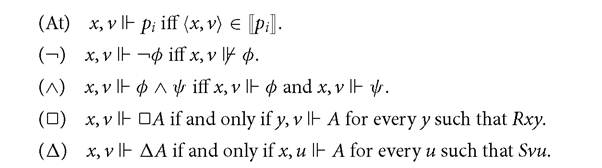
Note that for necessity we keep the precisification fixed and check for variation with respect to accessible possible worlds. For determinacy we keep the world fixed and look for variation with respect to relative admissible precisifications.
Although we will typically ignore the modal accessibility relation, R, and quantify over all possible worlds, we cannot make a similar move with the S-accessibility relation. A decent logic of vagueness ought to make room for the possibility of second- order vagueness (propositions such that it is borderline whether they are borderline), or, more generally, higher-order vagueness. If every precisification was S-accessible to

12.1.3 Degeneracy
What does the modal characterization of vagueness and precision amount to in this framework? To answer this question, our strategy will be to (i) take a set of world-precisification pairs (our proxy for a proposition) and use it to interpret the 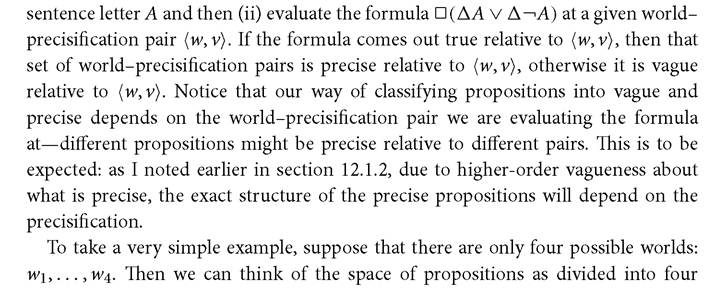
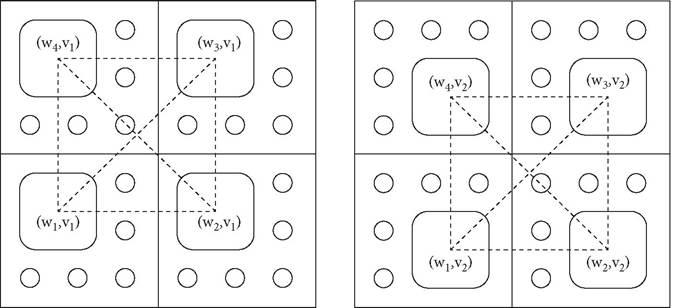
Figure 12.1. 'The space divided into four world propositions. The two diagrams represent two divisions into precise propositions depending on the precisifications v1 and v2.
quarters, as depicted by the four squares in either of the two diagrams in Figure 12.1, with each quarter representing the pairs that have a particular world as its first coordinate.
To evaluate a formula of the form □A at (w1, v1} we vary the world coordinate and see if A is true relative to each of the resulting pairs. Since there are only four worlds, there are only three world-precisification pairs accessible to (w1, v1) other than itself: (w2, v1), {w3, v1), and {w4, v1). Note here that even though our modal accessibility relation over worlds is universal, when we look at which pairs are accessible to one another, the modal accessibility relation forms a non-trivial equivalence relation. In our model, pictured in Figure 12.1, each equivalence class contains exactly four pairs, taken from each of the four quarters of our picture: we have represented the accessibility relations for two of these equivalence classes by the six dotted lines appearing in both the diagrams in the figure.
size=1 color=black face=Cambria>The rounded box surrounding (w1, v1) in the diagram on the left represents the world-precisification pairs that are S-accessible to (w1, v1). Note that all boxes are world-precisification pairs with w1 as the first coordinate, which is represented by the fact that it is a subset of the lower left quadrant. The proposition corresponding to the set of points in the rounded box around (wn, v1) is determinately true at (wn, v1) and determinately false at each of the other accessible worlds-precisification pairs. Thus each of the rounded boxes represents a precise proposition (i.e. a proposition which is necessarily either determinately true or determinately false). Note that any world- precisification pair that falls outside of the rounded boxes is determinately false at all modally accessible worlds, and thus the singleton of any such pair will vacuously be a precise proposition. I have represented the singletons of these pairs by the smaller circles in Figure 12.1. Note that the existence of these degenerate precise propositions is inevitable given the presence of higher-order vagueness. If we were to maintain that the rounded boxes took up the entirety of their respective quadrants, wed effectively be stipulating that each precisification was S-accessible to every other precisification.
We are now in a position to completely characterize the propositions that are precise relative to (w1, v1). Let's begin with the maximally strong consistent precise propositions.[165] As noted above, each of the rounded boxes is precise. It's also clear that any non-empty proper subset of the box around (wn, v1) will be borderline at (wn, v1), so no consistent proposition that is strictly contained in (i.e. stronger than) a box will be precise. As we noted earlier, the singletons of each world-precisification pair that lie outside the rounded boxes will be vacuously precise, and since they have no nonempty proper subsets, they automatically count as maximally strong consistent precise propositions. An arbitrary precise proposition is either the empty set or an arbitrary union of maximally strong consistent precise propositions.
I have illustrated the structure of the precise propositions according to the modal characterization using a supervaluationist framework. However, the conclusions are quite general: a similar structure will be shared by any theory which takes the notion of being borderline as primitive and defines precision using the modal definition.[166]
The precise propositions have a very strange structure according to this picture. Indeed, as we saw above, most of the maximally strong consistent precise propositions will be degenerate: a singleton of a world-precisification pair. This is problematic for both an intuitive reason and a more theoretical one.
The intuitive problem is that the degenerate maximally strong consistent precise propositions settle lots of seemingly precise questions: for example, they tell us the locations of the cutoff points for all the vague properties. Intuitively, no precise proposition should entail things like the cutoff for baldness is exactly 2,049 hairs.
The theoretical problem stems from the role that precision was supposed to play in the present theory. The Principle of Plenitude states that for any maximally strong consistent precise proposition and any proportion between 0 and 1, there's some vague proposition that takes up that proportion of the precise proposition: if p is a maximally strong consistent precise proposition, and 0 ≤ α ≤ 1, there is some vague proposition q such that Pr(q | p) = α for every rational ur-prior Pr. If there were any degenerate maximally strong consistent precise propositions, then Plenitude would fail: every proposition would either be entailed by it or be disjoint from it and, so, every proposition would have a conditional probability of 1 or 0 on it—no proposition will have a probability of 2 conditional on a degenerate proposition.
Other core principles of this theory are affected too. Indifference states that one should be indifferent between any two propositions that entail the same maximally strong consistent precise proposition. Rational Supervenience states that all coherent ur-priors agree conditional on each maximally strong consistent precise proposition. The force of these principles is significantly lessened if there are degenerate propositions all over the place. For example, every coherent prior must agree conditional on a degenerate precise proposition, since it is the singleton of an index, and so Rational Supervenience is vacuously satisfied; these considerations also show that, for similar applications, Indifference becomes vacuous as well.
class=40 style='margin-left:0cm;text-indent:0cm;page-break-after:avoid'>12.1.3 Doxastic features of vague propositionsMore suspicion is cast on the modal definition by the observation that we cannot adequately capture the distinctive doxastic features that differentiate vague propositions from precise propositions if we adopt that account of precision. For example, I suggest that the propositions expressed by the following sentences are vague due to their distinctive doxastic features:
1. Harryisbald.
2. Either Jocasta is the mother of Oedipus or Harry is bald.
3. Patrick Stewart is bald.
4. Patrick Stewart is actually bald.
These propositions have the following feature that is quite distinctive to vagueness: in all cases, there is some precise hypothesis, p, such that one is rationally required to be uncertain in the vague proposition conditional on p (provided there is such a p consistent with your evidence). In the former case, for example, one should be uncertain whether Harry is bald conditional on the precise proposition that he has N hairs, whenever N belongs to a certain class of borderline cases.
Consider now Oedipus, who believes that Jocasta is not his mother. Suppose Oedipus also knows that Harry is in the borderline region for being bald: for Oedipus, both 1 and 2 are on an epistemic par. He should be uncertain about both propositions in that distinctive kind of way characteristic of uncertainty about borderline matters. What explains the presence of this distinctive kind of attitude in this case? It seems completely obvious that the explanation for the presence of this distinctive kind of uncertainty ought to be the same in both cases, and that the explanation has something to do with both propositions being vague.
Yet note that this conflicts with the modal characterization of the distinction between the vague and precise. The proposition that Jocasta is Oedipus' mother or Harry is bald could not have been borderline since it is an a posteriori necessary truth that Jocasta is determinately Oedipus' mother. In short, both 1 and 2 have features characteristic of vague propositions, yet only 1 counts as vague according to the modal characterization.
A similar argument can be run for 3 and 4. Since Patrick Stewart is determinately actually bald, it couldn't have been borderline whether he is actually bald. But surely all the reasons we have to think that 3 is vague extend to the claim that 4 is vague.
It might be tempting to insist, in response to these puzzles, that the world parameters should be replaced by epistemically possible worlds. But the resulting picture leaves no work for the precisification parameter to play. Since vagueness involves ignorance, there must be epistemically possible worlds where, say, Harry has the same amount of hair but which differ about whether he is bald. (Indeed, if we interpreted the modal operators with the (□) clause, we would encounter violations of the supervenience of the vague on the precise; we will return to these issues in section 15.3.)
This argument rested on a quite general principle, namely that if there's a (consistent) hypothesis, such that conditional on that hypothesis we should be certain that p is borderline, and thus have that distinctive uncertainty about p characteristic of borderline cases, then p is a vague proposition:
Credence to Vagueness: If there's some consistent hypothesis, h, such Pr(Vp | h) = 1 for some conceptually coherent prior Pr, then p is vague.[167]
This provides us with another important connection between borderlineness and vagueness. For example, there are plausibly certain hair numbers such that it is a conceptual truth that people with that amount of hair are borderline bald in the sense that according to every coherent prior it's certain that Harry (say) is borderline bald conditional on his having that many hairs. Thus it follows that the proposition that Harry is bald is vague. The same goes for the proposition that either Jocasta is Oedipus' mother or Harry is bald: conditional on the hypothesis that Jocasta isn't Oedipus' mother and that Harry has N hairs, we should be certain that that proposition is borderline. The latter hypothesis in question is surely consistent according to any reasonably fine-grained account of propositions. There are, of course, very coarsegrained theories of propositions that predict that one cannot be uncertain about who Oedipus' mother is. However, I take it that most people accept enough finegrainedness to make sense of this uncertainty, and these theorists will be in a position to conclude that 2 is vague from Credence to Vagueness.
12.1
More on the topic BorderlinenessasPrimitive:
- Responding to the Sorites
- Bacon Andrew. Vagueness and Thought. Oxford University Press,2018. — 361 p. — (Oxford Philosophical Monographs), 2018