Fineness of Grain
Taking propositions as primitive is consistent with a wide variety of hypotheses about how fine-grained propositions are: indeed, it is consistent with the coarsegrainedness assumptions embodied in the possible worlds theories, and with more fine-grained assumptions.
A substantive theory of propositions would ideally provide some kind of independent criterion for individuating propositions. Here I investigate the general structure of questions of fineness of grain; I present my preferred criterion of individuation in section 11.3.In one important respect, our discussion here will be less than fully general: I shall restrict our attention to views which accept Booleanism—the view that propositions form a complete Boolean algebra under the usual logical operations (see section 3.2). We are thus assuming that propositions are not so fine-grained as to distinguish a proposition from its double negation, for example (as a structured proposition theorist might maintain).1
In what follows, we shall be investigating various hypotheses within the Booleanist framework concerning the individuation conditions for propositions. The possible worlds theory, for example, corresponds to the condition that propositions are individuated by necessary equivalence, whereas the view that propositions are sets of world-precisification pairs can be approximated by the idea that propositions are individuated by some combination of determinate and necessary equivalence, involving all possible iterations of both determinacy and necessity together. (We will see shortly, however, that the true individuation conditions for this view cannot be straightforwardly stated in a language containing determinacy and necessity.) Such hypotheses about individuation conditions are not logically idle either.
Identical propositions are intersubstitutable, so from the first hypothesis one can infer that if A and B are necessarily equivalent, they are intersubstitutable in all contexts, including contexts containing determinacy and necessity; a similar conclusion follows from the second hypothesis.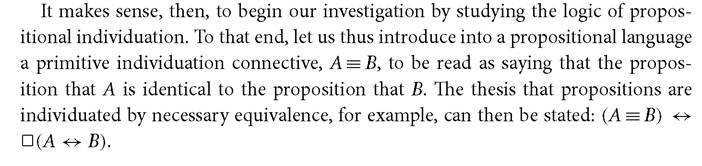
1 It may be possible to add in extra fineness of grain later if we wanted to, but for now it is useful to abstract away from that. For the most part, this assumption is harmless, since the fine-grainedness due to vagueness is certainly not due to structure. Indeed I suspect the Boolean assumption is not central to the approach I am advocating for: if one had a more fine-grained theory of propositional content, one could attempt to recover entities with the Boolean structure that I am interested in by quotienting out the extra fineness of grain (i.e. by forming equivalence classes of the more fine-grained propositions under some suitable equivalence relation). With that said, however, I shall make no serious attempt in what follows to make this theory consistent with non-Boolean theories of propositions.
VAGUE PROPOSITIONS 207
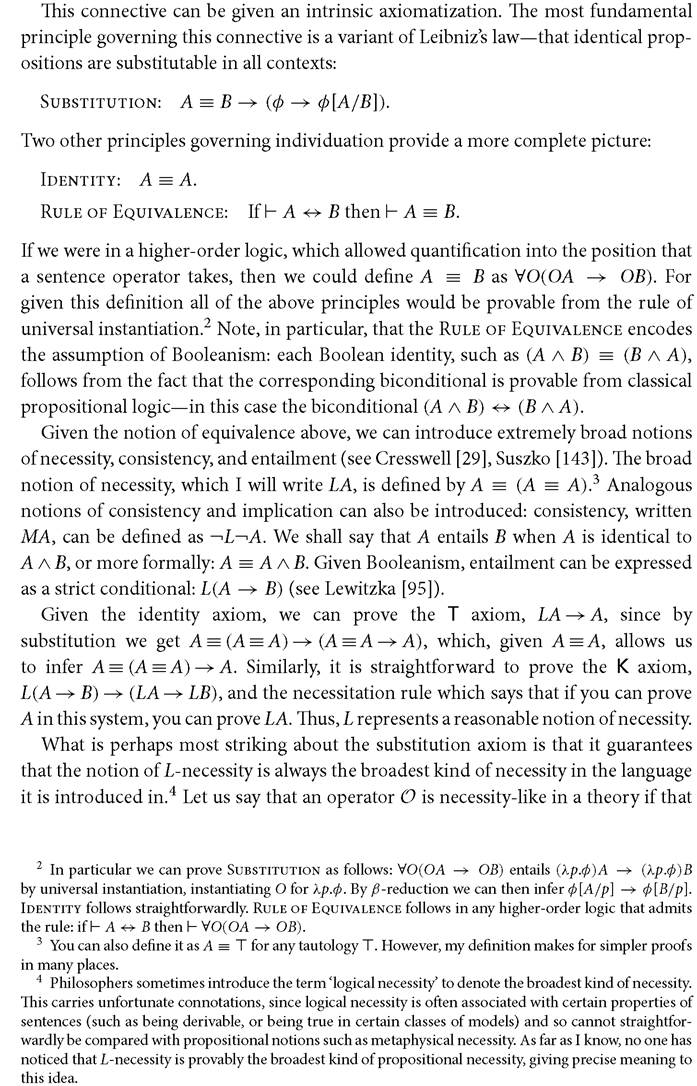
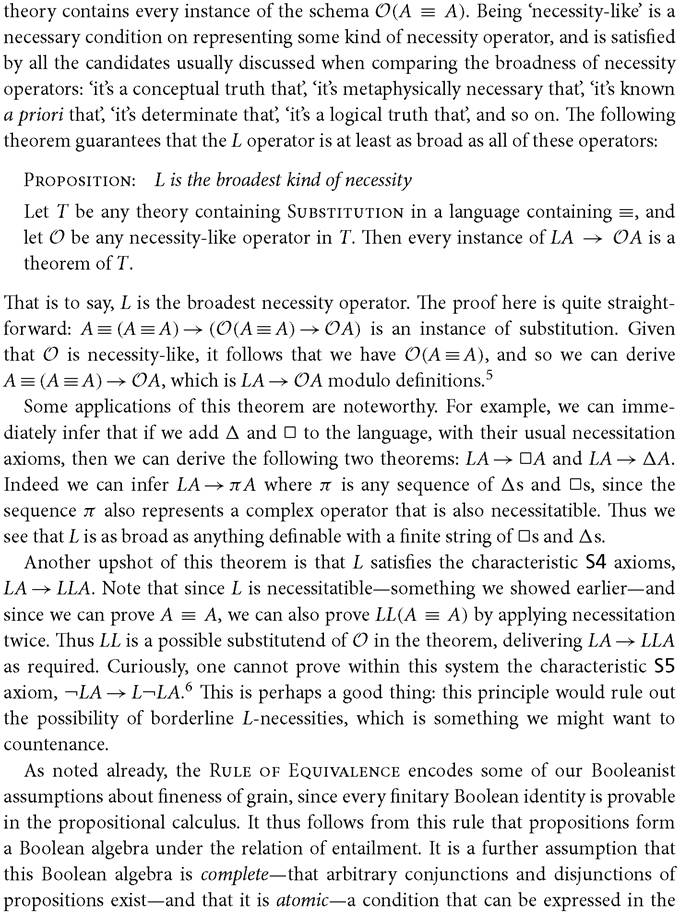
[1] The theorem proved shows that L is always the broadest necessity operator in whatever the language happens to be. A more general version of the theorem, that is not language relative, can be formulated in a higher-order logic: V0(0T → VP(LP → OP)).
Since writing this book I have explored this idea further in Bacon [3]; investigating this further here would take us too far afield.[1] See Cresswell [29].
object language by saying that, of L-necessity, there's some truth that L-entails every truth (see Williamson [165] p. 201). I shall not challenge these further assumptions.
style='font-size:9.0pt;line-height:122%'>Given these assumptions, we can always talk about maximally strong consistent propositions: a proposition that is consistent and is identical to any proposition that entails it. In the theory of Boolean algebras, these are called atoms, but in the present context I shall refer to them as indices. It is a standard result about complete atomic Boolean algebras that each proposition can be represented isomorphically by the set of indices that entail it, and that the operations of conjunction, disjunction, negation, and entailment get cashed out in this representation as the set-theoretic operations of intersection, union, complementation, and subsethood.
In many ways, the resulting theory is much like the possible worlds theory, in that we can represent propositions as sets of entities. But unlike the possible worlds theory, we are not committed to the modal account of propositional individuation. Indeed, if desire and belief operators contribute to the individuation of propositions then the indices will not in general represent metaphysically possible ways the world could be.
A general point about the propositions-first methodology must be stressed at this juncture. Although it does not rely on possible worlds as ordinarily conceived, it is not supposed to be revisionary to ordinary semantic theorizing. Possible world semantics has enjoyed a great amount of success among linguists and is widely adopted in contemporary semantics.
However, the success of this style of semantics has nothing to do with the fact that in many philosophical interpretations, the objects at which we evaluate sentences for truth are taken to be possible worlds; little would change if the worlds of the theory were interpreted differently. The proposed theory allows us to retain the thought that the meaning of a sentence is given by a non-linguistic entity, a ‘proposition’, whilst rejecting the claim that these things are individuated modally.It's worth noting that even without bringing in considerations having to do with propositional attitudes, the style of semantics which employs indices and accessibility relations may not always allow one to interpret the indices as possible worlds. For example, a purely modal language can only allow the indices to be interpreted as representing possible worlds if we are assuming a modal logic including at least the S4 principle. If we are taking the index semantics at face value, then only the indices accessible to the index representing the actual world will be genuine ‘possible' worlds and the other indices needed to represent the semantics cannot be understood as representing possible ways the world could be. Similar points hold for counterfactual logics which allow for non-trivial counterfactuals with impossible antecedents. Neither of these two examples relies on the features of propositional attitudes.
The possible worlds theorist identifies the things we have neutrally called ‘indices' with maximally specific ways the world could (metaphysically) have been, and we have observed that this assumption is not essential to the success of this sort of semantics. But more importantly, the assumption that indices are maximally specific ways the world could have been seems to load the dice in favour of natural language operators like ‘could’ and ‘possibly’. It is no surprise that on this way of construing indices, we run into trouble interpreting attitude operators like ‘believes that’ or ‘desires that’ in this framework. This assumption, however, is not forced on us; we could just as easily interpret the indices as being maximally specific ways the world could be believed, or desired to be.7 One can still think of sets of such things as representing truth conditions: they are, after all, still conditions which can obtain or fail to obtain. The conditions under which a belief, say, is true could easily be when Harry is bald or when Hesperus is Phosphorus. For these kinds of things can be true or not as the case may be, and they can be believed to be the way things are, or the way things are not, and so on and so forth. There is no good reason to think that truth conditions must be individuated coarsely by their relation to adverbs like ‘necessarily’ and ‘possibly’.
11.2