A Representation Theorem?
Given the assumption that the algebra of propositions forms a complete atomic Boolean algebra, we know that it is always possible to think of propositions as sets of indices and the modal and determinacy operators as certain kinds of mappings on these sets (see section 3.2).
It is natural to wonder what these mappings and indices must look like for the indices to be representable by ordered pairs, and the modal and determinacy operators by mappings determined by supervaluational clauses involving variation over the two coordinates. It is also natural to ask when such a representation is unique. These questions are of clear importance to the supervaluationist, for if a representation of this sort is always possible under reasonable assumptions, then it is always possible to introduce worlds and precisifications as certain sorts of abstractions. On the other hand, if such a representation is not always possible, we get a clearer understanding of what substantive assumptions the supervaluational framework imposes on us. In this section we investigate these questions.Recall that the supervaluational semantics is a special case of the general Kripke semantics. For given a set of worlds W, precisifications V, a relation R on W and S on V, we can turn this into an ordinary Kripke model by the following process. We begin by setting our indices, I, to be the set of ordered pairs from W and V, W × V. Then we introduce two relations, R' and S', on I defined so that R {w, v){x, u} if and only if v = u and Rwx, and S'{w, v){x, u} if and only if w = x and Svu. The result is a Kripke frame that satisfies all the conditions in Table 15.1. Usually, R is the universal relation on the set of worlds, in which case the R' relation defined above will be an equivalence relation that partitions the indices (the world-precisification pairs) into a number of equivalence classes equal to the number of precisifications.
The converse to this result is certainly not true: there are plenty of Kripke models (I, R, S) that are not isomorphic to any supervaluational model.
We already noted, for example, that a Kripke semantics does not in general validate the product logic. However, the unrepresentability of Kripke models in supervaluational ones remains true even if we insist that the Kripke models in question satisfy all the conditions in Table 15.1 corresponding to the product logic.Let us examine two possible ways in which this can happen. The first has to do with the cardinality of the frame. In any finite supervaluational model based on ordered pairs of worlds and precisifications, the total number of ordered pairs is just the result of multiplying the number of possible worlds by the number of precisifications. So if the total number of pairs is a prime number then either there is only one world or one precisification, and it is thus a model in which either there is no indeterminacy anywhere in the model or no contingency anywhere in the model. On the other hand, for any Kripke model, there is an operation that increases the size of the model by any finite number but makes exactly the same modal formulae true.[179] Thus, take any finite model of your logic which makes the formula VA ∧ — □A ∧ — □— A true somewhere in the model (since this formula is clearly consistent—it just says that A is both borderline and contingent—it is natural to think that whatever constraints you put on your Kripke models there will be a model like this). Now, find a finite model which makes the same formulae true at each index but has a prime number of worlds: this can be achieved by repeatedly increasing the size of the model by one until you reach a prime number. This model cannot be represented by ordered pairs of worlds and precisifications since, as noted above, any such model with a prime number of indices is one in which there is either no contingency or no indeterminacy at any index, but by stipulation, the formula stating that A is contingent and borderline is true somewhere in this model.18
The second barrier to representing a Kripke frame by a supervaluationist frame arises when we allow failures of the product logic: that is, when we allow the last three constraints from Table 15.1 to fail. For example, consider the following model—the one-way roundabout.
In this diagram the dotted lines represent the S relation, and the solid lines the R relation (both relations are implicitly assumed to be reflexive, although, to reduce clutter, I shall not represent this on the diagram).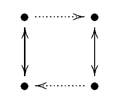
This model satisfies all but the last three principles of Table 15.1. Notice that cardinality does not seem to be a barrier to our representing this Kripke frame. It looks as though it could be modelled using two worlds and two precisifications giving us a total of four pairs. But when we try to define the accessibility relations over these two precisifications we find that we cannot because the determinacy accessibility relation goes in opposite directions on the top pair than on the bottom pair.19 Similar points apply to any Kripke frame that contains the one-way roundabout as a subframe.
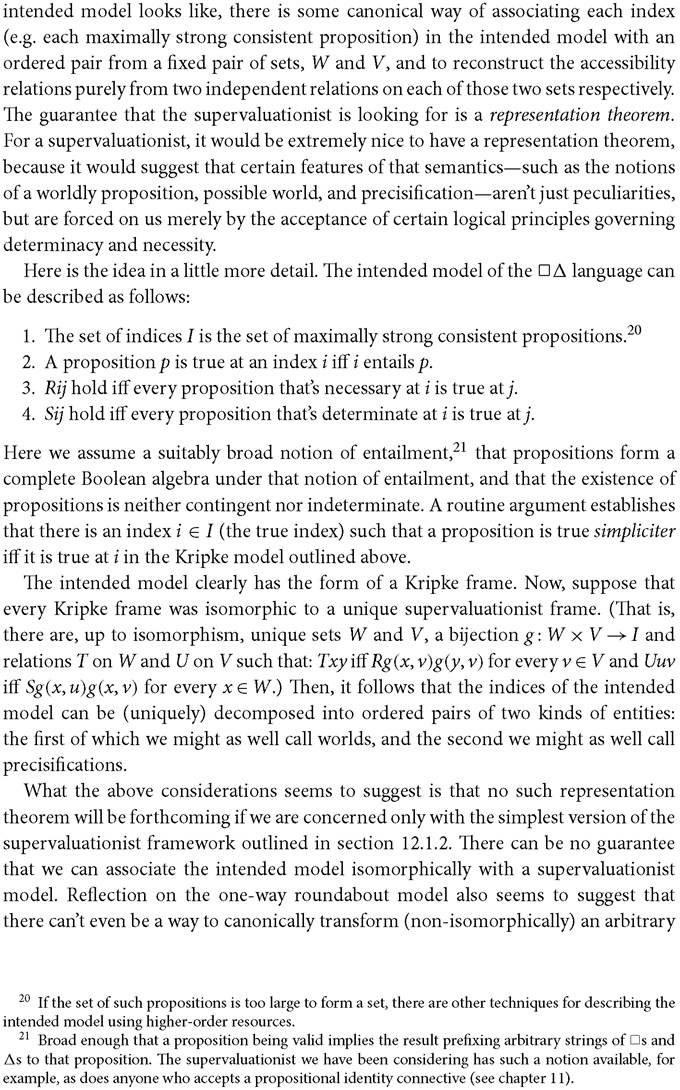
Why should we be interested in these sorts of results? A supervaluationist who wanted to put the formalism of worlds and precisifications in good standing might want to have some kind of general guarantee of the following form: whatever the 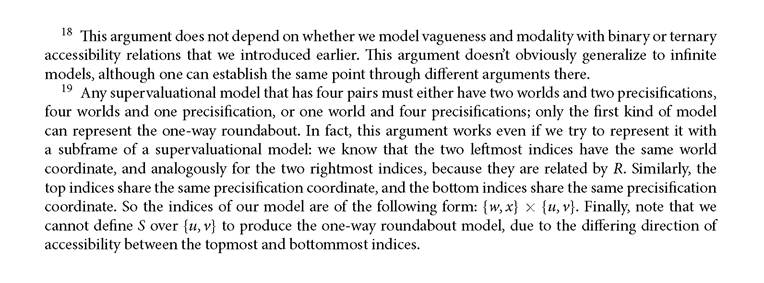
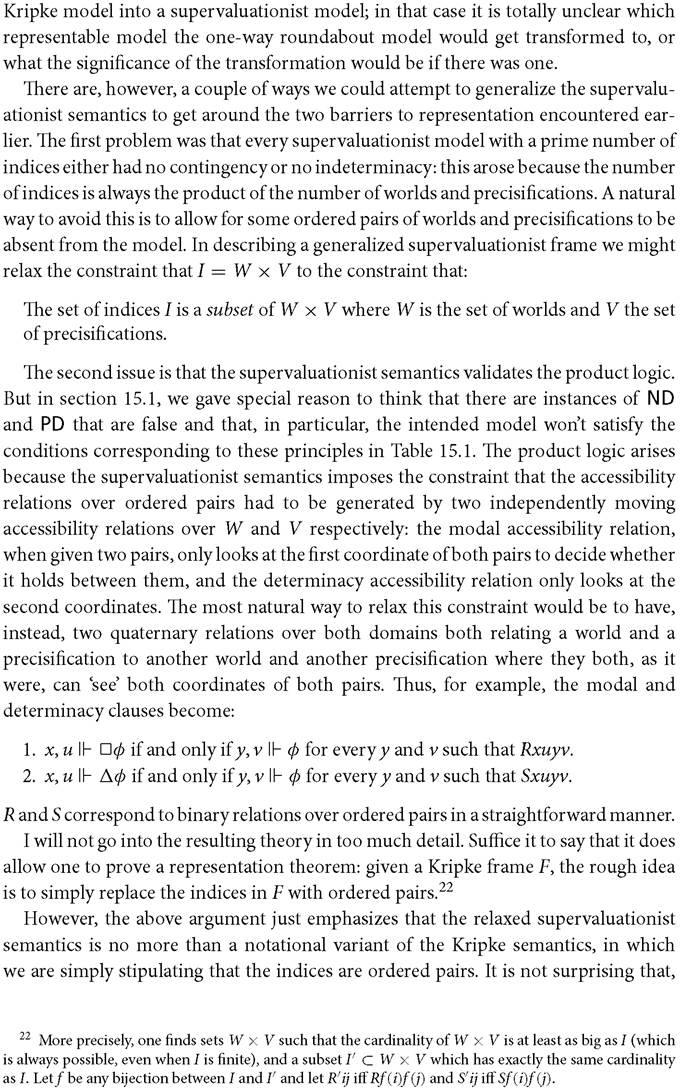
Lastly there is the issue that for this representation theorem to work, as we argued earlier, some ordered pairs must be left out of the model.
But this seems to go against some of the original motivations for the supervaluationist semantics. Intuitively, a precisification is supposed to tell you not only where the cutoff points in fact are but where they would have been, had the worldly facts been different. For every way the world could have been, the precisification tells us where the cutoff points would have been had the world been that way, and so every way of combining a world with a precisification produces a coherent description of how things are. To make the representation theorem work, we have to drop some of these combinations from the model, which is to deny some of the heuristic value of the formalism that made it attractive in the first place.size=1 color=black face=Cambria>Let us take stock. Insection 15.1, we observed that the most straightforward version of supervaluationist semantics is committed to the product logic, and we saw how this conflicts with the plausible hypothesis that metaphysical necessity is vague. In the present section, we developed a more general supervaluational semantics which is capable of representing failures of the product logic, and proved a representation theorem. But even in this context we saw that the supervaluational semantics imposes fairly strong and non-obvious constraints on the structure of determinacy and modality. What’s more, we observed that the structure of modality and determinacy alone was not enough to pin down the structure of worlds and precisifications. There are generally multiple ways of carving up logical space into worlds and precisifications that given rise to the same determinacy and necessity facts.
In section 15.2 and 15.3, we showed how the symmetry semantics introduced in chapter 13 does not impose these constraints, and we saw how various further theses, such as the product logic, and supervenience of the vague on the precise, could be imposed by adding certain constraints to the accessibility relations. In particular, we were able to see that attractive theses, like the supervenience of the vague on the precise, do not entail certain unattractive theses, like the precision of metaphysical necessity or the product logic.
More on the topic A Representation Theorem?:
- Index
- Resisting the Historical Objections: The Selective Strategy
- Rescuing h-traits via the gadfly, curiosity, and solitude