II That. The Play of the Being in Becoming of the Fragmentary and Fragmented Totality of the Multidimensional and Open World
That ‘is’: being of all that is, and nothingness, becoming, movement, positivity and negativity, space-time, unity, multiplicity and totality, world open or closed, finite or infinite or indefinite.
That ‘is’: the being in becoming of the fragmentary and fragmented totality of the multidimensional and open world - to name it in a not too dissociative language - as it constitutes itself in and through its encounter with the human being; it is rather inside this encounter that the Same says and makes itself.
For we can neither depart from the being of the human to reach being in becoming, nor do the inverse. We are always on the way to the heart of the Same - always problematic - always in the interlude.That ‘is’: the play of all its unveilings and all its occultations, all the readings and interpretations it arouses and troubles, all the machinations it provokes and breaks. This play is the One-All, the One-Multiple, BeingNothingness, the All-Nothing.
That ‘is’: the horizon of horizons that withdraws; one could call it simply World. You call that a world? The human is not without the world and the world is not - that is to say, is not said and done, is not a problem - without the human. None of them is the other and none of them goes without the other. They make neither one nor two. How, then, do they institute the Same? Behold the game.
That ‘is’: logos as language and thought of the world said by the human, spirit, idea, start and end of all that is, God, measure of creation, and physis as cosmic totality, universe of universes, energetic matter in mechanical and/or dialectical movement, historical humanity, producer and transformer of what it is and what it is not, technical scaffolding of reasons, actions, networks and passions that assemble and combine beings and things.
Each of the great designations of That, being, nothingness and becoming, space-time, unity, totality and world, God, nature, human and play, is not what it is and is what it is not.
That has been said and named, called and invoked, by remaining unthought and unprecedented in terms of enigma, of secrecy, of mystery, to become like a question and a problem, without escaping the unspeakable and the unnameable.
That neither escapes the finitude - the unique rather than double finitude - of the being of the world and the being of the human, finitude of time.
In this major finitude, the finitudes that are not simply particular are gathered, and proceed from it: in particular the finitude and the limitation of the imaginary (utopias and uchronias), which is not an infinite or even unlimited dump of possibilities and alterities, nostalgias and anticipations, desires and dreams - the finitude of history, the finitude of all the games.Each of the dimensions of That is encompassing and encompassed, is implicated in all the others and implies them; it is at once moment and totality.
Do all aspects of That reveal - and do they arise from - alliances and misalliances, relations of weakness and power? Are all the worlds of the world unsatisfactory? Are all forms of the game rigged?
It is not only the horizon of That and That as the horizon, it is even any idea of the horizon that has become problematic.
Each of the great circles, each of the great equivalences of That, comprises several aspects and versions.
It is That which happens when something - that - happens, even if what happens looks like nothing.
Most often That remains vague, vague, vague.
That can only remain the Unnamed, although requiring certain names.
That is caught in the meshes of an increasingly mediatised network of mediations. This is why everything is more and more complicated, making impossible any more or less immediate, evident, unproblematic attitude. Yet how persistent is the temptation to recover everything.
That is not neutral, although it neutralises everything, making everything possible, animating it, killing it, letting it return. It always remains in suspense.
That has also been taken in charge by the mystics and the esotericisms that discovered as-yet uncounted treasures, custodians of a tradition that plays with us as much as we play with it, itself rather mystified, believing ourselves dismantling it quickly.
Situated and situating, silent and speaking, does this esoteric and mystical tradition, several thousands of years old, await its hour?That, which is there, does not always and everywhere happen as an antiphanic epiphany.
The search for That, the theme of first philosophy or metaphysics or ontotheology, remained a science without a name, a sought-for science, an unfindable science.
That was also poured into the hollow mould of the world. We are always in a relationship of half-full half-empty comprehension with the all and the nothing ‘before’ thinking them. A tension towards, a relation to and an attraction by precede thought. Metaphysics and anti-metaphysics have grasped the being of the world as full and present in its totality. The intuitions, concepts, categories and ideas expressed it or cautiously put it into question. It is that which no longer goes.
This relation that is open to the ensemble of what is, communication - by instants - with the splendour of the world, the rhythm of totality, being swept away by the flow of life, that itself which can at certain moments leave traces that accord us with That, also exists and coexists with its contrary.
All contact is a function of an acquiescence and a resistance.
Similarities and dissimilarities attract and repel themselves.
All the elucidations of That comprise oscillations and pendulum movements, accomplish themselves through slanting leaps.
That cannot be read simply as a text offered by the Book of the World. There is no unique reading of the Book of the World, nor of any text whatsoever, though the world does not constitute a text.
That requires polarisations and polarisers.
We encircle That which encircles us.
It is That which is there: it unveils and veils itself, shows and hides itself, offers and withdraws itself, lets itself be grasped and remains ungraspable.
The game of ‘That’ itself allows us to call it provisionally, in considering all terms as equivalents, provided that one explicates them differentially: being, nothingness, becoming, totality, world, play.
What is being? That is the question.
It does not, however, comprise a positive answer, for as soon as one fixes Being by saying that it is this or that, one makes of it a particular being; this is how all philosophy later called metaphysics operates. Being reduces itself neither to the verbal infinitive nor to the verb becoming substantive, although it is closer to its verbal than to its nominal look. It does not reduce itself to copula and judgement. It is not even something that is, nor the foundation or the totality of everything that is. So? It is, but it does not exist as being. Implying nothingness and implicated by it, being is in becoming, is the becoming of the totality of the world, the play of errancy.Being was grasped from the start - that is to say, with the Greeks who named it - in and through the ontological, analogical and metaphorical logos. Moreover: it was identified with thought. Since then, the fundamental equation of ontological thought formulates itself: being = thought. What happens to the difference?
The-unity-and-the-difference between what is and what is said and thought of it remains troubling. What is this that resists the diverse approaches?
For metaphysical thought, being is presence or, in a derivative way, absence; presence grasped in modern metaphysics by consciousness present to itself in self-consciousness, in the representation that prolongs its action to become, at the threshold of its completion, representation of the representation.
As absent does not mean: absent.
Representation strikes presence, reigns over it and maintains conjointly the radiance and the obsession of the presence that thus perpetuates itself, even in the form of absence. So it suppresses and conserves - by exacerbating - presence-absence. It wants to render things present in their absence.
Because ‘absence’ calls for an original presence, effectively existing and/or existing in representation.Absence is only the reverse of presence. It is the reign of presence with barely reversed signs. It is the same orientation and the same nostalgia.
Most often one criticises the metaphysics of representation with the weapons of the philosophy of reflection.
To think That, philosophico-metaphysical thought appealed to the luminous and illuminated gaze and to clear hearing, scotomising opposing powers and neglecting the chiaroscuro and the silent and often inaudible noise of the sensible, and subordinating the world to the light and the word of Being. Being posited as thought became the focus of theoria, the logically discursive or logically intuitive vision, the central theme of representation and spectacle. The entire history of onto-theo-logy is a history of the eye and, even when it becomes anthropological history - thus completing metaphysics - this same history remains history of the eye, now human, until it stops looking without seeing and loses sight of itself. Regarding the ear - called external or internal, depending on the case - one never knew too well what it was listening to, or what to do with it: does it hear or not, and what?
What punctures the eyes and deafens the ears is no longer present.
What is present in itself is ‘indissociable’ from what is present to the human - within and beyond its representation.
Neither presence nor absence is: there is only their combined play and the play of which they are signs.
It is in the heat of dialogue, that is to say, ‘by playing a laborious game’, as he calls it himself, that the Platonic Parmenides poses his first hypothesis of the One (that is Being).
Usually, not knowing where to head among beings, we do not search for being.
Exceptionally, the latter, that is, the being of the world, starts to shine on particular inner-worldly beings. Searching for being, we meet only sparks of fragmented being, which, sparkling or dull, are said by the sparks of words and thoughts.Is it on the basis of the original fold between being and the being that nothing goes without fold?
Metaphysics sees and does not see the difference between being and a being.
Metaphysics makes Being a being, fixes it and subordinates it, and, at the same time, sinks every being into a second-rate reality, subordinating it to Being par excellence.
Roughly asked, the question formulates itself: what exists?
How does that exist which no longer exists or not yet, and, in general, the ‘inexistent’?
class=a6 style='text-indent:18.0pt'>To ‘being’ belongs what is no longer and what is not yet.Being and appearing are mortally linked, each one vivifying and mortalis- ing the other, animating and cancelling each other mutually and conjointly, because we can no longer save either essences or appearances.
What is, shaken by imbalance, instability, disorder, drowned in the unfinished and the unlimited, can reach the clearing of appearing only in a certain equilibrium combining stability and fixity, particular order and provisional completion, limits and limitations.
The path towards the appearance and the disappearance of the being is one and the same - and different.
Is it in our power to grasp the phenomenon as surpassing its conditions of appearance, that is to say, not reducing it to them or substituting them for it?
Metaphysics privileges light and the visible, although it relies on the invisible.
All that appears manifests itself, has invisible roots.
Vision has been clearly privileged at the expense of hearing: it is true that through it are conveyed so many opinions and platitudes, gratuitous and non-engaging things; but someone is not listening who simply listens without understanding anything, or who understands vaguely without listening.
To face the light, we use visors.
We mainly see, of all that is, only the side turned towards us - the side towards which we direct our gaze.
The eyes were seen as the windows of being.
Are there things that one sees and that do not exist and others that one does not see and that exist?
We see more of what emerges and less of what it emerges from.
What has not yet lived and what is already dead can sometimes almost be glimpsed. A buried and invisible treasure exists only on the day it is discovered. Where was it before?
When rays of light compose a beam, the hour of a certain clarity has arrived. A too brilliant and burning transparency would consume all.
Does ‘everything’ become clear, when ‘everything’ is finished?
Except at noon - where being and appearing coincide - each being and each thing that advances or recedes is preceded or followed by its shadow, and one always asks for a light from elsewhere to dispel it.
The law of the day and the passion of the night divide and share the being devolved to human being. Can it agree with the night without hating the day, and with the day without fearing the night? Does the agreement proceed from disagreement, or vice versa? Would there be an agreement with being, which, forgetting itself, would refuse to agree?
Has everything emerged from a dark abyss to which it will return?
Darknesses are only completely dark when they don’t know what they are. But are they then? From the moment they are recognised as such, what becomes of them - for us?
Light and obscurity, illuminations and darknesses take hold of all the foundations emerging from the without-ground.
Being has been posed as the fundamental position, the thesis par excellence, from which the other positions and oppositions are thetically and antithetically, analytically and synthetically derived. First and supreme hypothesis - wanting to be true and not just true-ish - it is, that is to say, comprehends itself at the same time as anhypothetical. It is also the fundamental proposition, itself subject, copula, attribute and predicate in speculative judgement: the being is being, the being is the being, or better: the being is (being, the being); so its placement in parentheses is prepared.
From the moment they are named, sense and being are barred, erased. Same goes for the foundation and the origin.
Every chain of questionings comes to butt against an initial question, variously said and enclosed by replies that eliminate it. What is being and why is it there? seems to be this ultimate question that surpasses all others in the direction of the interrogation that blocks and opens the play.
The fundamental search for a primus agens, for a prime being or mover, activates all thought and renders it reactive.
Everything, at every time and everywhere, obscurely or clearly asks why? and does not receive an answer. Is this an indication of the path leading to a cure from the question?
The principle of sufficient reason says: all that is has its reason (or foundation) for being, or, nothing is without reason (or foundation) for being. Except ‘Being’ itself, it would be necessary to add.
Between the given and the founded the bonds remain enigmatic. What one does not comprehend, even in saying so, plays several roles at once, blurs the tracks, in the general confusion, does not manage to dispel misunderstandings.
The call of the foundational remains extremely strong. Even if it cannot receive any foundation, a foundation opening and assigning the diverse signs of human and historical life their mobile place, thus to different structures of the ensemble, is always, and always again, expected.
Always the first and supreme foundation is itself founding and without foundation, without ground [fond].
Self-foundation and self-suppression of the foundation go together.
There is no master of being, being itself not being the master.
Thus, from now on, the ‘fundamental’ will remain without foundation; not that it possessed it before.
It is from the anonymity of being that words and names, gestures and actions, beings and things emerge.
Ontology, speculative theory of what is - what has been, what will be - already contains implicitly what will develop from it while also controlling it: a deontology, normative and more or less practical and ethical, of what must be. Theory of being and theory of must-be are mutually conditioning.
Into the nets woven by ontology and deontology - nets that weave them too - a certain axiology is always woven: a valorisation of beings and a theory of beings and things as values. But it is especially through the ontological tearing - more than through the holes of the nets - that these valorisations appear and are torn in turn.
About the mode of articulation of the ‘ontological’ and the ‘anthropological’, we cannot yet articulate a discourse.
To methodological abstractions supposedly correspond ontico-ontological domains.
The sensible, subordinated to the intelligible by metaphysics, therefore neglected, magnified at the expense of the supersensible by anti-metaphysics - the question of the link uniting the senses and sense always remaining in suspense, even and especially when it receives unilateral, bilateral or multilateral responses - is what shows itself by hiding itself.
All those who participate in the assault of the fissured ramparts of being that do not protect anything, lose themselves in the undergrounds and bastions full of sense which assail the assailants - sense produced by them or by their kind? - and, in the fury of combat, neglect the sensitive and the sensible.
There are differentiations that remain when differences are suppressed in and through indifference.
What is is in realising itself and in unrealising itself.
What is supposes an access to it - being for us.
More important than beings and signs are the relations and the relations between relations.
What is possesses and takes root and grows - sometimes - into a vast horizon. Even small horizons are plunged into immensity.
Seeking the unique and closed or total and open being, we meet only the unfinished and the incomplete.
What is near is usually far away, what is familiar does not cease being strange.
What is holds itself in danger; is it always necessary to face it?
Would an ‘ultimate’ attraction of being orient a thought that would open itself to the meditation of being in its withdrawal, withdrawal of being in the manifestation of the being, withdrawal itself withdrawing?
There is no longer an ultimate name of the origin and the end in an ultimate ontology.
Is there some strictly individual and particular, and if so, is it expressible and speakable?
All the readings of what ‘is’ appear more and more like equivalents. Will text and experiences equally become more and more indifferent and interchangeable?
Those who proclaim, state or murmur the invisibility of being do not comprehend how and why this Being-itself, its sense or its truth, is already barred, erased, deleted, crossed out, the erasure still rendering visible and readable what it erases and its own action. It is an index, if not the index.
To be and not to be, this is the horizon of the ‘ontological’ and central anthropological response.
Why would being aspire to become mobile, to be mobilised, after having been posed as immobile - moving without being moved - as denying movement?
For the moment, ‘being’ is so ingrained in our language - ‘our’ grammar, ‘our’ syntax, ‘our’ logic - that another possibility, which would not be entirely ours, is not yet clearly apparent.
Also pay attention, please, to the aura of what is.
Is being a hole - clear and/or obscure - in nothingness? Is nothingness a hole - clear and/or obscure - in being? All being true and nothing being true? All being false and nothing being false? In the obscurity of the presence-gap?
Nothingness - nothingness or the thought that thinks it? - is it some ‘thing’ derived, secondary, in relation to being that it presupposes? Is void the negative of the full? Is disorder only a different, incomplete, unexpected order? Is the possible only and principally what has been? Is it lack, absence, that hits the given and the thought so that these negative entities can emerge? So goes all philosophy - thought of light, of (compact) being, of presence. It will now devolve to us to experience the opposite. How not to see double?
Nothingness: would it be the invisible knocking on our doors?
Nothingness emits signs, without which it would not be, would not attract us.
Is it on and in the empty horizon that beings and things are outlined?
Negativity cannot only be reduced to returned positivity or simply affected by the minus sign.
Sometimes with clairvoyance and sometimes almost blindly, usually in a mixed manner, negativity continues its work as a mole that undermines all terrains and collapses buildings. The moles gnaw at and also cut the roots.
Negativity puts into action and into question. It errs and it fixates.
The development of what is is accompanied by its negation.
What is contrary must also be inventoried inventively.
Always and everywhere the worm is in the fruit.
Being: non-being; becoming. - Past; present; future. - Presence; absence; hope.
If hope is misleading, disappointment is no less misleading.
That deploys itself in the space-time of the world, where everything appears, disappears, reappears... It is not the world that is in space, but space that is in the world as space of the world where the various locations and the different places are situated, as well as all the movements and all the displacements. It is at degree zero that every place can be occupied; what occupies it then being denied by time.
Space knows both expansion and shrinkage. In it places and locations are built and it is by them that it is experienced.
Is not space a play of relations where time is in play?
The play of the space-time of the world ‘is’ the world itself.
In the space-time of the world, no one can move without an orientation available that avails of them - of the human more than of the world.
Extension and duration manifest the unity of the gaping fork of space and time where everything is engulfed.
Could not all particular ‘geometries’, of all kinds, be integrated into a global pangeometry that would not sacrifice the unitary perspective to the integration of plurality, or vice versa?
We must finally build the topology of the non-place.
Time is also spacing, and movement inspace is time. In extension-duration.
Becoming is becoming of being, of totality, of the world; it is the play of time whose temporality constitutes productive positivity and negativity, movement, historicity. It is in and through history that all manifests and institutes itself. The secret of the movement seems unfathomable: on what does the movement rest? Why and how all that is, therefore also us humans, seems to aspire only to rest, to a state so to speak anterior and posterior to movement, while being moved and provoking movement? Would time in its totality rest in immobility, and would it be that in which everything will gather itself and rest? Becoming is itself this oriented and global errancy - this determining and determined itinerancy - fundamental - though without foundation - pursuing a trajectory, but not including an answer to the question of why, rendering the question itself almost useless. Errancy signifies that one cannot assign a truth to the becoming of being, for it is in and through errancy itself that all truths and errors appear and disappear. It is precisely the deployment of the play having no foundation external to it.
In time and by fracturing it, humans elaborate a legend that they take for the history of their life and for their life itself, and history elaborates legends that give themselves as segments of the becoming of universal history, a major legend giving itself as universal history itself, the greatest legend taking itself for history - the becoming - of being.
Continuous becoming is equally discontinuous.
Even discontinuous, becoming continues and remains continuing and continued.
It is not only the beginning that is inchoate; the end too is inchoate.
Everything is pushed towards its non-definitive end.
We constantly have to go back over the steps of becoming.
What does not change, dies. What does change, dies also.
Watch out for the turns and detours of surpassing: what is surpassed, when, where and how, what has surpassed it, when, where and how, what has become of the surpassed and the surpassing?
What is surpassed remains ‘somewhere’ and goes back in time, because there is a past that is gone and a past to come, constantly recreated.
Can humans ever overcome both their obsession with duration and the haste to end it?
On the ground of the world without grounds, all that is must be grasped as the ensemble of its history: the little tree of the forest becomes a Christmas Tree and then the mast of a child’s boat, later providing the material for the pencils that serve to write the drafts of these children’s stories.
Time does not flow.
Is not time essentially, namely temporally, rhythm? Neither circular and repetitive, nor rectilinear and progressive, at once circular and repetitive, rectilinear and progressive, does not time in its entirety contain the whole of time and times, the totality of temporal development? What has been, is and will be. But how will be what has not already been in the finitude of the entirety of time? Logically and ontologically, the beginning as well as the development and the emergence of the new are somehow impossible: the beginning implies unfolding and ending that are nevertheless unforeseen; it is the end that reveals the beginning and the unfolding there where there is, there where one considers that there is an end. The becoming and the motive negativity, positive and annihilating, the time of the world - the play of time governs us and escapes us. Time unfolds itself multiply: it makes be and it makes disappear; it gets experienced and measured in many ways. It poses us the problem of its irreversibility and its reversibility, for we humans who never know too well with what time we are dealing. With so-called real-time? With lived time, which governs our memory and our memories, our confrontation with the present, our projections and anticipations, in the three-dimensional play of the past-present-future? With the time of techno-scientific calculation? With the time of representation? With the time of thought or the thought of time?
Everything seems to accomplish itself in time according to a pendulum movement, where lack and excess provoke the contrary movement, swinging the balance, marked by its scourge.
In any case, time will do its work, accomplish its labour. Strive, without too many contradictions, to see for whom and for what - and not why - time labours.
All the same: why does it produce almost always what we did not expect in this way, what we did not foresee exactly?
Do not over-isolate a moment; not to isolate it at all is impossible.
Very often, the past was not a present and often the future will not become one.
Inexorable and inglorious, becoming records the different needs of order and puts them into question: (it also raises the question: with what concepts is the putting into question done?).
To know how to wait, even the day after tomorrow, gaining and losing ‘one’s’ time, labouring and passing with time, seems and is difficult. Are we not all, as long as we are, precipitated, not bearing our weak share of freedom?
In the river of time, if one maintains this spatial imagery, the waters of the future are behind us and the past has already overtaken us.
The most radical contingency of ‘being’, is it time?
Was not all rest, first of all, movement?
Time is always in suspense and history unfinished: even when it reaches its end, it remains to pursue, without attaining it - without ‘end’.
A deaf struggle enchains actuality - which imposes itself - on immense temporality.
That is in time: both the more or less durable and the more or less fleeting.
The human can only seek to occupy - to structure - time through activity and imagination, to flee boredom and the flight of time.
How are the various movements contained in the ‘unique’ movement, the play of all that is?
The ‘ground’ of worlds gathers time and is gathered in the time that all philosophical (and idealistic) thought wants to abolish since Plato (out of time) up to Hegel (the victory of the spirit over time).
Time makes everything cease. What makes it cease? With stubbornness, humans would like a glimpse ‘out of time’ that would contain time.
Do not build only on sand, but with the sand of time.
One would like to keep in memory more than it can bear.
In the centre of the movement of whirlwinds and cyclones there is always a zone of calm.
Time takes revenge on all that seems to violate it.
Repetitions and constant changes compose being in becoming (the being of becoming, the becoming of being).
There is hardly any unique direction. The direction which gives itself as unique - and may effectively be - is the triumphant direction.
No path of becoming is quite straight: ellipse or spiral, it is usually warped.
We are always dealing with a semi-spiral.
What passes is, generally, the passage.
Omnitemporal becoming ‘well’ understood can only mean: being in becoming of the world in - and as - time - not in eternity - errant course of the totality of non-totality, play of the open world, multidimensional world without graspable origin and without foreseeable completion.
We grasp not so much the becoming as the become.
The end as such cannot be dominated. The polyphony of origins masks the aphony of the origin. There is no ultimate word of origin, if it is not the play of its unapparent apparition.
The origin that has not ceased to be and which always is, belongs again and always to the future. Thus the present is at once the most dominant mode and the most suspended mode of time.
The beginnings of the end are, when they are decisive, destined to reign interminably. It is as if the end doesn’t end ending.
When will we construct a chronology at once synchronic and diachronic, open to the succession and simultaneity of the three dimensions of time, each of which also counts three dimensions (past-present-future) that ceaselessly create and recreate?
Permanence, succession and simultaneity of the ecstasies of time inscribe themselves in the same totality.
Every past is mythical; the present becomes it; the future is it already.
There are only provisional completions. And the constancy of myths and rhythms of time.
Unable to pose, if not resolve, the question of reversibility and - above all - the irreversibility of time, according to the various plans and different approaches, humans desire a modifiable past, a present omnipresent throughout time and a future synonymous with eternity, for which they invented and imagined various histories.
It is in the fire of the play that the ephemeral and the durable appear, are lit up, consume themselves, as suits the game of all the antagonistic and complementary movements.
There are, incontestably, moments more opening than others. The distinction is however difficult to establish.
The relations between memory and time make the game of time that collects and undoes memories. For it is not memory that is the place of time, it is time that is the non-topological place of memory, always blurred.
Memories seek us and flee us.
Memories are as patchy as omissions.
In the course of time, let us take care not to forget the extreme power of oblivion.
No day, right until the last, is unique; there will be a following.
Why do we always have the sensation that everything that happens happens too soon and, above all, too late? How does the question of the right time pose itself?
Very intense beings, things and signs - apparently - do not last very long.
The play of time and the play with time, this bifurcated temporal play, temporarily and artificially permits the presenting, gathering at a precise moment of time other moments of time and times.
We strive to kill the time that kills us.
Stopping the ‘march’ of time is one of the strongest human obsessions. As if to avenge ourselves for it, humans have nostalgia for a past that could have been other than it was, and project a future radically different from the past and the present.
Time passes and makes pass, but just as it arises and makes arise. Countless histories are woven and told in the fable of time.
Everything matures quite slowly and consumes itself rather quickly.
Scrupulously examine the before-signs, which, for the most part, remain indiscernible.
One wants to organise time so it both passes and does not pass. One wants everything to finish quickly and everything to last as long as possible. One wants stability and passage.
Will we ever learn what we do anyway: gaining and losing ‘our’ time?
The habitual three-dimensionality of time cut into a good original past, a critical and bad present and an eschatological future good once again, feeds on experiences and can receive cosmic, psychophysiological, psychological, historical illumination: thought, a catastrophe befallen some higher animals, humans; the ice age; the foetal state and the desire to return to it; the golden age of infancy; naive and ‘natural’ primitivity.
Measured time, cosmic and natural time, psychological and historical time, all these times compose the fabric of time without exhausting it, because it is not in our power to take time - segmented or total - under our protection.
Over time, will we get used not only to feverishly counting time, but to counting a little more serenely with and on time?
Haste and precipitation, impatience, as much as slowness and waiting, patience, give time rhythm.
Time seems to impose a time when we have less and less time.
We comprehend backwards, the past comprehends us, and we live nevertheless forwards, in the future we do not comprehend.
Human time agrees more with the becoming than with the coming.
Diverse machines and machinations venture to dismantle time, and time dismantles them. That is in time and, moreover, that is, in the game, time itself.
How to distinguish between what changes, becomes other, differs, is or appears as new, transforms itself more or less radically, marks a revolution, what evolves, renews itself, blossoms and collapses, transforms itself gradually, and that which remains the same to itself, identical, joins itself, repeats itself, returns? Are the differences between radical and revolutionary change, jump and bound, and evolutionary transformation, step by step, differences in degree or in nature, and are the differences in degree and in nature differences in degree or in nature?
What returns in time - changed and the same, more different than identical, often with inverted signs - does not return from the side where one expected it.
What repeats itself is not so much the identical as the difference. It and its limits have no end. They have just a circular limit at the interior of which repeats indefinitely - and not infinitely - the repetition of difference.
The Same is not identical to itself.
Eternal return - that is to say temporal - of the same implying the other could indicate this: to assume all as if it had to return.
The temporal return of the same does not return the identical infinitely. Other is the enigma of repetition and rotation, the cycle of productivity and reproduction. Why, from the origin, does all seem already played? Where does the explosive force of the presentiment come from?
The new produces itself within the cycle of advancing repetition.
In the name of the Same, it is permissible for several adversaries to fight each other.
The same, in its history, is divided against itself.
The same has several terrains of application.
The return of the same changes and transforms itself in returning to the same.
Different interpretations of the same text can be openings.
Reborn from the ashes. This wish is part of the ashes. Is the temporal return of the same not comprehended in it?
Patiently practising accentuating the same in the other, the other in the same.
Order and questioning compose the ‘two’ sides of the same.
In the intersecting fires and games of resemblance and difference, a rather glacial separation sometimes emerges.
Moreover, how to unite or separate the other and the same, as well as what is and what is seen so or otherwise? Do the identical and the different rejoin themselves, not in indifferentiation, but in the One-All, which maintains all the differences in the indifference of the differentiated one?
The new that always arises new again - obeying what need? - borrows its clothes and its disguises from the old that thus renews itself.
The differentiated unity of being, of the Same - and not the indifferentiation of the identical where all sinks into indifference - is constituted by a network of relations that it constitutes at the same time.
Following the spirals that go from the similar to the same, let’s be attentive, more than to the nuance, to the specific difference and its play with indifference. In all domains. On all registers.
The totality is not the sum or synthesis of all that is, it is not a closed set. It contains all the totalities, it is and remains open to time, constitutes itself as a play of time. Already every totality has characteristics that are not parts. Every structure is more than the set of its constituents. No process is entirely reducible to one of its sectors and factors. All the more so the ‘totality’. It always remains fragmentary, because we are dealing only with its fragments, ourselves fragments of it, and we fragment it more to grasp it.
The whole of being and the totality of beings manifest themselves in the attraction, the withdrawal, and the secret of appearing - ‘in’ becoming - as neither identical nor separable.
The perspective of totality is in general grasped through the partiality of different particular optics. But each dimension encompasses and is encompassed by others, all the points of view - historical and systematic - communicate, their mobile ensemble (as well as all the multilateral crossovers between ensembles) and the nested plays making a part of the totality of our access to the totality, if not the totality of aspects of the totality of the world.
The whole world is never given, neither as original nor otherwise.
Since the whole ‘gives’ itself in the part, isn’t it then possible to act on the whole by acting on the part?
Does ‘all’ that is ‘sin’ through excess and/or through flaw?
All that, which is, is so singular and so linked to the rest.
None of the circles of the totality is completed, none possesses total autarky, none succeeds in excluding or securing the other circles.
There are no pure beings, in fact, no pure event. All that, which is, weaves more links with the rest than it destroys. Every fragment is part of an ensemble and every ensemble part of a larger ensemble.
Every isolated system fluidifies itself, liquefies itself: this provokes its playful experimentation.
The totality must not be comprehended in this manner: what is in all of the world. We again and always name the total movement of the world after particular movements.
All is structured, organic or organised; all that, which is, comprises, and is envisaged as comprising, rules. Formalised structure is a case in point of structure in general.
All that is and all the particular totalities know a genesis, a becoming, a history, are in a process, possess a system, a logic, a structure. All forms are formed and constitute formations, changing and persisting throughout permanences and changes. There is no genesis, no becoming, no history without structure, and there is no structure, logic, system, formation without genesis. Which, however, commands the other, how do they imply each other, and thanks to what do these transformations operate? The logical and systematic, formed and constituted structure knows a historical genesis, a becoming, a process. These know that. That is to say: it is we who are in the process and the structures, by erecting knowledge and recognising them, in the totality that perpetually makes itself and that we make. The development, the genealogical and phenomenological becoming, the dialectical and historical process, lead to a logical and systematic structure of the ensemble, this development itself being the becoming of a kind of initial and total structure. Thus the circle seems to turn, making us turn with it and leaving us in the plan, since we do not succeed in composing or decomposing the differentiated unity linking historical becoming and logical structure.
Does the structure of the ensemble find itself in the parts, or can we consider the parts as capable of making us find in them the structure of the ensemble?
This structure of structures, whether fanatically or half-heartedly sought, persists in not showing itself, although it is around us - and we in it.
All that, which is, seems to require a rhythm, a delimitation and a frame: word and thought, writing and typography, painting and architecture, human life and diverse games. This frame enframes and delimits what is carried by a rhythm and, in its interior and the frames of frames, everything is ‘worth’ itself, all keeps together. Even what appears as arrhythmic and overflows the frames. Revolutions themselves - never total - follow a rhythm, delimit themselves and are delimited, unfold themselves in the interior of a frame and mobilise frames. Whether the rhythm appears fixed, given or unchained, whether delimitation is respected or transgressed towards another delimitation, whether the frame is called order, organism, organisation, system, ensemble of rules and relations or structure, has secondary importance. No overflying thought can disassemble these times of the world and these worlds in the world, and no so-called rigorous and detailed analysis that traverses the corridors with the pace of (blind) rats can account for it.
We must look nowhere else than everywhere.
The origins will always steal away, my child (and the questions will overflow the frames).
All that is granted to us comprises the other face: what is refused to us.
How does one manage to isolate whatever there is of the whole?
There are no simple details, if they are treated according to a plan of the ensemble.
Are there defects of detail or are all the defects the defects of the ensemble?
The totality that is fragmentary (ontologically, so to speak) and fragmented (by us and our graspings that decompose it into aspects), the fragments that are totalitarian (in ‘themselves’) and totalised (by us) are always apprehended in an angular manner, because it is envisaged from a certain angle that everything shows itself and plays, totalitarianally, fragmentarily, angularly.
How is the difference of what reunites itself anew preceded in the whole?
What determines the human and what the human determines is preceded by a relation to the whole world, which seems to precede, and in any case include, the relation to beings.
Can everything become a said fragment of the totality?
One can enter a system through a particular point.
Unification and diversification impose themselves on all that is, and expose it to the danger of the opening and the closure.
Everything appears as cut out from a foundation of a horizon previously cut out.
Each thinker thinks one thought and all think the One-All: all the central intuitions, oriental and occidental, mythical or discursive.
What happens at the level of the ‘totality’ also happens on all planes, at all levels.
The totality is formed by sums and differences.
Everything, once ‘posed’, we can explore certain of its details.
Every totality, every system, every structure is stronger than its components, even though one of their constituents can make them explode.
Know that in every system or network a variable never functions alone, even though every systematisation or operation isolates one.
The open whole and the closed one do not constitute an alternative.
Everything fragments itself always more.
The intramundane fragments of the totality are not parts that would be in the same relation to the whole world as the fragment of something particular to the ensemble of this same thing.
The fragment: this collaboration of human and death.
The phenomena which burst out [eclatent] in broad daylight are splinters [eclats], possess a brilliance [eclat].
Some fragments are more total than others.
Each fragment of the universal comprises several specifications.
The agglomerated and the compact disintegrate themselves differentially, the scattered and the dispersed reassemble themselves. Everything tends towards unity, everything tends towards separation.
class=a6 style='text-indent:18.0pt'>Big organisations are chaotic, and chaos is as already organised.Distinctions, once established, play then as such.
Nothing is attacked frontally; everything is approached aslant.
All that is becomes sign. Signs, beings and things mix so inextricably that they become inseparable.
All that is appears, becomes, is done, comprises residues and waste.
We never meet a given totality: the totality is what is indicated in the play of presence-absence and beyond them.
The comings and goings between the partial, the particular and the singular and the total, the general and the universal often lose their way, remain on course, miss the departure or return.
The totality is not this or another circle, this or another spiral movement; the being in becoming of the totality is not ‘the being in becoming of the totality’ printed in italics or not, with or without quotation marks, yet printed black on white.
When the whole puts itself into motion, does the rest necessarily follow?
The totality of the expressions of a thing, is it the thing itself?
If one says that the concrete can only be grasped through the intermediary of the abstract and the whole through the intermediary of the part, one is tempted to add: and inversely.
In every part, is there ‘everything’, or can one find everything?
Is the whole not in its parts? From each angle, one grasps the whole, to a certain extent. Nevertheless, one always deals with parts. And even all the biases through which one can approach the same phenomenon do not exhaust it. Is it not, therefore, identical to the totality of its entries?
All can be considered more or less autonomous - possessing its own logic and particular dynamic - and as linked to the all and the rest, to the logic of the ensemble that escapes - the logic and the ensemble.
We never confront the total face of the world, calm, smiling or sad, uncovered or masked. We never see the total face of whatever is.
There is no totaliser of totalisations.
In turn or simultaneously, the totality can be subsumed under each of its moments - which it contains. The whole illuminates and implicates the part and the part the whole.
Nothing reduces itself entirely to the constellation of which it is a part, even if it entirely depends on it.
It is only an image of the totality: the serpent that bites its tail. All the circles remain sketched.
What relations maintain the totality of the world and the totality of our access to it?
What is impossible as totality can be possible as moment.
What’s paradoxical: the totality is more than the sum of its parts, and the set of subsets of a set possess a power superior to that of the set itself.
Everything that is given as total and universal is at the same time fragmentary and particular, and, for it to be able to appear, illuminate and fertilise an aspect of everything, it must, it seems, want to manifest as total.
Everything is as immediately mediatised.
Everything is to be reinvented, as one ceaselessly repeats. But everything is also thus used up, including its reinventions.
Everything tends to become mass and quantity, measurable and measured, accounted and computed, calculated, at the same time as everything tends to become number, figure, sign possessing its own, more and more symbolic, mediatised, formalised and fleeting reality. Thus all constitutes a total account in formation. A throw of the dice will never abolish chance, Mallarme thought, his eyes directed towards:
A constellation,
class=a6 style='text-indent:18.0pt'>cold with forgetting and disusenot so much
that it not number
on some vacant and superior surface
the successive impact
sidereally
of a total account in formation...
There is nothing outside of totality; strictly speaking, there is not even totality.
Everything and nothing: each keeps itself ‘behind’ the other.
Its limits delimit all that is.
Every system has its weak point.
All that is adjacent or subjacent traverses all the compossibles, of which a single formation will become effective.
Everything can be questioned: because limited or because unlimited.
Every function has its dysfunction: usually the phenomenon is not excessively serious.
To order and orders correspond counter-orders, to currents counter-currents.
The need for order, norms, forms, rules, laws, measurement, in short, hierarchy, who does not feel it, without the need for the reversal of hierarchies arising sooner or later?
Most often, systems and structures try not to exclude but include (what is excluded and what is included in any case are ordered reciprocally). What happens, however, to what exceeds structures and systems, their closure and opening?
All that is appears as fixed by (arbitrary and/or necessary) conventions.
The life of all that is - of organisms and of organisations - does not seem to be able to unfold itself without certain self-regulating automatisms.
Everything resides in a melange of extreme or rather attenuated oppositions.
It is not so easy to distinguish between the melange, the compromise and the mixture.
All the great powers and elemental forces, the regions of the world, and the dimensions of thought partially constitute a total aspect of the total relation to the totality of the opening.
Does all that is leave a trace? Perceptible by whom?
‘Somewhere’ all is strangely balanced.
And if all that is knew sometimes, somewhere, like a type of assumption?
Below the existing world, there is a pre-existing world.
We are missing several pages of world history.
That can also be called World. That is to say, its mode of being is to be World and to world itself [mondiαliser]. Never, however, do we meet the World itself; we ourselves, and all that we are dealing with, beings and things, never stop being intramundane. What is the world? For whom? For the Greeks, it is the deployment of logos-physis, uncreated and eternal in its beautiful order, a jewel (cosmos). For the Romans, mundus is at once an ornament and a pit, a mortal abyss open to subterranean darkness and to daylight, an abyss of light, a gorge of shadow, a hole. For Christians, the world and all that is worldly, creation in its ensemble, the universe, is that which is in time in opposition to the divine and eternal spirit. For the Moderns, it is all of what is, being in its totality, the all of becoming and the becoming of all, such that it exists for and reveals itself to human subjectivity, because there is no world without humans and no humans without world. The world refers to the human without being dependent on it. In the same way, the totality of thought, the totality of nature and the totality of history, without being under the domination of the human, do not occur without it. ‘The man of the world participates in the great game of life’ (Kant). Secondarily, world and worldly signify the great life of high society, the great world of the privileged, and distinguish themselves from the little world and the demi-monde of the inferior or declassed classes, with equivocal morals. What is then the world? The open, non-empirical totality of all that manifests itself and is grasped, experienced or produced through the human, in time. It is the supreme horizon, which encompasses what appears as thought, as god, as nature and as human history, in and as the play of time, the being in becoming of the totality. It is like a circle - or better: a spiral - infinite and finite, whose centre and circumference are everywhere and nowhere. It contains all the significations that one attributes to it, the faces and masks of its game. It surpasses all the dimensions according to which it grasps us and we grasp it, because it remains open. The human, who already through being born comes to the world, aspires to become a citizen of the world, although the human remains always a stranger to itself and to the world. In the interior of the world, worlds, particular ensembles, networks stretched over the world, various foci are consolidated and disintegrate. The world is at the same time unworldly. Heraclitus, the Greek poet-thinker, tells us that ‘the time of the world is a child that plays with pawns; the kingship of a child’; he also tells us that ‘such a pile of garbage scattered at random appears the most beautiful order in the world’. Augustine, the Christian theologian, declares: mundus est immundus.
The concept of the world is intramundane; only the world as a horizon is not it, while being it always and again.
The world seen as existing - as a problem - only through thought or envisaged as existing independently of thought, these two positions fall under thought and are carried by the world.
What to call the discordant accord between the human and the world, thought and things? Coincidence? Simultaneity? Encounter? Harmony? Isomorphism? Co-ownership? Equation? Exchange? Correlation? Dialogue? Homology? Analogy? Reciprocal play? What is the common root, the original unity, prior to the distinct and portentous manifestations of a future fusion - and confusion?
According to an old - and future - word, everything that arises and particularises itself - all intramundane things - joins again the universal cradle from which it came and is also its tomb, that is to say, the world. So the world rolls with an open tomb. This process, however, doesn’t permit itself to be entirely measured and calculated.
The world as it presents itself at each moment and to the individuals and societies of each epoch, marks and masks the World, whose world of being is being world, masked and revealed, proposed and refused, while one strives to uncover the afterthoughts of after-worlds.
No intramundane thing is integrated and integral. The world itself is not it, despite the unspeakable power of the whole.
The world, which always worlds itself, becomes now worldwide, is worlded and curtailed [monde et emonde]. As becoming-thought of the world - becoming-world of thought. What worlds itself? Platonism-Aristotelianism, Judaeo-Christianity, Cartesianism, Hegelian-Marxism. Together with the surging and dominating process of technique that Marx began to foresee. This domination accomplishes itself in a techno-scientific and techno-bureaucratic way. So begin to govern - cybernetically - logic and logistics, metaphysics, physics and mathematics, in short, technique. Hegelian-Marxism worlds itself thanks to its partisans and adversaries, who cannot ignore it, and it is thus put into question: economically and politically, anthropologically and ideologically. While the technical, industrial and statistical society establishes itself and is almost able to digest its crises and critics, Nietzsche says that European nihilism is also worlding itself. The technical world and the human as subject and object of technique find themselves launched into the planetary course - the errancy - where multiple machinations consolidate and disintegrate themselves. Seriously and ridiculously, this global adventure fails to give - and to give itself - a rhythm and a style to all that is produced and reduced, consummated and consumed. Everyone in the world is judge and judged, about to sue and about to be sued, but there is no final or supreme judgement. Excising signifies to cut, to rid of the superfluous. Worlding signifies to clean, prune, eliminate. What will happen to the encounter of production, reduction, provocation, consumption, usage, consummation?
What triumphs and what does not succeed in proposing or imposing itself within a world, itself a constellation visible to the naked eye and with the use of devices inside the world, is acted rather than acting. Computers, programmers and planners are taking over what passes and what remains in time. Universal errancy seems to abolish a good number of errors. So the worldwide and planetary errancy tries to correspond to the errant time of the world, to the errancy of the being in becoming of the totality. The flat, plane, global and errant world offers its finitude to experience through human finitude. Is there a finality in the unlimited deployment of limitation and finitude? What is planetary and global is at the same time parcelled, partial and particular. Planetary thought tries to think of That in its itinerancy, otherwise called the play of the world. We other passengers on this congested planet no longer have a last resort, no supreme, theoretical, practical or technical instance. In the play, which plays itself between the human and the world, the human is the player, the played, the plaything. The question of the gamble still remains unclear. Both constituting and contesting thought, as well as constructive and destructive experience, fail to overcome this englobing, which is the human, englobed by what it is not, namely the world. World and human, all at once partners and adversaries, judges and parties, parts and totalities, return the ball to themselves in the course of the same play; they are what they are not and are not what they are. No doubt there will be neither an - immediate - apocalyptic catastrophe nor a mediated and distant eschatological salvation. Neither black nor grey pessimism nor pink or pale optimism can trace a route of decipherment. Utopia and uchronia close space and time to us. The world rolls and will roll. Like a tumbril. Can ‘it’ pass without the human, being passing, being passenger?
One seeks to fix the vertigo. Is there a supreme chance? By playing with the earth ball - ball of frozen fire - will we burst it? Neither voluntarily nor involuntarily? Will errancy wish that by a trick, the planet shatters through an error in calculation, through erring of technique? And what about the prospects of managing the planet and human life on it? Or the conquest of other stars? Will we go from the similar to the same? Everything fluidifies itself, unrealises itself, at the same time that everything consolidates itself, realises itself. So-called stable structures and revolutionary events accomplish a rotary, traditional and revolutionary movement, which in its immobile mobility traverses a finite curve, successively passes through the same points and returns to the point from where it left. Progress and repetition, advance and temporal return of the same, change and recovery, frenzy and stagnation go hand in hand. What do we regard and what regards us? In French, regard also signifies - according to the Littre dictionary - the situation of two stars that orbit each other. The occidental obsession, currently becoming worldwide, the indefinite search for happiness, for organised and indefinite well-being, is in full swing and succumbs to the attraction, to the fulfilment and to the fear of the void. With the maximum, or almost, of rationality and absurdity.
Something follows its course and seeks itself. All the established and/or revolutionary powers provoke it and turn their back on it. The game played is extremely complicated. The thought that tries to think it remains unheard. It appears in contradiction with everything, even though it belongs to it. Faithful and transgressing thought, it tries to see, to hear, to say, to do. Everything seems to indicate that its suspicion is untenable. Even if it had to appear so clearly in the constellation of the planetary world, it would be only for it to be quickly ejected, flattened, levelled, eclectically amalgamated, sunken into the inevitable worldwide and planetary confusionism - to be comprehended as a dominant ideology ‘similar’ to Asian and oriental Confucianism, a sort of reunion if not a universal reconciliation of thoughts, beliefs and experiences. One will restore it in rank and order, this thought, for the need for order and rank is imperious. Not thinking for thinking, nor practice for practice, nor activist and monoideatic, nor unilateral, nor abstractly general, nor narrowly regional, nor vaguely multilateral and total, the play of the thought of the play of the planetary world, enrooted speaking and thinking activity, should concretely and meditatively confront the world as a problem and the problems of the world, should shape the ensemble and the details. By apprehending the differences and the oppositions that exclude each other by plunging them into a kind of neutralising indifference, in a sort of englobing unity, through not misrecognising the complementarity of irreconcilables, the conjunction and not the synthesis of opposites, the play of thought would not offer us all-access keys that open only open doors, would not arm the mouths of spokespeople of advertising slogans, would not run away into the myth of the world, quodlibet in quodlibet, but would try to orient and experience what, beyond the world of the Orient where the sun rises and that of the Occident where the sun sets, forms and traverses the world, pursues its itinerancy, with a terrible and somnambulant precision, in an open horizon which contains the ‘given’ world contained in the opening of the World.
Just as the totality is more than the sum of its parts, the ensemble more than all of its components, the world is more than the ensemble of intra- mundane beings.
The closure of the human to the world is only a mode of its relation to the world; the opening of the human to the world as such effectuates itself more rarely.
All that, which is, is of the world more than in the world, since the world is not a spatial englobing.
The world perceptible to the five senses is a tiny fraction of what, in becoming, is in its entirety.
In the world, one lives or inhabits several worlds.
Every world is forged with the materials available.
There are worlds that communicate only with great difficulty.
It is the speaking world that makes the ‘silent world’ speak.
To the putting into question of every word and every thought responds or corresponds to the density of the being-there of the world.
No world can be the whole - open - of the world.
All the worlds in the world know ebb and flow, contraction and dilation.
The world empirically offered, given, produced, is only one of the faces of the world.
Is the world finite because the human is finite? Does it not remain indefinite?
The world — more than the being of the world or the world of being — is never integrally apprehended: neither immediately, nor thanks to mediations. The worlds that form themselves in it can be neither confused nor distinguished; they are given together but apart. Fragmentarily offered and elaborated, they do not permit us to affirm that the world is unsayable or that it can say itself or can be said. The world keeps itself neither in language nor out of it; we pursue ceaselessly - and with much distraction — it, the world, which is not something to say, which has not pursued someone, the human, to say it.
The unlimited play of interpretations constitutes the world. This play sweeps through the human.
It is the world that is the enigma and the solution to all enigmas through the reunion — fragmentary — of all the elements — fragmentary — which have been separated in an ensemble — fragmentary — which forces thought, speech and writing to be and to remain fragmentary and to differ incessantly. This does not prevent the world — quite the contrary — from remaining enigmatic.
To the amplification of the world corresponds its reduction. To its com- plexification, its simplification.
There are not two worlds: one visible and apparent and another hidden and concealed, one superficial, the other profound. It is in the interior of the same world that these differences exist — even though their differentiation is problematic — show and hide themselves.
There is no other world: one must recognise the plenitude and the desert side of ‘this one’.
In any expenditure of energy, there is inevitably waste, the rhythm of the world proceeding by elimination of the human contributions.
New horizons succeed and superimpose lost horizons: openings and closures.
What metaphysical philosophy left unthought and what it even evacuated is the problem of the world.
The suspicion of the other dimension of the world - the abandoned - is not only suspicion of the other dimension.
To build a world of the World is always tempting.
The world is always richer than one imagines.
The world is not a whole but the whole.
Everything is torn from ‘its’ world and thrown into the world, while dwellings, which crumble and renovate themselves, remain ‘habitable’, and while a rather traditional life, between consistency and inconsistency, continues its course.
The world is at once a world of rarity and profusion.
Does a world only withdraw into the appearance of another - of a new - world, which it makes be and that it bears - secretly - through its own withdrawal and its own disappearance? And does the new eclosion not belong to its own - and new - withdrawal?
Beware impasses: one often ends up there, and new passages open themselves.
What was given until now as the end of the world was only the end of a world.
The total refusal of the existing world is a very insufficient step. Being against is inoperative.
What is the world when it ‘keeps quiet’? What keeps quiet?
When the world is obscured, there are those who hope that the flame will be maintained by someone somewhere. Yet it is never an entire flame that conserves itself. Many carry a scrap of this flame.
Monstrous formations, apt or not to survive, are part of the world.
About everything, that is, whatever, can’t we reconstruct the history of the world?
Does the question of the sense of the world, ‘therefore’ also of life, have a sense? And if there are senses, is there a sense?
Having no destiny as a destiny contributes to transforming the world into an anti-world.
Who leads the world? Those who answer the question or those who close it?
There is no solution to the problem of the world. Because it embraces all the solutions and shatters them - in surpassing them.
The unity of the human and of the world can be neither established nor re-established.
More than in the world, we are always in the between-world.
You already know it: it is about the problematic that is the world, the world-problem, more than about the problematic of the world, as long as that is a problem.
To the hollow world correspond the hollows of the world.
In the combat with the world, who to privilege?
Why does the world constantly ask for something new? Because the old and the existing are unsatisfactory? To fill what gaps and propose what additions?
‘Too much’ problematising dislocates everything. But where to stop?
The entire world is an enormous interrogation.
In any case, the human is a citizen of the world and a deserter of the world.
At the moment that the world becomes planetary, let us beware of launching planetarism on the world market.
The everyday world possesses usually and in public opinion a perceptible and symbolic certainty made of evidences; it is when its reassuring and customary aspect disappears that problems arise.
Everydayness is a land where all that is weaves itself. Its consideration, examination and criticism must be extremely attentive to all its folds and refolds. For it is equally on its terrain - if not primarily - that the great formative powers and the elementary forces of the world are situated, that the destiny of language and thought, of openings to the world, of the divine and of nature, of the human and history, poetry and art, play out. It is that which absorbs and resorbs all that is, it is that which poses itself as a problem requiring a change and that opposes the change, it is that which teaches us daily - banally and fatally - that one should neither overestimate it, nor - especially - underestimate it. Cradle and tomb of all that is, it makes all take off from the earth of the earthlings where all will come to earth.
Everyday life could offer an almost limitless field to criticism and transformation, to play, if its play were not more blocked than it appears, preventing fair play and rendering extremely difficult - and nonetheless facilely tempting - more complex plays.
The one. The one identity. The identical. The undivided. The unique. The united. The unitary. The unifying. The universe. The universal. The unequivocal. The same. The tautology. They always throw at us their founding and fracturing call.
The identical, the equivalent, the tautological try to master the powers of the same and the other, opening wide the door to banished contradiction. Identity and unity were never thought and distinguished or united.
The primitive uroboric unity, how does it develop next?
The duality. The double. The doubling. The duplication. The duplicity. The bipolarity. The alterity. The contrariety. The opposition. The contradiction. The breaking. The binary. The one and the other. The being and the appearing. The true and the false. The good and the bad. The beautiful and the ugly. The life and the death. The light and the obscurity. The high and the low. The here and the elsewhere. The presence and the absence. The male and the female. The before and the after. The positive and the negative. The sensible and the intelligible. The physical and the moral. The soul and the body. The heart and the reason. The inside and the outside. The surface and the depth. The front and the behind (or the back). The right and the left. These antagonistic forces are all at work, have a singular and common origin, demand to be united, do not tolerate remaining separated, but cannot be artificially surpassed, do not let themselves be taken up into an identity, because they are adjoined as two aspects and moments of reversibility.
Being, non-being, becoming. The three dimensions of space and those of time. The body, the soul, the spirit. The beginning (the arche), the development (the growth), the final outcome (the telos). The male trinity. The female triangle. The Father, Son and Holy Spirit. The man, the woman and the child. The man, the woman and the other. The man, the woman and death. The ternary dialectic: the thesis (position), the antithesis (negation), the synthesis (negation of the negation). Each thing, its contrary, the unity of itself and its contrary. The action, the reaction (backlash) and the result. The enigma of the triad - combining itself with the enigma: what is, is it so, or is it seen to be so? - never stops guiding and troubling us.
The four elements: earth, water, air, fire. The four dimensions: length, width, height, time. The four moments of time: the future anterior, the past, the present, the future. The four kingdoms: the mineral kingdom, the vegetable kingdom, the animal kingdom, the human kingdom. The four seasons: spring, summer, autumn, winter. The four stages of the day: morning, afternoon, evening, night. The four cardinal points: north, south, east, west. The four ages: childhood, youth, maturity, seniority. The four angles and directions of every cross. The x. These ‘square’ powers - meeting with triangular configurations, duals and unitary aspirations - present themselves and are much more fruitful than they appear through mythological, symbolic, allegorical or scientifically natural representations. Their presence is immediate and mediated, acting and poetic. It fertilises works and days, animates being, appearing, disappearing, and the rebirth of beings and things. It manifests itself in the becoming of the world - neither rectilinear and progressive, nor circular and repetitive, nor the one and the other - what carries and carries off the human.
The multiple. The plurality. The diversity. The variety. The sparks. The fragments. In all parts and particles, is there the whole of the world that manifests itself through its aspects and regions and according to our divisions and perspectives? Does not each person apprehend it in many ways and on many planes, according to multiple mediations and multiple segmentations, according to various functions and variables, the One-All, the One- Multiple, never integral and never integrally decomposed? Will the combat, if it nevertheless imposes itself between polycentrism and unity, be engaged?
All that is can be transposed and transcribed on several registers.
Never anything is or is done for one reason alone.
Monotony and polyphony combine their voices. So monochrome and polychrome combine grey and colours. Is grey the philosophical colour of the world, the barely visible pictorial dominant of spectral movement?
In the midst of the One-Multiple - of the multiplicity of the one, of the unity of the multiple - all splits itself - at least - in two - in all the domains - the two separated elements reuniting themselves.
In each figure a polygonal problem is dissimulated.
The multiple protects us from the one, the one structures the multiple. A discordant accord knots the destiny of the university to that of the multiversity.
Plurality and multiplicity plunge us into embarrassment.
How to unite to distinguish, to distinguish to unite, what ceases, stops, dies, finishes, accomplishes, ends, incompletes itself?
We always play one - and on one - plan against another and others.
Do not trim angles and see their districts.
The sphere of being and of spheres. The ring of the being that holds, maintains, contains, encloses. The circularity of becoming. The circle of the totality and concentric circles. The open and delimited, empty and gaping circle. The hole. The zero. The rotation of time. The cycle of the beginning and the end (that enigmatically and mutually presuppose each other, referring to each other). The wheel of stars and that of history. (The wheel is at once mobile and immobile; it is motive, motor of movement, and its movement rests in immobility.) The planet that turns. The revolution of all movement. The circus of human games. The circulation. The rounding. The repetitions. The tours. What turns and/or does not turn around and in a round. The game already played must be played until the end and resumed. Why do we fail to think of time - the gulf of experience and openness - as omnitemporality and not as limited or eternal time, as a unity of the old and the new and not as a fleeting instant or as duration that flows, as time of the world and not as world in time?
Every circle is magical, vicious, infernal. How to get out? By breaking it? Is this possible? Or by entering more resolutely within?
Is the gulf an unlimited hole and not an encircled opening? In the heart of the circle of every opening, is there not a hole?
In the centre stands this invisible void that maintains everything that springs from it and converges towards it, focus of light that renders everything visible, abyss that engulfs everything, broken circle from which straight and curved, conquering and broken lines radiate and return.
Every opening to the world does not lack corresponding closures. Every opening is delimited by a closure.
The opening of all that is constitutes at the same time its wound and its tearing.
Through tears and tearing a field of vision is also offered.
How many gaps and even openings are not barred?
Is it in the interior of concentric circles that everything redoubles itself, multiplies itself variously, unifies itself?
Entering the round already indicates that one will leave this one to enter another, even larger.
We are both in the interior of the enclosure and in what exceeds it.
In the spiral of spirals, one goes from the periphery to the centre and from the centre to the periphery, periphery and centre being everywhere and nowhere.
Every beyond of the world is built on the below.
The being of the world has been taken over by onto-logic - mystical and/or discursive - itself taken over, in turns and conjointly, by theology, cosmology, anthropology, technology. Each expresses and betrays Being, none exhaust the ontological question, none even confront That. It contracts and expands, falls and shines out among all the particular beings and all the privileged beings, supposed to be, successively or simultaneously, Being, itself, which is neither personal nor neutral, neither being nor non-being, not becoming nor always identical, letting itself be said negatively, and positively shaking all that is, traversing all the fragments of the totality - it also not being what contains it.
First philosophy, or general philosophy, metaphysics or ontotheology, lets a schema be deployed through it. Thus, we all depart, as long as we are, or almost, believers and unbelievers, initiates or laypeople, from a ‘total’ representation of the being in becoming of the totality of the world. Absolutely from the origin, in the beginning, there is the arche, the dominant power and principle: it is the logos or the spirit or the idea or god, that traverses nature, creation or matter-energy (that is to say the evolutionary dynamic or the dialectical movement, thus implying the logos), to end up with the human, who, through its history, elaborates them, recognises them, expresses them. The loop is thus looped, the movement is circular, and one can operate, either starting from the logos or starting from god or starting from nature or starting from the human, to arrive at the same result. Both spiritualism and idealism as well as materialism and realism, whether they recognise it or not, inscribe themselves in this rotating schema. Monism and dualism do the same. A being (ideal or material, divine or natural or human) is said to be the source and the sense of Being as being and of the being of all that, in its becoming, is.
From this first position, the totality of the world lets itself be reconstructed or constructed by thought. Everything holds itself in three acts (all thought seems ruled at once by the obsession of unity, that of duality and that of the trinity). First act: there is a divine, cosmic or human logos, which is the sense and rhythm of all that is, that renders everything intelligible, because it already is. Act two: what is manifests as nature, universe, cosmic system, earth. After the material kingdom of inorganic matter, the mineral kingdom, succeeds the vegetable kingdom. From simple matter-energy and plants come the animal kingdom and finally the human emerges, beginning of the third act. These reigns are supposed to take place one after another in space and time (logically, providentially, evolutionarily or dialectically). The process ends in the human, master of matter-energy, plants, animals and itself. Each realm of this curious kingdom possesses its own laws and principles, each level of this total pyramid rests on the level below, is conditioned by it, although every level also constitutes a specific novum in relation to the inferior level, and its own novelty renders it almost autonomous. The human continues to become. Its body, soul and spirit develop themselves in the historical community (whether it progresses, tramples, regresses or is already - theoretically or practically - almost complete, is little important here). It is only with the human that there is history strictly speaking. This history embraces and empassions individuals, peoples and societies, states, civilisations and cultures, and inscribes human subjectivity - through magic, myths and religion, politics, poetry and the arts, philosophy, science and technique - in the historical process leading from prehistory - across Orient and Occident - to the current phase of universal history, the planetary era of humanity. The humans in history look at what they are and at what they are not, and grasp through thought - at the end of becoming - the whole process. The human collective will do this even better tomorrow. The serpent bites its tail, all is recovered, the start implies and joins the end, the end contains the total movement and contains itself. The piece can be played starting with any of its three acts - which constitute a single piece - or even by any of its scenes or actions. It can be played in a rough or very subtle way. It always remain the same, and it also encompasses opponents, deviants, antagonists and contestants, letting them participate in the same game.
Logically and onto-logically, to each principle or to each way of being corresponds a grasping or a way of knowing. To Logos-god or to God-logos, to cosmic Nature and History, to human consciousness and unconsciousness, correspond, colour for colour and unit for unit, the adequate graspings. To Logos-god or to God-logos correspond - on the basis of onto-theo-logy, first and general philosophy or metaphysics, which is a kind of prephysics - logic as speculative knowledge or formalised ensemble, unapplied mathematics. Ontologically, logically and paradoxically, being as being, rather the being of all that is, the being-logos and the being-god, that is to say, the being of the totality which ontotheology, logic and mathematics deal with, also reveals itself as nothingness and nothing that the named approaches do not recognise but fill up. Because ontotheology, logic and mathematics deal with being-nothingness, the all-nothing. Human language thinks it expresses the logos of being. The human being imagines itself, itself being the aim, or the mediation, to grasp the original and dominant logos, from which it comes and of which it is the outcome. To cosmic nature correspond, after the philosophy of nature founded on pre- and meta-physics, the natural sciences, which always derive their origin from a philosophy equal to metaphysics. Mathematical physics, astronomy, cosmogony, geology, chemistry and biology explore, experiment and transform the heaven and earth, the stars, the material, vegetable, animal and (physiologically) human world. To nature therefore physics corresponds. So the human apprehends and comprehends, thanks to knowledge, what preceded their birth. The human also wants to grasp their own being, their history, their works. Polymorphic anthropology, psychology, sociology and the social sciences, the various histories and historical, philological, archaeological, etc., sciences, in short, the human sciences (are there inhuman ones?) tackle magic, myths and religions, economics and politics, poetry and the arts, philosophy, science and technique - historically and systematically, and drawing several intersections - and grasp, so to speak, in the second degree the being, the becoming and the works of the human, the way in which they come into contact with the All and with all, by transforming it.
‘That’ is consequently unitarily, dually and trinitarily taken over, and the somewhat mysterious logos of the ‘beginning’, simple logos, logos of being, divine logos, cosmic logos, flashes up at the end, that is to say, is known and recognised, assembled and scattered, as human logos, that, in addition, examines itself; one can also, if one wants, make of the human logos the beginning and the end of That, its aspects, dimensions and modalities of being grasped. Each of the great powers, which link the human and the world, takes hold in its own way of logos, god, nature and human history. Philosophy, science and technique want to express them and shape them thematically. When philosophy precedes science, technique is at once their growth, their engine and their outcome. Because technique also grabs hold of all that composes the World. Logical and logistical, linguistic and mathematical techniques want to grab hold of the logos. Physical techniques of all kinds want to seize nature. Psychological, historical and social techniques want to seize the human, wanting to signify in all these cases: effectively doing it by playing their roles with brio.
Philosophy, before its eruption and its explication into the sciences, wanted to embrace the all of That and all that. Now it remains a little behind, at the same time raising the need for a global and concrete thought. Thus philosophy, science and technique speak, explore and transform what is and becomes, whether of the order of logos, of nature, of the human. The all is unitarily cut into three: domain of onto-theo-logical and mathematical beings and perspectives, domain of physical beings and perspectives, domain of anthropological and historical beings and perspectives. This tri-partition is then reduced to a bi-partition, the world finding itself cut in two: into cosmic Nature and human history, cosmic universe and social universe, more or less corresponding to the split in two: matter and spirit, physical and moral, sensible and intelligible. The university itself, pillar of knowledge, sciences and universal techniques, distributes the cards of the game.
How can the harmony and the concerns that lead to fruitful research, how can the distribution of roles in and through the theatre of the world, be problematised or even be straightaway problematic? Does not the ‘non’- scientific and ‘non’-technical and, moreover, metaphilosophical interrogation lose all its rights? From the beginning, at the initial moment, beyond which nothing and no one can ever go back, at the very start of all that is and has been (strange and persistent confusion of being and having), the Logos or the idea, the spirit functioning a priori, or the divine logos, or the cosmic logos or the human logos (functioning a posteriori and recognising the a priori afterwards), or God or Nature as energetic matter or the Human who reconstitutes it, this first moment, through its consciousness and its science, leads to - renders intelligible, creates, produces, founds or institutes, either in the order of presence or in that of representation - the Universe, that is to say, the energetic matter, the minerals, the plants, the animals, the humans, prolonging and being recognised by human History, which lives the deployment of economy, magic, myths and religions, morality, poetry and arts, politics, philosophy, sciences and techniques, from prehistory to today, the days of History, for the first time effectively worldwide, of collective humanity, which, in its turn, grasps all that has been, is and is produced, says it, thinks it, explores it, transforms it, since in their turn - works of humanity in its historical becoming - philosophy, onto-theo-logical and metaphysical, logic and mathematics, the ancient philosophy of nature - now explicated in cosmogony, astronomy, geology, mineralogy, botany, physics, chemistry, zoology, biology and medicine - ethnology, history and various histories, psychology, law, sociology and social sciences as well as philology and archaeology, which take up the ancient philosophical anthropology and philosophy of history, living on them - the problem of ethics remains in suspense - correspond step by step and by performing a grandiose flashback after the arrival, to all that in its being and its becoming is highly appropriate to them, while powerful techniques operate in all the domains and all disciplines, marching, briskly but surely, to a gigantic and total technology that grabs the entire scaffolding of the world and all the particular scaffolds. Because the force of technique and its technological explanation resides in the fact that the logical powers, formerly divine, cosmic and human, social and historical, thereby find themselves bound.
On being as being - as one says still out of habit, to not say that of this being one makes a being - on the logos, which is coextensive with this being, on god, of whom one speaks so much, dodging the problem of the sacred and the divine, on the original spirit or matter, on the sense - the signification and the direction - of the total and particularly historical and human becoming, on these some specialists of the universal, professorial or brilliant professors, gifted or domiciled mavericks, writers or journalists, illuminated or dull autodidacts are still leaning. All these types lean on and speak of ‘That’, through very little troubling themselves to think. Others reflect from time to time on the ‘highest questions’, declared unsolvable, useless and idle by strong minds. But imbeciles are also part of That. While an open thought still remains in the state of waiting and sketchiness, not assimilated even when it manifests itself. If indeed high-level thought can ever be radical enough not to make itself, God, nature or the human the last instance, recognising that all so-called logical thought emerges from a physiological humus, namely organic and biocosmic, psychological, namely psychic and affective, and sociological, namely historical and social, and that it can only obey the play of the world, which it says, thinks and shapes.
To say it again: the logos is the condition for speaking-and-thinking, it expresses and says the sense of being in becoming; the logos says certainly the being of the world, but it is as if its saying rests on the base of a preliminary call and a preliminary reading of this being, moreover: being and thought are supposed to be and to be thought identical; the logos says itself and thinks itself, says and thinks the being in becoming of the world - what calls it and whose logos it is - what has manifested itself as god-logos (creator of all that is or the human creature), as cosmic nature generating the human that evolves in the space-time of human history - in the course of which language, thought and action (logos and praxis) develop that say all that is, transform and organise it practically and technically - and that itself ends in philosophy systematising the circle, which turns from where we begin it - also turning in the opposite direction - beginning and end joining each other. This circle of the - fragmentary and fragmented, even though global - totality of the multidimensional and open world, constitutes ontico-onto-logically - that is to say, both at the level of experience and beings as well as at the level of the logos of the Being of all that is and that manifests itself unitarily and differentially - the system of knowledge and the light of practice, all ‘flowing’ from each of its points, every particular approach leading to all, pursued right to the ‘end’, each case always remaining to refill anew, although there is nothing more - philosophically - to know. Philosophy - love of wisdom - was in its historic-systematic becoming, and became especially in its completion, the onto-theo-cosmo-anthropo- historico-logical system - if not wisdom - and it gave the system of world each time its ‘sense’. This historic-and-systematic ensemble of these senses - is that wisdom? - forms precisely the system of completed philosophy - by having reached its term, its goal and its end, theoretically at least - that lets itself be replaced by techno-scientific activity and that ‘must’ open the field to the thought which precedes it, traverses it and succeeds it, this thought no longer obeying the being in becoming of the world - by the logos and the praxis of the social being of the human - said, thought and done according to a sense, but by experimenting, speaking and thinking That as game, structuring and structured, one and unique, in all the possibilities of its permutational combinatorics.
Strong is the temptation for a kind of global interpretation of the world, comporting specific interpretations of its diverse modes of being. The logos of the world would be brought to language by a thought and a language, namely a dialectical logic that would imply formal logic, would analyse and order the production of languages, knowledges, ideologies, would tend to lead if possible to a formalisation capable of fertilising the methodological and epistemological searches and systematisations, and to give life to a polyvalent and generalised semantics and combinatorics inscribed in electronic machines. The being in becoming of the totality of the world, That, should be expressed through a subtle dialectical materialism essaying to surpass ontological idealism and materialism and discover what the world in time is and becomes thanks to the theory and the practice of humans. The cosmic world, nature, would be grasped through a scientific cosmology and through the physico-mathematical and experimental natural sciences, which would strive to decode all messages. The human and history would be explored by an anthropology and a theory of history, psychologically and sociologically, psychosociologically, by means of a whole group of approaches ranging from psychophysiology and depth psychology, though the theorisations and techniques of a historical materialism at several levels, up to different sociological explorations. Finally, all the spiritual productions of historical humans - mythological, artistic, ideological, theoretical and practical, in a word, cultural - would be dismantled and structured according to ensembles combinatorially linking diverse possibilities and realisations, arranging into sense what without them would remain without. This total explanation of the world and these different graspings, which would be integrated into it - unitarily and multidimensional^ - would become, speculatively and philosophically, more and more cyber- netically techno-scientific, the theoretical and scientific knowledge not so much generating practical and technical transformation, but rather being moved by it. What would it lack so that this map, dynamically exposing the ensemble and the ensembles, be complete and satisfactory, the very dissatisfactions that would provoke it conferring on it the dynamism of its progression? Certainly, the map is not the territory; this everyone, or almost everyone, knows. This total picture that would represent, beyond the reign of the representation, the famous total reality and the particular realities, constituting and constituted, would not be blameworthy as a picture, orientation table and programming schema. Where would its lack reside, if it lacked? Wherein would it lack and what would it lack, provided that every lack has not already been taken over by it? Would it not offer a non-figurative, serious and decisive configuration of the game of the world and a unified scaffolding of multiple games? Certainly. The game of the world loves dashboards, and the table of tables guiding the knowledge and action of humans is one of its favourite playthings.
size=2 color=black face="Times New Roman">Everything, in the domain of thought and action or in that of the world, can be reduced to one of the great foci, from which all flows, and with whose aid everything can be envisaged, explored and practised. Everything can be reduced to each of the elemental forces and great powers of the world, from which all that is apprehends itself and constructs itself, any of the great foci co-producing, so to speak, the totality of the world. Everything can be situated in the schema of world history and plunged into its historical process. Dimensions and orientations of thought and regions, aspects and sectors of the world correspond, systematically and historically, to any circle of what is or what is grasped - speculatively and techno-theoretically, techno-scientifically and practically - leading to all the others: everything can consequently find its place on the basis of a certain implicit or explicit ontology, in the schema of dimensions and regions of the world, of thought and other approaches, according to the manner and the manners of appearing and being grasped. The order is certainly mobile, and the schematisation permits logical, ontological and ontic permutations; this is why one can find the same themes multiply grouped and diversely regrouped according to the angle of approach, of exposition, according to the articulation. Elemental forces, for example, precede the great powers, but it is only from the latter that they become more visible. We begin to speak and think from the logos, which is like a prologue and a propaedeutics to encyclopaedic systematisation, although the logos is already an interpretation of the play of the being in becoming of the totality of the world. All the great centres emerge from the grand whole and lead to it, form aspects or approaches of the being in its entirety - fragmentary-total aspects and approaches - can be linked, combined, seen as starting points or links in the chain, all the particular plays orienting us towards other plays and towards the play of the world, each one of them serving to decode all the others at the centre of a table with several entries: ontological and systematic, genetic and historical, logical and methodological, ontic and theoretical, techno-scientific and practically transformative, multidimensional and total, the total schema itself not exhausting the world in its entirety, world open and in becoming.
The global logico-ontological schema - thought, nature, history - corresponds, since the Platonic Academy, to the tri-partition of philosophy into logic, physics and ethics.
After the three fundamental thoughts, God, Nature, Human, said by and in the Logos, will there be others, or will the same be grasped otherwise? Watch out for the Game.
Thus, alternately and conjointly the world has been said as logos, as god, as nature, as historical humanity. For, effectively, all is also in any case logos, god, nature, human, appearing - simultaneously - as such, which should prevent us from saying that logos or god or nature or human precedes or constitutes all. It goes without saying that all combinations are possible or have been effected: logos-god, god-logos, logos-nature, nature-logos, logos-human, human-logos, god-nature, nature-god, god-human, human-god, nature-human, human-nature. Etc. The wider and deeper a thought is, the more it thinks, at once and according to an order, logos and god, nature and the human, history and art.
If one of the links in the chain logos-god-nature-human is dislocated and disappears, does it drag down all the others? On which register?
All that, which is, is also - and fundamentally - logos, nature, human, history, play.
Usually the world is subsumed by logic, physics, ethics, psychology, sociology, aesthetics.
The temptation of an intelligent empiricism, positivism and pluralism is always tenacious. However, they are assumed and integrated, rather than assuming and integrating.
The three articulations: logos, spirit or idea - onto-theo-logical - that says being-nothingness-becoming (spatio-temporal), the one-multiple- all, by posing and presupposing the logos that speaks, that is said and that says the world and its worlds, conceptually or otherwise; cosmic nature, or universe - constituted through matter-energy-life in motion in spacetime - whose realities are measured objectively (by inter- and pan-human subjectivity) - and that is supposed to constitute objective reality; human and history, whose spirit and phenomena unfold themselves almost empirically in space and time, seem to require more and more three types of approaches: a speculative, meta-onto-logical and meta-dialectical approach; a physical, objective, measurable and calculating, experimental approach; a meta-phenomenological, ontic and empirical, psychological, historical, sociological and poetic approach that accounts for whoever speaks (of themself and the ‘rest’), for the world where they speak and that of which they speak. It goes without saying that the problem of tri-unity and difference remains unelucidated.
The world has been maintained for a very long time under the triple yoke of the true (logical), the good (ethical), the beautiful (aesthetic), and often shaken by efforts to be liberated from them or liberate them. Would it be better now to surpass them, even if we would have the suspicion that nothing is ever finished and surpassed?
Nonetheless, humans remain under the yoke of the true, the good, the beautiful.
The world does not belong to anyone.
Is the solution of non-solution a solution?
It is not forbidden to examine autonomies, that is to say, to consider them as specific.
This problematic inertia of the world, it is us who shake it, it is it which shakes us.
The play between the enchantment and the disenchantment of the world consists of a constant back-and-forth.
Following the easy slope, if not without difficulty, in certain contexts, times and places of the world, thought, the human and history, has reached the lowest level.
Everything is well held in place, logically, physically, biochemically, psychologically, historically, sociologically, and still plays the game of movable and, to a limit, surpassable frontiers.
The moving ensemble of networks and bundles that group what is and its ensembles, as well as our explanations, comprehensions (concerning which we obviously do not understand each other), constructions, explorations and interpretations; logico-ontologically, methodologically and epistemologically. The structured and decomposed processions. The - inexhaustible? - combinatorics of factors, sectors, vectors. The ‘totality’ of all that sinks like a wedge into the world. The rings of totalities, totalisations, detotalisations and residues. Rigid and fluid order of access routes and means. The strategic and tactical ordination of targeted aims and fixed objectives - near and far. The order of aspects, flashes, angles of attack, sightings. The organisation of viewpoints and visions, optics and revisions, dimensions and directions, perspectives and forecasts. The more-than-problematic hierarchy of stages, planes, levels. The conceptual apparatus and apparatus of inherences, inferences and interferences, inductions and deductions. The - integral and differential - calculus of variables, probabilities and possibilities. The computation of spaces and times. The schematisations of disorder and orders. The schemas and channels of trajectories of continuous and discontinuous movements. The global configurations and local constellations. The enchaining and unchaining of potencies and impotencies. The actions, the interactions and the chain reactions. The retrospective considerations, the retroactive effects, the feedbacks and the programming, the planning, the projects, the rejects, the projections, the prospectives, the anticipations. The functions and the dysfunctions of tendrils and grilles. The inversions and the reversals of signs, significations, signals. The treatment of information. The regulation of governments and organic and organised, automatic and cybernetic regulations. The more or less dynamic models and the more or less moving rules of diverse plays. The scaffoldings of determinations, conditions, motives and reasons, and multiple groundings. The forms and the contents of forms and contents. The demonstrations, the argumentations, the experiences and the shipwrecks, and the ships that did not go to sea. The detection of poles, areas and auras, and everything that didn’t cast off. The anatomies of the normal, the analyses of the pathological and the therapeutic remedies. The circular processes linking cohesion and dislocation, coherence and incoherence, correspondences and non-correspondences, relations and cuts, passages and correlations, circuits and short circuits. The rhythms and the measures of evolutions and involutions. The indices of inclusions and exclusions, the emergence of questions, problematic solutions, conscious and intended (and especially unconscious and involuntary) eliminations, and the non-registration of what happens unnoticed or is not even perceived. The classifications, the typologies, the structurings that at once want to isolate entities and make them communicate with each other, coordinate unities and differences, variants and invariances. The classes of commutations and permutations, nestings and transfers, transitions and translations, implications and explications. The analytic or synthetic abstractions and the exemplary or arbitrary concretisations. The convergent series and the divergences. The groups of equivalences and alternations, words and things, figures and numbers, signs, sigils and symbols. The grouping of centres and decentrings, formations, information and malformations. The fields entangled in each other, delimited and elusive, dominant and/or underlying. The more or less durable or transient systems. The systematics of images and intuitions, representations and schematisations, reasoning and formulations, codifications and formalisations, decodings and decryptions. The systematisations of intersections, interrelations, correlations, connections, interlockings. The entangled spirals deploying themselves in the spiral of spirals that ‘embraces’ all. All these non-figurative figures, all these operational, operative and operated - handled and obscured - operations compose and decompose the maze and labyrinth of the world. All this grasps perspectively and prospectively, effectively shapes and transforms logico-ontologically, epistemologically and technologically aspects, sectors and all the world.
Putting it into order is something to celebrate.
Watch out, too, for the particular, the conditioned, the determined, the concrete, the circumstantial.
Between the extremes, intermediaries, melanges, mixtures, compromises, conciliations, excluded thirds, are realised.
The world does not personally assume all the world’s reasons, all being somewhere right, all finding a kind of justification.
The last figure of the world is the universal empire of representation, in and through which presence and presences exist, move, are grasped, being become appearing more than apparition and falling, as being and beings, under the hold of representation posed as the equal of being: being thus equals presence of appearing, equals representation. No point of view can overview this situation, because all points of view, as such, are engulfed in this egalitarian and visual but not visionary realm. That is why the last humans, who are the ones who last the longest, invent happiness and look at everything - without seeing - by blinking their eyes.
What is the truth? It is surely the play of unveiling and veiling (άλήθεια) of all that is. It is, no less surely, as veritas, the adequation between intellectus and res, at once an agreement of thought with itself and with the reality of being and appearing, in the name of thought or reality, an adequation between what one thinks and says with what is and what one does. The truth is therefore the contrary of error, of falsity, of the lie. Having been all that and still being it, will it not continue its path that illuminates every path? Undoubtedly its shadows enchain it: it does not know very well how to clear itself from error, concealment, falsity, lie, deception, illusion. Even more: it itself becomes more and more problematic. Declaring everything true is tempting and true. Declaring all untrue also is, even though this proposition negates itself. Establishing the criteria of truth - whether one situates them on the side of the senses or on the side of thought, in reality or in its intellection, in experience or in ideas - puts us before the question of the truth of these criteria and so on, every foundation or ensemble of axioms, postulates or basic positions shaking in its very foundations. There remains the other way: to see and make in truth and truths figureheads of errancy, triumphal constellations of erring, signalisations of itinerancy. Universal errancy takes over and overcomes both truths and errors. It and its figures and constellations do not replace the truth and its forms and contents. Errancy contains them, assigns them an emplacement, because their foundations are unfounded. The truth and the truths maintain and abolish themselves, becoming consequently problems and questions, foci and dwellings of the erring of the world. What corresponds to it illuminates and darkens, because it does not correspond to anything, anywhere, anytime, anyhow. The corresponding powers are the moments dominating the visible scene or the subterranean course of its play and time.
An active comprehension of the ensemble of (coordinated) ‘truths’ and ‘truth’ (situating and situated horizon) - in the play of errancy - disarticulating disciplinary specificities and articulating globality, a comprehension of the differential and total historical system of the ‘true’ - constitutive of the play of errancy, constituted in it - could it lead - thanks to a learned mixture of words and silence, after having effected a ‘tour of the horizon’, traversed nihilism, accomplished an enormous and patient effort - to ‘absolute knowledge’ and not total knowledge (knowledge which would open perspectives on partial knowledge and partial actions)? The schema of great powers and elemental forces, whose play coordinates itself with the errant play of truth, the schema of world history that performs this knowledge through the journey of world-historical thought, belong to the open circle of the play of the world. This contains all the schemas and the whole journey, offering us the ensemble and regions of all that is, becomes, is thought, known, done: it ‘is’ the ‘circle’ of ‘absolute knowledge’. Provided one comprehends it in time, as time, finite and unlimited, open to the past-present-future.
NON-SCHEMATIC SCHEMA
AND PROBLEMATICALLY CIRCULAR CIRCLE OF THE PLAY OF ERRANCY, OF ‘THAT’, GRASPED THROUGH ITS CONSTELLATIONS AND ITS ITINERANCY, OUR ITINERANCIES AND OUR REITERATIONS.
SCHEMA OF THE ELEMENTARY FORCES AND THE GREAT POWERS OF THE WORLD in the play of logos-praxis
LANGUAGE AND THOUGHT.
WORK (animating the economy) and STRUGGLE (for power). LOVE (institutionalising itself in the family) and DEATH. PLAY.
MAGIC, MYTH, RELIGION (institutionalising itself as Church). POETRY and ART.
POLITICS (institutionalising itself as State).
PHILOSOPHY (institutionalising itself as University), SCIENCES and TECHNIQUE.
SCHEMA OF WORLD HISTORY the becoming-world of logos-praxis
PREHISTORY.
[OUTSIDE OF HISTORY: wild, primitive, archaic.] ORIENT: Mesopotamia. Egypt. India. China. Iran. Palestine. [PARAHISTORY: Barbarians. America. Africa.]
OCCIDENT: Greek and Roman antiquity. Judaeo-Christianity [and Islam]: Oriental - Byzantine - and Occidental (Middle Ages). European modernity. USA. USSR.
PLANETARY ERA.
PATH OF WORLD-HISTORIC THOUGHT the becoming-logos of the world and praxis
HERACLITUS and PARMENIDES.
PLATO and ARISTOTLE.
[AUGUSTINE and ST. THOMAS.] DESCARTES, [SPINOZA, LEIBNIZ], KANT, HEGEL. MARX and NIETZSCHE.
(THE PLAY OF) THE BEING IN BECOMING OF THE TOTALITY OF THE WORLD
First and general philosophy; metaphysics; ontology
|
| Speculative and techno- theoretical approach | Techno-scientific approach |
| LOGOS | Grammar. Rhetoric. Theory of language. Semiotics. Logic; dialectic. Theory of knowledge and science; methodology; epistemology. | Linguistics. Mathematics. Logistics. Cybernetics. Game theory. |
| GOD | Mythology. Theology. |
|
| lang=EN-US style='font-size:10.0pt'>PHYSIS | Mythology and cosmogonic religions. Philosophy of nature and life. | Mechanics. Astronomy. Physics. Chemistry. Geology. Mineralogy. Botany. Zoology. Physiology. Biology. |
| HUMAN | Philosophical anthropology. Ethics. Pedagogy. | Psychology. Psychotherapy. Psychosomatic medicine. |
| HISTORY | Philosophy of history. Social and political philosophy. | Ethnology. History. Human geography. Demography. Economy. Law. Political sciences. Sociology. |
| POETRY AND ART | Poetics. Aesthetics. Theory of particular arts. | Philology. Literary history. Archaeology. History and technique of the arts. |
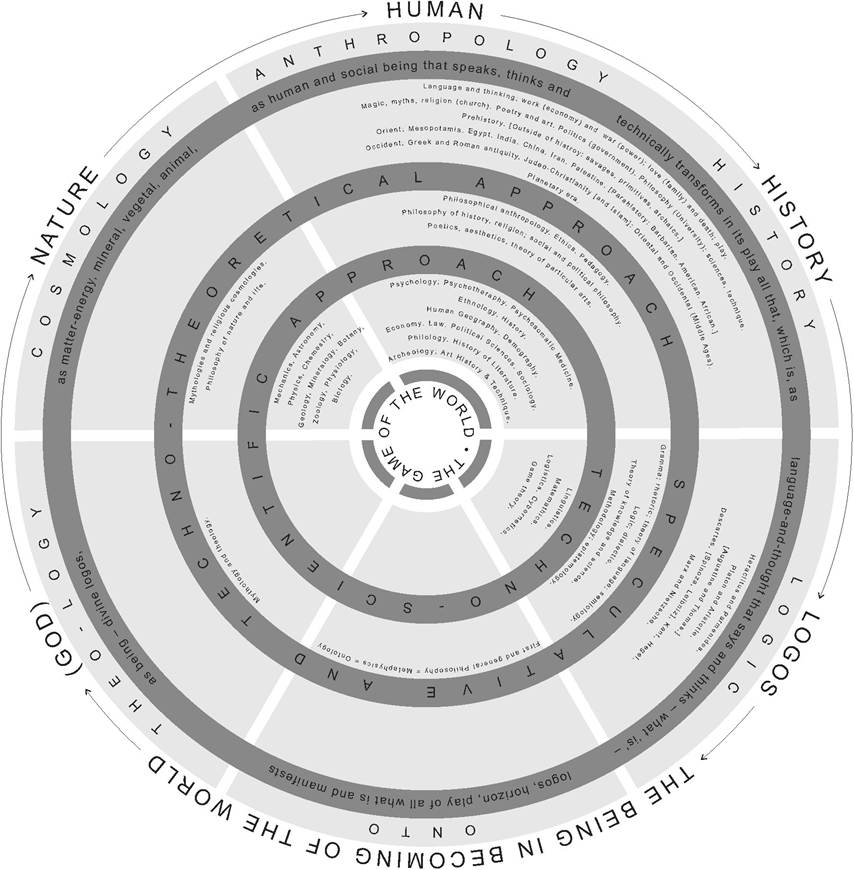
The play of errancy, taken over by knowledge, must be understood, not without irony and humour, in its unity, its duality, its trinity, its multiplicity, its totality - angular and global - its ‘circularity’, its spiral.
The error has been considered almost as a moment of truth, the un-true (the false) passing into the true (Hegel). The truth has been considered as a genre of error, the true passing into the un-true (Nietzsche). It remains for us to consider errancy as the opening, in which appear the truths, figures which correspond to it, and the errors, figures which move away from it and move apart.
What was and is true was and is held as and recognised as true by ordinary mortals and by superior humans. We remain in this optic even when we write and think that ‘The truth is in its essence untruth’ (Heidegger).
Does not the play between truth and lie resemble a battle of darknesses in a dark tunnel?
What corresponds to errancy should not be understood as another type of ‘truth’.
size=2 color=black face="Times New Roman">Never has there been an anteriority of truth to all the means of its errant inscription.
Know how to greet, whenever you can afford it, what liberates (us) (from) the error dressed as truth.
Certain fair and flat truths are far less effective than certain forceful and flamboyant errors.
Truth, a triumphant and weakening figure of errancy, a symbolic function of it, can let us sense that errancy - which itself is also a symbolic function - and manifests itself and conceals itself only through this truth and these truths. The problem of the hierarchy of its truth and truths can only remain gaping; only particular, oriented and perspectivist, functional and operatory hierarchies can be established.
Ferments and catalysts reveal the truth, namely what is recognised or misrecognised as such by eliciting adhesions and polemics.
From truth to truth, we discover little by little the errancy which abolishes a good number of errors.
Errancy lets us comprehend that the truths of the past were errant.
For almost two and a half millennia, one tries to think the truth. The task imposes itself: to think fiction, is it still too arduous?
Do error, fault, injustice, crime, sin, guilt consist in a certain isolating separation, an insolent particularisation in regard to logos and physis, God and other humans?
Error and lie are - voluntarily or involuntarily - what does not correspond to the deployment and unveiling of errancy, what falsifies it or conceals it, what disguises it, even though they always express it in a distorted form.
The arcana of errancy are to be explored concretely, judiciously and meticulously.
The deployment of errancy is not just the movement of a planet whose orbit is fixed, calculable and known.
The errancy of the world is installed, arranged, inhabited, in the course of the errancy of the human that also knows dwelling.
The ludics of illusion, empirical and transcendental, is transfiguration.
Where does one encounter reality? Are we not always grappling with the res that themselves make arise the nothing from which they arise? Why is it the accusative of the word res in French that gives the nothing (rien)? How to separate and/or unite things, words and thoughts? Would reality be a mode of being and grasping, in the dimension of presence, representation, experience and objectivity (that also encompasses subjectivities), effected by the practical and theoretical activity of objective subjectivity? Through where passes the dividing line between what is real and what is not? To what extent, when, where and how, are thoughts and dreams, words and visions, part of reality? To think, to dream of a large glass of water, to say it and to see it in imagination, does not accord it with reality for whoever is dying of thirst. On the other hand, several soft or violent thoughts, reveries, words and visions really change the face of the world.
From what threshold did they become real? Is the difference between being and existing real? How to apprehend unreality? Weren’t angels and demons for centuries as angels and demons said, painted, carved, experienced as real? To say that everything is real, including phantasies and phantoms, would be the equivalent of saying that nothing is. Would real be what is active, acting, forming and transforming? In what space, what time and for which worlds? Reality, really, as well as truth, truly, couldn’t they indicate problematically what corresponds to the errancy of being in becoming, in time and in times?
A very large part of what is called external reality is constituted through our projection. Correlatively, the most interior and intimate reality is constituted through the introjection of natural and social powers acting as from the exterior.
For a long time, humans thought and believed that what they were calling reality - since the Latins - was mostly resistant and frustrating; they will realise, little by little, that imagination is no less so.
Is not the belief in the sensible, empirical, material, objective immediately given or constructed reality, thanks to techno-scientific mediations, part of the myth and the imaginary of modern humans?
What humans call reality is one with so-called symbols and what are also called signs and significations. All signals include diverse variables, fill several functions, and are to be interpreted multiply. And humans always ‘think’ that reality is elsewhere.
Sincerity consists in the correspondence to errancy: to say what one thinks and does, to think what one says and does, to do what one thinks and says.
Truth and reality are supposed to be common and universal. They are part of everything it takes to make a world - if it takes everything to make a world, until the end of the world.
The two aspects of the world, sensible matter and suprasensible and intelligible truth, are caught in errancy from their separated and conjugated appearing in the nascent philosophy and despite their intentions. In the Platonic Timaeus matter is called errant cause and in the Socratic Cratylus the truth is designated as divine errancy. Plato went so far as to speak of a true lie.
The world, both ontologically and gnoseologically, has been seen as unique (spirit or matter, thought or empirical experience) and double (dualism). The problem thus posed is inextricable and lacks precise formulation. Unity comes up against a certain dualism: in what is and what we grasp (being and knowing). Dualism comes up against the unity that seems to encompass everything. And there is no middle way. The oppositions appear to us effective: between the sensible and the intelligible, the senses and the sense (signification and direction), the empirical and the metaphysical (transcendent and/ or transcendental), the physical and the moral, the soul and the body, the innate and the acquired, the theoretical and the practical, the interior and the exterior; each being and each thing project something like their double. They manifest on several planes. Not privileging one of the two terms that call the other can still be done. But to abolish or to overcome duality itself, without spiriting away the problem and without dialectical prestidigitation, to unite the two poles of dialogue, is it thinkable and feasible? Sometimes we think yes, sometimes we think no. We can certainly tell ourselves that the pendulum movement takes place on the same clock, but we cannot get out of the circle. Perhaps it would be necessary then to enter it resolutely and see how it turns. For all global thought is and remains circular, as if That itself, its regions and our access to it were and remained circular.
Yet none of the five positions is satisfactory. Each of them, however, is very tempting. Reducing everything to the movement and complexities of matter, sense or reality, from the origin of all that is to ourselves and all that concerns us, is tempting. To seize everything in terms of ‘ideals’ is no less so. Great also is the temptation of dualism, of the binary structure that separates and unites, and no less great is the call of unity containing - somewhat problematically - the diverse modes of being and making different worlds that communicate (how?). Finally, circularity offers and imposes itself on us and carries us along as it carries everything in its movement. Human thought and experience pursuing each of these schemas and paths, and all at the same time, always get into an impasse, nevertheless effecting a passage and sometimes a jump.
All materialism, realism, positivism is underpinned by idealism, which is one of its configurations. Idealism and romanticism crumble; at the same time every ideal falls: ideal of an ideal and real truth, ideal of a knowing speaking being, ideal of the ideal man or woman, ideal of an ideal life, ideal of an ideal society - it would call itself real - ideal of ideal poetry and art. But to the idealism suppressed, erased, deleted, barred, crossed and crucified - sign that indicates the cross that we put on every cross, the four dimensions of the horizon and the unknowable x - necessarily corresponds to the conjoint suppression of realism, particular reading of the ‘real’. Dualism opposed them; the two poles must fall. Where to? Idealism - with mythology, religion, poetry, philosophy - enlightened one half. The other total half? And - at the beginning of a new decentring - ontological, epistemological, ethical unity?
Are not all speculative thought, all mysticism, even that of empirical practice, all high poetry, tearing away from the sensible, idealist team? Is not language itself already, as such, at once a sensible activity and an idealising action? The fact that the world and its diverse aspects can be said, thought and practised, thus or otherwise, bears all the inversions of signs, does not change anything of this unbearable intertwining of the two ‘halves’ of the ‘totality’, its two manners of being unitary.
The subject-object relationship is not sempiternal. In the eyes of the Greeks, there are beings and phenomena (manifestations and appearances') of the cosmic and divine physis revealing themselves and remaining invisible through and in the logos, the δντα and the φαινόμενα, the forms of what is, its visages and faces through which we think, the ideas, and the products of human activity, the poetic and practical techne, the erga, which inscribe themselves in the same rhythm of the being in becoming of logos and of the physis (not created and eternal) to which they do not do violence. The Greek world does not know the subject-object split. Υπο-κείμενον is the foundation, the substratum; what has become subjectum then is, for the Greeks, infinitely more ‘object’ (non-objective) than ‘subject’. It is with the Romans that the notion of res enters the scene. From now on, the (human) persona opposes res. Thus personalisation and reification, the rights of the person and the res publica are born simultaneously and conjointly. But the Romans do not confront objects. In the Hebraic-Christian and, subsequently, rather Christian perspective, there emerges the conception of what is as ens creatum. The world is the ensemble of entia creata, created ex nihilo by God (supreme creator) and dedicated to the final Apocalypse and/or Redemption. In this perspective, a new project comes to light, an unprecedented task: to struggle against created nature to make the eternal Spirit triumph. Humans, creators within Creation, can ‘create’ entia, because even in creating they recreate, populating the earth with new creations. They march for the dominion of the earth, fulfilling the plans of providence. It is only with European modernity that the position of the subject and the object - and their opposition - enters into the world and upsets it from bottom to top. Descartes is the founder of this theory and this reality of (intimately linked, if not indissoluble) subjectivity and objectivity. In this dualism are caught: the subject, the ego cogito, the foundation of what is and does, and the object, the res extensa, the things that face us, that we grasp and shape. The two poles of this relation are, strictly speaking, the res cogitans (the thinking and active subject being comprehended both as subjectivity and as thing) and the res extensa (the field of the theoretical and practical activity of the human, the world as an object). The face of what is faced (Gegenstand) loses itself and sharpens itself in becoming an apprehended object (Objekt). Philosophical thinking, science of nature and history, technics engage in the conquest and transformation of the world. The modern epoch is the epoch of subjectivity (Cartesian ego, Kantian transcendental self, absolute and spiritual subject in the Hegelian optic, objective, material and socialised subjectivity in the Marxist view) and, at the same time, the epoch of objectivity (of objectification, the grasping all that is as object for a subject, of realism and reification). For the foundation of objectivity is nevertheless (objective and human) subjectivity and its objectives. The subject and the object depend on each other, can reverse their roles through the fact that a subject can make another subject an object, etc., and the question of their foundation remains open, is not even explicitly posed. Modern and European thought and technics surpass the confines of the Occident: they put the whole planet into motion, ideologically and technologically invading every region of the globe. Humanity wants to pose as a subject and as an ensemble of freed and free subjects, to rationally dominate and economically exploit the totality of the so-called objective world. All humans aspire to subjectivity, all things are caught in the nets of objectivity. This march, when it has reached its goals and when these will be realised and generalised - at the level of individuals and at the level of socialisation - will lead nevertheless further.
We are already on the threshold of a new epoch: the planetary era. It mondialises what is and what produces itself, unifies - through technics - the globe, throws humans and things into a becoming that, to tend to universalisation and globality, is no less errant and does not exclude platitude. The earth, an errant star, becomes in its ensemble the theatre of human activity, and planning and planetary technics seems to launch itself on the conquest of the universe. The links between subjects and objects become inextricable, precisely because all humans aspire to become subjects making all beings objects. Everything is caught in this play of mirrors between the subject and the object that reflect each other; no one can distinguish between what is and is received, what is put into and interpreted into. Is there still external or internal evidence, or a place of their encounter? The circle of hermeneutics, analytical, synthetic, explanatory, comprehensive and everything one would want, keeps us glued to it and prevents us from stopping time. In this total becoming, both the subjects as subjects, as well as the objects as objects, and the opposition subject-object enter the phase of their radical transformation, their suppression, their supersession. Everything consolidates and liquefies itself (at once), everything is caught up in the cycle of production and consumption, fabrication and usage, planning and annihilation. In language and literature, in science and painting, in politics and in everyday life, we are already witnessing - by participating in - this process of surpassing the subject and the object. Another worldliness appears and is produced, beyond subjectivity and objectivity (of an idealist or realist type). The productive dialogue between the being in becoming of the human and the being in becoming of the world - through the annihilation of old entities and the strange production of new structures - begins to unfold itself in a new horizon.
Production, consummation and consumption allow the human to accord itself to the world. If the destiny of the world is a ‘useless’ and unlimited accomplishment, the human - limited being, acquiring, expending and squandering all kinds of riches - is the player and plaything of this accomplishment for nothing. Subjects and objects going towards what will surpass them, will we soon see subjects without consciousness and a consciousness without subjects, a consciousness no longer having anything for object?
The problem of the limit invites us to crossings and keeps us nailed on the spot.
Distinctions, genera, species, cases, modalities, entities, in their ontological and methodological imbrications and differences, pose delicate problems.
What is cause and what is reaction? How to unravel in entanglement, other than in an operational and functionally segmental fashion? The search for causality remains affected by a coefficient of culpability: one wants to track down, liberate or domesticate the culpable or capable cause. In this and that, in the slippages of sense, a certain finality pursues its path, rushing through and getting caught in the nets of the rules of the game.
The secret or complete causes of things slip away to make place for operative apprehensions and effective calculations.
Knowing above all effects and results, we bring back to the causes the certainty concerning them.
Causality uses many determinations. The relation primes the cause.
In a still simple schema of causality, A acts on B and B on A. A and B act on each other and both on a first and a third product that acts and reacts on them. In the schema of causality, the complementary and circular path, marked by the interaction of fields, functions and multiple variables, is treated with more than just neglect.
The analysis of the play of determinations is inexhaustible. In the bundle of causal explanations and comprehensive interpretations, how to determine the most determining factors?
Let us suppose that a cause determines an effect, which, in turn, is the caused becoming the causing, and determines a third product: is it caused by the first cause or the effect becomes cause (insofar as one can isolate them)?
Only one possibility of the fan is realised? Where are and what becomes of unrealised possibilities? If the possibility is what renders possible its actualisation, what can then indicate, if they exist, the unrealised possibilities?
The possible is a way in which the present comprehends the past: it constitutes what was necessary and effective.
At the heart of what is, making a sign towards what is not, in the melee where the possible manifests what renders possible its actualisation and the possible which does not actualise itself, stands the impossible hoping against all hope.
There are always certain possibles that are realised and combined, others finding themselves excluded.
Chance - with or without quotation marks - remains troubling in the eyes of whoever envisages it without losing sight of necessity and probabilities.
The play between the necessary and the arbitrary - to diverse readings - loses itself in the arcana of its own constructions. The same goes for chance and destiny.
Chances - encounters - strongly resemble necessities.
Quantity and quality belong to what is. Does quantity change into quality, even when it extends its grip - quantitatively? Is the combat between the quantitative and the qualitative a question of quantitative or qualitative debate, if the distinction can be maintained?
Everything is relative, conditioned, determined, circumstantial, situated, depending on its place and time and on the point of view according to which one envisages it and, at the same time, everything is, in all its fragmentarity, absolute, partially absolute.
Go recognise yourself in the muddled game of the ‘essential’ and the ‘occasional’ that mutates the one into the other.
Chase this or that; it returns at a gallop.
What are the principal figures of the play of That? Evidently, God, nature, the human.