The Gap in Play Scholarship
Although well known and highly regarded by French thinkers, and presenting the most voluminous12 and in-depth treatment of the world-in- and-as-and-through-play of all the French, German and English thinkers, Axelos’s work has to date been almost entirely ignored by the vast English scholarship.13
(Berlin: Weidmannische Buchhandlung, 1903), 66-84.
Gunter Wohlfart dedicates a whole book to this one sentence and its significance for Nietzsche: Gunter Wohlfart, Also sprach Herakleitos: Heraklits Fragment B 52 und Nietzsches Heraklit-Rezeption (Freiburg: Alber, 1991).8 In his study on Heraclitus, Axelos traces him through the history of Western and Eastern thought to pose the dichotomy as a Western construct: Kostas Axelos, Heraclite et la philosophie: La Premiere Saisie de l’Etre en Devenir de la Totalite [Heraclitus and Philosophy: The First Grasp of Being in Becoming of the Totality] (Paris: Editions de Minuit, 1962).
9 Eugen Fink, Spiel als Weltsymbol (Stuttgart: Kohlhammer, 1960).
10 Eugen Fink, Le Jeu comme Symbole du Monde, ed. Kostas Axelos, trans. Hans Hildenbrand and Alex Lindenberg (Paris: Editions de Minuit, 1966).
11New Roman"> Eugen Fink, Play as Symbol of the World: And Other Writings, trans.
Ian A. Moore and Christopher Turner (Bloomington: Indiana University Press, 2016).12 Axelos’s French work on play unfolds on about twice as many pages as Fink’s German work on play.
13 Only two influential major studies on play briefly address Axelos’s play. One mentions Axelos in a note: Mihai I. Spariosu, Dionysus Reborn: Play and the Aesthetic Dimension in Modern Philosophical and Scientific Discourse (Ithaca: Cornell University Press, 1989), 127, n. 77. Likewise, the second mentioning keeps Axelos mostly in notes: Brian Edwards, Theories of Play and Postmodern Fiction (New York: Garland
Yet - despite this patent absence - Axelos nonetheless exerts an occult influence on a range of play scholars. For example, about a decade after the first publication of Le jeu du monde, James S. Hans published a book that echoes Axelos’s title: The Play of the World.14 Although Hans traces theses regarding play in Deleuze, Derrida, Hans-Georg Gadamer (a colleague of Fink and Heidegger) and, indirectly, in Heidegger to Nietzsche,15 he seems unaware of its Heraclitean lineage and the kinship of his work with that of Axelos. Despite this lack of any direct nomination of Axelos, Hans cites such collections as Game, Play, Literature, which of course include Axelos’s contributions.16 Even Mihai Spariosu, who traces the concept of play in most of the aforementioned authorities - including Nietzsche, Fink and
Publishing, 1998). While Edwards places Axelos correctly among Ehrmann, Fink and Hans (ibid. 21; 34, n. 23), he errantly argues that Axelos does not separate ‘game and play’ and is ‘similar in approach to’ the dramatist of German idealism Friedrich Schiller (ibid.
32, n. 8). The sameness between ‘game’ and ‘play’ is meaningless due to Edwards referencing two English translations of two texts by Axelos (ibid. 277) originally written in French, a language like German that has for both ‘game’ and ‘play’ one word: jeu (and respectively Spiel). Presenting Axelos’s play within the German idealism of Schiller, who derives his concept of play as a synthesis of opposing drives from synthesising Kantian play and Fichtean drives (see Friedrich Schiller, ‘Briefe uber die Ssthetische Erziehung des Menschen’, in Lektionen 1: Dramaturgie, ed. Bernd Stegemann (Berlin: Theater der Zeit, 2009), 270-3), misses that it is precisely the project of Axelos’s play to overcome such - idealist as well as materialist - dialectics.14 James S. Hans, The Play of the World (Amherst: University of Massachusetts Press, 1981).
15 See for a study that identifies play as a key Nietzschean contribution: Eugen Fink, Nietzsche’s Philosophy, trans. Goetz Richter (London: Continuum, 2003), 171. As an example of Nietzsche’s playful influence, note the aphorisms throughout the following seminal meta-study on play: Brian Sutton-Smith, The Ambiguity of Play (Cambridge, MA: Harvard University Press, 2001).
16 Hans, The Play of the World, 201, n. 1. See one English essay taken from a book by Axelos appearing in a work edited by Ehrmann and another one in his remembrance: Kostas Axelos, ‘Planetary Interlude’, in Game, Play, Literature, ed. Jacques Ehrmann, trans. Sally Hess (Yale French Studies 41, 1968), 6-18; and Kostas Axelos, ‘The Set’s Game-Play of Sets’, in In Memory of Jacques Ehrmann: Inside Play Outside Game, ed.
Michel Beaujour, trans. Beverly Livingston (Yale French Studies 58, 1979), 95-101. Hans (The Play of the World, 76) asks what happens when ‘we say our book on play is nothing more than an attempt to imitate Gadamer, Derrida, Deleuze and Guattari, Nietzsche, and so on, as far as we are aware of our imitative lineage’. Considering the silence regarding Heraclitus and Axelos in the light of Hans’s title, his awareness of the French thinkers of play, Fink’s and Ehrmann’s book on play, and their lineages, must we conclude that Hans’s book on play unconsciously imitates Axelos’s book on play obscured in the ambiguity of an and-so-on?Heidegger in their consideration of Heraclitus - only acknowledges the existence of Axelos’s contribution in a note.[8] Axelos’s book on the play of the world, a notion that lies at the heart of Spariosu’s own approach, eludes him. It is rare to find English scholarship locating Axelos in the proximity of play philosophy, as briefly done by Ian Moore and Christopher Turner in the introduction of their 2016 Play as Symbol of the World translation.[9]
Axelos’s treatment by English play scholarship cannot therefore be simply due to ignorance, absence or irrelevance. Perhaps, then, its insistent obscurity is in part because - as the reader of this work will very rapidly acknowledge - Axelos’s work moves ‘diagonally’ to the best determined aspects of this situation.[10] As part of the Greek resistance during World War II, Axelos had to flee his homeland due to having been sentenced to death by the emerging rightist government.[11] Fleeing in 1945 on the Mataroa, with other left-wing intellectuals such as Cornelius Castoriadis, Axelos, who was also fluent in German and French, arrived in France. He then undertook research at the Sorbonne, as well as at the Centre National de la Recherche Scientifique and at the Ecole Pratique des Hautes Etudes.
Despite his own training and teaching in the prestigious research centres of Paris, Axelos himself admits that he was not very academic; or, at least, that it was not the academic milieu and training that provided the key impetus for or aims of his interests.
He was an important contributor to the post-World War II intellectual milieu in France - which is now almost universally acknowledged as one of the great epochs in recent philosophical thinking - where he became familiar with such figures as Roland Barthes, Georges Bataille, Jean Beaufret, Gilles Deleuze, Jacques Lacan and many others. He was one of the editors of the important journal Arguments, which, following its closure, he then parleyed into a famous and influential series for Les Editions de Minuit. He continued to write and publish extensively up until his death in 2010.Yet it is above all for his work on games and play that Axelos’s intervention must be counted. On this point, Deleuze is clear: ‘From the outset of his < cuvrc, Axelos has taken this concept of play to the highest point.’[12] Against this, many influential works on play seem content to approach play through fragmenting it into games and rules in the world,[13] dissociating play from reality,[14] or disjoining ‘free’ from ‘regulated’ play.[15] But fragmentation and separation only bear upon a total partiality of a partial totality, and miss the play of the world that is not simply one moment, instance, act or modality of play among many, with rules imposed from an outside. It is Axelos’s contribution to pronounce the play of plays that binds fragmentation and separation through deploying itself in the world precisely as heterogeneous kinds of games and various modalities of play. Perhaps the most important point to emphasise here is that ‘the game of the world’, as ungrounded totality of all that takes place, is not one game or play among others, but is productive of all such differences without ever being reducible to any one of them. In being so, the latter - regional games, varying rules, this or that activity of play - are nonetheless paradoxically articulated by the game of the world in a non-reductive fashion.
We shall say more about this extraordinary conception below.Moreover, while the theme of play reappears throughout Axelos’s multilingual body of work, it is this magnum opus, Le jeu du monde, that fully engages the ‘theme’ on all registers. The book thus plays the key role in his
The Unfolding of the Game
The Unfolding of Errance
Contribution to Logic
(1977) The Unfolding
of an Investigation
Heraclitus and Philosophy (1962)
Arguments of an
Investigation (1969)
Marx, Thinker of Technique (1961)
border=0 cellspacing=0 cellpadding=0 style='border-collapse:collapse'>Toward Planetary Thinking (1964)
For an Ethics of Problematics (1972)
Problems
at Stake (1979)
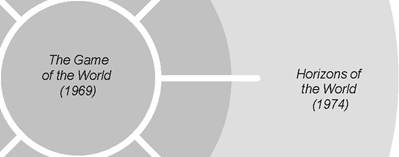
Fig. I.1 Axelos’s Le jeu du monde at the centre of his trilogy of trilogies.
oeuvre, indeed occupying the centre of his work, of which the main body forms three trilogies. Each trilogy names a specific unfolding, deploiement, which together position Le jeu du monde as the second volume of the second trilogy and thus as the fulcrum of Axelos’s key writings (see Fig. I.1).
As should already be evident, Axelos’s work intervenes into a very complex and crucial twentieth-century intellectual situation in which the question of games and play came to occupy the very centre of thinking, if according to quite heterogeneous - even antagonistic - projects and references. Here, we will indicate five key tendencies: the phenomenological, the sociological, the psychoanalytic, the analytical-ethical and the cybernetic. This quintuple is self-evidently neither extensive nor exhaustive, but it can perhaps serve to outline some of the most important features of a complex general context that bears upon Axelos’s own specific contribution to the thinking of the nature of games and play.
More on the topic The Gap in Play Scholarship:
- Strengths and Gaps in the Current Scholarship
- CONCLUSION
- THE CHALLENGES THAT LIE AHEAD
- Background and aims
- Anathema and Inspired Speech in 1 Corinthians 12:3 and 16:22
- Fact or Norm? Founding Moments Envisaged in Constitutional Theory
- CHAPTER SEVEN Francis Bacon
- CONSTRUCTIVISM AND CONFLICT ANALYSIS
- DIRECT INTERVENTIONS IN MODERN TIMES
- Independence from political decision makers