Vague Objects
So far we have made little progress in elucidating the idea of a vague object. Even if it turns out that the notion of a vague object is conceptually basic, it would still be nice to have some sort of independent test for objectual vagueness that might placate those who insist that the notion is too obscure to theorize about.
In the following, I shall rely on the fact that we have a reasonably firm pretheoretic handle on the distinction between vague and precise properties.
Unlike the somewhat murky objectual notion, the difference between, say, the property of being bald and the property of having 2,330 hairs or less is manifest to anyone familiar with the phenomenon of vagueness. In that spirit, one might propose the following test for being a vague object:Objectual Precision: An object x is precise if and only if Fx is precise, whenever F is precise.
More informally, a precise object is one that converts every precise property into a precise proposition, whereas a vague object converts some precise property into a vague proposition.[189] (The test is most intuitive when we focus on properties— functions of type e → t—but in practice it is sometimes convenient to test for vagueness with functions from e to other types.)
Objectual Precision is a consequence of the account of vagueness at higher types I proposed in section 16.1. To show the left-to-right direction, suppose that o is a precise object, and let F be any precise property. Our definition of property vagueness says that F is precise only if it maps every precise object to a precise proposition. Since o is precise, so is Fo.
To show the right-to-left direction we shall show that if o is vague, then there is some precise property that converts o into a vague proposition (a precise property F such that Fo is vague). This direction requires the (by this point uncontroversial) assumption that there is at least one vague proposition H—the proposition that Harry is bald, say. The argument can be given a model theoretic justification, if we assume that the domain of the type of properties is full: for any function f from individuals to propositions there is a corresponding property F—a property such that for any individual a the proposition that a is F is f (a). Just consider the property F, corresponding to any function that maps each precise object o' to some precise truth, such as the contradiction ⊥, and which maps the vague object o to some vague proposition, H. It follows by our theory of property precision in section 16.1 that F is precise, since Fo' = ± and is thus precise, whenever o' is precise. It also follows that Fo is vague since Fo = H. (Turning this into an argument in the object language argument is a bit delicate, but can be done under reasonable assumptions.16 17)Our principle brings to salience an obvious question. Given that we can identify the precise objects once we know which properties are precise, it's natural to wonder whether we should be taking property precision as basic instead of objectual precision, as we did in section 16.1. Indeed, it's technically possible to reduce everything to property precision, since a proposition p is precise if and only if the constantly p function, λx.p, is a precise property. With objectual and propositional precision defined, precision at all other types follows as in section 16.1.17 Be that as it may, such a reduction is not forced on us. While Objectual Precision maybe a convenient way to explain the notion of a precise object to someone who has the notion of a precise property, this is not necessarily the direction of reduction.
We can now check that our test delivers the correct verdict in the case of Mt Kilimanjaro.
The property of being exactly 19,341 feet tall is precise, for example, yet applying this property to Mt Kilimanjaro delivers the seemingly borderline and, thus, vague proposition that Mt Kilimanjaro is exactly 19,341 feet tall. It follows by Objectual Precision that Mt Kilimanjaro is not a precise object.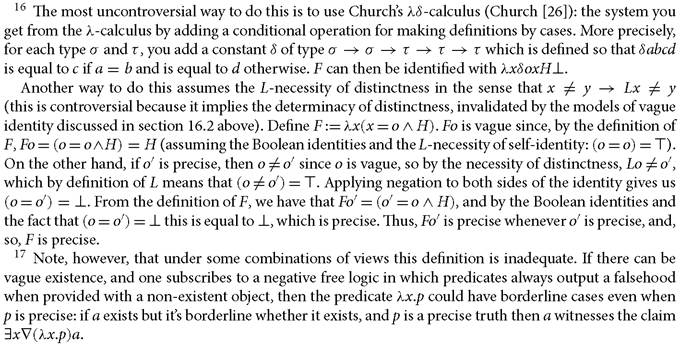
We established this by appealing to a particular precise property. We shall now see that many of the cases of interest discussed in section 16.2 turn out to be particular applications of our test. Identity is a logical relation and so, presumably, a precise one. It follows that if there were vague identity statements, there would have to be vague objects, vindicating Evans' claim that the existence of vague identities is at least a sufficient condition for the existence of vague objects. To establish this, recall that a binary relation such as identity is represented by an element of the type e → (e → t), taking an individual x to the monadic property of being equal to x, which we write x =. If the object x is precise, it follows, by Objectual Precision, that the property of being equal to x is precise (letting F be the identity relation mapping x to x =). Since x = is precise, it follows that, whenever y is precise, x = y is also precise, applying the test again. And so, finally, if every object is precise, the proposition that x = y is precise for every x and y. Contraposing, we get that if there is a vague identity statement—an x and y such that x = y is not precise—then there is a vague object (either x, y, or both). By completely analogous reasoning we can also establish that if there is a vague parthood statement, there is at least one vague object. Here, we rely instead on the premise that parthood is a precise relation. Indeed, most of the features connected with vague objects—having a vague location, or a vague boundary, or a vague height, and so on—can be seen to fall out as applications of our test, for locative properties and properties to do with boundaries and heights are plausibly precise.
A little care is needed when evaluating the claim, asserted above, that parthood and identity are precise relations.
It is common in this literature to talk as if the considerations we've raised about Mt Kilimanjaro and other vague objects can be seen as establishing that the parthood and identity relations are vague. Note, by contrast, that most would consider it a mistake to conclude that conjunction was vague from the observation that there are vague conjunctions. The proposition that Harryis bald and tall, formalizedp ∧ q, is vague not because conjunction is but because the arguments p and q are. Conjunction is a binary relation between propositions, but we also make similar distinctions for properties and relations that operate on type e. We similarly don't conclude that the property of being exactly 19,341 feet tall is vague, from the vagueness of the claim that Mt Kilimanjaro is exactly 19,341 feet tall. By parity of reasoning, we should not conclude that parthood is vague from the vagueness of the proposition that a particular rock is part of Mt Kilimanjaro, or that identity is vague from the vagueness of some proposition stating the identity of two objects. The most we can conclude is that the source of the vagueness is either in the identity or parthood relation or in the objects flanking the relation. But given that our putative examples of vague identity and parthood statements seem all to involve apparently vague objects, the conclusion that identity and parthood are vague relations is not substantiated. Talk of‘vague identity' and ‘vague parthood' in this context are thus a bit of a misnomer—this way of talking might more accurately be replaced with talk of vague identity statements and vague parthood statements.As I warned at the beginning of the chapter, one question I have not attempted to answer here is whether there are any vague objects. Indeed, I suspect that the answers to these questions will involve engaging in some substantial metaphysics—it would be too much to expect the answers to fall out of a general theory of vagueness of the sort I have been attempting to provide here. What I have offered, however, is a framework in which one can sensibly raise the question of whether vague objects exist; this is something which the linguistic theorist, by contrast, has not succeeded in doing.