Vagueness and Decision Theory
Let me begin by outlining a standard formalism for representing an agent’s beliefs, desires, and decisions—decision theory a la Jeffrey [73].
According to this framework each consistent proposition, A, is assigned a real number, V (A), that represents the expected value (sometimes called the news value) of A. Roughly, V (A) measures how positively you regard things to be on the supposition that A. At an initial parse, to evaluate V (A), one first supposes that A is true, and then attempts to quantify how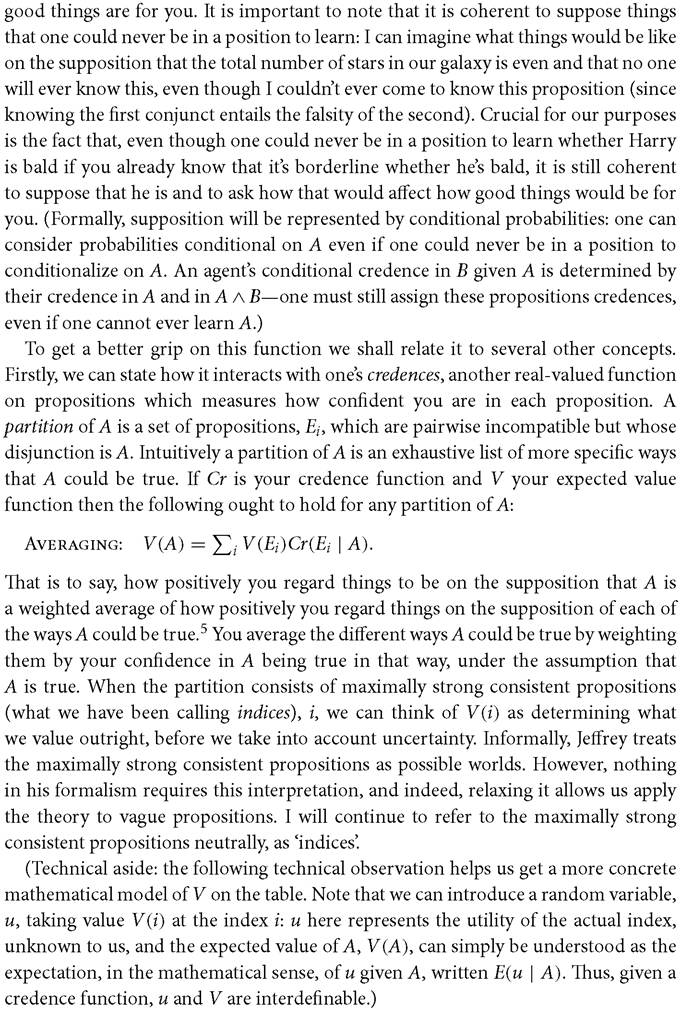
[1] When uncountable partitions are in play, we must use a generalized kind of integration; I shall set these technicalities aside.
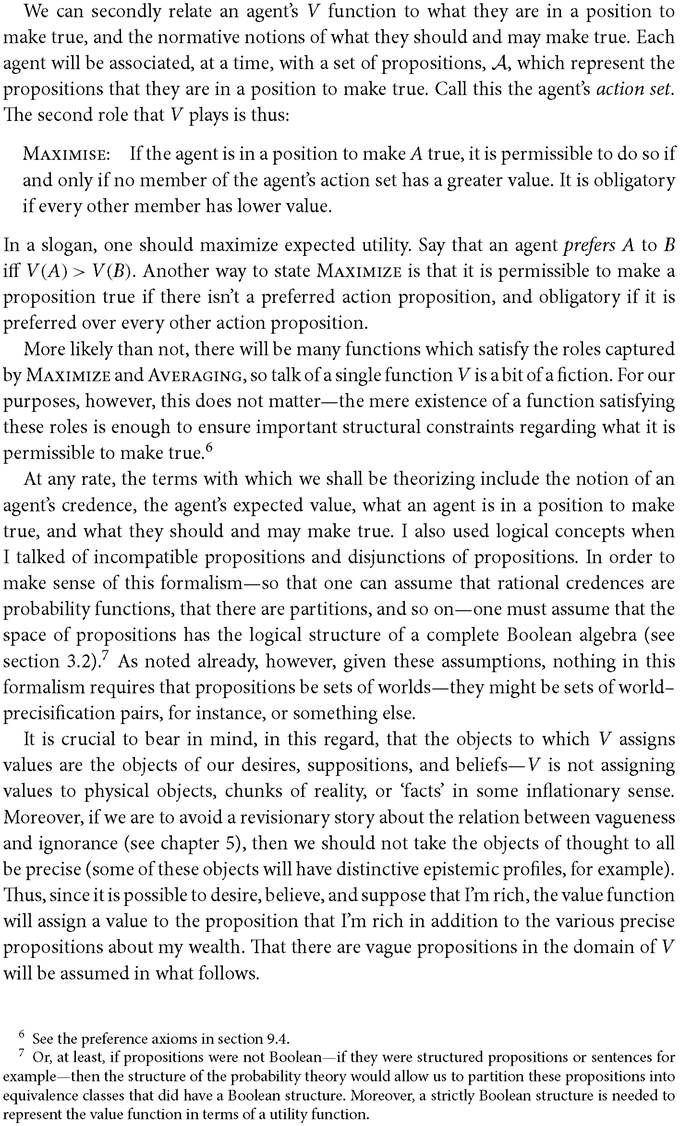
Someone who endorses Practical Irrelevance within this framework, then, should not take exception to the idea that we can assign values to vague hypotheses. The thesis is rather that these values are utterly otiose. While one can sensibly ask how good things seem to be for me on the supposition that I’m rich, this value is redundant for the purposes of decision making since one could as easily explain my actions in terms of my suppositions, beliefs, and desires in the precise. There are precise propositions about my wealth whose values are, at a more basic level, guiding my actions. Knowing an agent’s values, and perhaps also their credence, in each precise hypothesis is all that we need to explain their behaviour, and all that they require to reason practically.
9.2