Appendix 2.1: Alternative ways for the modeling of LDSs
The operationalization of the conceptual and interpretative framework for SHD at the local level requires moving beyond standard analytical methodologies. For instance, Schmiedeberg (2010) underlines how econometric methods (such as difference-in-difference), and particularly spatial econometrics, can quantitatively test the effects of local development policy.
For instance, Taylor (2012) designs a simulation method based on local general equilibrium effects - Local Economy-Wide Impact Evaluation (LEWIE) - in order to capture the full impact of government programmes and exogenous shocks on local economies.However, data requirements and methodological standards are high, and often fail to take adequate account of soft factors (Maggino and Nuvolati, 2011). Moreover, in cases of territorial differences and place-based processes, econometric estimates regarding firms' performance or people's well-being (among other things) may be biased if multilevel analysis is not conducted.
Without any intention of exhaustiveness, the aim of this appendix is to briefly introduce six methodologies for alternative ways of modeling that can help make the STEHD framework advanced in this book operational. These methodologies share a common feature: flexibility. Furthermore, they can introduce qualitative variables as explicative determinants, as well as, for the first two methods, descriptive factors as an integrated part of modeling. Nonetheless, applying these methodologies may require specific statistical assumptions and is demanding in terms of time and resource, especially if data needs to be collected.16
Agent-Based Modeling and computational economics
Agent-Based Modeling (ABM) and Simulation (ABMS) is a relatively new approach to modeling economies as complex adaptive systems in systemic and non-linear analysis. These systems are composed of interacting, autonomous “agents” who interact with and influence each other, learn from their experiences and adapt their behaviours so that they are better suited to their environment (Nelson and Winter, 1982; Lombardi and Squazzoni, 2005; Macal and North, 2010).
Such models are able to simulate systems including heterogeneous agents (in terms of perspectives, knowledge, capabilities) with bounded rationality and adaptive behavioural patterns within fluid or turbulent social conditions and collective structures (Axelrod, 1997; Tesfatsion and Judd, 2006).The application of ABM to LDSs provides a useful analytical tool for investigating territorial evolution and for understanding mechanisms and processes relating to local development and institutions that enable capability expansion (see for instance Brenner, 2001; Lombardi, 2003; Lombardi and Squazzoni, 2005).
According to Andersen (1994), the main epistemic assumptions of ABM are as follows:
1) Agents have incomplete information and tend to satisfy local rather than global optimality criteria.
2) Systemic institutional causes limit the decision-making processes.
3) Imitation, learning and creation of novelty are fundamental processes.
4) Path dependence, together with potential discontinuity traits, shape dynamic processes.
5) Interaction among agents and disequilibrium are strongly interconnected.
6) The dynamic results that ensue are non-deterministic, open and irreversible.
Data Envelopment Analysis
Data Envelopment Analysis (DEA) is a flexible non-parametric mathematical model for the management and assessment of the technical efficiency of social organizations in relation to their size and resources. Key advantages of this technique include a multi-input/multi-output approach, indifference to the measuring unit of the considered variables and avoiding specific ex-ante assumptions about the shadow prices of inputs and outputs (Charnes et al., 1978). Bellucci et al. (2012) utilize DEA for the calculation of a "sociocultural efficiency frontier” going beyond the standard economic frontier, while Binder and Broekel (2011) have applied it in relation to individual conversion factors and functionings within the CA.
The first model introduced by Charnes et al.
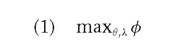
(1978) takes the form of constant returns to scale and is often called the "CCR model”. A subsequent model developed by Banker et al. (1984) allows for variable returns to scale and is known as the "BCC model”. Both allow for the identification of efficiency frontiers from observations of the considered dataset. The determination of the efficiency measure for each of the n production units in a sample involves the solution of n linear programming systems, whose orientation is dependent on the type of efficiency we want to assess: "input-oriented efficiency” is used to measure the ability to compress input while maintaining a constant output; "output-oriented efficiency” is used to measure the capacity to expand output without reducing inputs.17As regards to the output-oriented version of the BCC model, it is possible to write the maximization problem in the following way:
Under the constraints: 
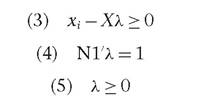
with 1 < 0 < to and 0 — 1a scalar representing the proportional increment of output that the z-th decision-making unit could achieve maintaining constant inputs; k representing a N x 1 vector of constants; x representing the input data matrix; and Y the output data matrix.
Consequently, the technical efficiency score is defined by 1/0 and can vary between 0 and 1.
Social Network Analysis
Social Network Analysis (SNA), rooted in graph theory, is based on the assumption that relationships among interacting actors are important to explain development processes and institutions (Bellandi and Caloffi, 2010). Watts and Strogatz (1998) formulate a mathematical model describing systems with "small world properties”. These systems have two core properties: (i) high local density, as actors have dense connections with their neighbours; and (ii) few connections with other distant actors (Giuliani and Pietrobelli, 2011, p. 14).
Relational data, represented in two-way matrices, is critical for network data (see Giuliani and Pietrobelli, 2011 for several empirical examples). A network is considered as a finite set (or sets) of actors and the relations the define them. An actor is a discrete individual, corporation or other organizational unit, such as people, associations, firms, research institutes, universities and government agencies. Social ties link the actors together and each actor is identified as a node in the network.
As Wasserman and Faust (1994) illustrate, SNA differs from standard social or behavioural science methods, viewing characteristics of the social units as arising out of the structural or relational processes and focusing on properties of the relational systems themselves, which are crucial in analysing LDS within an SHD perspective.
Structural Equation Modeling
Economists have begun to apply Structural Equation Modeling (SEM) in order to measure latent concepts, such as institutional changes and technological capabilities. According to Hox and Bechger (1998), SEM can be understood as a combination of factor analysis and regression or path analysis. The basic idea is that, after relationships of interest variables are defined, latent variables18 can be estimated by the relation to observed variables (multiple indicators).
The SEM theoretical construct on the latent factor can follow the framework flow, and it implies a structure of co-variances between the observed variables. It can be visualized by a graphical path diagram, showing indirect and direct pathways.
SEM can be applied to the CA in order to measure a specific individual capability basing the measure on observable functionings and personal characteristics (Kuklys, 2005; Di Tommaso, 2007; Krishnakumar and Ballon, 2008). In addition, SEM can be applied in order to examine complex relationships between observed and latent variables such as opportunities to function or functionings at territorial level in terms of SHD.
An interesting example is given by Metaxas and Economou (2012) on the importance of territorial characteristics/assets (i.e. agglomeration economies, urban infrastructure, factors of labour and cost) on small- and medium-sized firms' competitiveness in Thessaloniki (Greece). In order to examine relationships of interest, the following measurement and the structural equation models are estimated (Metaxas and Economou, 2012, pp. 11-12):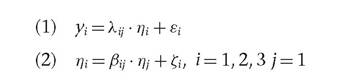
where yi are the observed variables, while the latent variables (agglomeration economies, quality of life /labour, urban infrastructure) are symbolized with nZ the m variable is the latent factor of "firm competitiveness”; kii are the factor loadings indicating the effect of the latent variables on the observed indicators, while ei, are the measurement errors that are assumed to be uncorrelated between measurement equations with nd and Z representing measurement errors in the structural equations, respectively, and ß, denoting factor loadings indicating the effect of the three latent variables upon "firm competitiveness”.
The scale of latent factor "firm competitiveness” is fixed by assuming that it has a unit variance. It is also hypothesized that: E(£t) = 0, Cov(Zi, nt) = 0, Cov(et, Zi) = 0.
The results show that firms' competitiveness in the territory - the latent factor - is strongly and positively related to all three latent variables.
Scenario Analysis
A scenario describes (textually or graphically) a set of events that might reasonably take place. Scenarios can be considered as hypothetical images of the future, which describe the functioning of a system under different conditions with a certain degree of uncertainty. Kahn and Wiener (1967, p. 3) originally defined scenarios as ‘hypothetical sequences of events constructed for the purpose of focusing attention on causal processes and decisionpoints'.
Basically, scenario analysis enables a number of possible alternative futures to be imagined, described and evaluated. Scenario analysis can be performed according to a range of approaches, ranging from highly qualitative styles of exploration to more formal mathematical modeling procedures(Bunn and Salo, 1993). One of the main advantages of scenario analysis with respect to standard statistical forecasting techniques is that it can be used to consider the impact of future exogenous shocks and major structural changes in the system under analysis. Scenario based on expert assessment can however benefit from a structuring processing of the elicited information, e.g. using network analysis and methods to verify the consistency and accuracy of expert assessments (Gambelli et al., 2010).
Bayesian Networks
A Bayesian network is a compact probabilistic model for the handling of uncertainty in expert systems (Jensen, 1996). It can be interpreted as a graphical model of the interactions among a set of variables, and a set of directed edges between variables, where each variable has a finite set of mutually exclusive states. The resulting network should have a Directed Acyclic Graph (DAG) format, i.e. a graph with no directed cycles among nodes. Each node A is associated to a conditional probability table P(A|B1,..., Bn), where B1,...,Bn are parents nodes of A, i.e. nodes upon which A is dependent.
The advantage of this approach with respect to standard econometric tools (e.g. discrete choice models for risk evaluation) is the possibility to consider the cumulative effects on risk due to a combination of risk factors, and that qualitative evaluation of utility can be considered. Bayesian networks can be designed from hard statistical data using specific “learning” algorithms, or based on expert knowledge. Among many other fields and examples, here we just mention the potential of Bayesian networks as decision support, when integrated with a utility function (Cowell et al., 2007), and for risk evaluation (Gambelli et al., 2014).