An evolutionary analysis of multilevel governance mechanisms for SHD at the local level
As stated by the Committee of the Regions of the EU (2009, p. 6), ‘Multilevel governance is a dynamic process with a horizontal and vertical dimension, which does not in any way dilute political responsibility.
On the contrary, if the mechanisms and instruments are appropriate and applied correctly, it helps to increase joint ownership and implementation' (emphases added). It follows that the activation and dynamics of evolutionary processes that effect political mobilization and participation on the one hand, and ownership and multilevel alignment on the other, are intrinsic characteristics of MLG.In adopting the SHD perspective at the local level, it is crucial to frame the dimensions and elements of (dis)articulation discussed so far, in order to analyse who acts upon resources, services and local public goods, which are the effects of misalignment and disarticulation. In other words, the application of the STEHD framework (taking into account the guiding questions posed in Table 2.1) helps us to understand how multilevel arrangements keep redefining their interrelations with regards to the evolution of territorial SHD and the local provision of global public goods.
In Figure 3.1, the interconnections representing the multilevel articulation in horizontal and vertical dimensions have been highlighted.
Firstly, the institutional dynamism and creativity that local systems often exhibit can be nurtured by the transformation of political mobilization MLG entails, when it reinforces formal and informal partnerships among
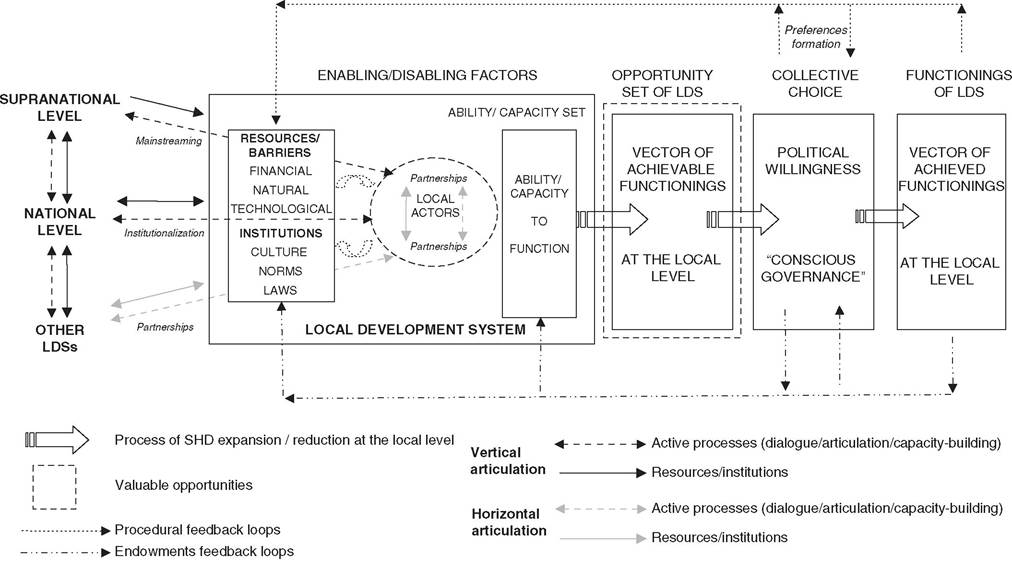
Figtire 3.1 The STEHD framework: Multilevel articulation fostering or hampering the territorial dynamics of SHD processes Source: Authors.
individual or associational stakeholders within the system, as well as their share and exchange of knowledge, financial capital, skills, and so on.
For instance, the mix of cooperation and competition practices among local actors, which characterizes the most successful industrial districts (Becattini et al., 2009), sustains the enhancement of trust and the valorization of social capital for common development purposes, such as the provision of local public goods (Bellandi, 2009). Moreover, MLG relations substantially affect the extent of the inconsistencies or alignment between the rationales of the two sub-systems in each particular territory - community of people and population of firms (Ramazzotti, 2010).Secondly, direct relationships among territories themselves (e.g. decentralized cooperation; territorial cooperation within the EU) may involve the establishment of long-standing partnerships based on common values, institutions or visions of development, as long as they are horizontal and egalitarian, instead of unbalanced and paternalistic (Badia i Dalmases and Coll, 2013; Fernandez de Losada, 2013). In this respect, resource flows and processes of dialogue and capacity building can be encouraged to address the challenges and constraints associated with the achievement of territorial functionings. For example, in the descriptive account of European decentralized cooperation experiences provided by Fernandez de Losada et al. (2012), a distinctive focus on “soft” initiatives emerged. These initiatives reinforced the institutional and operational capacities of local authorities and corresponding decentralization processes.
In other words, these multi-actor and multilevel horizontal relations within and among territories have the effect of strengthening cognitive, organizational, institutional and social proximities among close local actors and between distant stakeholders (Boschma, 2005). This helps to nurture innovation dynamics in broad terms as well as the consolidation of enabling systems for sustained economic development and human flourishing.
Along the vertical dimension, the highlighted connections display: (i) the relationships between each LDS and the national and supranational institutions that have to cope with the complexity of new governance demands, and (ii) the interactions among all levels of governance - for example, the systematic dialogue between European and national associations of local and regional governments for the delivery of EU Structural Funds and European Social Fund, among others (EU, 2001; Martinez-Fernandez et al., 2011).
The former relates to boosting processes of dialogue, articulation and capacity building, as well as the provision of resources and institutions (e.g.
a strong legal framework for protection of property rights). These processes connect each territory to its national government and institutions, and increasingly provide a direct connection (a key feature of MLG) to the supranational level (through, for instance, para-diplomacy of European regional authorities in Brussels or international cooperation interventions for local development). Within an evolutionary perspective, it is crucial to view local adaptation in the context of national political economies,14 as the state continues to be the main regulator of economic activity (Sepulveda and Amin, 2006) through sound macroeconomic policies for SHD (Ranis et al., 2000; Cornia and Stewart, 2014).In addition to the argument supporting the reconciliation of top-down and bottom-up approaches to SHD, the available evidence suggests the importance of two processes. The first is the institutionalisation of intranational relationships. For example, Noferini (2012) finds evidence of a positive net effect for sub-national governments in Spain due to reinforced intrastate relations through the definition of a joint common position in the EU policymaking. The second piece of evidence is the mainstreaming of balanced and diffused interactions between territorial societies and supranational institutions. The urgency of this is stressed by the EU Committee of the Regions, which points out that ‘the Lisbon Strategy undeniably lacks coordination and continues to represent an exclusively top-down approach' (EU, 2009, p. 22).
The latter concerns the tripartite and simultaneous interrelations that not only shape decision-making dynamics within the EU ‘by making use of networks, grassroots organisations and national, local and regional authorities' (EU, 2001, p. 11), but also international cooperation strategies for the achievement of the MDGs/SDGs and IMF financial assistance plans for highly indebted countries or regions. Our STEHD framework highlights the importance of tailoring these relationships to reinforce the composition of resources, institutions and capacities as territorial enabling factors for SHD.
Overall, the value of multilevel articulation is in the capacity to foster the valorization of endogenous resources through local stakeholders' participation, inclusion and agency, and by linking them with resources, competences and initiatives coming from other territories and levels above. In this respect, the reinforcement and institutionalization of MLG coordination mechanisms for economic animation, social inclusion, gender and ethnic equity, and conflict prevention or management represent a process for supporting and strengthening the sustainable expansion of people's capabilities and well-being within territorial societies.
In fact, the Committee of the Regions of the EU has specifically invited the Commission and the member states ‘to reform the open method of coordination to make it more inclusive, by developing participatory governance indicators and territorial indicators, in conjunction with regional and local authorities' (EU, 2009, p. 23). Central to this is the role of MLG in widening or restricting the spaces to manoeuvre of territorial actors as "political entrepreneurs” and "policy innovators” in fostering SHD processes.
3.4