Adam Smith
2.2.1. The ‘mechanical clock’ and the ‘invisible hand’
Newton’s theory of universal gravitation contributed to the diffusion of the idea of an ordered and rational universe and exerted a great influence on illuminist thought.
Natural phenomena, according to this idea, are reducible to the movements of atoms regulated by laws which are intrinsic to the state of nature. God created the universe together with the laws that regulate it and then he stood aside. There is no need for his continual intervention to hold the world together, as it is completely self-regulating. Furthermore, as the natural order is rational, it can be understood by human intelligence. This was the extreme outcome of a philosophical conception that had already been advanced by Descartes: rational understanding is possible, and the more abstract it is the more precise it will be. Mathematics is its most efficient and potent instrument, more powerful than observation itself. This conception, which the Scottish universities helped to spread throughout Great Britain, crossed the boundaries of the natural sciences and enjoyed enormous success even in moral philosophy, where its influence intertwined with that of natural-law philosophy. The idea of a ‘natural order’ played a fundamental role in the birth of classical political economy, and the conviction gained ground that human relationships were regulated by objective mechanical laws, with which positive law, which was formulated by man himself, should try its best not to interfere.However, the influence exerted in the eighteenth century by the natural sciences over the social sciences cannot be ascribed only to the great prestige attained by the former. In fact, it can be better explained by a theoretical need which arose within the social and political thought of the period.
The central problem of European political philosophy in the period from the beginning of the Renaissance to the French Revolution was that of accounting for social life without having to resort to metaphysical presuppositions.
In the Middle Ages, social consensus was maintained by two fundamental principles: authority and faith, both justified by the assumption of the existence of God. The problem of modern social thought was: how is social life possible if those two principles and their metaphysical justification are left aside?A first answer to this question was given by Machiavelli and Hobbes: the natural egoism of man makes free social life impossible and the absolute State necessary; the principle of authority is based on the monopoly of power, and does not need to be legitimized. It is based on violence, and only obtains obedience through its strength. The citizens, mindful of a primitive ‘social contract’ of subjection and driven by the survival instinct and the desire for security, can do nothing else but obey. Civil society originates from repeated acts of obedience. The alternative would be social disintegration and the law of the jungle. So power gives foundation to the State, and the State makes harmonious social life possible. Now, this solution was certainly applicable to the absolutist States of the sixteenth and seventeenth centuries. It was no longer tenable after 1649, the year of the proclamation of the English Commonwealth, and, above all, after the Glorious Revolution (1688) and the Declaration of Rights (1689).
The emerging social classes created by capitalist development, and excluded from government by the absolutist States, strived to obtain what they considered to be their rights, if it is true that money is power. On the one hand, therefore, was the need for a political philosophy by which the civil society could justify itself independently of the State. On the other hand, it was necessary that such a justification take into account the real processes of wealth formation. If Hobbes’ Leviathan assumed the natural egoism of individuals in order to justify the State, then it was necessary to demonstrate that a free social life is possible even in the presence of selfish individuals.
Moreover, as the sphere of action of human egoism is economic activity, a change of focus from politics to economics was necessary. Finally, as a metaphysical justification had to be excluded, it was also necessary to formulate such a justification in ‘scientific’ rather than purely speculative terms.Natural-law philosophy was one of the paths attempted. The followers of this view believed in a ‘natural order’ that presupposes the free expression of human activity. The ‘positive order’, based on laws and conventions, creates the State, but is only legitimate if it is not in conflict with the ‘natural order’. This was a dangerous path to take, as was demonstrated by the difficulties Locke encountered in justifying the inequality in the distribution of property and wealth, and even more so by the radically egalitarian results which that philosophy was to produce in France.
A different path was attempted by the English and Scottish empiricists and ‘moral-sense’ philosophers. Their approach was based on the assumption of the existence of a natural ‘benevolence’, or ‘moral sentiment’, which man experiences towards his fellows. If individuals are not naturally egoistic, they tend spontaneously to associate themselves and there is no need for external intervention to give sense to social life; neither God nor the State is necessary. It is sufficient to assume a particular structure of the human psyche. Now, apart from the fact that this way of thinking succeeds in solving the problem simply by ignoring its existence, the main difficulty with it is that the assumption on which it depends, benevolence, not only runs against common sense but also is not basically different from other metaphysical assumptions; nor is it less arbitrary and easier to demonstrate.
Both Hume and Hutcheson, Smith’s teacher, and Smith himself moved in this direction. However, according to a widespread and quite orthodox interpretation, Smith’s main contribution, the one which made him the father both of economic science and of modern liberalism, came precisely at the moment when he introduced innovations within that tradition.
His stroke of genius consisted, not in the rejection of the empiricist position, but in taking it to its extreme logical conclusions, by leaving out even the arbitrary hypothesis of benevolence. With the ‘theorem of the invisible hand’, Smith simply aimed at demonstrating that individuals serve the collective interest precisely because they are guided by self-interest.A similar attempt had been made by Quesnay, a medical doctor, who, however, from the philosophical point of view, had remained tied to a natural-law position, while, in order to demonstrate the natural tendency of social agents to produce order, tried to use a biological analogy. Quesnay’s natural order was very similar to Menenio Agrippa’s apologue, and failed to focus on the role of individual actions in ensuring social equilibrium. The economic subjects to which Quesnay referred were collective social agents, classes of individuals, not individuals. Smith was strongly influenced by Quesnay’s work, and it is possible to say that the truly ‘classical’ component of Smith’s thought, that which was later to be developed by Ricardo and his followers, originated precisely from his attempt to assimilate some of Quesnay’s fundamental ideas and to correct some of his secondary errors. However, there is a component in Smith’s thought that clearly distances him from the physiocratic position, and it is that which aims at demonstrating the invisible-hand theorem. Here, collective agents disappear and the organicist analogies become meaningless. The scientific reference model is mechanics, and the objects studied are social atoms. It is not by chance that Smith is considered to be the founder of economic science not only by the classical but also by the neoclassical economists.
This, we repeat, is the most diffused interpretation of Smith’s thought. We will mainly follow it, but we will take the freedom to contest it in section 2.2.6.
2.2.2. Accumulation and the distribution of income
In 1776 Smith published An Inquiry into the Nature and Causes of the Wealth of Nations, a milestone in modern economic thought.
The work begins with an analysis ‘of the causes of improvement in the productive powers of labour’—improvement immediately identified as the main condition for the growth of real wealth. The division of labour is a process by which a particular productive operation is subdivided into a certain number of separate operations, each of which is carried out by a different person. With the division of labour the worker’s skill increases, the idle time in transferring a worker from one activity to another is reduced and, above all, technical progress is stimulated. However, the division of labour is limited by the size of the market, is only possible when the economy can produce for a sufficiently large market, and can be intensified only if the market is expanding.In turn, the market will be larger the more the transport and communications systems are developed, the more credit and monetary instruments are diffused, and the faster the growth in the volume of production. Smith believed there is a cumulative mechanism that operates in a capitalist system which proceeds according to the following sequence: division of labour—enlargement of the markets—increases in labour productivity, and so on; a real virtuous circle of growth.
If it is the division of labour that triggers the growth process, it is the accumulation of capital that drives it. Smith subdivided capital into fixed capital, consisting of machinery, plant, buildings, etc., and circulating capital, which is used to buy raw materials and pay for labour and energy. The wages fund is that part of the circulating capital which is used to pay the workers. In real terms, it is a part of the goods produced in a productive cycle which is used to pay the workers in the successive cycle. Wages are paid before the product is sold, and for the capitalist, who advances them, they are capital.
The theory of income distribution among the social classes plays a fundamental role in Smith’s theory of growth. In fact, the three basic classes, capitalist, workers, and landlords, are distinguished both by the productive resources they hold—capital, labour, and land—and by the way in which they spend profits, wages, and rents, their respective incomes.
The relationships among the types of productive resource held by the various classes, and among the ways in which their incomes are spent, constitute the essential part of Smith’s theory of capital accumulation.The landowners, who do not own productive capital, are not interested in its enlargement and have no inducement to save and accumulate capital. Their propensity to save is zero, and they make no contribution to the growth of the wealth of the nation. On the other hand, the workers only possess their labour. Both the ability of the capitalists’ coalitions to influence the government and parliament and the competitive forces on the labour market push real wages down to subsistence levels. But with a subsistence wage the propensity to save must be zero. Therefore, not even the workers make a positive contribution to the growth in a nation’s wealth, although they make an essential one to its production. Finally, the capitalists possess the productive capital and aim to increase it. This means they have a very high propensity to save. It follows that the higher the proportion of the national income going to profits, the higher the growth in the wealth of the nation. The general interest of the nation, therefore, coincides with that of the bourgeois class.
Smith also made an important distinction between productive and unproductive labour. The former is employed in the production of goods, the latter in the supply of personal services or in similar activities. Smith had in mind the difference existing between workers who are employed by capitalists and domestic staff who are employed by the ‘leisured class’. Accumulation is the accumulation of goods. Thus productive labour is essential to sustain accumulation whereas unproductive labour is not. This means that a growing economy must reduce to a minimum the percentage of workers engaged in unproductive labour.
2.2.3. Value
Smith also made an important contribution to the explanation of the value of goods, but he did not manage to formulate a completely successful theory of value. His starting-point was to recognize that the structure of a productive process can be represented in terms of the series of quantities of labour employed to produce the goods. In fact, even the loom that is used by the worker to produce cloth has been, in its turn, produced by means of labour aided by other means of production: ‘Labour, therefore, is the real measure of the exchangeable value of all commodities. The real price of everything, what everything really costs to the man who wants to acquire it, is the toil and trouble of acquiring it’ (p. 133). Smith deduced from this fact that a necessary prerequisite for a good to have value is that it be produced by human labour. On the other hand, the value of a good is measured by the quantity of labour it is able to ‘command’: the value of a commodity ‘to those who possess it, and who want to exchange it for some new production, is precisely equal to the quantity of labour which it can enable them to purchase or command’.
Smith clearly saw that the measure of value in labour commanded does not coincide with the amount of labour embodied in the goods. Such a coincidence could only occur
in that early and rude state of society which precedes both the accumulation of stock and the appropriation of land... If among a nation of hunters, for example, it usually costs twice the labour to kill a beaver which it does to kill a deer, one beaver should naturally exchange for or be worth two deer. It is natural that what is usually the produce of two days’ or two hours’ labour, should be worth double of what is usually the produce of one day’s or one hour’s labour... In this state of things, the whole produce of labour belongs to the labourer; and the quantity of labour commonly employed in acquiring or producing any commodity is the only circumstance which can regulate the quantity of labour which it ought commonly to purchase, command, or exchange for. (pp. 150-1)
Under these special conditions, therefore, the quantity of labour commanded coincides with the quantity of embodied labour.
Things change when one passes from a system in which the whole product of the labour belongs to the worker to one in which the control of the means of production, and therefore the production, is no longer in the workers’ hands. When capitalists and landlords take part in the division of the product, the exchange value of a good must be such as to allow the payment of a profit and a rent besides a wage. This implies that the quantity of labour the good can pay for must be greater than that employed to produce it. In a capitalist society, therefore, embodied labour is no longer a good measure of the exchange value of goods.
Labour commanded is a relative price; it is the value of a good expressed in terms of the value of another: the labour that can be bought with it. Since Smith maintained that the price depends on the incomes paid to produce the good, he expresses it as the sum of those incomes: wages, profits, and rents. Here, for the sake of simplicity, we will ignore rent. Let us imagine an economy in which, on free land, only one good is produced, corn, for example, by means of itself and labour. The good, measured in tons, is used as a wage good as well as a capital good. Let us assume, again for simplicity, that wages are paid after the work has been done. k is the capital coefficient, namely, the quantity of seeds necessary to produce one ton of corn; l is the labour coefficient, namely, the quantity of labour-hours directly used to produced one ton of corn. If l is the labour directly and indirectly embodied in a ton of corn, lk will be that embodied in k tons of grain used as seeds. Therefore:
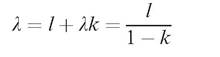
Now, let r be the rate of profit, w and p the monetary wages and the monetary price of one ton of corn. p/w will be the labour commanded by it, and w/p the real wage. The price of corn will be equal to the sum of the costs sustained in producing it and the profits earned by the capitalists. The cost of labour is wl, the cost of capital pk, the profit pkr. Therefore, p = w + pk + pkr. Expressing the price in labour commanded:
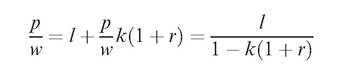
It is easy to see that the labour commanded is greater than the embodied labour precisely because there is a profit, and that it becomes always greater as the profit rises. It is also possible to say that the price of the good is nothing more than the sum of wages and profits (and of capital) paid to produce it. It is equally clear, however, that the equation of labour commanded does not serve to determine labour commanded, which is known once the real wage is known, but only the rate of profit, which is determined residually: given the real wage, w/p, the equation has only one unknown, r. Similar results are obtained in the general case in which n goods are produced.
The theory of value based on labour commanded is correct as a price theory if it presupposes a theory of profit as a residue. On this argument, however, Smith sometimes lets himself be led astray by misleading propositions. One of these is that an increase in wages can lead to an increase in prices, rather than to a reduction in profits; another is that profit serves as a remuneration for the risk, or even for the disagreeableness, faced by those who advance capital; yet another is that ‘wages, profit and rent are the three original sources... of all exchangeable value’ (p. 155). Taken together, these three propositions would induce one to consider a non-residual theory of profit; which would lead to a logical error in a theory of value based on the cost of production. It is from these misleading assertions that the so-called ‘additive’ theory of value emerged, a theory which determines the value of a good by the sum of the incomes paid to produce it. When we speak of the mistakenness of such a theory, we are referring, not so much to the idea that the price of the good is expressed as a sum of the incomes, but to the interpretation that considers incomes as the primary sources of value. In such an interpretation, wages and profits would be determined by the forces of supply and demand in the ‘factor’ markets, so that their sum would determine the value of the good. But from the equation of labour commanded it is easy to see that, if wages and profits are predetermined, there are no more variables to determine: the equation becomes over-determined. However, Smith did not pose the problem in these terms; not only was he not completely aware of the reasons why a measure of value in labour commanded is preferable to one in embodied labour, but he did not even understand the dangers of a non-residual explanation of profit within a theory of value based on the cost of production.
2.2.4. Market and competition
The theory of labour commanded plays a significant role in Smith’s theory of growth. In fact, a necessary condition for the existence of a positive growth rate is that the labour commanded by the net product is higher than the quantity of labour used to produce it. In fact, only in such a case can the surplus exist which is necessary to sustain capital accumulation.
On the other hand, the additive theory of price, in that it encourages the abandonment of an explanation based on the cost of production, seems to bring back the forces of demand as fundamental determinants of the prices of goods. Coupled with a theory of profit as a normal remuneration of entrepreneurial activity, it seems to lend itself to the attempt to demonstrate the allocative efficiency (or even distributive justice) of the competitive equilibrium. Even if this line of development was followed rather more by some of Smith’s followers than by Smith himself, there is no doubt that it was Smith who opened up the road. We will speak more about this in the next section.
The distinction between market price and natural price is important here. The former is the actual price of a good at a given moment; the latter is that which would allow the payment of workers, capitalists, and landowners at normal rates of remuneration. The market price depends on the forces of supply and demand. In the presence of an excess of demand, the market price will rise, while it will fall if supply exceeds demand. However, ‘the natural price... is, as it were, the central price, to which the prices of all commodities are continually gravitating’ (p. 160); and this occurs precisely because competition regulates the operation of the markets.
Smith illustrated this process with an illuminating example. Let us assume that a public funeral causes an increase in the quantity demanded of black cloth. Competition among the buyers of black cloth will intensify, and this will cause an increase in the price; when the market price exceeds the natural price, the capital invested in the production of black cloth will obtain a higher return than that attainable in other industries. The capitalists who produce that good will be stimulated to expand their production, while new capital will be transferred from other uses to its production. This will cause an increase in the supply of black cloth, which at a certain moment can even exceed the demand; and this will lead to a decrease in the market price. The adjustment process will continue until the market price returns to the natural level.
The natural price is determined by the production costs, but realized on the market. The fluctuations of the market price depend on the forces of demand, but are regulated by the production conditions. The adjustment process described above is an integral part of the market mechanism by which the economy adjusts itself to its ‘natural’ equilibrium path, it is the movement through which the ‘invisible hand’ works. Self-interest is the driving force of the system, the force that prevents the slide into chaos. A large number of operators, a certain knowledge of the price conditions on the part of buyers and sellers, the mobility of capital, and the absence of entry barriers are all conditions that limit the ability of each single agent to influence the prices to his own advantage. Under such conditions, the market conditions ensure that exactly those goods in exactly those quantities are produced which best satisfy the final demand. In an equilibrium situation, the forces of demand provide for the distribution of capital among the various industries. While the conditions of supply determine the relative prices, the conditions of demand determine the relative quantities of goods produced.
In this view, the market is its own guardian and is capable of complete selfregulation. So that, while everybody is free to follow his personal interests, everybody is, in fact, controlled by an impersonal force. Each person is induced by an ‘invisible hand’ to contribute to the achievement of an economic end which was no part of his intentions: this is Smith’s theorem of the invisible hand. It states that, in conditions of competitive equilibrium:
(a) the productive system will produce those goods the consumers demand;
(b) the chosen production methods are the most efficient, that is, those which do not waste any resource;
(c) the goods are sold at the lowest price possible, which is the production cost inclusive of a normal profit.
The main weakness of this grand construction is that it has remained unproved. In particular, Smith did not demonstrate either that equilibrium exists or that it is unique and stable. In regard to these three points, however, even if they are fundamental, we should not be too hard, as even today economists are still struggling with the problems of uniqueness and stability, while those of existence have been solved only recently.
2.2.5. Smith’s three souls
Somebody said that, if you want to know three diverging opinions on a particular problem, you may ask three different economist chosen casually; or just one: Adam Smith. The quip is not so venomous as it seems. It suggests a clue to sort out the labyrinth of Smith’s encyclopedism. Actually there are three different components in Smith’s economic theory; let us call them macroeconomic, microeconomic and institutionalist components. They are tightly intertwined and it is difficult to separate them, but it is possible and useful to do so. We will deal with the third component in the next section.
The core of the first two components, which will be dealt with in this section, consists of the theory of surplus and the theory of the individualist competitive equilibrium. The philosophical roots of the two theories are different; and it would not be difficult to trace the empiricist and moralphilosophy roots of the theory of competitive equilibrium from the influence of Hume, Hutcheson, and Shaftesbury; nor would it be difficult to trace the theory of surplus to its natural-law roots and to the influence of Locke and Quesnay. However, this is not the place to go deeper into such an argument. We will add only that, even though Smith seems perfectly aware, at the philosophical level, mainly of the first kind of influence, the second is no less strong, as is demonstrated by the presence in his work of the tension, typical of natural-law philosophy, between the is of history and institutions and the ought to be of the natural order. This tension was to lead Smith to foreshadow a theory of profit based on exploitation.
It is possible to trace back most of the successive Smithian orthodoxies to those two theoretical components: the macroeconomic, based on the theory of the surplus, and the microeconomic, based on the theory of competitive equilibrium. The first, for example, is at the base of his theory of growth, and was in fact formulated in the attempt to adapt Quesnay’s analysis to a non- stationary economy. The conceptions of the social classes, the analysis of their different types of income and expenditure behaviour, the distinction between productive and unproductive labour, the explanation of value in terms of embodied and commanded labour and, finally, the theory of profit as a residual income, are all elements of the first component. The second component, on the other hand, provides the foundation to the theorem of the invisible hand, to the idea of a competitive capitalist economy as a natural economic order, to the theory of additive prices in connection with the explanation of profit as remuneration for risk, and to the theory of wage differentials. The economic subjects which appear in this second component are no longer collective agents such as social classes, but individuals: for example, buyers and sellers of a single good who decide the quantity to demand or supply on the basis of a price they cannot modify; or single capitalists who decide to transfer investments from one sector to another in the search of a higher profit rate.
In order to understand how these two components of Smith’s theory are really different, yet strictly interrelated, we will consider them at work on a specific problem: that of the explanation of the nature of labour and the level of its remuneration.
Chapter 5 of Book I of The Wealth of Nations begins thus:
The real price of everything, what everything really costs to the man who wants to acquire it, is the toil and trouble of acquiring it. What everything is really worth to the man who has acquired it, and who wants to dispose of it or exchange it for something else, is the toil of our own body. That money or those goods save us this toil. They contain the value of a certain quantity of labour which we exchange for what is supposed at the time to contain the value of an equal quantity. Labour was the first price, the original purchase-money that was paid for all things. It was not by gold or by silver, but by labour, that all the wealth of the world was originally purchased; and its value, to those who possess it, and who want to exchange it for some new productions, is precisely equal to the quantity of labour which it can enable them to purchase or command. (p. 133)
This famous passage has been interpreted in two completely different ways within two different streams of thought.
Ricardo and his followers, the Ricardian socialists, and Marx and the Marxists have placed the accent on the ‘quantity of labour’ with which the goods are produced or which is commanded by them. Here labour is intended as an investment of energy, a productive service that can be technically specified and measured in objective units, for example, working hours. This good enters into the production of others on the basis of objective technical relations, and is exchanged with others on the basis of objective exchange relations. Its productive role and its value are independent from the choices of individuals and from psychological factors. The determination of its price and its productive role can be set out in macroeconomic terms, completely ignoring single individuals. This leads to a theory of distribution that, being based on the notions of ‘wage’ as ‘natural wage’ and of ‘surplus’ as a ‘deduction from the produce of labour’, cannot but be a macroeconomic theory, and needs no microeconomic foundations. In the same way, a theory of value based on embodied or commanded labour cannot but be an objective theory of value, and needs no psychological foundations.
A completely different interpretation of the passage has been given by Jevons on the basis of theories put forward by Bentham and Gossen—an interpretation which has been accepted by all the neoclassical economists. It must be recalled, however, that Galiani had already tried to interpret the labour theory of value (of Locke and Petty) in this way. Jevons placed the accent on the ‘toil and trouble’ of labour. This was now defined as ‘any painful exertion of mind or body undergone partly or wholly with a view to future good’ (p. 189). Evidently, we are dealing with ‘a case of negative utility’. Its measurement is expressed in terms of‘pain’, and it is impossible to define it objectively. In fact, each individual has his own idea of how ‘painful’ his own work is. A theory of the price of labour based on this interpretation must have microeconomic foundations, in that it must take into consideration individual choices. Thus the theories of value and distribution that treat labour in this way cannot avoid dealing with the psychology of individuals; and they can, with good reason, be defined as subjectivist theories of value and distribution.
There is no doubt that this passage by Smith can be legitimately interpreted in both ways. But this is not all. In Chapter 10 of Book I, Smith tackles the problem of wage differentials:
The whole of the advantages and disadvantages of different employments of labour and stock must, in the same neighbourhood, be either equal or continually tending to equality. If in the same neighbourhood, there was any employment evidently either more or less advantageous than the rest, so many people would crowd into it in the one case, and so many would desert it in the other, that its advantages would soon return to the level of other employments. This at least would be the case in a society where things were left to follow their natural course, where there was perfect liberty, and where every man was perfectly free to choose what occupation he thought proper and to change it as often as he thought proper. Every man’s interest would prompt him to seek the advantageous, and to shun the disadvantageous employment. (pp. 201-2)
This passage seems to prove the neoclassical interpretations correct. In fact, the reference to individual choices is clear when Smith speaks of ‘every man’ and of his freedom to ‘choose’. The confirmation of the legitimacy of this interpretation is given by the fact that, according to Smith, the first determinant of wage differentials consists in the ‘agreeableness or disagreeableness’ or the ‘ease or hardship’ of the work. Thus, in order that ‘the advantages and disadvantages of the different employments’ become equal, the wage differentials must reflect the differences in hardship. This would happen under free competition, in a situation in which ‘perfect liberty [existed] and where every man was perfectly free to choose’. We are referring to this point of view when we speak of the theory of individualistic competitive equilibrium as the microeconomic component of Smith’s thought.
Ricardo and Marx, of course, would not agree with such an interpretation. And they would not be completely wrong. In fact, the second determinant of wage differentials consists of the high or low cost of training; and this can be interpreted as an objective determinant. In fact, the training costs of a labour skill, as Marx was to suggest later, are given by the quantity of labour employed to produce a certain working ability, and can be determined by referring to the ‘educational technology’ available in a given society in a given period, which is again an objective and macroeconomic phenomenon. We are referring to this type of interpretation when we speak of the theory of surplus as the macroeconomic component in Smith’s thought.
We will see that almost all Smith’s followers in the period from the publication of The Wealth of Nations to the end of the Napoleonic Wars developed their ideas in relation to the theory of individualistic competitive equilibrium. This fact explains why Ricardo, in order to re-establish the authority of Smith’s theory of surplus, had to bring about a revolution by taking Smith himself as his favourite target. We should like to add here, for clarity, that a fundamental contribution to the theoretical development and the cultural success of the microeconomic component of Smith’s thought, to the detriment of the macroeconomic side, was given by Bentham, the founder of utilitarianism. We will discuss this later.
2.2.6. Smith as an institutionalist
The third component of Smith’s thought, which has been neglected for over 200 years, has recently been rediscovered and revalued, mainly due to the contemporary revival of institutionalist thought. The institutionalist foundations of Smith’s thought can be traced in The Theory of Moral Sentiments, published in 1759, and in the Lectures on Jurisprudence held at Glasgow University during the years 1762-63 and 1763-64. Institutionalism may therefore appear to represent the philosophical approach that Smith followed before he wrote The Wealth of Nations, an approach that was to be eclipsed by the discovery of the ‘invisible hand’. In reality Smith never abandoned the basic convictions he expounded in the works of his youth, as shown by the fact that he continued to publish revised editions of The Theory of Moral Sentiments up to the sixth, issued in 1790. Moreover, as recent research has brought to light, substantial elements of institutionalist thought can also be found in The Wealth of Nations. In point of fact, this work should be read as an investigation into the institutional conditions that make the achievement of public prosperity possible through pursuit of private interest.
The theories attributed to Smith by the various free trade orthodoxies, from classical to neoclassical, should be reconsidered in the light of an institutionalist interpretation. For example, the thesis whereby the market mechanism is necessary and sufficient for the constitution of social cohesion fails to capture the full wealth of Smith’s thought. First, Smith conceives the market as a set of institutions: private ownership, ban on monopolistic practices, etc. In addition, and even more important, in Smith’s opinion, another two spheres of human action play a fundamental role in constructing social harmony: those of moral and legal rules. One distorted interpretation sees Smith as a theoretician of Homo oeconomicus, a philosopher who defines the social agent as an autonomous, rational, and self-interested individual. In reality, Smith had a concept of man as a subject blessed with multiple selves, whose soul was characterized by different and contrasting sentiments. Broadly speaking, there are selfish and altruistic sentiments.
The first category includes: the desire to improve one’s life; the desire for social esteem, to which pride and sense of honour are related; the desire to be admired by others, in other words, vanity; the desire to accumulate property and wealth, or avarice; the desire for power and domination; the desire to lead an easy life and avoid all effort. Clearly, these sentiments do not all boil down to utilitarian egoism, i.e. the inclination to maximize one’s utility which the invisible hand could bend to serve the interests of the community.
Some of these sentiments give rise to strong externalities and contribute to obstruct the market mechanism. Avarice, for instance, accounts for the impulse to accumulate, but also for the propensity to exploit others instead of applying oneself to the efficient production of income. Nowadays this would be called ‘opportunism’. The need for social esteem and power contributes to obstructing the competitive mechanism when they lead to the build up of monopolistic situations. These sentiments lead to ‘man’s natural insolence’ which causes inefficiency precisely through opportunism. The tendency to avoid effort, as emerges from Smith’s critique on the laws of apprenticeship, may give rise to productive inefficiency, by inducing idleness at work. Unlike a piece-worker, an apprentice is not paid on the basis of his productivity; he therefore tends to provide second-rate work and little effort. But this inclination generates inefficiency also when it is associated with accumulation of wealth. Very wealthy people lose interest in economic activity. Landowners from the aristocracy dedicate much of their life to lavish consumption and besides not worrying about putting by the income necessary to increase their wealth, they do not even take the trouble to manage efficiently the production activities from which their wellbeing derives. On the other hand, their bailiffs and agents have no incentive to increase productivity, since they do not own the land or the wealth they manage, and therefore tend to act in a ‘negligent, uneconomical and oppressive manner’. But this problem is not confined to the aristocracy alone. The same vice also affects the bourgeoisie, as capitalists tend to lose their parsimonious spirit when they earn very high profits. And if ownership is organized in the form of a joint stock company, a separation between ownership and control arises which generates the well-known problems of managerial inefficiency, with executives failing to manage other people’s money with the same ‘concerned alertness’ that the owners would use; ‘negligence and waste’ then ensue. In conclusion, it can be said that for Smith self-interested behaviour is not sufficient to generate social harmony in the presence of perfect liberty. Some form of moral and institutional restraint is necessary.
Fortunately, human nature is also endowed with altruistic sentiments, like benevolence, which prompts the individual to please his fellow men and directly generates co-operative behaviour. Others, like sympathy, are more ambiguous. Sympathy is the ability to imagine oneself in the situation of others in order to assess their reactions to one’s decisions. Also rather ambiguous is the love of praise, the desire for social approbation— ambiguous because it has both egoistic and altruistic implications. The individual practises sympathy in order to gain his fellow’s approbation and avoid his disapprobation. In this way, he endeavours critically to examine his own behaviour towards others and that of others towards himself. This is how the moral and behavioural rules that contribute to social cohesion are created. These rules are accepted by a community and internalised by the individuals who belong to it. They build up in each individual’s mind a sort of social conscience which Smith called ‘an impartial spectator’. Social control on individual behaviour operates through the judgements and orders of this spectator.
Seen in this light, the ‘invisible hand theorem’ is much more interesting than traditional micro-economics textbooks suggest. In the market, economic agents do not exchange goods only, but also messages of approbation or disapprobation, so that individuals, albeit behaving in a self-interested way, tend to do so complying with the legitimate expectations of others as well as moral rules. In this way opportunism is kept at bay and co-operative behaviour is stimulated. In short, the invisible hand that contributes to constructing the good of all, appears to be that of the impartial spectator rather than that of utilitarian greed. Free competition seems to be regulated by the law of sympathy not by that of the jungle. And that is why the market works.
Furthermore, despite his insistence on the laws of nature, Smith did not treat human nature as a ‘natural’ fact, an exogenous datum. Instead, he endeavoured to identify the processes by which the social context influences the formation of the person. He pinpointed one very important personality building mechanism, which consists in the inclination of people to emulate individuals who rank higher on the social ladder of wealth and prestige. In this way, not only are moral rules socially established, but also those very sentiments that determine human choices. Thus the thirst for enrichment, for example, is an attitude typical of a particular social setting, that of modern capitalist economies, within which it has the function of stimulating initiative and innovation; but it tends to foster exploitation and the formation of monopolies when the impartial spectator is weak. Smith made it quite clear that there is nothing ‘natural’ about this attitude and that, what is more, it often proves to be misleading in the pursuit of individual happiness and common good.
The legal rules are no less important than the moral rules. Here too orthodox liberal interpretations have provided a partial and distorted reading of Smith’s thought, an interpretation in which the state is seen as a body that is neutral and external to society. In this perspective the state is considered as a simple emanation of the will of civil society, which on the ground of its capacity for self-constitution in the exchange sphere, would delegate to the political authorities only the function of producing a few essential public goods, such as justice, national defence, economic infrastructures. Thus the harmony that society would naturally generate in markets, would not be altered by the legal rules, nor would the latter contribute in any decisive way to forming this harmony.
Smith did not see it in quite the same light. First, he was perfectly aware of the fact that, in the exchange sphere, the economic agents enter into a nonco-operative type of relationship with each other which can impair public interest rather than foster it. Second, he observed that, in the endeavour to pursue their objectives, individuals organize themselves into social groups directed at increasing their members’ power. Third, he studied the state as an apparatus which is continually crossed by economic conflict and an instrument with which coalitions pursue their particular interests. The invectives which the Scottish economist hurled at the great commercial companies as well as at the governments who favoured them by granting licences and privileges and adopting mercantilist policies, are well known. Similarly well known is his criticism of a judicial system in which he who asks for justice ‘with a large present in his hand’ obtains ‘something more than justice’.
One field in which the powers of State are exercised in a strongly nonneutral way is the regulation of the labour market and determination of wages. Smith, unlike the mercantilists, argued that a subsistence wage was a fact rather than a normative principle. According to him there is no valid ethical reason why a wage should be fixed at subsistence level. Nevertheless, historical observation showed that its ‘natural’ value tended to stabilize precisely at that level. Unlike later classical economists, however, Smith did not think this tendency was caused by natural economic mechanisms, such as the dynamics of the population and of labour demand. While he did not overlook the role played by these factors, he saw clearly that this was privileged territory for social conflict and that the classes enter it with political instruments which are powerful, yet asymmetrically distributed. The capitalists enter it in a position of strength. Since they are less numerous than the workers, they have easier access to monopsonistic practices of the type that aims to control the demand price; in short, they may easily agree on the maximum wage to pay workers, and so avoid competing with each other. Furthermore, since they are very wealthy, they have a greater capacity to resist in industrial actions: they do not face the risk of starving to death after a strike or lock-out. Finally, and this is the most important factor, they control the state and use it to strengthen their own bargaining power by, for example, making it issue anti-combination laws. In this way wages are pushed to subsistence level. The forces of demand and supply now and then avert the market wage from the ‘natural’ wage but they cannot alter its basic trend. This is nothing else but a political-institutional theory of the long run normal wage. It should be added that subsistence consumption was not defined in purely biological terms. On the contrary, it was considered as determined by the habits and customs that prevailed in a given historical period and in a given society. Thus, not only is the magnitude of the real wage institutionally determined, but its composition too.
Smith did not confine the state and the normative institutions to an external and neutral sphere with respect to that of social action. They all operate within civil society and the markets, thus contributing in a substantial way to control individual behaviour as well as the mechanisms of production and accumulation of wealth. Legal and moral institutions are endogenously determined in the process whereby society and the economy are self-constituted and self-regulated.
All this induces us to consider the predominant liberal interpretation of Smith as unsatisfactory. A recent version of this interpretation has been put forward by Coase, who believes the market is a perfect substitute for benevolence—in the sense that by arriving where benevolence cannot, it succeeds in achieving much more than the latter. This seems to be a rather aporetic interpretation. On the one hand, Coase admits that to work well, the market presupposes the practice of benevolence and the respect of a mercantile moral code by all the agents; on the other, he argues that market performance depends solely on the egocentric interests of those who take part in it. In other words, market existence presupposes the practice of certain virtues, yet these practices have no bearing on the results of the market process. But why ever should a rational subject practise a virtue such as benevolence if the results obtainable through market interaction can be achieved irrespective of those practices?
The opinion that any concern for other persons is redundant finds confirmation, according to this interpretation, in the famous passage in The Wealth of Nations where Smith says that ‘it is not from the benevolence of the butcher, the brewer or the baker that we expect our dinner but from their regard to their own interest’. This celebrated maxim seems strangely to contrast with another less well known but just as authoritative, which opens The Theory of Moral Sentiments: ‘how selfish soever man may be supposed, there are evidently some principles in his nature which interest him in the fortune of others and render their happiness necessary to him though he derives nothing from it except the pleasure of seeing it’. Attention should be paid to the adjective ‘necessary’: Smith intends to suggest here that attention for another is a fundamental part of human nature, and therefore that to assume its existence is essential to the understanding of all human choices, including economic ones.
Smith’s ‘schizophrenia’ has given rise to much debate, and lengthy discussions have taken place between historians of economic thought on an Adam Smith problem. Undoubtedly, some of Smith’s contradictions and ambiguities may lead to contrasting interpretations and no one can claim that his own interpretation is the authentic one. But in the case of the contradiction under discussion, we think it is possible to give a convincing explanation: the controversial passage in The Wealth of Nations presupposes in its enunciation the theories set out in The Theory of Moral Sentiments, and in particular those concerning the existence of a fundamental system of ‘rules of economic and civil morality’ based on sympathy. This system of rules guarantees orderly functioning of the market without the individuals having continuously to resort to enforcement to compel their counter-parties to play by the ‘rules of the game’. So the above maxim merely says that a market economy would be in a position to function even if the ulterior motives of all the participants were exclusively self-interested: it is an exaltation of the soundness of the organization of the economic activities permitted by the market rather than a negation of the relevance of the intrinsic motivations. But, more generally, Smith appears to argue that only within a relational type of social structure, systematically fuelled by the practice of ‘moral sentiments’, is it possible for the pursuit of self-interest to produce positive results, in other words, for ‘the gains of both (parties)’ to be ‘mutual and reciprocal’, as he affirms in the chapter ‘Of the natural progress of opulence’ in The Wealth of Nations.
Regrettably, following the hegemonic influence of utilitarian culture, especially in the version embraced by the marginalist theory, a particular interpretation of Smith’s arguments has prevailed in the mainstream which transformed the ‘special case’ of egocentric agents into a ‘highly representative case’, thus exposing economic theory to the ‘hyper-minimalist’ anthropology of Homo oeconomicus. But today, in the light of more recent institutionalist research, it can be said that, thanks to the plurality of philosophical influences to which his thought has been subjected, Smith has built up a richer and more complex theoretical system than that attributed to him by the many interpreters who have endeavoured to eliminate the ‘contradictions’.
2.3.