Alternative Approaches
8.5.1. Allyn Young and increasing returns
The problem of economic growth, which had been at the centre of the theoretical reflections of the classical economists, lost its privileged position with orthodox economists during the Victorian age.
Perhaps this happened because economic growth had begun to be considered within a more general vision of human progress, so that it was no longer seen as a problem, or because it had been ousted by more pressing questions, such as those linked to the determination of prices and of remuneration of resources in situations of allocative efficiency. Finally, considerable responsibility must be attributed to the seduction exerted by the formal elegance of the neoclassical theoretical system and its ability to monopolize economists’ interests; neoclassical theory deals with institutions, population, and technology, which are key elements in the growth process only as exogenous data, the causes or factors of their change being considered outside the scope of economic science. Thus the economists wishing to study these matters have often been forced to leave the fold. This is how institutionalist economics was born.Even the subjects of the division of labour and increasing returns, Smith’s great research areas, ended up by being considered as a special and irrelevant case of equilibrium price theory. And Allyn Young, a Harvard economist, had to write, in 1928, a vehement article (‘Increasing Returns and Economic Progress’) to remind his colleagues that these were matters of fundamental theoretical importance. In the presence of increasing returns, change might be cumulative, since the forces for change are endogenous. Thus the actual state of the economy during any period cannot be predicted other than as a result of the sequence of events of preceding periods.
The fundamental consideration from which Young started is that any increase in the supply of goods enlarges, at least potentially, the market of other goods.
Therefore, ‘the extension of the market’ depends on the division of labour just as much as the division of labour depends on the extension of the market.Adam Smith’s dictum amounts to the theorem that the division of labour depends in large part upon the division of labour. This is more than a mere tautology. It means [... ] that the counter forces which are continually defeating the forces which make for economic equilibrium are more pervasive and more deeply rooted in the constitution of the modern economic system than we commonly realize. (p. 533)
The process of economic growth, according to Smith, is basically cumulative in nature. Increases in quantities produced (enlargement of the market) allow work to be divided in a better way; and to the degree to which labour is specialized, its productivity increases. Therefore, given the level of employment, further increases in production are possible which provide new growth stimuli.
What disintegrates, in the presence of increasing returns of scale, is the concept itself of long-run equilibrium. In fact, if any change in use of resources or any reorganization of productive activities creates the opportunity for a further change that would not have occurred otherwise, then the theory of the optimal allocation, according to which each resource gives at the margin an equal contribution to the output whatever its use, loses any meaning. If the pattern of resource use depends on the preceding uses, the concept of economic efficiency based on the principle of the allocation of scarce means among alternative uses can no longer be maintained, except in the short run, when plants are fixed by hypothesis; Marshall seemed fully aware of the problem, to judge by his attempt to draw an ‘irreversible’ supply curve.
A further important consequence of the existence of increasing returns is that, when there is an increase in the level of output, it becomes profitable to increase the capital-labour ratio: the higher the level of output, the more specialized the machinery which can be profitably used.
In Young’s words: ‘It would be wasteful to make a hammer to drive a single nail, it would be better to use whatever awkward implement lies conveniently at hand’ (p. 530). This means that the choice of the capital-labour ratio depends on extension of the market rather than on relative input prices, which is the opposite to what marginalist theory would lead us to believe.Voices of dissent such as that of Young were heard during the inter-war period, and they were notable—it is enough to mention Schumpeter. But they were not listened to, both because neoclassical theory was evolving according to an internal logic that rendered it inaccessible to such radical and simple criticisms, and because a great many of the dissenting forces were being attracted and united by the new general short-run theories. For the same reasons, few people listened to the institutionalist economists, who began to speak up again in this period.
8.5.2. Thorstein Veblen
In the 1890s classical economics had almost completely disappeared from the scene, so that, beginning from that decade, the external attacks against political economy became criticisms of neoclassical economics. And this happened in America with the institutionalist schools. This line of thought was initiated by Veblen in the 1890s and developed by further generations of institutionalists in the following decades. In America, its development and its criticisms have always accompanied (perhaps compensating for the weaker development of Marxist criticisms) the development of neoclassical orthodoxy. A. Gruchy has recently described the institutionalists as thinkers who ‘inquired into problems such as the impact of technological change on the structure and functioning of the economic system, the power relations among economic interest groups, the logic of the process of industrialization and the determination of national goals and priorities’ (‘Institutional Economics’, p. 11).
In order to grasp the meaning of such a definition, we need to glance at the course of American economic history from 1880 to 1915, the most active period of the intellectual career of Thorstein Veblen, the ‘founder’ of the institutionalist approach.
This epoch was far from being one of ‘Victorian tranquillity’. Apart from the fact that the five-year period 1885-90 was like the eye of a storm between the depressions of the 1870s and 1890s, it is necessary to keep in mind that the country was involved, in those years, in developing an industrial sector which was later to threaten British economic supremacy. Besides this, the ‘frontier’ had reached its extreme limit around 1890, and territorial expansion began to direct itself overseas. Finally, a new wave of prosperity began around 1897, Kondratiev’s ‘third wave’, ushering in impressive innovations in the automobile and chemical sectors. The concentration of capital, especially in the oil industry, moved ahead undisturbed until the passing of the Sherman Act in 1890 (the first anti-trust law, which however had modest results). But the workers’ movement also produced its great ‘concentrations’ in this period: in 1881 that great union was formed which was later to be called the American Federation of Labour, while at the end of the century a series of other trade unions, of various types and varying degrees of radicalism, arose.Veblen developed a radical critique of all orthodox economic theory, from Smith onwards, putting both classical and neoclassical economists in the same basket. It was, incidentally, Veblen who branded Marshall’s theoretical system with the term ‘neoclassical’. The orthodox doctrine was, in his opinion, contaminated by taxonomic, hedonistic, and teleological theoretical attitudes.The orthodox approach is taxonomic because it boils down to classifying economic problems, without however really explaining them. In the study of resource allocation and price formation, for example, consumers’ tastes, social institutions and technology are assumed as data. On the basis of these data, the values of the variables are then determined: prices, quantities produced, income distribution, etc. But the data are not independent of the variables, according to Veblen, and change as the latter vary.
A truly scientific economic theory—one that aims to understand rather than to classify reality and, worse still, to defend vested interests—should endo- genize ‘data’ such as consumers’ tastes, technical progress, institutional change and explain them together with the ‘variables’.Orthodox theory is also hedonistic, since it assumes human behaviour motivated by maximization of utility. But Homo oeconomicus does not exist, he is merely the product of fictitious psychology invented by simple-minded economists who are unaware of the achievements of modern psychology. According to Veblen, human behaviour is governed by basic instincts and the propensities to action which are formed both by nature and the institutions, the latter being defined as socially shared mental habits. Some of these instincts, parental bent, idle curiosity, workmanship, contribute positively to improving society and life conditions. Others, like the predatory instinct, on the contrary, produce deleterious effects.
Lastly, economic orthodoxy is teleological in that it makes use of concepts, like that of equilibrium, which are surreptitiously normative. It ‘describes’ an economic reality that tends towards the achievement of a state of social organization in which a harmonic and mutually beneficial form of human coexistence is possible. This is a pre-Darwinian view of evolution. According to Veblen, economics should instead be an evolutionary science and study social change in Darwinian terms. Real evolution is not teleologic, nor is it governed by any hidden end. It is powered by instincts and institutions that may serve progress and human improvement, but may also be disserviceable and even idiotic. It is furthermore cumulative and path-dependent. Ongoing processes are the result of their particular historical path and determine future paths which however remain open and unpredictable. The important essay Why Is Economics not an Evolutionary Science? was almost completely ignored when it was written in 1898, but contemporary evolutionary and institutionalist research has acknowledged its merit.
Veblen did not limit himself to criticizing theory. He also elaborated a ferociously critical analysis of the real economic system of his times, that is, in point of fact, American capitalism. At the centre of Veblen’s analysis of capitalist society was the distinction between ‘industry’ and ‘business’. The former ‘produced things’, the latter ‘produced money’. The active agents of industry are engineers and allied professionals; the active subjects of the business world are merchants, rentiers, and speculators. The first group is motivated by the instinct of workmanship and idle curiosity, the second by predatory instincts. The members of the second group compete with each other in terms of ‘conspicuous consumption’, a type of consumption that does not satisfy real needs but only feeds the desire to display one’s status in the eyes of a social reference group. It was in his famous book The Theory of the Leisure Class (1899) that Veblen applied his social theory to the way of life of the average American consumer. Here he showed how the instinct towards hard work could become atrophied by emulating the ‘predator’ (the successful businessman), and how the natural requirement of need satisfaction could be distorted by conspicuous consumption.
Veblen believed that technology is the major factor in socioeconomic growth, and that it is cumulative and independent of the actions and the will of the businessmen. However he was convinced that technical progress, when is abused by predatory instincts, is accompanied by institutional changes which would lead the economy both to a state of chronic depression and to monopolistic concentration. This state of affairs would intensify the struggle between industry and business. Veblen himself was not too clear about where such a fight would lead. However, in the final section of The Theory of the Business Enterprise (1904) he wrote: ‘Which of the two antagonistic factors may prove the stronger in the long run is something of a blind guess... It seems possible to say this much, that the full dominion of business enterprise is necessarily a transitory dominion’ (p. 400).
This uncertainty persisted in Veblen’s thought almost until he died. In Economic Theory in the Calculable Future (1925) he appears to suggest that the business world will prevail—from which he inferred sad omens for economic science. In the business-dominated world—he wrote in Essays in our Changing Order (1934)—the economic science would be ‘a science of business traffic’, adding that ‘any technical advance can get a hearing and reach a practical outcome only if and so far as it is presented as a business proposition, that is to say, so far as it shows a convincing promise of differential gain to some business concern’ (p. 13). In fact Veblen, this new Saint-Simon, considered the industrial engineer as the real progressive factor of the modern economy, and firmly believed in the existence of a fundamental conflict between engineers and capitalists. But capitalists, in Veblen’s opinion, were only those who work in the financial sector. There is no room, in his theory, for the idea that workers are exploited by the industrial capitalists.
8.5.3. Institutional thought in the inter-war years
The most important American institutionalists of the generation which followed Veblen were Wesley Clair Mitchell, Robert Lee Hale, Clarence Edwin Ayres, Walton H. Hamilton, and John Rogers Commons. Mitchell had been one of Veblen’s students, but he was soon to distance himself from his master in his emphasis on empirical research and in his caution towards theoretical generalizations. He criticized orthodox theory for the static nature of the notion of equilibrium. He also rejected the theory of perfect competition, arguing that many prices are sticky in that they are determined by institutional factors such as contracts and conventions. He criticized orthodox theory, but also Veblen’s, for their excessively speculative characters and their unsuitability for empirical investigation. In his research he focused on the empirical study of business cycles, emphasizing the role played by money in their dynamics, and demonstrating the permanence of the cycle through time, a permanence that had manifested itself in the American economy despite the great changes which had affected its demographic structure, technological bases, institutional order, and financial system. Mitchell made a lasting contribution to the development of economic science, both by his work on collecting and ordering statistical data and, above all, by his refinement of the methods for their study. He carried out this activity at the National Bureau of Economic Research, an organization he founded immediately after the First World War.
Hale taught at Columbia University Law School from 1919 until the mid 1950s. He set up his own privileged field of study in an area on the borderline between economics and law and can be considered one of the founders of the new discipline of law and economics. He tackled the study of economic systems as systems of power in which individual liberties are defined as legally established rights. In this perspective, the citizens’ freedom of choice takes the form of opportunity sets which are invariably restricted by the action of other citizens, the prices of commodities and the law. The legal structure of an economy, by establishing rights, in effect protects particular interests. The right of ownership on a good, for example, is legally guaranteed as a condition of the freedom of those individuals who possess it, but this guarantee consists in fact in excluding other individuals from having access to that good, unless at the conditions and at the prices fixed by the owner. Every right therefore generates a non-right, every protected particular interest presupposes the existence of non-protected interests. Thus there is a strict link between freedom and coercion. It is pointless to distinguish between free legal-economic systems and coercive systems or between interventionist state policies and liberalist policies. Every system needs coercion in order to structure liberties. The differences between systems regard specific liberties that are better protected by governments. In setting up the legal structure of an economy, a State determines its performance by privileging certain interests rather than others, just as it determines the distribution of income and social inequalities. But the influence is reciprocal, since performance, distribution of income and conflicting interests in turn determine State action. Therefore this is not exogenous in respect of economy and society. Rather, Hale sees it as political and juridical ground for social conflict.
In the same way as Hale, Clarence Ayres adopted a concept of freedom as a constrained set of choice opportunities. But, unlike Hale, he tended to study the expansion processes of freedom, by focusing on technological rather than legal conditions. He held that there is a reciprocal dependence between growth of freedom and technological development, since freedom of thought and expression, for example, is a condition for the expansion of knowledge, whereas the ensuing growth of income and well-being facilitates the expansion of freedom. Ayres’ theoretical approach reflects that of Veblen, whereas Hale’s is closer to that of Commons. Ayres developed above all Veblen’s dichotomies between instrumental and ceremonial behaviours and between industry and business. He based the first dichotomy on a theory of social value, by which he endeavoured to escape from ethical relativism— that almost inevitable product of every institutionalist theory—by attributing positive values to all human practices which contribute to improve the conditions of life. Thus, the institutions which favour technical progress are good, whereas those which, through ceremonial behaviour, encourage conservation of the status quo, of customs, beliefs, and culture inherited from the past, are bad. Ayres re-elaborated the dichotomy between business and industry, by transforming it into a contraposition between the pecuniary and non-pecuniary aspects of economic organization, without overlooking the opportunity to associate the former with ceremonial behaviour and the latter with instrumental behaviour.
Ayres was introduced to institutionalist thought at Chicago University by Walton Hale Hamilton, one of the leaders of the generation of socially committed economists of the period between the two wars. It was Hamilton who dubbed the school of thought initiated by Veblen and Commons as an ‘institutionalist approach’. At a meeting of the American Economic Association in 1918 he presented the new approach as more realistic and significant than the neoclassical, considering it more appropriate for dealing with the fundamental problem of economic science, the social control of economy. Hamilton was a critic of laisser faire. Market competition, in his opinion, had played a positive role at the time when small businesses and industries had found themselves fighting against big mercantilist monopolies at the onset of the industrial revolution. But the implicit error in the Iaissez- faire doctrine is ignorance of the fundamental role of the State in setting up and imposing the rules of competition and, ultimately, in creating market institutions. The development of big industry and modern monopolies has, however, created the conditions for a drastic loss of social control on economy and has intensified worker and consumer exploitation. Society, therefore, needs new controlling agencies. Hamilton did little further investigation into the nature of these new agencies. But in a research study on the bituminous coal industry (in collaboration with Helen R. Wright), he put forward some very interesting suggestions which, for those times (the ’twenties), were quite innovative. The most subversive of these suggestions even proposed to replace the capitalist control of firms with joint control by the workers and consumers. This labelled Hamilton as perhaps the most socialist-minded American institutionalist economist of that generation and one of the classic points of reference in the contemporary recovery of the radical version of institutionalism.
Unlike most of the other American institutionalists, Commons showed a great interest in theoretical generalizations. Although Commons’ research had begun before the end of the century, his main works were published in the years of high theory: Legal Foundations of Capitalism came out in 1924 and Institutional Economics in 1934. His interests range from the sociology of legal institutions to the history of labour, from the theory of public economics to the theory of the conflict of interests. He believed that the study of ‘collective action’, i.e. of the activity (and the apparatus) of ‘control of individual action’, should be placed at the centre of economic theory. He argued that individuals act by maintaining strong relations of interdependence, both in conflict and in co-operation. The ‘bargaining transactions’ contribute to the transfer of property rights and the fixing of prices and rewards. In fact these are determined not so much by the forces of demand and supply in competitive markets, but by the power relationships among contracting parties. At any rate, his kind of transactions represent only a part (and not even the most important part) of economic transactions. More important are ‘managerial transactions’, i.e. those concerned with the exercise of command between superiors and inferiors, such as between employers and employees. Finally there are the ‘rationing transactions’, i.e. those in which costs and benefits are shared out among the members of an organization, such as the collection of social contributions in a trade union, or the
distribution of the tax load by the government, or the distribution of the profits of a company. All these types of transaction take place in a specific institutional and legal context which gives them sense and makes them binding. Laws and customs are what Commons calls ‘working rules’. They serve to assign power and limit its use. In this way individual action is controlled so as to force people to co-operate. Commons had a difficult academic life, and found a stable academic position only rather late in his career, at the University of Wisconsin. There he gathered around him a group of young economists, among them A. Gruchy, S. Slichter, and
J. K. Galbraith, who were to continue the institutionalist tradition.
At the beginning of the 1930s two institutional textbooks, one by W. E. Atkins and the other by Slichter, received a certain acclaim in American academic circles. There were two main reasons for this. The first was that the institutionalist Rexford Tugwell, after having taken part in Roosevelt’s brains trust, became responsible for the Ministry of Agriculture of the Federal Government of Washington, a position in which he fought to defend the Welfare State. One point on which Tugwell particularly insisted was the necessity for economic theory to examine the economic institutions (companies, the government, and interest groups) and the non-commercial as well as the pecuniary incentives for human action. All these elements, Tugwell maintained, must be considered as they were in the real world, and not as orthodox theory thought they should be. He also recommended statistical measurement of economic phenomena, a difficult problem which the dominant theory of the period often tried to avoid. The second reason was that the University of Wisconsin became a source of ideas, as well as of practical initiatives, for American social legislation. Commons, in a certain way, was for America what Bismarck had been for Germany in the second half of the nineteenth century and Lloyd George for Britain in the early twentieth. His group of economists fought for the approval of the Social Security Act, a law which, overcoming a harsh reaction of the entrepreneurs, gave birth to the Welfare State in the USA.
Veblen had been a pessimistic and critical institutionalist. Commons, on the other hand, tended to emphasize the positive aspects of the American economy. He believed that the main defects of that particular capitalist system could be remedied by means of wise institutional reforms. However, beyond specific differences of opinion and research, some common characteristics unite them in the institutional approach. First is their emphasis on the ‘open’ nature of the economic system, which led them to adopt a broad definition of the field of investigation of economics and to reject its definition as the science of efficient allocation of resources among alternative uses. Second, in order to explain the way in which economic systems function and grow, institutional change was considered rather more important than that which Knight was to call ‘the mechanics of the price system’. We must note that, according to the institutionalists, the market cannot be considered as the only institution able to lead a society towards economic growth. Third, they maintained that it was reductive to base economics on the analysis of the behaviour of single economic agents, leaving aside social influences on the decision processes. If political economy wishes to concern itself with change and the evolutionary aspects of the economic system, it must focus on the complex interactions between individual behaviour and the institutional context.
Two important consequences at the level of economic analysis are derived from these principles: first, that individualism is inadequate as an explanatory device, and second, that equilibrium analysis is irrelevant; economic science should study social processes occurring through historical time rather than analysing the equilibrium positions of individual choices.
Here, we should like especially to mention Gunnar Myrdal, an unconventional economist who, as we have already seen, began his career within orthodox theory. We have mentioned the importance of his Monetary Equilibrium (1931), a book that innovated monetary economics but without departing too much from the neoclassical approach. In 1932, after realizing that there was a basic weakness in his preceding work, he experienced a radical conversion. In the past he was convinced that, when all metaphysical elements are get rid of, a sound body of positive theory remains in economic science which is value free and gives objective knowledge. Successively he recognised that this is naive empiricism, if at all, because valuations are necessarily involved at the very stage when facts are observed. In reality the presumed neutrality of economic theory only serves to conceal the value judgements from which any researcher always starts.
It was from this conviction that Myrdal decided to abandon the old theoretical system to follow, in a rather personal way, an institutionalist line of research. He concerned himself with the multiple aspects of the problem of economic growth and, above all, with the relationships between countries at different levels of development. He put the study of the problems of underdeveloped countries, particularly Asian, at the centre of his research interests and even lashed out at the methods and theories adopted by international economic and financial institutions. Anticipating the current debate on globalization, Myrdal proposed a form of democratic socialism that would lead to a radical reform of the international organizations founded at Bretton Woods, with the object of sowing the seeds for economic development in which fairness and efficiency could coexist.
8.5.4. From Dmitriev to Leontief
Perhaps it is not possible to speak of a real Russian school of mathematical economics, but there is no doubt that the beginning of the century saw the formation of a group of Russian economists who faced certain problems of economic theory using a common methodology, mainly based on linear algebra, and following a fairly homogeneous theoretical line of thought. Their main doctrinal reference was general economic equilibrium theory; but some of the Marxist debates, especially concerning the theory of value, also provided important stimuli.
Undoubtedly, the most important exponent of this group was Vladimir Karpovich Dmitriev, ‘the father and founder of Russian mathematical economics’, who, in the Economic Essays on Value, Competition and Utility, proposed a reconciliation between the Ricardian theory of prices and distribution and the neoclassical theory of marginal utility. The reconciliation consisted in the demonstration that the former, even though analytically rigorous, was a special case of the latter—a special case defined by the hypotheses that production occurs in the presence of constant returns to scale, perfect competition, and the employment of only one primary input: labour. Dimitriev demonstrated that, under such hypotheses, conditions of demand only influence the composition of output while prices are determined by conditions of production. It is easy to see here the essential elements of that ‘non-substitution theorem’ which was later to be rediscovered in the 1950s. Dmitriev also anticipated some of the aspects of Leontief’s input-output model when he tried to calculate the total labour requirements necessary for the production of the goods, those defined as ‘labour values’ in classical-Marxist theories. Dmitriev supplied the first general formulation of the criteria for determining such values, referring to a model of production of n goods, and demonstrating that, in order to calculate the labour embodied in these, it is necessary and sufficient to know the technical coefficients and the direct labour coefficients. Therefore labour values, unlike exchange values, do not depend on the distribution of income, as Ricardo seems to have understood when struggling with the difficulties of the invariable measure of value. Dmitriev calculated exchange values by completely ignoring labour values, and expressed them in terms of the quantities of labour invested and capitalized in previous ‘epochs’ to produce the wage goods consumed by the workers. In an economy in which wage goods are produced by means of wage goods, the rate of profit is determined simultaneously with the exchange values, and depends only on the production conditions of wage goods, and not on those of luxury goods. Furthermore, the rate of profit is a decreasing function of the wages.
Dmitriev only mentioned Marx occasionally, and focused his attention on Ricardo; yet his conclusions are of great importance for the Marxist theory of value, especially in regard to the problem of the transformation of values into prices. Ladislaus von Bortkiewicz immediately realized this, and wrote two important articles on the subject. By formalizing a numerical solution of Tugan-Baranovskij and extending some of Dmitriev’s analytical procedures, Bortkiewicz reached two important results. First, he proved that, contrary to the opinion of some of Marx’s critics, the transformation is possible. The deficiencies of the procedure adopted by Marx himself were due to the inadequacy of his analytical tools and not to a defect in the theory. Second, however, he proved that precisely what made the transformation possible also made it useless; in fact, production prices can be calculated without knowing the labour embodied in the goods, so that the labour theory of value can be relegated to a purely ‘auxiliary’ role.
The subject was taken up again by Georg von Charasoff, who tried to reformulate in a rigorous manner the theoretical foundations of the Critique of Political Economy. In regard to the transformation problem, he generalized Bortkiewicz’s solution to the case of n goods, and proved that the transformation procedure followed by Marx was not mistaken, but only incomplete, as it could be interpreted as the first step in an iterative transformation process capable of approaching the solution of production prices. However, in this way the inessential nature of the labour theory of value emerges even more clearly. In fact, the iterative process can be initiated from any price vector, so that the vector of labour values carries out the simple role of an arbitrary vector of exchange values.
Von Charasoff discovered other interesting properties of the productionprices model. He clearly distinguished between ‘basic products’ and luxury products, and proved that production prices and the rate of profit only depend on the production conditions of the former. He calculated the rate of profit by means of a dual iterative process. Assuming a subsistence wage and assimilating the inputs of wage goods to those of other capital goods, von Charasoff proved that, by beginning from any vector of the quantities produced, it is possible to go back to the vectors of the quantities employed as inputs in preceding ‘epochs’ by means of an iterative process which converges towards a particular input vector. He called this vector Urkapital (primary capital). Its adoption in the productive process would generate an output vector which would differ from Urkapital only by a scale factor. In other words, in production with Urkapital the goods produced are in the same proportion among themselves as the means of production, and the profit factor coincides with the scale factor that links input to output. Furthermore, if all profits are reinvested, the rate of growth of the production of Urkapital will coincide with the rate of profit. Another important result concerns the distribution of income, on which von Charasoff worked by assuming as given the technology and real wages, and as variable the length of the working day: he proved that, by reducing the latter, the rate of profit would fall, to reach a zero level when surplus value is nil.
Let us return to Bortkiewicz. We know that he taught in Berlin from 1901 to 1931. In 1926 he was invited by Ragnar Frisch to form a group of mathematicians and economists as the German section of what was to become the Econometric Society. We do not know a great deal about the activities of this group; but we do know that between 1926 and 1929 Bortkiewicz was in contact with Robert Remak, a German mathematician, and with Wassily Leontief, who was taking his degree in Berlin. Bortkiewicz introduced Remak to the problem of the existence of solutions for a ‘circular-flow’ model of n equations. Remak worked on this and produced one of the first rigorous proofs of the existence of solutions for a generalequilibrium model, albeit of a very special type.
By a strange historical coincidence von Neumann was also teaching in Berlin during that period (1927-9). We have no proof of any contacts between him and Bortkiewicz’s group, but we know that in that period (perhaps in 1928) von Neumann took part in one of Marschak’s seminars on general equilibrium, during which he suggested the possibility of dealing with the problem of free goods by using disequations. Already at that time he had begun to think about the problems from which he was to develop the famous ‘von Neumann’ model.
On the other hand, we know that this model shares with those of Bortkiewicz, Leontief, and Remak that special notion of production which considers it as a ‘circular process’ of production of commodities by means of reproducible commodities. This idea is directly linked to the concept of ‘economy as Kreislauf ’, as a circular flow. Even consumer goods, reduced to the ‘necessities of life', were treated as reproducible inputs in that model. This concept was so basic and so strange for the times that von Neumann felt the need to emphasize it from the first line of his 1937 work. From this point of view, the endowments of scarce resources are simply ignored (von Neumann was explicit on this), and the problem of price determination is defined within the approach of reproducibility and not within the usual neoclassical conception of scarcity: it is the production conditions of goods that determine their prices, not their scarcity in relation to demand. This conception not only united the abovementioned economists, but also clearly distinguished them from the mathematical economists of Menger's Kolloquium. Schlesinger and Wald, for example, were working within a tradition that went back to Cassel and specified the analysis of production in terms of a unidirectional process. From this point of view, production begins with the input of primary resources, nonproduced goods, and ends with the production of final consumer goods, products not used as inputs.
Let us now return to Russia. There, in the 1920s, an important debate on planning was taking place from which two pioneering theoretical contributions were to emerge, one by A. V. Chayanov and the other by P. I. Popov and L. N. Litosenko. Chayanov developed Dmitriev’s theory, producing a simple input-output model for agriculture. Popov and Litosenko did a research aimed at improving calculations for the ‘material balances' on which the first attempts at planning were based. The material balances were crude accountancy instruments aimed at calculating the uses and productive requirements of various groups of goods on the basis of certain coefficients of planned inputs called ‘norms’. These balances contained, in a nutshell, all the information necessary to construct input-output tables. Popov and Litosenko tried to integrate the information that could be deduced from these balances with the Marxian analysis of the reproduction schemes. In this way they managed to reformulate these schemes, dividing the two Marxian sections into twenty-two productive sectors. The results were rather primitive, but there is no doubt that the first step had been taken towards the construction of the input-output model. Leontief was well aware of the work of the two pioneers, having reviewed it in 1925, before publication. He also knew of the work of Bortkiewicz, under whom, in 1927, he had prepared his degree dissertation. In 1928 he published part of his dissertation in an article in which he presented a small model similar to those of Bortkiewicz and Remak. In 1931, Leontief emigrated to America, where he began teaching at Harvard University. In 1931 he began the research which was to lead him to the invention of the input-output model. In 1936 he published his first important results, but it was not until 1941 that he published The Structure of the American Economy, 1919-29, today considered the classic work on input-output analysis.
His work continued in the following decade, and led to the publication of Studies in the Structure of the American Economy (1953) and Input-Output Economics (1966). During the 1950s and the 1960s this new branch of economic theory caused a real research boom: a boom which gave rise to various analytical advances in regard both to empirical applications and to theoretical formulations. We will discuss these in Chapter 11.
Here we will limit ourselves to a short presentation of the most elementary and fundamental of Leontiefis contributions, the static and open inputoutput model. The analysis assumes the knowledge, which can be deduced from empirical research and from national accountancy data, of an input-
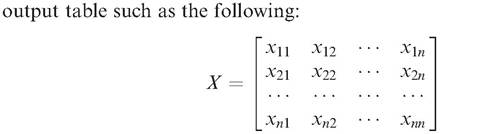
where xij represents the amount of output of sector i used as input in sector j. Let x = [x1, x2,... xn]' be the column vector of the quantities produced in the various sectors. Then, if constant returns to scale are assumed, it is possible to divide each element of the input-output table by the corresponding element of the vector of outputs and calculate the technical coefficients. In this way, one obtains a matrix of technical coefficients, A = (aij), in which aij = xij /xj is the coefficient of the input of product i in sector j.
By imposing equality between supply and demand for each product, the following system of equations is obtained:

where x represents the supplies of the various products, Ax the demand for intermediate uses, y = [y1, y2,... yn]' the demand for final uses. If the economic system is ‘vital’, it is possible to produce a quantity of each good which is not inferior to that used as input and at least one good in a higher quantity. Then it is possible to solve the equation to determine the levels of output necessary to produce the desired final quantities:
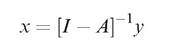
where I is the identity matrix and (I — A) 1 is ‘Leontief’s inverse matrix’. The ιth column of such a matrix contains the output quantities of the various goods that must be activated to obtain one unit of good i in the final demand. If we multiply the preceding equation by the vector of the labour coefficients l = (l1, l2, ∙ ∙ ∙ ln), we will find the level of aggregate employment L = lx = I (I — A) 1 y. It should be noted that the vector l (I — A) 1 is the vector of total labour requirements necessary to produce an amount of each product which appears in the final demand; in other words, it is the vector of labour values.
We will conclude this section by mentioning Leonid Vitalevic Kantorovic (1912-86), an important Russian mathematician and economist who was a contemporary of Leontief. Among his economic works was Mathematical Methods of the Planning and the Organization of Production (1939), in which he traced the general and essential lines of the theory of linear programming. However, he was not able to find an efficient method for the solution of linear-programming problems, a failure which was later to be overcome by Dantzig, who thus opened the way for practical applications for this type of programming.
8.5.5. The reawakening of Marxist economic theory
The years from the publication of the first volume of Capital (1867) to the beginning of the new century saw the affirmation of Marxist hegemony over socialist thought. Original works produced by Marxist writers in that period were very few indeed, however, especially in the field of economics. The truth is that, as soon as Marxism became the official ideology of the German Social Democrats and, through the Second International, of the international workers’ movement, it rapidly transformed itself from the critical theory it had been for Marx into a new kind of orthodoxy. In this form it was only able to produce very few theoretical innovations. It was not until the 1910s that there was a reawakening of creativity among the Marxist economists. Driven on by an unrestrainable social explosion, various socialist militants tried to apply the theoretical instruments of Marxian economics to understand the nature and the evolutionary tendencies of contemporary capitalism. We have only time to mention three of the most important works of that decade: Das Finanzkapital (1910) by R. Hilferding, Die Akkumulation des Kapital (1913) by R. Luxemburg, and Der lmperialismus (1816) by V. I. Lenin.
Hilferding tried to account for a fundamental structural change in the capitalism of the belle epoque: the emergence of German-type mixed banks, their intrusion into the productive sphere, and the role they played in accelerating the processes of ‘concentration’ and ‘centralization’ of capital. The other two books analysed the tendency of capital in the most developed countries to spread through international markets, generating and embittering interimperialist conflict, while the capitalist mode of production was extended on a world scale. Luxemburg’s basic argument was that the imperialistic drive was due to the lack of effective demand generated in internal markets due to a very unequal distribution of income. Lenin’s work, on the other hand, by drawing on Hobson’s and Hilferding’s theories, focused on the effects of monopolistic power on the tendency of capitalist countries to expand their empires.
Then, in the 1920s, immediately after the Russian Revolution, a brief season of fervent creativity exploded in the Soviet Union. That season however soon died away under Stalin’s purges, in which, among others, economists like Kondratiev, Chayanov, and Feldman disappeared. The revolution had freed intellectual energies and, at the same time, placed a series of extremely important problems on the agenda. We cannot here give the Soviet debates of the 1920s all the attention they deserve. We have already mentioned briefly the debate on planning; here we will mention two other interesting debates, on the crisis of capitalism and on the problem of socialist accumulation.
An interesting contribution by Nikolaj Dmitrievic Kondratiev emerged from the debate on the crisis of capitalism. In various works published in Russian between 1925 and 1928, Kondratiev tried to give a theoretical explanation, as well as an empirical verification, of the long waves (or major cycles). Such waves had already been noted in 1901 by the Russian Marxist economist A. I. Helphand, and the study of them had already produced fruitful results, in 1913 from Pareto and from J. van Gelderen and in 1924 from S. de Wolff. It is interesting to note that three out of four of these forerunners of Kondratiev were Marxists. Kondratiev’s empirical verification was not very convincing and his theoretical explanation was even less so. However, his work was noticed because it was ingenious. Based on a mixture of Tugan-Baranovskij’s cycle model and Marshall’s short- and long-run equilibrium theories, Kondratiev’s theory endeavoured to explain different- length reinvestment cycles by means of the different lengths of periods of capital immobilization. He maintained that the major cycles, which are half a century long, are generated by capital immobilizations due to important long-run investments in infrastructure, roads, railways, etc. Kondratiev’s main article on the argument was published in 1925 and translated into German in 1926. It became finally known to a wide audience when it was published in the Review of Economics and Statistics in 1935 with the title ‘The Long Wave in Economic Life’.
Another important discussion of that period focused on the industrialization of the Soviet Union. The pearl that came out of this debate was an article by G. A. Feldman of 1928. Feldman began from the Marxian schemes of reproduction, which he modified by including in the two sectors producing consumer goods and fixed capital the industries producing the circulating capital used by them. He hypothesized a constant capital-output ratio in the two sectors, and posed the problem of how to share investments among them so as to obtain the maximum rate of accumulation for the economy as a whole. He concluded that the rates of capital growth in the two sectors must be equal. The principal merits of the model are not those arising from the disaggregation into two sectors, however, but rather those that refer to the aggregate relationships existing between growth in the stock of capital and growth in production. In his study of this relationship Feldman anticipated some aspects of the Harrod-Domar model of warranted growth. It is also important to note that Domar was one of the few contemporaries of Feldman who appreciated his work, from which he was inspired to construct his own model.
Outside the Soviet Union, Marxist economic thought did not produce particularly innovative results in the inter-war years. In regard to the problem of the crisis of capitalism, old pre-war debates on the final breakdown came to light again, but without giving any new light. A particularly interesting contribution was made by M. H. Dobb, who, in Political Economy and Capitalism (1937), and especially in the chapter on crises, proposed a non-dogmatic version of Marxist economic theory which was full of Keynesian suggestions. Times were changing, however, and Dobb’s original interpretation of Marxist theory had little success. Greater success was achieved in Marxist circles by the more orthodox and simpler synopsis of Marxist economic thought given by P. M. Sweezy in The Theory of Capitalist Development (1942), a book which was to become the authority on the interpretation of Marx for more than a quarter of a century.
Finally, in regard to value and profit, we should mention two important contributions by K. Shibata come out in 1934 and 1939. In regard to the fall in the rate of profit, Shibata formulated a theorem according to which, if the criterion of profitability in the choice of techniques is that of cost reduction (rather than that of increasing labour productivity), then, given the wage rate, technical change will always lead to an increase in the rate of profit, whatever the nature of the innovation. A few decades later, N. Okishio, in reconsidering Shibata’s theory, showed that this was not a demonstration of the fallacy of the theory of the falling rate of profit but an indication of the restrictive hypotheses on which its validity depends, in particular: the output-capital ratio must be decreasing. On the subject of value, Shibata took up again Bortkiewicz’s solution to the problem of transformation, confirming that the calculation of labour values was not necessary to the determination of prices and the rate of profit. As had happened to Bortkiewicz in Europe 30 years before, these arguments were ignored by orthodox Marxism, not only in the West but also in Japan. In fact, they were dangerous for the labour theory of value, as they implied, if taken to their extreme logical conclusions, that the only correct solution to the problem of the transformation was its dissolution. This only became clear, however, in 1960, with the work of Sraffa.