Developments in the New Welfare Economics and the Economic Theories of Justice
10.2.1. The two fundamental theorems of welfare economics
Let us now turn to the normative component of the neoclassical theoretical system. With the full incorporation of utilitarianism into economic theory, welfare economics originated as a partially autonomous branch of research.
There are three basic principles of utilitarian philosophy. The first concerns the evaluation of alternative situations, and states that the only correct basis for such evaluations is the welfare or the satisfaction economic agents derive from doing what they prefer doing. It is excluded that any element different from welfare, for instance, individual rights, enter the valuation process. This principle is called ‘welfarism’. The second principle concerns the choice basis of the actions, and states that actions must only be compared or evaluated on the basis of the consequences they produce; no consideration must be reserved for the intentions of the agents, or, rather, for motivations which are different from welfare. This principle is known as ‘consequentialism’: the value of the action is entirely determined by the value of its consequences. The third principle deals with the way of organizing the welfare of single agents, and states that the aggregation criterion must be that of the sum of the individual welfares. This is known as ‘sum-ranking’: the evaluation of alternative social states is made in terms of the sum of the individual utilities associated with them. Over time, these three fundamental principles of Benthamian doctrine have been reformulated and interpreted in different ways. In particular, with the emergence of ordinalism, the third principle was replaced by the Pareto criterion.It was Roy Harrod who made the important distinction, in ‘Utilitarianism Revised’ (1936), between act-utilitarianism and rule-utilitarianism. Later, John Harsanyi, in Rational Behaviour and Bargaining Equilibrium (1977), laid down the basis for neo-utilitarianism with his distinction between ‘ethical preferences’ and ‘personal preferences’.
In the following paragraphs, we shall try to explain the sense in which the new welfare economics continues to have utilitarian foundations, and discuss the problems these foundations pose. We will discover that the birth of the theory of social choices is linked to such problems. Arrow’s 1951 book, Social Choice and Individual Values, represents a turning-point in the history of welfare economics.The first modern formulation of the relationship between the Walrasian equilibrium and Pareto optimality is in a paper by A. Bergson, ‘A Reformulation of Certain Aspects of Welfare Economics’ (1937-8). During the 1930s and the 1940s, many other authors, including Hicks, Kaldor, Lerner, and Lange, developed and refined this new branch of the discipline. However, we had to wait until the beginning of the 1950s to obtain the first rigorous proofs of a global result (Pareto’s results were, in fact, local): a competitive equilibrium is not dominated, in the Paretian sense, by any feasible social allocation. And this is the meaning of the first fundamental theorem of welfare economics, the one which Kenneth Arrow and Gerard Debreu proved in the famous 1951 articles.
The same authors also demonstrated the converse result: given any desired optimal allocation in the Paretian sense, it is always possible, under certain conditions, to find a way to distribute the initial endowments among individuals in such a manner that the Walrasian equilibrium associated with that distribution coincides with the desired allocation. And this is the content of the second fundamental theorem of welfare economics, which is usually interpreted as representing a solution to the problem of how it is possible to obtain a Pareto-optimal allocation through decentralized decisions. These two theorems, taken together, sanction a type of one-to-one correspondence between Walrasian equilibrium and Pareto optimality, which is why they are of fundamental importance. Thanks to these, Smith’s invisible hand would cease to be a suggestive metaphor and would seem to become a theorem full of political consequences: the justification, not only ideological but also analytical, of laissez-faire.
The first theorem basically asserts that the perfectly competitive equilibrium is non-wasteful, in the sense that resources are not wasted. This results from the demonstration that a general equilibrium of production and exchange has the following three properties:
(1) efficiency in the allocation of resources among firms;
(2) efficiency in the distribution of produced goods among consumers;
(3) efficiency in the composition of the final product, in the sense that the composition of output fully coincides with the preference structure of the agents.
These properties make it possible to give prices a more complete definition than that which reduces them to exchange relations between goods. In the equilibrium configuration, the price of a good in terms of another good is,
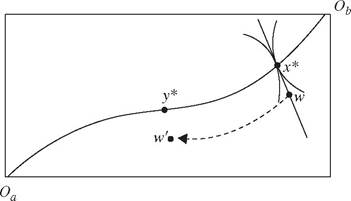
Fig. 18
at the same time, equal to the marginal rate of substitution for all consumers and equal to the marginal rate of transformation in the production system. Price is thus defined as the common value of relationship both ofpsychological and of technological equivalence.
Consider Fig. 18, which depicts Edgeworth’s box diagram relating to the exchange activity between two individuals, A and B. On the two axes starting from point Oa we represent the quantities of individual A’s goods; on those starting from point Ob, the quantities of individual B’s goods. The curve joining points Oa to point Ob is the contract curve. In any of its points the marginal rates of substitution of the two goods are the same for the two individuals and are equal to the price ratio. Clearly, there will be a different general-equilibrium configuration which is Pareto efficient in any point on the contract curve. But which of these infinite number of points is selected by the market mechanism will depend on initial endowments of resources.
The problem that now arises is no longer a problem of efficiency, but rather one of distributive justice.
And this is how the second fundamental theorem should be understood. If w is the initial endowment of goods, considering the co-ordinates of point w with respect to origin Oa and origin Ob, it is easy to see that A possesses much more than B. The competitive equilibrium associated with w is x*. However, an allocation such as y*, which also lies on the contract curve, and therefore meets the efficiency requirement, seems preferable to x* on the basis of considerations of justice. Can the competitive mechanism, given w, lead an economy to an allocation such as y*? The answer is provided by the second fundamental theorem of welfare economics, which ensures that a competitive market is unbiased, or neutral; by means of an opportune initial redistribution of resources between individuals, it is possible to reach any desired Pareto optimum as a competitive equilibrium.Let us imagine that a public authority makes cash transfers between individuals. Each agent has an account with this authority in which all the goods he owns are listed. Let us assume that there are l goods (j = 1,2... l) and m individuals (i = 1, 2...m). Consider an initial allocation w = (w1, w2... wm) and a desired allocation y = (y1, y2... ym), where wi and yi are l—ples whose elements, wij and yij, represent the endowments of goods j of individual i. The problem is as follows: is there a lump-sum transfer vector T = (T1, T2... Tm) and a price vector p = (p1, p2... p) such that each individual maximizes his utility function Ui (i = 1, 2... m) subject to pyi ≤ pwi + Ti ? The affirmative answer is to be found in the second fundamental theorem. It is assumed that the Ui functions are individualist and monotone (increasing) and that the indifference curves are convex.
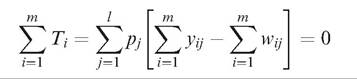
y* is any Pareto-efficient allocation for which yij* > 0 for all the is and js. Then there is a transfer vector T and a price vector p, such that the pair (y*, p) is in a competitive Walrasian equilibrium, given those transfers.It is easy to see that the algebraic sum of the Tis must vanish. In fact, the theorem ensures that, for all the is, y* maximizes Ui under the constraint pyi < pwi + Ti. On the other hand, for the assumption of monotonicity (non-satiety) of the Ui functions, the individuals will spend all their incomes. Thus: pyi = pwi + Ti. For the whole economy we will have:
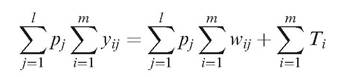
Since it is only a reallocation of given resources, the summation of final endowments, yij, must be equal to that of initial endowments, wij:
An important observation about the specific use of the second theorem needs to be made. The new welfare economics has used it to sanction the separation between efficiency problems and distributive-justice problems. The market is efficient as an allocation instrument. Therefore, if the distribution of welfare (or of income) following a competitive bargaining process is deemed unfair, then it is sufficient to revise the initial endowments by means of lump-sum transfers. This implies admitting the existence of a dichotomy between the moment of the production of wealth and the moment of its distribution. The intervention of the public authority would be justified only at the second moment and not at the first. But a doubt soon arises.
Attention should be paid to what the second theorem presupposes for its validity. The central authority must know, not only the technological possibilities and the initial endowments of the single individuals, but also their utility functions.
Otherwise it will not be in a position to determine the Ti transfers exactly. But if the authority knows all this, why is the market mechanism necessary? Could not the authority itself directly reach the y* allocation without resorting to the market mechanism, for example by means of some type of planning? The answer is affirmative.As has been forcibly shown by P. Dasgupta in ‘Positive Freedom, Markets, and the Welfare State’ (1986), the following paradox seems inevitable. The second fundamental theorem of welfare economics, whilst it is called on
to support the argument that the authority must avail itself of the market, is only valid in those circumstances in which there is no need to resort to the market as an allocative mechanism. This is, obviously, a fundamental paradox to which there does not seem to be a credible solution.
But there is even more to it. What conditions must be satisfied for the second theorem to be used to demonstrate that efficiency and equity can cohabit in a market economy? There are two fundamental conditions: a general equilibrium that is unique and stable. In fact, once the public authority has made the initial desired distribution of resources, if the equilibrium is not unique the market, instead of leading to y*, may lead to a ‘wrong’ equilibrium, even to one that is more unequal than the one to be corrected. On the other hand, if the equilibrium is unstable, as soon as the initial w state is left behind, the market mechanism may destabilize the economy so that it may never reach an equilibrium; in other words, the desired equilibrium would be unachievable precisely because of the way the market functions.
10.2.2. The debate about market failures and Coases theorem
Among the many and various assumptions which must be made to demonstrate the two fundamental theorems, one (apart from the existence of complete markets) is crucial: the absence of external effects. Thus the following circumstances must be excluded:
(1) that the consumption choices of some agents influence the levels of utility of other agents;
(2) that the production functions of some firms are influenced by the production decisions of other firms.
Externalities exist when, given the usual definition of property rights, in terms of the rights and duties of those who exercise an economic activity, the agent who does the damage is not obliged to compensate the consumers or producers who suffer damage as a result of his activities.
The presence of externalities indicates an insufficiency in the market mechanism, in the sense that individuals’ choices are made on the basis of prices and costs that do not reflect the true value of the resources utilized. In the case of a factory which emits smoke, the producer will act on the basis of a cost of his activity, the private cost, which is lower than the social cost, i.e. the sum of the private costs and the damages suffered by the others. The latter is what he would have to sustain if he had to pay for compensation for the damage caused to his neighbours. The result is that he will tend to increase his production beyond the level he would have maintained if he had to pay the social cost. This is why the market mechanism does not operate perfectly.
In short, it is possible to say that the fundamental theorems can only take into account those categories of social interaction conveyed by the price mechanism. The latter, in the presence of externalities, is incapable of informing the decision-makers correctly; and this deprives the competitive- equilibrium allocations of optimality.
The cure for the inefficiencies caused by externalities lies in the introduction of opportune corrective measures: basically, those taxes and subsidies already proposed by Pigou. If, in a consumption or production activity, an individual damages others, he should have to pay a tax proportional to the damage he has caused, while if he benefits the others he should receive a subsidy.
The solution envisaged by Pigou, and later adopted and improved by Samuelson in the 1940s, calmed the waters troubled by those who doubted the ability of the market to achieve an efficient allocation of resources. However, the truce was short-lived. From the late 1950s, another line of attack against the tenets of free-market doctrine gained ground, starting from the observation that, for various reasons connected with the process of economic growth, the conflict between individual action and the satisfaction of individual preferences is liable to become bitter. To get what you want and to do what you want are incompatible whenever mass phenomena of social interaction are present. Consider the case of the commons, first brought to light by G. Hardin in ‘The Tragedy of the Commons’ (1968). Commons are resources that can be used by many individuals, none of whom is the owner. Each individual, if he is self-interested, will try to get maximum utility from these goods and ignore the necessity of other people. The result is that, if all people behave like that the resources will be finally exhausted. All individuals could be better off, collectively speaking, if their behaviour were restricted; but nobody, individually speaking, is interested in self-restriction. In these situations, which become increasingly frequent as an economy evolves, individual action is no longer a sure means of achieving individual objectives. It was, above all, Albert Hirschman and Amartya Sen who demonstrated that such objectives can best be reached either by collective action or by tying individual action to a moral code of behaviour, a ‘richer’ code than the mercantile moral code of the classical and neoclassical economists—richer in the sense that, besides honesty and trust, it includes benevolence.
Also consider the numerous cases described in the famous ‘prisoner’s dilemma’. These are cases that regularly crop up whenever ‘public goods’ are considered, i.e. goods characterized by the absence of rivalry in consumption (a number of individuals can, at the same time, benefit from a good without this reducing the utility of each individual) and by the inexcludability from benefits (whatever good is made available to somebody, it is not possible or worthwhile to exclude others from the benefits the good produces). The paradoxical result is that, in the case of public goods rational subjects are motivated to choose the course of action which does not maximize their welfare.
Because of the property of non-rivalry in consumption, the marginal costs of supplying the benefits of a public good are zero, so that it would seem optimal to make this available to the whole community. The community, however, has to pay for the public good. If each consumer must pay the same amount, then the consumers with the lowest marginal utility will prefer not to consume the public good, and this is sub-optimal in view of the fact that additional consumption by an individual does not increase the total cost. Thus the condition of optimality requires that each consumer pay a price equal to his marginal evaluation—a result already obtained by Wicksell and Lindahl.
What makes it impossible to reach an optimal equilibrium is the problem of the free rider—the presence of consumers who take advantage of collective consumer goods by not participating adequately in their financing.
A further case of market failure is due to asymmetric information, and was brought to light by G. Akerlof in ‘The Market for Lemons’ (1970). One of the conditions for the correct functioning of markets is perfect information about the goods and services exchanged. Now, it is a fact that the buyer’s knowledge is often a great deal less than the seller’s. In situations of this type, the agent in possession of more information is driven by the criterion of rationality itself into a situation of moral hazard or adverse selection. The latter are those situations in which the contracting parties have different information concerning some characteristics of the contract (e.g. the quality of the product) and this is why one speaks of hidden information. Moral hazard situations, on the other hand, arise when the possible effects of a contract depend on the actions of at least one of the contracting parties, and when such actions are not perfectly observable by the other party (in this case one speaks of hidden action). In both cases the agents are motivated to give false information—to violate, in other words, the code of mercantile morality which is necessary for the correct functioning of the market. As Arrow observed, adherence to a Kantian code of professional ethics could remedy these specific forms of market insufficiency.
The fact that non-utilitarian behaviour is needed in situations in which the market and personal interest produce undesirable results has restored the notion of benevolence. The need for norms and ethical behaviour that would integrate with, and at times replace, self-interested behaviour seems one of the most interesting results of the theoretical research of the last twenty years on the foundations of free-market doctrine.
The diversity of the results derived from ‘benevolent action’ and the action inspired by the familiar criterion of economic rationality obliges us to reconsider the latter: what kind of rationality is one that leads to sub-optimal results? Above all, it throws serious doubts on the logical possibility of keeping separate the judgements of rationality, intended as judgements dealing with the relationship between choices and preferences, and moral judgements, intended as judgements about the preferences themselves.
It should be noted that the impossibility of restricting the notion of rationality to judgement of the appropriateness of the means in respect to given ends is of a logical nature: it follows from the gap that social interaction produces between the intentions and the results of the action, i.e. from the gap between the expected and actual results of individual choice.
What is the moral of the story? That the principles of personal interest and mercantile morality are inadequate as instruments of social organization when phenomena of social interaction are massively present, as in the case of the highly industrialized modern economies. In these situations, the simple pursuit of self-interest no longer ensures even the attainment of economic efficiency.
A radically alternative way to tackle the problem of externalities, public goods, and informative asymmetries was suggested by Ronald H. Coase in his famous article ‘The Problem of Social Cost’ (1960). In the presence of complete information on the part of the agents and in the absence of transaction costs, the consequences of externalities and public goods can be corrected by means of the market itself, no recourse to State intervention is needed. In fact, Coase demonstrated that, if the parties involved are really able freely to negotiate the effects of externalities, an optimal allocation of resources can be reached independently of the initial distribution of property rights, and without any State intervention. In other words, Pigou’s argument ignored (according to Coase) the possibility of agreement and therefore of a ‘transaction’ between the parties. If, with no costs, an act of exchange is possible between the agents whose actions generate externalities and the agents upon whom the external effects fall, then the externalities can be ‘internalized’. Let us consider the case of the factory emitting polluting material and the community affected. The community, which has the right to enjoy clean air, can transfer this right by selling ‘concessions’ to pollute; each concession allows the factory to produce one unit more of output and the pollution associated with it. The community will continue to sell concessions as long as the marginal benefits so obtained exceed the marginal costs represented by the increase in pollution. It is clear that Coase’s theorem is based on the idea that individuals can freely use their property rights as an object of negotiation, just as if they were any other good.
Coase’s theorem is rather stronger than the first theorem of welfare economics. It is similar to it in that it states that, if everything, including property rights, is negotiable, then Pareto-efficient results are assured, whatever the property structure on the basis of which the subjects operate. Unlike it, however, it has no need of any hypotheses of convexity, pricetaking behaviour, and complete markets. The only thing that it requires is the absence of any barrier to bargaining. Now, since Coase’s theorem depends on the hypothesis that the subjects bargain in an efficient way, it is obvious that it has explanatory strength only if there is reason to believe that efficient bargaining is possible.
On this specific point, recent literature on the theory of bargaining, associated with the names of K. Binmore, P. Dasgupta, and J. Farrell, among others, has shown that the results promised by Coase’s theorem only apply in a few uninteresting cases, for instance, in the case of a modest number of agents and in the absence of transaction costs. The hopes of many economists of the ‘Chicago School’ thus remain frustrated: it is no longer possible to maintain, as they do, that the prisoner’s dilemma is an institution failure rather than a market failures and that an appropriate allocation of ownership rights would solve any such problems.
Lastly, the difficulties that invariably arise when ownership rights are to be attributed to individuals should be considered. To whom should the ownership of a common good, as for example a meadow, a lake, etc., be assigned out of all those who make use of it? Coase’s theorem shows that the initial allocation of ownership rights for the purpose of efficiency is irrelevant; but certainly not that it is irrelevant for the purpose of achieving some form of desired distribution. And who has established that distributive equity should be sacrificed on the altar of allocative efficiency?
10.2.3. The theory of social choice: Arrow’s impossibility theorem
There was a double response to the ‘identity crisis’ faced by the new welfare economics at the beginning of the 1950s: the neo-institutional approaches, and the theory of social choices. We shall concern ourselves with the latter in this section. This theory dates back to 1951, when K. Arrow published his famous Collective Choice and Individual Values. The book received immediate and extraordinary success, above all because of the widespread need to accept the challenge issued by Keynesian theories.
It is well known that public intervention in Keynesian theory is defined, not so much by State control of economic activity, but rather by the activation on the part of the public authorities of a level of expenditure capable of stimulating the private sector to produce more. From this point of view, the problem of social choice obviously comes second. The relationship of the State with the economy is not considered in terms of the choice how to employ the resources of the society, but in terms of the satisfaction of all the interests that an increase in public spending renders compatible with each other. However, the gradual extension of the public sector after the Second World War created a new problem: the choice between different alternatives in the use of resources. In fact, beyond a certain threshold of public intervention and with structural or technological unemployment, it seems obvious that the problem of social choice can no longer be avoided. This is why Arrow’s research has aroused so much interest.
The roots of the modern theory of social choices can be traced back to Illuminist thought, especially to two distinct sources: the normative study of welfare economics initiated by Bentham’s works and the theory of voting and committee decisions linked to the names of Borda, Condorcet, and Rousseau. However, the influence of these two streams of thought has been different through time.
Up to the 1920s, the philosophical position of welfare economics (it was not yet called the theory of social choice) was that of classical utilitarianism. Let Ui be the utility function of person i defined over the set X of alternative social states. Then we may say that x is at least as good as state y, in symbols xRy, if and only if
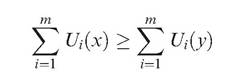
Here, clearly, cardinality and interpersonal comparison of individual utilities are needed. After Robbins, the only grounds on which it was considered permissible to base judgements about social welfare was that of the m—ple of individual (ordinal) utilities. These, however, could not be compared interpersonally, and thus the traditional sum-ranking criterion became untenable. In particular, since the cardinal-utility functions of the subjects had been replaced by their binary preference relations, Ri, the socialpreference relation, R, could only be derived from the m~ples of the individual orderings Ri.
It was in this context of ‘information crisis’ that the contribution of the other stream of thought mentioned above emerged. The welfare economist who, before the 1930s, had no reason to concern himself with the works of Borda, Condorcet, Lewis Carrol, and others, happened to discover, in voting theory, an instrument suitable for tackling the problem of the lack of information brought to light by the methodological changes of those years.
This convergence gave rise to the modern theory of social choice. The first steps were certainly not auspicious, to judge by Arrow’s impossibility theorem. In fact, even before the failure of the approach based on the compensation tests, Harrod and Bergson, among others, had already cast doubt on the possibility of building an individualistic ordering of social states without having in some way to resort to interpersonal comparisons of welfare. Arrow’s key paper in this field was the explicit and rigorous demonstration of the validity of this insight.
Here is the problem. Each individual possesses, by assumption, a well- defined ordering of preferences over the set of social states. As these orderings are expressions of the systems of individual values, they do not generally coincide with each other. A ‘function of social choice’ is, by definition, a map from the set of all the logically possible m—ples of individual orderings to the set of all possible orderings of social preferences over the various social states: R = F(R1, R2... Rm). In deciding the ordering of social states x and y, the only admissible information is that, let us say, the ith subject prefers x to y, and the jth subject prefers y to x. Arrow
demonstrated that there is no social-choice function capable of satisfying the following minimal requirements of coherence and morality:
(1) universal domain (the domain of the social-choice function must include all the profiles of individual orderings which are logically conceivable);
(2) independence from the irrelevant alternatives (the social choice derived from a given set of alternatives must not be influenced by the way in which individuals order the alternatives not included in that set);
(3) Pareto’s condition (if all individuals prefer x to y, x must be socially preferred to y);
(4) no dictatorship (there must be no dictator who invariably succeeds in imposing his own preferences over those of the others).
The difficulty lies in this: for at least some patterns of individual orderings, the attempt to satisfy these requirements generates an ordering of social preferences which does not satisfy the property of transitivity, just as happens with the paradox of Condorcet’s majority ballot. x, y, and z are three social alternatives to be chosen from on the basis of the majority criterion. It may happen that, in the comparisons between x and y, x wins; between y and z, y wins; and between x and z, z wins. Therefore there is no alternative capable of beating all the others. In fact, x loses against z which loses against y which loses against x. This means that the social choice, in so far as it cannot be rationalized by a transitive binary relation on X, does not satisfy the rationality requirement.
Thus, either one rejects at least one of the conditions imposed by Arrow on social choice (or possibly weakens it), or one changes the reference framework itself, so as to allow, for example, the utilization of an information structure which goes beyond the mere coherence of the individual preferences and their aggregation into a social-choice function dependent solely on the individual orderings. Arrow’s result proved extremely important, as it demonstrates that minimal ethical-rational properties, seemingly little restrictive for assuring the democracy of the social-evaluation process, generate unbelievable results if adopted all together.
10.2.4. Sen and the critique of utilitarianism
Amartya K. Sen attacked the ‘information poverty’ of Arrow’s scheme. In particular, two types of information were not taken into consideration by that scheme: information about the utilities of single individuals and extra-utilitarian information. This was a consequence of Arrow’s ordinalist choice—a choice implying that what matters in social decisions is solely individual preference orderings and not, for instance, the comparisons individuals themselves can make among their orderings. However, there is another constraint, implicit but no less restrictive, on the set of admissible information. In fact, Arrow’s conceptualization implies that, in the definition of R, it is not possible to account for the ‘objective’ characteristics of the alternatives; only the way in which these are ordered by individuals must be considered. This condition, known in the literature as the ‘neutrality condition’, is a reflection of ‘welfarism’, i.e. of the view that the levels of welfare or of utility manifested by individuals are the only legitimate basis on which to achieve an aggregate evaluation of the social states. In conformity with the standards of welfarism the set of relevant information contained in any social state is reduced to a vector of utility levels, each component of which refers to an individual.
From here, beginning from his Collective Choice and Social Welfare (1970), Sen developed his criticism of utilitarianism. For what reason, he asked, in deciding what is morally acceptable behaviour, or what should be the way to aggregate individuals’ preferences, should the individuals’ judgements be recognized as an ultimate authority? Of course, the principle of ‘consumer sovereignty’ is a form of respect shown towards individuals. But, apart from the fact that even utilitarians such as Harsanyi recognized the necessity of not considering certain anti-social preferences, and therefore of censuring the utility functions expressed by certain members of the collectivity, it is difficult to deny that some things have a value even if they are not desired (or preferred) by somebody. Similarly, even if there are some individuals who do not have the opportunity to manifest their preferences in regard to certain values (consider the people who live under an oppressive regime and do not have the courage to express their desire for freedom), nothing suspends the duty of granting them what they do not explicitly ask for. On the contrary, there are goods individuals believe they have a right to and which society cannot legitimately grant them, for instance, heroin.
In regard to rights, utilitarianism is particularly fragile, and this is for three specific reasons. First is its rather restricted view of the human person. Second, rights cannot find a place in a theoretical structure which postulates continuity, in that they represent areas of discontinuity; areas in which an unlimited trade-off between the alternatives at stake cannot even be conceived. The third reason is concerned with sum-ranking. Clearly, in putting together the pieces of utility into a total sum, the identity and separateness of the individuals is lost, but these requirements are necessary to make possible the allocation of rights.
In conclusion, any attempt to introduce rights into the moral calculus must break with utilitarianism. The latter cannot restrict itself to the argument of ethical individualism, according to which all and only the individuals count, and all count equally. Acceptable ethical individualism implies something more than the respect of individuals; it implies respect of the individual. In exploring the territory of rights, Sen ran up against an impossibility result, formally analogous to Arrow’s, but substantially more embarrassing. This is the famous argument put forward in ‘The Impossibility of a Paretian Liberal’ (1970). The argument is that there is no social choice function (or rule) which satisfies, at the same time, the conditions of:
(1) universal domain;
(2) minimal freedom (there must be at least a couple of alternatives belonging to the protected sphere of the individual, over which his desire or will must reign supreme);
(3) Pareto’s condition.
The following example clarifies Sen’s demonstrative strategy. There are two individuals: A, who is a strait-laced, prudish type, and B who has no moral scruples. The object of social choice is the reading of a rather licentious novel (Lady Chatterley’s Lover, in Sen’s original example). The possible alternatives are: x (A alone reads the book); y (B alone reads the book); z (no one reads the book). Given the psychological characteristics of the two individuals, A’s order of preference will be: z > x > y, where the symbol ‘ > ’ stands for ‘preferred to’. B’s will be: x > y > z. If we now ask A to choose between z and x, he will opt for z, whereas if we ask B to choose between z and y, he will opt for y. Considering condition b) above, the collective choice should satisfy the following order: y > z > x. Yet for both individuals x is preferred to y and the x option is therefore Pareto superior to option y. The collective choice that respects the condition of minimal freedom contradicts the collective choice that complies with the Pareto principle.
What is the sense of Sen’s theorem? This is, first of all, a result which, unlike Arrow’s, presupposes the specification of only one preference-ordering for each individual. Second, neither transitivity nor quasi-transitivity of the social preference are required here, but only its ‘acyclicity’, a much weaker condition which requires that, given n social alternatives x1, x2... xn, if x1 is preferred to x2, x2 is preferred to x3... xn-1 is preferred to xn, then x1 must be preferred to xn. Third, the appeal to an increase in the utility information is not admissible in this case; and this is for the obvious reason that the libertarian conception requires that rights be taken into consideration in virtue of the nature of the choices at stake, i.e. of the fact that they are ‘personal’ questions, and not on the basis of the net utility gains connected to them. Fourth, the impossibility in question has nothing to do with the absence of extra-utilitarian information, since the minimal-freedom condition itself embodies such information. Rather, the impossibility of the Paretian liberal can be ultimately explained in terms, not of inadequate information, but of the incongruent use of the available information: the Pareto principle states that certain classes of social decisions must be exclusively based on utility information, while the liberal principle insists on conferring a primary role on extra-utilitarian information to reach some other classes of social choices. The impossibility result captures the tension between the two principles.
There have been various and numerous attempts at extending Sen’s work, as well as several ingenious attempts to avoid its negative results. But it is obvious that the interest of Sen’s arguments is not in their paradoxical nature but rather in their ability to show that the introduction of rights into the process of social choice poses new problems to the economist who believes that it is not necessary to gather information on the motivations underlying individual preferences or to take into consideration the nature of the social alternatives at stake.
10.2.5. Economic theories of justice
One of the most interesting spin-offs from research on social-choice theory has been the deep change in the way of conceiving the link between efficiency problems and distributive justice. Smith, in the Theory of Moral Sentiments, had maintained that justice is the main pillar of the social building.
Men are led by an invisible hand to make nearly the same distribution of the necessaries of life, which would have been made, had the earth been divided into equal portions among all its inhabitants, and thus without intending it, without knowing it, advance the interest of the society, and afford means to the multiplication of the species. (pp. 184-5)
But over the course of successive developments, the principle of self-interest ended up by attracting the attention of the economists, thus contributing to relegate the category of justice to the limbo of ethical, i.e. meta-scientific, considerations. Why was there a resurgence of interest in the subject of justice in the second half of the 1970s? Is there a connection with the great emancipation movements of those times?
We have already mentioned that utilitarianism had strong reformist political implications, at least in its early stages—consider J. S. Mill, Marshall, Wicksteed, and Pigou. It was only later, with the rise of the ordinalist statute, that it became an apology for the status quo. In particular, the belief that distributive justice and efficiency are antithetical was a consequence of the Pareto-efficiency criterion. On the other hand, if that belief is neither disturbing nor worrying, this is due to the way in which Keynesian theory laid down the terms of the relationship between efficiency and justice. In fact, in that theory, the State never enters into conflict with the market, but helps it, since public intervention simultaneously pursues objectives of equity and efficiency. An unemployment situation derived from a lack of effective demand is a clear waste of resources, and therefore both inefficient and unfair. Keynes was explicit on both points. On the other hand, the argument that there are special historical circumstances in which the State can act successfully as a neutral mediator between the classes was a really great political achievement of Keynesianism. A higher level of public investment in a depression not only generates more jobs for the unemployed, and therefore a higher wage bill, but it also helps the capitalists to obtain a higher level of profits.
However, this economic role of the State no longer applies when the political conditions for the functioning of human face capitalism are absent. Then Keynesian economic policy and the philosophy of the administered market enter into conflict. So it is not surprising that, starting from the 1960s, the idea of a trade-off between efficiency and justice was taken up again both by economists and by policy-makers. Arthur Okun, in Equality and Efficiency: The Big Trade-Off (1975), has elegantly summed up the liberalist viewpoint: ‘any insistence on carving the pie into equal slices would shrink the size of the pie. That fact poses the trade-off between economic equality and economic efficiency’ (p. 48). The inefficacy of public interventions in the field of distribution is depicted by Okun with Pareto’s fable of the bucket with a hole: ‘the money must be carried from the rich to the poor in a leaky bucket. Some of it will simply disappear in transit, so the poor will not receive all the money that is taken from the rich’ (p. 91). At the root of the thesis of trade-off is the idea that, to achieve equality objectives, taxbased redistribution schemes must be adopted which would anyway have distortion effects on resource allocation.
Recently, doubts have been cast on the ‘justification’ approach to economic rationality, an approach that for so long has allowed the economist to work ‘undisturbed’ by worries concerning the fair distribution of resources and incomes. First, the various difficulties connected with the correct functioning of the market mechanism, as presented in section 10.2.2, have undermined what appeared to be the sound certainties about the ability of the market to achieve efficiency. Second, awareness spread that the societies in which we live are complex structures in which it is possible to have equal rights but unequal distribution of opportunities. We are at the same time members of the ‘citizenship club’, in which we are recognized as equal (one head, one vote), and members of the ‘market club’, whose fundamental rule (one penny, one vote) provides prizes and sanctions resulting from transactions that obey no principle of social equality. The most common tensions are those between the rights of citizenship and the rights of ownership; between rights and opportunities; between being equally free to do or to own something and having different basic abilities to do or to own something. But economic democracy and political democracy cannot diverge too much and for too long, otherwise the very foundations of the market system would be dangerously affected. Which is tantamount to saying that keeping the allocative objective and the redistributive objective separate does not meet the criteria either of efficiency or of equity, as was convincingly argued by Anthony Atkinson in The Economic Consequences of Rolling Back the Welfare State (1999).
Contemporary economic theories of justice pursue the project to define an analytical framework capable of dealing at the same time with questions of efficiency and of justice, thus overcoming the traditional separation of the fields of research. The various lines of attack so far put forward are mainly variants, more or less radical, of the two principal traditions of thought in the field of political philosophy, the contractarian and the utilitarian. The first, which can be traced back to the work of Hobbes, Locke, and Rousseau, conceives the State as the result of a bargaining process among self-interested agents, just as happens in a business contract between economic agents. From an utilitarian perspective, on the other hand, the State is an organization that maximizes social welfare, just as a firm maximizes its profit. It is a sort of super-agent aiming at resolving conflicts of interest among individuals in the same way that the individual resolves his own interior conflicts. In a contractarian view, on the contrary, the individual can be a maximizer, but not the State, for this has the specific task of fixing the basic rules (the constitution) that legitimate individuals in pursuing their own private ends.
In his influential A Theory of Justice (1971), J. Rawls reawakened interest in the contractarian line of thought by putting forward an alternative procedure to the utilitarian one to express a judgement of social preferability among alternative states. A distributive pattern is ‘just’, according to Rawls, when it is fair, i.e. when it offers the same opportunities to all members of the collectivity, provided that, if such equality does not actually exist, the rules of the game favour the most disadvantaged groups in the assignment of resources. This is the meaning of the social-choice criterion called ‘maximin’: it consists of maximizing the welfare of the subjects at the lower echelons of the social scale. To accept this criterion of choice, the subjects must distance themselves—according to Rawls—from the knowledge of their own personal attributes, placing themselves behind a ‘veil of ignorance’. Behind the veil, everybody finds himself in an ‘original’ position of total equality, in the sense that each possesses the same information about the probable effects of the different distributive rules on his own future position. From this position all individuals will fear he possibility of falling in a disadvantaged situation, and therefor all will accept the maximin rule. Thus justice is introduced by virtue of the impartiality of the collective decision-making process. Rawls’s theory is typically ‘end-state-orientated’, in the sense that, when evaluations must be made, it focuses on the final state.
An alternative approach, put forward by von Hayek and Nozick within the liberal tradition, developed a theory of procedural justice, in which justice is defined in terms of compliance to the rules and procedures by which agents may acquire resources and rights. In his illustration of the entitlement theory, put forward in Anarchy, State and Utopia (1974), Robert Nozick clarified the two principles of justice of his theoretical proposal: justice in acquisition (the initial acquisition of property must comply with the rules of the game), and justice in transfer (the transfer of property between different subjects must occur on the basis of a valid entitlement). Nozick’s process- orientated approach therefore rejects consequentialism, a pillar of the utilitarian construction, according to which only the consequences of a given course of action must be taken into account. This is perhaps the sharpest way to justify a ‘minimal State’.
Hayek, too, in The Constitution of Liberty (1960), supported the process- orientated approach: in judging the results of social institutions such as the market, attention should only be paid to the process by means of which those results are obtained; and the process is just if it respects the rules on which rational and self-interested individuals would agree. Thus, the process justifies the result; in other words, the means justify the end, and not vice versa, as in the end-state approach. Another important thesis put forward by Hayek is that the very notion of social justice is meaningless. Justice is only a virtue, according to him, and, as such, it pertains to individual behaviour rather than collective choices. Hayek’s and Nozick’s approach has been defined ‘libertarian’ by its followers, but improperly so. In fact this term is traditionally referred to anarchist positions and not to extreme conservative ones. Therefor we propose to use the term ‘ultra-liberalist’, rather than ‘libertarian’, when referring to Hayek, Nozick and their followers.
Sen tackled the problem of justice in a different way. In On Economic Inequality (1973) and Commodities and Capabilities (1985) he centred his analysis on the observation that basic values such as liberty cannot be enjoyed below certain levels of welfare. Bundles of commodities are valued non in themselves but for the functionings they enable: being well clothed and in good health, being protected by violent attacks, taking part in community life, being able to understand the world, etc. In this view the value of commodities does not only depends on individual preferences. It depends much more on the social circumstances in which people are embedded. The set of functionings among which an individual is able to choose represents his capabilities. The wider is this set the freer the individual is. Freedom cannot be valued in term of welfare, yet it has value. Consuming bundle x when an individual has freely chosen it in a vast set of opportunities, is not the same thing as consuming it when there are no alternatives. Sen suggested to define justice in terms of capabilities. It is not enough to consider the amount of goods and services available to an individual; it is also necessary to ascertain whether these really enable him to satisfy his own needs and freely choose his life project. Justice, in this approach, is equality of capabilities: not welfare or income or wealth have to be equalized and maximized, but the people’s capacity to choose.
More recently, in The Wealth of Reason, Sen clarified the connection between his concept of justice and his concept of freedom. The latter is not the concept of being free to choose to which Milton Friedman referred in his influential Capitalism and Freedom, in other words, freedom as mere self-determination. Rather it is freedom in the sense of self-realization, a distinction that Sen explained as the difference between ‘freedom to act’ (absence of restrictions or interference from outside sources) and ‘freedom to realize’ (possibility of affirming one’s personal identity). The relativistic view of freedom, by reducing it to mere private permissiveness and denying it public significance, according to Sen, has led to serious confusion between ‘market omissions’ (what the market could but does not do) and market malfunctions (what the market does do, albeit badly). It is here that that kind of economic policy originates which, instead of encouraging ‘marketincluding’ interventions (endeavouring to remove the causes of various market failures), tends to realize ‘market-excluding’ interventions (which substitute the market).
Based on these principles, Sen, in his Development as Freedom, put forward the idea of growth as a process of expansion of the freedoms that are actually enjoyed by people. Thus he contributed to overcoming the reductionist concepts of development, for example, ‘those that identify it with growth of the gross domestic product or the increase in individual incomes, with industrialization or with technological progress, or modernisation of society’ (p.18). Economic theory cannot be limited to the study of the means of economic development, it must also contemplate the problem of defining the goals. The vast practical implications of this conceptual approach have influenced both the way in which human development indicators are constructed and the choice of intervention strategies in the fight against poverty.
10.3.