Marx’s Economic Theory
4.3.1. Marx and the classical economists
Just when theories of economic harmony were spreading all over the capitalist world, Karl Marx was working on a ‘critique of political economy’.
The dates here are important. The defeat of the workers’ movement in 1848 ended a cycle of struggle which had lasted for more than thirty years and opened a phase of bourgeois cultural hegemony and capitalist economic growth previously unknown in Europe. The old revolutionaries, forced into exile and political inactivity, had to find a modus vivendi. The road taken by Marx was to closet himself in the British Museum Library and dedicate most of his time to study. The revolutionary leader became an ‘economist’, convinced that he was still working for ‘the old mole’. It was certainly a return to the ‘weapon of criticism’. But the ‘critique of political economy’ must be, according to Marx, a weapon for the proletarian revolution.The first volume of Das Kapital was published in 1867. The other two were published posthumously by Engels in 1883 and 1894. Marx did not have time to arrange them into a final version, and some chapters are little more than a collection of notes. Two other important works of Marx, the Theorien uber den Mehrwert and the Grundrisse, are also collections of more or less ordered notes.
There is a close relationship between Marx and the classical economists. In fact, he himself never had any difficulty in acknowledging the scientific merits of the great English classical economists, Ricardo in particular. The name itself, ‘classical’, which he attributed to them was almost a tribute from a student. By it, he intended to distinguish them from the ‘vulgar’ economists, the apologists of capitalism who worked to produce consensus rather than science. His definition of ‘classical political economy’ is simple and rigorous, and coincides with that of ‘Ricardian economics’: a theoretical system based on the theory of surplus, the labour theory of value, the methodology of aggregates, and the analysis of the behaviour of the social classes and their relationships.
Smith’s thought itself was scrutinized in the light of the Ricardian system, and did not always pass the test.Marx considered classical political economy as a theoretical expression of the bourgeoisie in the period when the modern capitalist economy was asserting itself. The historical reference was to the English Industrial Revolution and the struggle for political hegemony that the bourgeoisie conducted in Great Britain and France between 1815 and 1848. In the struggle against the forces of aristocratic and clerical reaction, the bourgeoisie interpreted the needs of the whole society, endeavouring to present its own class interests as collective interests and the spirit of private accumulation as an instrument to increase the national wealth. The other side of the coin was that the interests of the landowners had to be shown as conflicting with those of the collectivity. This is why the classical theoretical system was based on the analysis of the social classes, the study of class conflict and the dynamics of economic aggregates resulting from the behaviour and interaction of collective agents. Marx was referring to all this when he argued that the classical economists proposed to penetrate the inner physiology of the bourgeois society. Thus, the analytical apparatus of classical political economy was robust, and Marx adopted it wholesale.
According to Marx, however, after 1830 came an important turning-point in the history of economic thought. The industrial bourgeoisie, as soon as it came to power with the help of the proletariat in England and France, tried to change alliance. At that moment the class conflict with the proletariat had become more important, whereas the struggle with the landowners had abated. Now the bourgeoisie needed to demonstrate that the enlightenment dream of a society of free citizens had finally been realized, that in this society there was no oppression or exploitation, that each person received what he gave, and that class conflict, or, rather the classes themselves, had no longer a reason to exist.
At this point a theoretical system based on classes and class conflict no longer served; the theories of harmony of interests and of co-operating productive factors were more useful. Thus, as the scientific inheritance of classical political economy had been betrayed by the ‘bourgeois economists’, it now passed to the socialist economists. Now it was the working class which represented its interests as coinciding with those of the collectivity. This is the origin of the socialist cognitive interests in penetrating the physiology of bourgeois society. Marx believed that the proletariat had inherited science from the bourgeoisie, while waiting to inherit the world. This would explain the place of Capital in the history of economic thought. And this, according to Marx, accounted for his ability to recognize the limits of classical political economy; in fact, as we should not forget, Marx’s theory was a ‘critique of political economy’.Marx differs from the classical economists in that his philosophical background is neither utilitarian, empiricist, nor based on natural law philosophy. Nor, insofar as the ontological foundations of political economy are concerned, can his thought be reduced to classical and neoclassical individualism or to historicist and institutionalist holism. On the definition of individual motivations, in fact Marx argued that
Whether he [the individual ] appears more as an egoist or more as selfless [—that was a quite subordinate question, which] could only acquire any interest at all if it were raised in definite epochs of history in relation to definite individuals. (p. 246)
In more general terms, his basic theory is that
Individuals have always and in all circumstances ‘proceeded from themselves’, but since they were not unique in the sense of not needing any connections with one another, and since their needs, consequently their nature, and the method of satisfying their needs, connected them with one another (relations between the sexes, exchange, division of labour), they had to enter into relations with one another.
Moreover, since they entered into intercourse with one another not as pure egos, but as individuals at a definite stage of development of their productive forces and requirements, and since this intercourse, in its turn, determined productions and needs, it was, therefore, precisely the personal, individual behaviour of individuals, their behaviour to one another as individuals, that created the existing relations and daily reproduces them anew.[...] Hence it certainly follows that the development of an individual is determined by the development of all the others with whom he is directly or indirectly associated. (pp. 437-8)These passages from German Ideology, written in collaboration with Engels, are indicative of the depth of Marxian critique of the metaphysics of Homo oeconomicus. Marx developed an ontology of the social being as an alternative to the one on which the liberal political economy of his times was being founded, an ontology that exalts the role played by the institutions, culture and the material conditions of production on the formation of ‘human nature'. Marx invariably refused to see the individual as a social atom or a cog in a wheel and considered human nature as both malleable and autopoietic at the same time. It is malleable since the interests, needs, tastes, endowments and ideas of human beings are formed not by ‘nature' but by history and the social context in which they live; the economist cannot therefore take them as ‘exogenous data’. Political economy must determine ‘human nature' endogenously with respect to the economic structure studied. It is autopoietic since the very circumstances in which the social subjects act are determined by their action and their ends. For Marx, economic action is always intentional, even when individual perception of the interests in play is distorted by ideologies. For him, the ideologies themselves are instruments of social action. Theory serves practice, science serves social change: the Communist dream of a society made up of free and equal individuals can only come true if it is realized with the conscious intention and the collective action of the subjects who create it.
Marx made many specific criticisms of the classical economists, but three, in particular, are important. The first deals with their inability to explain the nature of profit and capital. They had posed the problem of determining the size of profits, not that of explaining its social bases, i.e. its origin in the exploitation of labour. Marx acknowledged that Smith had had an insight into the problem and that, in his distinction between embodied and commanded labour, Smith had set down the premisses for the correct solution. But Marx conceded nothing more. He did not even acknowledge this in Ricardo.
The second criticism is linked to the first, and concerns the inability of the classical economists to acknowledge the historical character of capitalism. As these classical economists did not know what capital was, they were unable to distinguish between its technological and social dimensions. As the need to use the means of production to produce goods has always existed and always will, capital and the social order which it creates seem eternal. Marx, on the contrary, argued that capital is a social relationship: it is not simply a set of means of production, but rather, the power that their control gives to the bourgeoisie; the power to use the means of production to produce profits. Only in a particular social system, which he called ‘the capitalist mode of production’, do the means of production become capital. Therefore, the aim of the critique of political economy should be, on the one hand, to understand how this mode of production works and, on the other, to discover its ‘laws of movement’, i.e. its laws of historical evolution and transformation.
The inability of the classical, but especially the ‘vulgar’, economists to acknowledge the existence of exploitation at the basis of the capitalistic mode of production led them, according to Marx, to focus their attention on relationships of exchange rather than of production. This is the third important criticism.
The individuals enter into an exchange relationship as autonomous subjects, for exchange is the result of their independent decisions. They also enter it as equal subjects, for exchange is studied as the exchange between equivalents, and the qualitative difference between the goods exchanged, for example the difference between labour and wages, is hidden by the equality of their exchange value. This is the reason why a market system seems to be a system of equality and liberty. Smith had spoken of such liberty in terms of free competition or ‘perfect liberty’ of the single economic agent. If individuals are equal and free, their ability to recognize and pursue their personal interests will activate the ‘invisible hand’, and this will reconcile the interests of all. Thus, a freely competitive exchange economy is a system of social harmony, a system in which each person has what he wants and manages to pay, i.e. what he gives. It is easy to see why Marx, who wished to explain the nature of the social relationship that ties labour to capital, focused on the sphere of production, rather than that of ‘circulation’ or exchange, and, in particular, the mechanisms that regulate the production of income and its distribution between wages and profits.4.3.2. Exploitation in the production process
Marx’s theory of exploitation aimed at bringing to light the true nature of the capital-labour relationship by unmasking the form of relationship between equivalents in which the exchange between wages and labour was presented. The worker enters the labour market as a seller of the only productive requisite he owns: his ‘labour power’. As with any other good, this also has to obey the ‘general law of value’: in equilibrium it receives a price determined by the conditions of production. Each worker, in order to produce his working capacity, must consume a certain quantity of wage goods in the proportions determined by the consumption habits prevailing in a certain epoch. Thus, the ‘value of the labour power’ is equal to the value of the means of subsistence necessary for the survival and the reproduction of the working class. The capitalist enters the labour market with the good he possesses, i.e. capital, a part of which consists of wages. He pays the ‘exchange value' of labour power and acquires its ‘use value'. After the exchange, labour becomes a means of production, and its use, given the rules established in the employment contract and the prevailing norms, is the prerogative of the capitalist. Thus, the product of labour, i.e. the set of goods produced with the use of labour, belongs to the capitalist.
In the production process, labour produces goods whose value is superior to that of the labour power. The difference is the ‘surplus value'. This is immediately considered as an attribute of capital, as labour has already entered the productive process as capital. Marx called ‘variable' capital that part of the advances necessary to pay the labour power; ‘variable’ because it enters into the production at a value lower than that of the goods that it produces, because it is capital which ‘self-valorizes’. On the contrary, ‘constant' capital is that which is advanced to buy the means of production: it transmits to the product only its own value, without adding anything.
Thus, surplus value is the valorization of capital and belongs to the capitalist. Everything has followed market rules. The workers have received a ‘just’ price for the good they have sold, and the capitalists have paid for it. Yet capital has increased in value. The reason for this is that labour has the ability to produce more than is necessary for the reproduction of the ‘labour power'.
This is a theory that explains how and why the production of a surplus, in a capitalist economy, takes the form of production of surplus value, i.e. of a capital attribute. This theory differs from that of the Ricardian socialists, who tended instead to demonstrate the existence of exploitation by arguing that, in the setting of the ‘value of labour’, there is a violation of the natural law according to which each good should be paid for at its own ‘natural’ price. Marx criticized these theories, maintaining that, in the explanation of exploitation, it is necessary to start from the idea that the ‘just’ price for labour is that determined by the market, and not that determined by a hypothetical natural law. Thus, Marx did not even have to pose the problem of who had the moral ‘right’ to the product of labour.
The conditions of exploitation have to do with control of the production process. The sale of labour power to the capitalist boils down to the worker assuming an obligation to obedience. The capitalist exercises command in the production process precisely by virtue of the rights of control he has acquired by contract, giving rise to a situation which Marx calls ‘formal submission of work to capital’. Exploitation arises out of the fact that the capitalist exercises command to make the workers produce a higher value than he pays them as a wage. In formal submission there is no revolutionizing in production techniques. The capitalist limits himself to making his employees work using the same techniques they would use if they were self-employed workers, craftsmen, peasants etc. Even in this way he obtains a surplus-value: to be more precise, what Marx calls an ‘absolute surplus-value’, which can be further increased by extending the working day.
But the capitalist is not content with formal submission. He wants real submission, in which labour can be reorganized technically so as to make the workers produce more than they would if they were self-employed. In this way labour becomes part of the technical apparatus in which the capitalist investment is realized, and can be transformed through technical progress. This is what Marx calls ‘real submission of labour to capital’. Exploitation is heightened with the extraction of a ‘relative surplus-value’, in other words, by increasing labour productivity through technical progress.
While in the market individuals co-operate through competition, in a capitalist factory there is organized co-operation. In the chapter on ‘Co-operation’—one of the most interesting in the first volume of ‘Capital’— Marx lists a number of advantages of co-operation, among which economies of scale, specialisation, rationalization of labour times, economy of space and means of production, ‘mass force’. The latter is a quite modern concept and corresponds to what we would now call ‘team production’: the combined labour productivity of a group of workers is greater than the ‘sum total of the mechanical forces exerted by isolated workmen’ (p. 326) so that it is impossible to separate and define each worker’s specific contribution to production.
All these advantages boil down to increases in average labour productivity and are made possible by organization and co-ordination. The business structure of a firm strongly contrasts with market disorganization and enables labour to be divided on the basis of a rational plan. For Marx, a firm is a rational and efficient place, whereas the market competition gives rise to anarchy and waste. The organization of a firm therefore plays a fundamental technical function.
But in a capitalist firm the many advantages produced by co-operation do not go to the benefit of the workers. Because they are produced by a legitimately acquired labour power, those advantages are legitimately appropriated by the buyer. The buyer is a capitalist who has acquired through an employment contract the power necessary to rule the production process, control labour activities and oppose the workers’ resistance. It is therefore his prerogative to exercise command in the factory in order to increase labour productivity. Organization thus assumes a disciplinary function which flanks and supports the technical function:
By the co-operation of numerous wage-labourers, the sway of capital develops into a requisite for carrying on the labour-process itself, into a real requisite of production [...] The control exercised by the capitalist is not only a special function, due to the nature of the social labour-process, and peculiar to that process, but it is, at the same time, a function of the exploitation (of a social labour process)—[...] Again, in proportion to the increasing mass of the means of production, now no longer the property of the labourer, but of the capitalist, the necessity increases for some effective control over the proper application of those means. [...] If, then, the control of the capitalist is in substance two-fold by reason of the two-fold nature of the process of production itself,—which on the one hand, is a social process for producing use-values, on the other, a process for creating surplus-value—in form that control is despotic. As co-operation extends its scale, this despotism takes forms peculiar to itself. (Kapital, I, pp. 330-2)
In other words Marx recognizes that the fundamental command relation in capitalist production is based on power. Implementation of the production plan and actuation of the advantages of co-operation rest in fact on the factory hierarchy. It is only because capitalists have this power of command that workers can be constrained to produce more than they receive as wages. In other words, it is this organizational power that makes exploitation possible, whereas the fixing of a higher or lower wage is only an external condition.
4.3.3. Exploitation and value
From a formal point of view Marx analysed exploitation by using the theory of labour value. It seemed evident to him that surplus value is produced by labour and only labour. He believed that the different social structures that had succeeded one another through history could change the form in which surplus product appears (e.g. profit in the capitalist economy and tithes in the feudal economy) but could not change the substance. And, in substance, value is labour and surplus value is surplus labour.
The value of the gross product is assumed to be equal to the labour directly and indirectly used to produce it. The value of the net product is equal to the labour directly applied, which is called ‘living labour’. The value of constant capital is the same as the labour employed indirectly, and is called ‘dead labour’. Assuming that only one commodity is produced, corn, by means of itself and labour, l is the labour-value of a unit of corn, l living labour, k the input of seeds, and v the value of labour power, i.e. the labour used to produce the corn paid as a wage to one unit of labour. Thus, the values of the gross and net products are respectively equal to:

Constant capital is C=lk; variable capital is V = vl; therefore surplus value is S = l(1-v). Now it is also possible to write 
So, surplus value is labour. In fact, l is living labour, vl is the labour necessary to reproduce the labour power, and l— vl is the labour appropriated by the capitalists. If l is a working day, vl represents the number of hours the workers work for themselves, and l— vl is the number of hours they work for the capitalists. The rate of ‘exploitation’, or of ‘surplus value’, σ, is equal to:
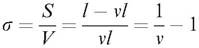
and it is easy to see that it vanishes when the workers spend the whole working day working for themselves, i.e. when v = 1.
It may be useful, in order better to understand the Marxian theory of value and exploitation, to compare it with the theory of the Ricardian socialists and with that of Hodgskin, in particular. Furthermore, in order to frame both of these theories in a historical perspective, it is worth tracing them back to the natural-law theory of value and ownership.
The attempt to use the labour theory of value to account for the distribution of income and wealth goes back at least to seventeenthcentury natural-law philosophy, if not even to scholastic thought. However, it was Locke who produced the first comprehensive formulation. Locke’s theory of value and ownership can be reduced to three fundamental propositions:
(1)In the ‘natural order’ the value of the product is the product of labour.
(2) The relationship between value and labour is not altered by social conventions.
(3) Private property is the result of accumulation of past labour and therefore does not contradict natural law.
The first proposition is a well-known argument which is central to every ontological labour theory of value. Value is created by labour. Thus the value of goods coincides with embodied labour. Locke admitted the existence of a productive contribution of land, but maintained that it was insignificant and, in any case, that it could be equated to the contribution of labour by means of a few arithmetical operations. The second proposition refers to money intended as a social institution created by collective consensus. Money allows the accumulation of the products of labour beyond any immediate subsistence need and, at the same time, allows the transfer of accumulated wealth from one person to another. The third proposition is derived from the other two. As value is produced by labour, and as natural law states that each individual must possess his own labour, so private property derived from accumulated labour is legitimate. If it is distributed in an unequal way, it is only because money allows each individual to accumulate, not only the products of his own labour, but also those bought from other individuals. As the monetary convention is based on collective consensus, and as it does not alter the law of exchange based on embodied labour, private property is legitimate, even if unequally distributed.
Hodgskin converted this doctrine into a theory of exploitation by means of a simple operation: he accepted the first proposition and rejected the second. Instead of focusing his attention on the institution of money, however, he referred more specifically to the socio-institutional structure of the capitalist economy. As profits must exist in this economy, goods can no longer be exchanged at their ‘natural prices’, i.e. at labour values, but must be exchanged at ‘social prices’, which are higher than the former by the amount necessary to make profits possible. This led him to argue that the third proposition is not valid, and that private property is not just the result of the accumulation of past labour. Property is unevenly distributed because the workers are not paid on the basis of the value of their labour, and is illegitimate because goods are not exchanged at their natural prices.
Marx, for his part, accepted the first of Locke’s propositions, but, given his philosophical background, rejected any reference to natural law. He substituted for the idea of natural law that of ‘production in general’, which, however, had the same theoretical implications as the first. ‘Production in general’ is a productive structure defined by abstracting from the particular institutional and social conditions in which production takes place. With ‘production in general’, the labour values are perfectly determined once the productive technique is known. They make up the ‘substance of value’.
In regard to the problems connected to Locke’s second thesis, Marx’s position is a little more complicated. As the ‘socio-economic forms’ change over the course of history, so do the ‘forms’ of extraction of the surplus value. In the capitalist mode of production, the necessity to ensure a uniform rate of profit, required by the hypothesis of competition, implies that the goods are exchanged no longer at labour values but at ‘production prices’ (we will discuss this in the next section). However, changes in the form cannot alter the substance; and the substance of value remains labour. Thus, production prices redistribute value among the various productive sectors, but do not modify its amount. For this reason, and with reference to aggregate production, Marx obtained a result similar to that of Locke’s second propositions. Even within a determinate socioeconomic structure, such as capitalism, the overall value of the product remains the product of labour, so that the aggregate surplus remains equal to the surplus value.
A consequence of this is that Locke’s third proposition is also valid—certainly not in the sense that private property is ‘just’, but undoubtedly in the sense that property is the result of an accumulation of past labour, except that it is the accumulation of other people’s labour. In this way Marx managed to deal with exploitation without referring to any ethical- philosophical justification of the type put forward by the Ricardian socialists. Instead, Hodgskin formulated a theory of exploitation which implied a condemnation of profit by using natural-law arguments. However, and paradoxically, Marx distanced himself from Locke less than Hodgskin had done: in his theory, all three of Locke’s propositions on value and wealth remained basically valid.
4.3.4. The transformation of values into prices
Marx appreciated the reasons for Smith’s distinction between embodied and commanded labour, and criticized Ricardo for not having well understood the reasons why goods are not exchanged at labour values. He maintained that goods are exchanged at ‘production prices’, which are prices determined in such a way as to guarantee a uniform rate of profit. In general, the ratio between the production prices of two goods does not coincide with the ratio between the quantities of labour embodied in them.
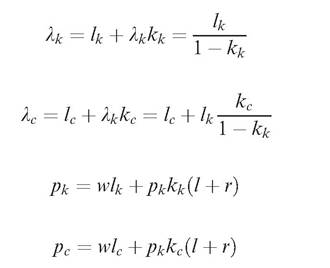
In order to understand this in the simplest possible way, let us now consider an economy that produces two commodities: a capital good and a consumer good. Let kk and kc be the quantities of good used to produce one unit of capital good and one of consumer good respectively, lk and lc the
152 SOCIALIST ECONOMIC THOUGHT AND MARX
inputs of living labour, λk and λc the labour values, pk and pc the monetary prices of production, w the money wage, and r the rate of profit. We have:
The relative labour values and the relative prices are respectively:
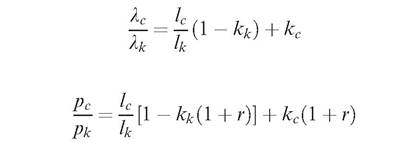
Only under two conditions can λcJ λk=pclpk occur. The first is that r = 0; but this is irrelevant, as in a capitalist economy the profit must be positive. The second is that kkllk = kcllc, or lcllk = kclkk. In fact, by substituting kclkk for lcllk in the preceding two equations, λclλk = pclpk is obtained.
In general, the prices diverge from the labour values because different techniques are used to produce different goods. Marx accounted for this result by saying that there are different ‘organic’ and ‘technical’ compositions of capital in the two sectors. In our example prices diverge from values because kk∕lk = kc∕lc.
However, Marx maintained that in the aggregate the valuations in prices could not diverge from those in values; which means that the labour theory of value is not valid as an explanation of the exchange values of the single goods, but is still valid as an explanation of the value of the gross product and its aggregate components. This is the reason why, in the whole of the first volume of Capital, where Marx studied the working of a capitalist economy at the maximum level of abstraction and aggregation, he measured all the economic variables in embodied labour. His idea was that the valuation in prices would only lead to a redistribution of the overall value among the various sectors, but could not alter its aggregate size, which depends solely on the quantity of labour employed by the society to produce the gross income. A consequence of this is that the aggregate rate of exploitation could not be changed by the way in which the surplus value is shared out among the capitalists, because it is
given by the ratio between the total surplus value and the total necessary labour. A final consequence is that the aggregate rate of profit could be calculated, if the technique and the real wage are known, without knowing the prices; and, as it cannot be altered by the valuations in prices, it could be applied to the costs of production of the single industries to calculate the prices themselves. In this way, the values would be ‘transformed’ into prices, an operation that Marx attempted in the third volume of Capital.
In order to understand where the difficulties of the transformation lie, we will calculate the average rate of profit in labour values and in production prices and see if the two measures coincide. The economy we are considering is stationary. Therefore, the gross product of the capital-goods sector is the same as replacements, 1 = kk + kc, and the value of aggregate capital is pk if valued in prices and lk if valued in labour values; furthermore, the gross production of consumer goods coincides with the aggregate net product, and its value is pc if valued in prices and lc if valued in embodied labour; finally, L = lk + lc is total employment. Then, the rate of profit calculated in prices is: 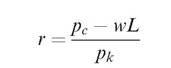 and that calculated in embodied labour, p, is:
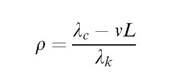
By equating these two expressions, and keeping in mind that the real wage is wr = v∕lc = w∕pc, it happens that the two rates of profit are equal if and only if:
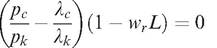
that is if pc∕pk = lc∕lk. The other condition, wr = 1∕L, means that the real wage is equal to the productivity of labour. In this case the profit is zero and pc∕pk = lc∕lk holds true again. We already know that these conditions, apart from the case r = 0, imply equality among the organic compositions of capital. It can be proved that the same conclusion is reached by considering any other ratio among aggregate variables, wage share, rate of exploitation, etc.
It is possible to conclude, therefore, that in general the aggregate variables and the ratios between them are altered by the valuation in production prices. It seems that he market does not just redistribute the surplus value among the capitalists, but would alter its size. Thus, the actual rate of profit and the actual rate of exploitation differ from those calculated in embodied labour. The meaning of this conclusion is simple: given the wage and the technique, the rate of profit and the rate of exploitation cannot be known before knowing the prices of production; they depend in an essential way from the distribution of income. Production prices furnish a correct valuation, as they express the social (income distribution) and technical (production methods) conditions of capitalist production. On the other hand, the valuation in embodied labour is independent from the distribution of income, and is therefore not a correct valuation.
4.3.5. Equilibrium, Say’s Law, and crises
As already mentioned, prices of production are determined in such a way as to guarantee a uniform profit rate among the various industries. They are, in a sense, equilibrium prices; in order to understand in which sense, we need to define the equilibrium conditions. Marx did this on the grounds of the analysis of Quesnay’s tableau economique, which he studied in depth and developed into his ‘reproduction schemes’. These schemes are equations defining the equilibrium conditions in terms of sectorial interdependences; and they serve to determine the flows of goods that must ‘circulate’ among the different productive sectors in order that each has the inputs necessary to carry out production. When the level of output in each sector guarantees a supply of goods corresponding to the demand generated by the output levels themselves, then the economy is able to reproduce itself. As Marx put it in the Grundrisse, an economy is able to reproduce itself when there is ‘balance of demand and supply; balance of production and consumption; and what this amounts to in the last analysis, proportionate production’ (p. 153).
With reference to our example of a two-sector economy, the reproduction conditions can be defined in the following terms. First of all, there must be equality between supply and demand for each of the two goods produced, the consumer good and the capital good. Furthermore, the part of the consumer good which is not demanded by the workers and the capitalists operating in the consumer-good sector must itself be equal to the demand for the consumer goods from the workers and the capitalists operating in the capital-good sector. On the other hand, the excess of output of capital goods with respect to the reinvestments in the capital-good sector must be equal to the demand for capital coming from the consumer-good sector.
These are the results reached by Marx with his ‘simple reproduction schemes’; ‘simple’ in that they relate to a stationary economy. For a growing economy Marx formulated some ‘expanded reproduction schemes’; but we will not discuss them here.
An equilibrium such as the one just defined is a state of the economy in which supply and demand of all the goods are equal, while the goods are exchanged at the prices of production. It is a reproduction equilibrium, i.e. a state that guarantees the reproduction of the economy. The prices prevailing in this state depend exclusively on objective factors, such as the techniques in use and the distribution of income.
It is evident that Say’s Law rules in a reproduction equilibrium. If the supply and demand are equal in each sector, they must be equal on aggregate. On the other hand, in the equations of the simple reproduction schemes the demand for consumer goods coincides with net income. This implies that income is entirely spent. In the expanded reproduction schemes, all the non-consumed profits are invested. Marx never admitted it explicitly, but in a large part of Capital, when he studied accumulation, ‘capital in general’, exploitation, the ‘law of value’, etc.—in other words, when he used a methodology of aggregates, valuing goods in labour value or in prices of production—he adopted Say’s Law.
Yet Marx criticized this law. He formulated the reproduction schemes to demonstrate that the equilibrium defined by them could be reached only ‘by chance’. The economy he studied always moves in disequilibrium. The goods are exchanged at market prices, and supply does not coincide with demand. The excess demands cause market prices to vary and the rates of profit guaranteed by the market prices differ from the ‘average’ rate. As aggregate demand ultimately depends on capitalists’ decisions regarding production levels, it can at any time diverge from aggregate supply. The rhythm of accumulation depends, in turn, on the rates of profit. If these are low, the capitalist may decide not to reinvest all the profits earned and to ‘hoard’ them. In this way, part of the income produced and distributed is not spent, and this creates a situation of ‘over-production’, i.e. of lack of aggregate demand. This is the crisis: all goods are in excess supply, so that their value cannot be realized and the market prices and the rates of profit fall. This leads to a further disincentive to investment and a further fall in aggregate demand. In this way the crisis spreads and deepens.
All this, however, in Marx’s system, does not create chaos and does not lessen the importance of the reproduction conditions as final determinants of the movement of the capitalist economy. In fact, the disequilibrium dynamic is regulated by laws that make the crises come with a certain regularity. They generate a cyclical movement which, in the long periods of accumulation, will prevent the economy from systematically diverging from the reproduction equilibrium.
4.3.6. Wages, the trade cycle, and the ‘laws of movement’ of the capitalist economy
The Marxian theory of cycle is based on two fundamental hypotheses:
(1) Investment is an increasing function of the rate of profit.
(2) The rate of profit is a decreasing function of wages.
If wages increase, investment will be discouraged. This will reduce the aggregate demand and trigger a crisis. The market prices will fall together with the levels of output, pushing the average rate of profit down again. Thus the crisis will deepen. However, with a reduction in investment, the demand for labour will also decrease and the ‘industrial reserve army’, i.e. (manifest and hidden) unemployment, will rise. As a consequence, sooner or later wages will fall. Furthermore, the crisis itself, by expelling from the market the most inefficient firms and the most obsolete machines, will contribute to raise labour productivity. Therefore, the average rate of profit will increase again, reactivating economic growth. When employment levels and wages begin to rise again, it will be the beginning of a new cycle.
The wage used in this model is the market wage. This is not, however, a price simply determined by the forces of supply and demand of labour. Marx explicitly admitted that ‘workers’ coalitions’ were created precisely in order to counterbalance the effects of wage competition. Sometimes Marx reasoned in a classical manner, by treating market wages as being determined by market forces; but at other times he reasoned in his own way, by maintaining that wages were only influenced by market forces. His original contribution to this problem lies in his treatment of the market wage as a price fixed by collective bargaining and dependent on the power relationships among the classes. The market only acts to the degree that the variations of the ‘reserve army’ contribute to weaken or strengthen the trade unions. A wage determined in this way would therefore tend to oscillate with the business cycle.
The trend in such oscillations is represented by what Marx called the ‘value of labour power’, a concept corresponding to that of ‘natural wage’ of the classical economists. Obviously, Marx did not recognize anything ‘natural’ in it, even if he treated it as a subsistence wage. His wage theory differed markedly from that of the classical economists. In fact, Marx did not just admit the fundamental role played by long-term changes in workers’ consumption habits, but, by recognizing the role played by trade unions in the determination of the wage trend, besides its oscillations, he downgraded the importance of habits and customs as exogenous determinants of wages.
His theory, to the degree to which it differs from the classical one, is a theory of ‘normal’ wages based on the power relationships among the classes. The workers enter into the conflict by trying to control the supply of labour by means of the trade unions; the capitalists enter it by trying to control the demand by means of their investment decisions. In the course of the business cycle, wages will oscillate with the levels of output. In the course of accumulation, the trend variables, including wages, will be determined by the organized strength of the workers on the one hand and technical progress on the other. In fact, in the long run the demand for labour will be strongly influenced by the ability of the capitalists to replace labour by machines—an ability which depends on the type of technical progress incorporated in the means of production.
Given that technical progress tends to substitute machines for labour, if trade unions did not exist the forces of competition would cause real wages to decrease permanently. The action of the ‘workers’ coalitions’ fight such a tendency. According to Marx, however, the trade unions were strong enough to contrast the effects of technical progress on wages, but not strong enough to prevent a decrease in the wage share or an increase in the rate of exploitation. This occurs because technical progress acts on the wage shares from two sides. On the one hand, given the rate of accumulation, it will depress the rate of growth of labour demand and therefore will increase the ‘reserve army’ (this theory, to be precise, is a development of the Ricardian theses about the occupational effects of the introduction of machines). The increase in the ‘reserve army’ will then slow the growth in wages. On the other hand, the use of increasingly modern machines will raise the productivity of labour. Marx believed that there is a tendency for labour productivity to increase more rapidly than real wages.
This idea is at the basis of the theory of ‘increasing immiseration’ of the proletariat, one of the most important ‘laws of movement’ of the capitalist economy. The employed workers constantly improve their own standards of living as real wages increase. However, their position with respect to the capitalist class worsens as the wage share diminishes. Furthermore, their dissatisfaction as consumers increases, as capitalist growth raises their needs more rapidly than the income necessary to satisfy them. But also their dissatisfaction at work increases as they become increasingly subordinated to mechanized work processes. At the same time, their subjection to capital deepens. Finally, as the ‘reserve army’ increases too, the percentage of employed people in relation to the population able to work decreases. This means that the relative ‘misery’ of the working class as a whole increases even more than that of employed people.
The second law of movement concerns the tendency of the rate of profit to fall. The profit rate is an increasing function of the rate of exploitation and a decreasing function of the organic composition of capital. Marx believed that the processes of mechanization are undertaken to offset the negative effects of class conflict on the rate of profit. In phases of prosperity, wages rise and create the conditions for the crisis. In response, capitalists introduce machines that allow them to dismiss workers and increase productivity. Thus, the rate of profit rises again. Then, in the successive phase of prosperity the workers recover the lost ground, and so on. However, the process of mechanization, even though it raises the rate of profit following each wave of innovations, in the long run would lower it, as it would reduce the size of the cake to be shared out in relation to that of the capital invested to produce it.
In other words, behind the Marxian theory of the falling rate of profit lies the hypothesis of a fall in the output-capital ratio—a hypothesis that Marx justified, not too convincingly, with the limits that the working day would pose to the growth in the value of output, there being no limits to the growth in the value of capital.
This ‘law’ can be proved quite simply by using a model of an economy in which only one commodity is produced. The maximum level for the rate of profit, rmax, holds when the wage is zero:

Note that, when the wage rate is zero, v = 0, the profit rate is maximum and coincides with the output-capital ratio: rmax = (1—k)/k. The rate of profit will tend to fall if its upper limit is decreasing. Thus, the hypothesis that must be done is that technical progress always increases the quantity of means of production necessary to produce the net output.
According to Marx, another two laws can be derived from the law of the falling rate of profit. One has to do with the tendency of crises to become increasingly severe. Since, in order to overcome a crisis, capital must activate innovative processes that reduce the output-capital ratio, the ensuing crisis will always be more difficult to overcome. Given the wage increases, each crisis will bring about a greater fall in the rate of profit than the preceding crisis. This means that the combination of technological progress and class conflict will not only diminish the incentive to invest but also widen the amplitude of the oscillations around the long-run growth trend. So, sooner or later, the final crisis will arrive.
Another law of movement deals with the structure of markets and the size of firms. In order to compensate for the fall in the rate of profit, the capitalists try to raise its level. This explains the push towards ‘concentration’ and ‘centralization’ of capital. On the one hand, capital accumulation and the increase in its organic composition will raise the size of firms; on the other, the unequal decrease in the rate of profit will allow the big fish to swallow up the little ones. According to Marx, the competitive struggle amongst capitalists is no less bitter than the class struggle between workers and capital. The final effects of competition were valued positively, however, as they would lead to the reduction in the anarchy of capitalist production and to an increase of the dimensions within which working activity is planned and organized.
The four laws of movement taken together account for the tendency of the capitalistic mode of production to create the conditions for its own overthrow. The fall in the rate of profit and the increasingly severe crises will weaken its driving force, while the growing immiseration will strengthen the will and motivation of the workers towards revolutionary change. Finally, the concentration and centralization processes will push the system towards creating the conditions for overcoming the capitalist anarchy of production. The qualitative jump will bring about an economic system in which the workers are able collectively to control productive activity. In such a new economic organization, the anarchy of capitalist production would be abolished, together with exploitation, and each person would be remunerated according to his own productive contribution, i.e. to the quantity and quality of his work. This is the first phase of communism.
4.3.7. Monetary aspects of the cycle and the crisis
Marx was very interested in the monetary aspects of economic dynamics, and studied them with a great deal of acumen, producing a particularly illuminating and modern theory of money. He believed it was important to study money in order to understand the real operation of the short-run dynamics of the capitalist economy; and thought that, even though the fundamental causes of the cycle and the crisis are real, the working of the monetary system could make its own specific contribution to the amplification of the economic fluctuations, even in the real aspects.
Marx studied in depth the English monetary debates of the first half of the nineteenth century and sided with the banking school, from whose theories he drew a great deal of inspiration. Particularly important was his acceptance of the arguments that the equation of exchanges makes the quantity of money supplied and its velocity of circulation depend on transaction needs.
The adjustment of the money supply to demand, according to Marx, occurs in part through variations in the liquid balances, i.e. in ‘hoarding’, which vary anti-cyclically due to the fact that money is also held for precautionary purposes. Money, he states in the Grundrisse is ‘absolutely secure wealth’ (p. 234), and serves to bring ‘general wealth into safety and away from circulation’; thus ‘among private individuals accumulation [of money] takes place for the purpose of bringing wealth into safety’ (p. 230). Therefore, liquid balances are accumulated during the phases of contraction and decumulated during prosperity. The influence of Thornton’s theory of liquidity preference is evident, and Marx explicitly recognized it when he quoted Thornton’s view that ‘Guineas are hoarded in times of distrust’ (p. 816).
But the adjustment of money to the needs of transactions does not only occur through variations in the speed of circulation; still more important is the role played by credit in the adjustment of the money supply. Marx adopted a wide definition of money, including in it, besides currency, deposits and bills of exchange. Credit plays a fundamental role in the process of capital accumulation. During the expansion phases there is a rapid growth, not only in production, but also in the aggregate excess demand and in market prices. In these phases the capitalists, as a whole, spend more than they earn, and a part of the purchasing power needed to finance accumulation is supplied by bank and commercial credit. The money supply is very elastic with respect to income. For this reason the rate of interest, during prosperity, rises less than the rate of profit. In this way, the monetary system fuels productive expansion in phases of rapid growth.
In these phases the capitalists’ net indebtedness rises, and the risk exposure of the banking system increases with it. When the real cycle begins the downturn, owing to the increase in wages and the fall in profits, the demand for credit is kept high by speculation on goods, which is progressively fed by the increase in prices. The banks, however, at this point being to defend their own reserves and the rate of interest climbs very fast. The turning-point of the monetary cycle is triggered by the change in the behaviour of the speculators. When these begin to sell, the prices and profits fall dramatically, as the demand for goods for productive purposes has already begun to weaken. Thus, the realization crisis begins. Aggregate demand decreases, pulling down production, and the aggregate excess supply (‘overproduction’) tends to spread. For many capitalists it becomes difficult to cover the costs of production. And for many it is difficult to collect the funds necessary to repay debts. Those who manage to find liquidity tend to accumulate it in inactive balances, ‘waiting for more favourable market conditions’. The banks also behave in this way, and restrict credit advances. So the demand for money rises just when the propensity to create more of it is at a minimum. This is the liquidity crisis or the ‘dearth of money’. During this crisis the intertwining of credit and debt may bring about the disastrous phenomenon of chain bankruptcies. At this stage the rate of interest reaches its maximum and the crisis touches the bottom.
When the least efficient firms have been expelled from the market and the most obsolete machines have been eliminated from the factories, when the unemployed workers have learned to moderate their grievances and the employed to accept intensified exploitation, then the conditions will have been obtained for productive recovery. At the same time, huge idle liquid balances, ‘latent monetary capital’, will have been accumulated. The conditions for a new credit expansion are in place. The crisis performs a fundamental function in creating both the real and the monetary conditions for recovery.
The modernity of this dynamic monetary theory is evident, as is the influence exercised on it by the English anti-bullionist and anti-currency schools. The influence, already mentioned, of Thornton’s liquidity preference theory also seems notable. In the formulation of his own special version of the liquidity preference theory, however, Marx was an innovator. He established two fundamental principles which make his theory an important anticipation of Keynes’s. The first of these was that it is necessary to consider the total money stock, rather than the flow of new money or credit, when studying monetary dynamics, i.e. the movements of supply and demand for finance, the changes in hoarding and in the velocity of circulation, and the oscillations in the rate of interest. From this principle comes the view that the rate of interest is the price of ‘monetary capital’, i.e. of the stock of money rather than the flow of credit. The second principle concerns the rate of interest. This is considered as a price, but one of a special kind, an ‘irrational’ form of price. This is because the market price of a real good has a dynamics regulated by the production price. The price of money, on the contrary, depends solely on the forces of supply and demand and does not possess a normal value around which to oscillate. Mill’s and Ricardo’s idea, that the rate of return of real capital is the equilibrium value of the rate of interest, is completely foreign to Marx’s way of thinking. Marx believed that long-term movements in the rate of interest are definable only as averages of short-term movements, not as regulators of these, and that they are determined by general consensus, habits and legal traditions.