Appendix: Proofs
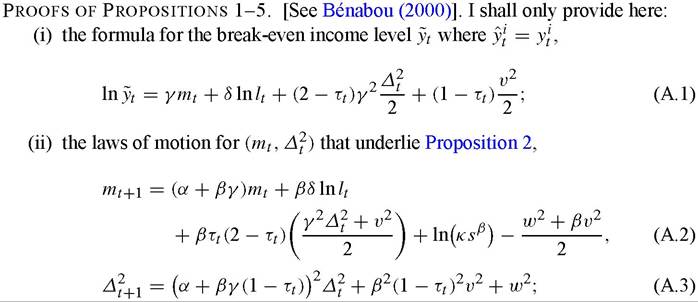
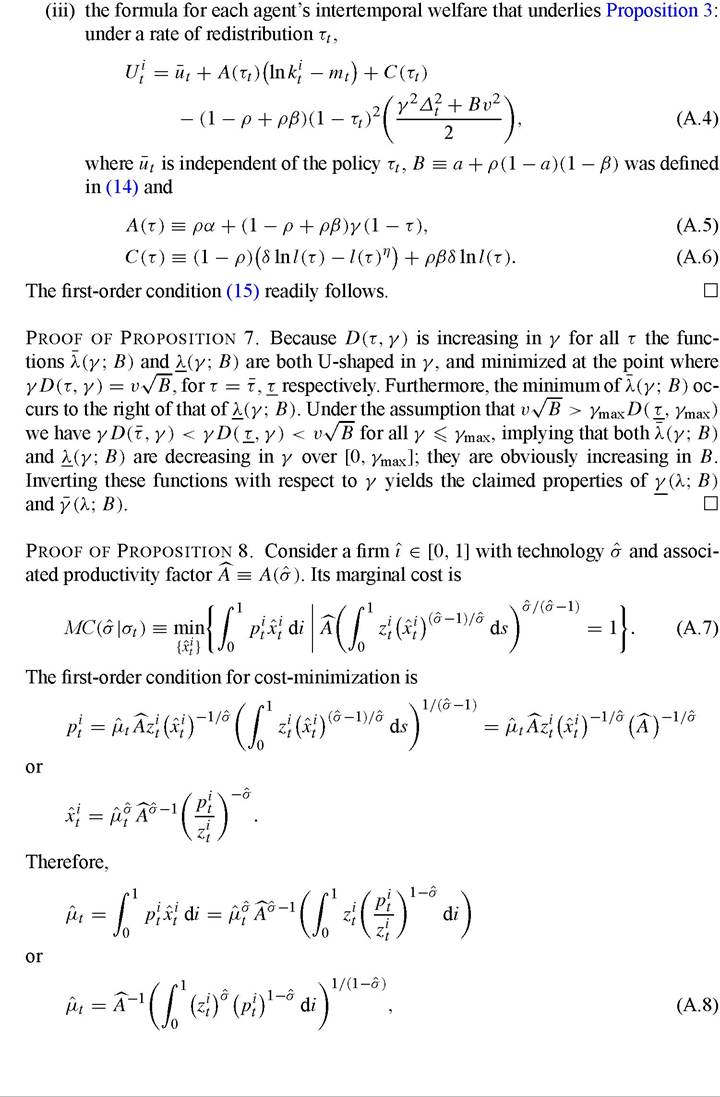
which establishes (32).
Now, replacing the equilibrium prices from Equation (27) yields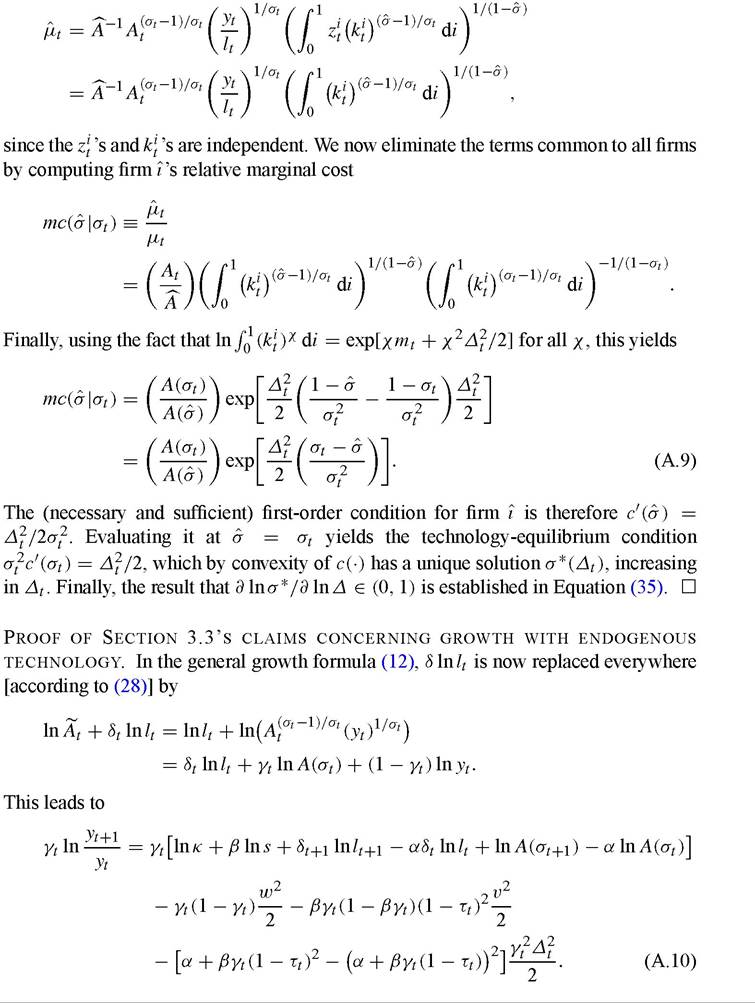
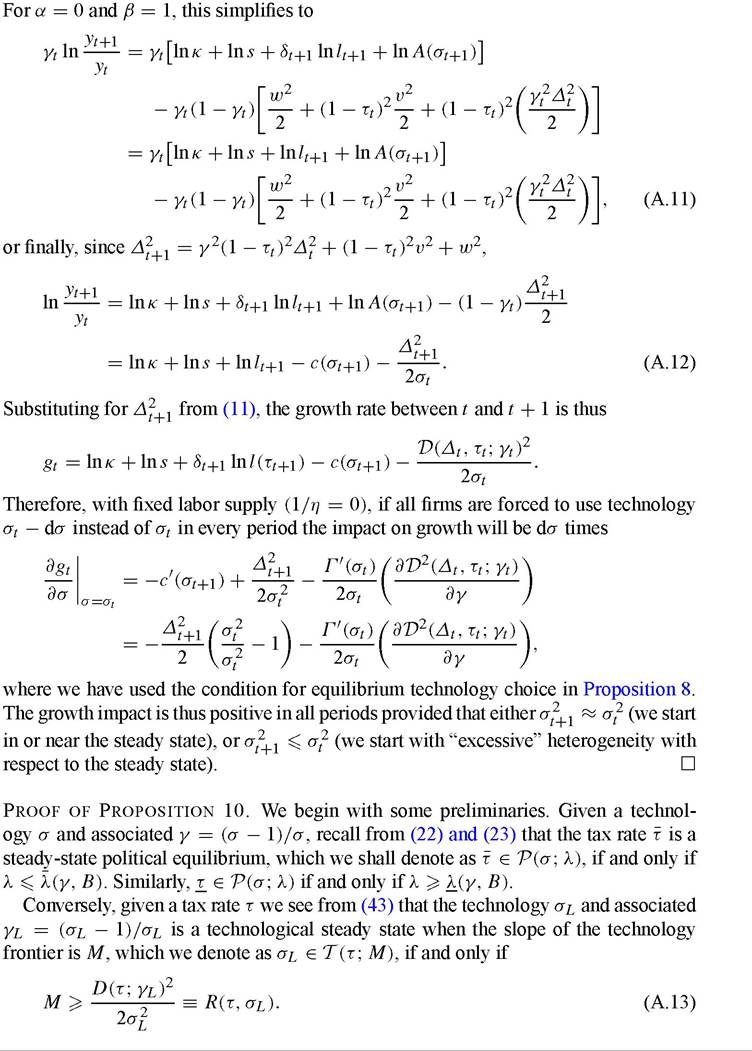
Indeed, the fact that λ(γ∏; B) < λ < λ(yL; B) means that τ ∈ P(aL; λ), whereas τ ∈ P(σ∏; λ). The rest of the claim follows from the fact σ2 ∈ T(τ; M), since M > R(τ,σb).
Claim 2. After the political shift in C1, (r,σg) is the only steady state for that country.
First, since λ' > λ(yL; B) > λ(γ∏; B) we now have τ ∈ P; λ') and τ ∈ P(σ∏; λ'), so there is no steady state with policy τ. Moreover, since M < R{τ^,σf) we have σ2 ∈ T(τ; M), so the only possible equilibrium is (r_, σ∏). It is indeed an equilibrium, as M < R(r_, σ∏) means that σ∏ ∈ T(τ; M), while λ(γ∏; B) < λ' means that τ ∈ P(σ∏; λ').
Claim 3. After C1 has switched to the technology σ∏, so that C2 faces the technology frontier m, the only steady state for C2 is ( τ, σ∏).
First the fact m < R(τ, σf) < R(τ, σf) implies that (τ, σf) is no longer a technological equilibrium, and a fortiori neither is (τ, σf).
Second, the fact m < min{R( τ, σL), R(∑,σ∏)} means that the only technological equilibrium under policy τ is σ∏. Finally, since λ > λ(γ∏; B~),∑ ∈ P(.σH; λ) whereas τ ∈ P(σ∏; λ), which concludes the proof. ?References
Acemoglu, D. (1998). “Why do new technologies complement skills? Directed technical change and inequality”. QuarterlyJournal of Economics 113 (4), 1055-1090.
Acemoglu, D. (2003). “Cross-country inequality trends”. Economic Journal 113, 121-149.
Acemoglu, D., Aghion, P., Violante, G.L. (2001). “Deunionization, technological change and inequality”. Carnegie-Rochester Conference Series on Public Policy 55, 229-264.
Acemoglu, D., Robinson, J. (2000). “Why did the West extend the franchise?”. Quarterly Journal of Economics 115 (4), 1167-1195.
Aghion, P. (2002). “Schumpeterian growth theory and the dynamics of income inequality”. Economet- rica 70 (3), 855-882.
Alesina, A., Angeletos, G.M. (2005). “Fairness and redistribution: US vs. Europe”. American Economic Review 95 (4), 960-980.
Alesina, A., Glaeser, E., Sacerdote, B. (2001). “Why doesn’t the U.S. have a European-type welfare state?”. Brookings Papers on Economic Affairs (2), 187-277.
Alesina, A., Rodrik, D. (1994). “Distributive politics and economic growth”. Quarterly Journal of Economics 109 (2), 465-490.
Autor, D., Katz, L., Krueger, A. (1997). “Computing inequality: Have computers changedthe labor market?”. Quarterly Journal of Economics 113 (4), 1169-1214.
Baland, J.M., Robinson, J. (2003). “Land and power”. Mimeo. University of California Berkeley.
Banerjee, A., Duflo, E. (2000). “Inequality and growth: What can the data say?”. Journal of Economic Growth 8 (3), 267-299.
Banerjee, A., Newman, A. (1993). “Occupational choice andthe process of development”. Journal ofPolitical Economy, 274-278.
Barro, R. (2000). “Inequality and growth in a panel of countries”.
Journal of Economic Growth 5, 5-32. Bartels, L. (2002). “Economic inequality and political representation”. Mimeo. Princeton University. Becker, X. (1964). Human Capital. ColumbiaUniversity Press, New York.Benabou, R. (1996a). “Heterogeneity, stratification, and growth: Macroeconomic implications of community structure and school finance”. American Economic Review 86 (3), 584-609.
Benabou, R. (1996b). “Inequality and growth”. In: Bernanke, B.S., Rotemberg, J.J. (Eds.), National Bureau of Economic Research Macro Annual, vol. 11. MIT Press, Cambridge, MA, pp. 11-74.
Benabou, R. (2000). “Unequal societies: Income distribution and the social contract”. American Economic Review 90, 96-129.
Benabou, R. (2002). “Tax and education policy in a heterogeneous agent economy: What levels of redistribution maximize growth and efficiency?”. Econometrica 70, 481-517.
Benabou, R., Tirole, J. (2006). “Belief in a just world and redistributive politics”. Quarterly Journal of Economics, in press.
Berman, E., Bound, J., Machin, S. (1997). “Implications of skill-biased technological change: International evidence”. Quarterly Journal of Economics 113 (4), 1245-1280.
Bourguignon, F., Verdier, T. (2000). “Oligarchy, democracy, inequality and growth”. Journal of Development Economics 62 (2), 285-314.
Caroli, E., Van Reenen, J. (1999). “Skill biased organizational change? Evidence from a panel of British and French establishments”. CEPREMAP Working Paper 9917.
De Mello, L., Tiongson, E. (2003). “Income inequality and redistributive government spending”. IMF Working Paper 314.
Engerman, S., Sokoloff, K. (1997). “Factor endowments, institutions, and differential growth paths among new world economies”. In: Haber, S. (Ed.), How Latin America Fell Behind: Essays on the Economic Histories of Brazil and Mexico 1800-1914. Stanford University Press, Stanford, pp. 260-304.
Fellman, J. (1976). “The effect of transformations on Lorenz curves”. Econometrica 44 (4), 823-824.
Fernandez, R., Rogerson, R. (1998). “Public education and the dynamics of income distribution: A quantitative evaluation of education finance reform”. American Economic Review 88 (4), 813-833.
Figini, P. (1999). “Inequality and growth revisited”. Trinity College Economic Papers 2/99, September. Dublin.
Forbes, K. (2000). “A reassessment of the relationship between inequality and growth”. American Economic Review 90 (4), 869-887.
Fortin, N., Lemieux, T. (1997). “Institutional changes and rising wage inequality: Is there a linkage?”. Journal of Economic Perspectives 11 (2), 75-97.
Freeman, R. (1995). “The large welfare state as a system”. American Economic Review Papers and Proceedings 85 (2), 16-21.
Freeman, R. (1996). “Labor market institutions and earnings inequality”. New England Economic Review (May/June), 169-172.
Galor, O., Moav, O. (1999). “From physical to human capital: Inequality in the process of development”. CEPR Discussion Paper 2307, December.
Galor, O., Moav, O. (2000). “Ability biased technological transition, wage inequality, and economic growth”. Quarterly Journal of Economics 113 (4), 1055-1090.
Galor, O., Tsiddon, D. (1997). “Technological progress, mobility, and growth”. American Economic Review 87 (June), 363-382.
Galor, O., Zeira, J. (1993). “Income distribution and macroeconomics”. Review of Economic Studies 60 (1), 35-52.
Glomm, G., Ravikumar, B. (1992). “Public vs. private investment in human capital: Endogenous growth and income inequality”. Journal of Political Economy 100, 818-834.
Gradstein, M., Justman, M. (1997). “Democratic choice of an education system: Implications for growth and income distribution”. Journal of Economic Growth 2 (2), 169-184.
Grossman, G. (2004). “The distribution of talent and the pattern and consequences of international trade”. Journal of Political Economy 112 (1), 209-239.
Grossman, G., Maggi, G. (2000). “Diversity and trade”. American Economic Review 90 (5), 1255-1275.
Hassler, J., Rodriguez-Mora, J. (1999). “Employment turnover and the public allocation of unemployment insurance”. Journal of Public Economics 73 (1), 55-83.
Hassler, J., Rodriguez-Mora, J., Storesletten, K., Zillibotti, F. (2003). “The survival of the welfare state”. American Economic Review 93 (1), 87-112.
Kiley, M. (1999). “The supply of skilled labor and skill-biased technological progress”. Economic Journal 109 (October), 708-724.
Kremer, M., Maskin, E. (1996). “Wage inequality and segregation by skill”. NBER Working Paper 5718.
Kremer, M., Maskin, E. (2003). “Globalization and inequality”. Mimeo. Harvard University.
Kreps, D., Porteus, E. (1979). “Dynamic choice theory and dynamic programming”. Econometrica 47 (1), 91-100.
Krueger, A. (2002). “Inequality, too much of a good thing?”. Mimeo. April. Princeton University.
Krusell, P, Rios-Rull, J.V. (1996). “Vested interests in a positive theory of stagnation and growth”. Review of Economic Studies 63, 301-329.
Lee, D. (1999). “Wage inequality in the united states during the 1980s: Rising dispersion or falling minimum wage?”. Quarterly Journal of Economics 114 (3), 977-1023.
Lee, W., Roemer, J. (1998). “Income distribution, redistributive politics, and economic growth”. Journal of Economic Growth 3, 217-240.
Legros, P., Newman, A. (1996). “Wealth effects, distribution, and the theory of organization”. Journal of Economic Theory 70 (2), 312-341.
Lindbeck, A. (1995). “Welfare-state disincentives with endogenous habits and norms”. Scandinavian Journal of Economics 97 (4), 477-494.
Lloyd-Ellis, H. (1999). “Endogenous technological change and inequality”. American Economic Review 89 (1), 47-77.
Loury, G. (1981). “Intergenerational transfers and the distribution of earnings”. Econometrica 49, 843-867.
Moav, O. (2002). “Income distribution and macroeconomics: The persistence of inequality in a convex technology framework”. Economics Letters 75 (2), 147-287.
Mookherjee, D., Ray, D.
(2003). “Persistent inequality”. Review of Economic Studies 70, 369-393.Perotti, R. (1996). “Growth, income distribution and democracy: What the data say”. Journal of Economic Growth 1 (2), 149-187.
Persson, T., Tabellini, G. (1994). “Is inequality harmful for growth? Theory and evidence”. American Economic Review 84 (3), 600-621.
Piketty, T. (1995). “Social mobility and redistributive politics”. Quarterly Journal of Economics 110 (3), 351442.
Piketty, T. (1997). “The dynamics of the wealth distribution and interest rate with credit-rationing”. Review of Economic Studies 64 (2), 173-190.
Pineda, J., Rodriguez, F. (2000). “The political economy of human capital accumulation”. Mimeo. February. University of Maryland at College Park.
Rodriguez, F. (1999). “Does inequality lead to redistribution? Evidence from the united states”. Economics & Politics 11 (2), 171-199.
Romer, P. (1987). “Growth based on increasing returns due to specialization”. American Economic Review 77 (May), 56-62.
Rosenstone, S., Hansen, J. (1993). Mobilization, Participation and Democracy in America. MacMillan Publishing Company, New York.
Saint-Paul, G. (2001). “The dynamics of exclusion and fiscal conservatism”. Review of Economic Dynamics 4, 275-302.
Saint-Paul, G., Verdier, T. (1993). “Education, democracy and growth”. Journal of Development Economics 42 (2), 399-407.
Sheshadri, A., Yuki, K. (2004). “Equity and efficiency effects of redistributive policies”. Journal of Monetary Economics 57 (1), 1415-1447.
Tamura, R. (1992). “Efficient equilibrium convergence: Heterogeneity and growth”. Journal of Economic Theory 58 (2), 55-76.
Thesmar, D., Thoenig, M. (2000). “Creative destruction and firm organizational choice”. Quarterly Journal of Economics 115 (4), 1201-1239.
Thoenig, M., Verdier, T. (2003). “A theory of defensive skill-biased innovation and globalization”. American Economic Review 93 (3), 709-728.
Vindigni, A. (2002). “Income distribution and skilled-biased technical change”. Mimeo. June. Universite de Toulouse.
Zhang, J. (2005). “Income ranking, convergence speeds, and growth effects of inequality with twodimensional adjustment”. Journal of Economic Dynamics and Control 29 (3), 547-566.