Conclusions
The poor countries are not rich because they have failed to adopt the modern techniques of production which first emerged in Britain during the Industrial Revolution and then spread to some other nations in Western Europe and elsewhere.
As a result, their economies have stagnated. By contrast, the rich countries possess market environments where the same techniques have been continuously refined, upgraded and extended, leading to what are now striking disparities between themselves and the poor.Why would techniques not be adopted even when they are more efficient? Is it not the case that more efficient techniques are more profitable? The main objective of this survey has been to review a large number of studies which show why self-reinforcing traps may prevent the adoption of new technologies. For example, Section 5 showed how increasing returns can generate an incentive structure whereby agents avoid starting modern sector businesses, or invest little in their own training. Section 6 focused on credit market imperfections. Poor individuals lack collateral, which restricts their ability to raise funds. As a result, projects with large fixed costs are beyond the means of the poor, leaving them locked in low return occupations such as subsistence farming.
Recently many economists have highlighted the role of institutions in perpetuating poverty. Section 7 looked at why rent-seeking is both bad for growth and yet strongly self-reinforcing. Essentially similar societies may exhibit very different levels of predation simply as a result of historical accident, or some spontaneous coordination of beliefs. In addition, the role of kinship systems was analyzed as representative of the kinds of social conventions which may potentially harm formation of the modern sector.
Together, these mechanisms add up to a very different picture of development than the convex neoclassical benchmark model on which so much of modern growth theory has been based.
Growth is not automatic. Small initial differences are magnified and then propagated through time. Poverty coexists with riches, much as it is observed to do in the cross-country income panel.9.1. Lessonsforeconomicpolicy
There is a real sense in which poverty trap models are optimistic. Poverty is not the result of some simple geographic or cultural determinism. The poor are not condemned to poverty by a set of unfavorable exogenous factors, or even a lack of resources. Temporary policy shocks will have large and permanent effects if one-off interventions can cause the formation of new and better equilibria.
In practice, however, engineering the emergence of more efficient equilibria seems problematic for a number of reasons. First, we have seen many examples of how bad equilibria can be stable and self-reinforcing. In this case small policy changes are not enough to escape from their grip. Large changes must be made to the environment that people face, and the structure of their incentives. Such changes may be resisted by the forces that have perpetuated the inefficient equilibrium, such as a corrupt state apparatus fighting to preserve the status quo.
Second, coordinating changes in expectations and the status quo is difficult because norms and conventions are highly persistent. While it is possible to change policy and legislation almost instantaneously, it needs to be remembered that informal norms and conventions are often more important in governing behavior than the formal legalistic ones. Informal norms cannot be changed in the manner of interest rates, say, or tariffs. Rather they are determined within the system, and perpetuated by those forces that made them a stable part of the economy’s institutional framework.
Third, policies can create new problems as a result of perverse incentives.[256] Successful policies will need to be carefully targeted, and operate more on the level of incentives than compulsion. These kinds of policies require a great deal of information.
Traps which prevent growth and prosperity cannot be overcome without proper understanding and the careful design of policy.Acknowledgements
Support from the Program of Dynamic Economics at UCLA is acknowledged with thanks, as is research assistance from Athanasios Bolmatis, and discussions with David de la Croix, Cleo Fleming, Oded Galor, Karla Hoff, Kirdan Lees and Yasusada Mu- rata. The second author thanks the Center for Operations Research and Econometrics at Universite Catholique de Louvain for their hospitality during a period when part of this survey was written. All simulations and estimations use the open source programming language R.
Appendix A
Section A.1 gives a general discussion of Markov chains and ergodicity. The proof of Proposition 3.1 is outlined. Section A.2 gives remaining proofs.
A.1. Markov chains and ergodicity
In the survey we repeatedly made use of a simple framework for treating Markov chains and ergodicity. The following is an elementary review. Our end objective is to sketch the proof of Proposition 3.1, but the review is intended to be more generally applicable.
Consider first a discrete time dynamical system evolving in state space S ⊂ R". Just as for deterministic systems on S, which are represented by a transition rule associating each point in S with another point in S - the value of the state next period - a Markov chain is represented by a rule associating each point in S with a probability distribution over S. From this conditional distribution (i.e., distribution conditional on the current state x ∈ S) the next period state is drawn. In what follows the conditional distribution will be denoted by Γ(x, dy), where x ∈ S is the current state.
Because for Markov chains points in S are mapped into probability distributions rather than into individual points, it seems that the analytical methods used to study the evolution of these processes must be fundamentally different to those used to study deterministic discrete time systems.
But this is not the case: Markov chains can always be reduced to deterministic systems.To see this, note that since the state variable χt is now a random variable, it must have some (marginal) distribution on S, which we call ψt. Suppose, as is often the case in economics, that ψt is a density on S, and that the distribution Γ(x, dy) is in fact a density Γ(x, y) dy for every x ∈ S.In that case the marginal distribution for xt+1 is a density ψt+1, and ψt+1 (y) = fS Γ(x, y)ψt(x) dx. This last equality is just a version of the law of total probability: The probability of ending up at y is equal to the probability of going to y via x, weighted by the probability of being at x now, summed over all x ∈ S.



probability mass is mixed across the state space - all areas of S communicate. In the case of (10) it is easy to show that supp Mψ = (0, ∞) = S for every ψ ∈ D. This is clearly sufficient for the condition.
A.2. Remainingproofs
The proof of Proposition 5.1 in Section 5.2 is now given. The first point is that the banks b = 1,..., B — 1 are equal-cost Bertrand competitors, and as a result always offer the interest rate r to all firms in equilibrium. The main issue is the optimal strategy of the last bank B. So consider the following strategy σ⅛ for B, which is illustrated with the help of Figure 30. To firm n the bank offers i* defined by i* = f [(n — 1)/N] — 1 if n ≤ αcN.To the remaining firms B offers the interest rate r. (Without loss of generality, we suppose that the index of firms from 1 to N and the ranking of the offers made by
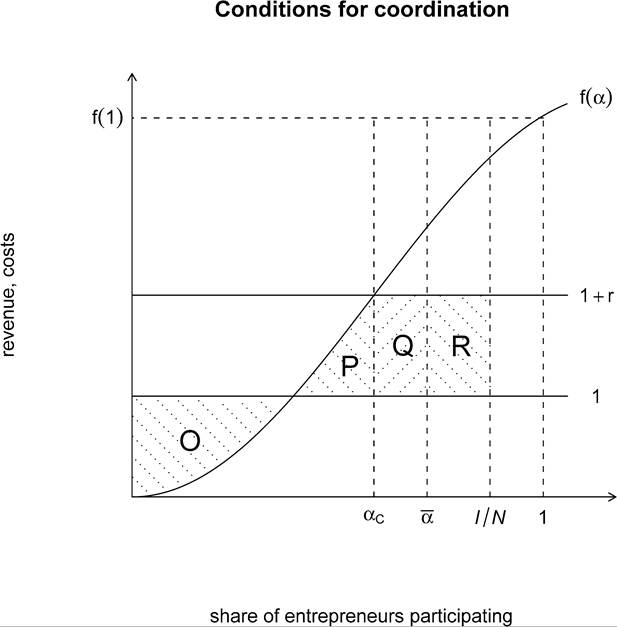
Figure 30.

References
Acemoglu, D. (1997). “Training and innovation in an imperfect labor market”. Review of Economic Studies 64 (3), 445-464.
Acemoglu, D., Johnson, S., Robinson, J. (2005). “Institutions as the fundamental cause of long-run growth”. In: Aghion, P., Durlauf, S.N. (Eds.), Handbook of Economic Growth, vol. 1A. Elsevier, Amsterdam. Chapter 6 in this volume.
Acemoglu, D., Zilibotti, F. (1997). “Was Prometheus unbound by chance? Risk, diversification and growth”. Journal of Political Economy 105 (4), 709-751.
Adsera, A., Ray, D. (1997). “History and coordination failure”. Journal of Economic Growth 3, 267-276.
Aghion, P., Bolton, P. (1997). “A theory of trickle-down growth and development”. Review of Economic Studies 64, 151-172.
Amir, R., Mirman, L.J., Perkins, W.R. (1991). “One-sector nonclassical optimal growth: optimality conditions and comparative dynamics”. International Economic Review 32 (3), 625-644.
Arthur, W.B. (1994). Increasing Returns and Path Dependence in the Economy. University of Michigan Press, Ann Arbor.
Azariadis, C. (1996). “The economics of poverty traps”. Journal of Economic Growth 1, 449-486.
Azariadis, C. (2005). “The theory of poverty traps: what have we learned?”. In: Bowles, S., Durlauf, S., Hoff, K. (Eds.), Poverty Traps. Princeton University Press, Princeton.
Azariadis, C., Drazen, A. (1990). “Threshold externalities in economic development”. Quarterly Journal of Economics 105, 501-526.
Azariadis, C., Stachurski, J. (2004). “A forward projection of the cross-country income distribution”. Mimeo, Universite Catholique de Louvain.
Baker, E. (2004). “Institutional barriers to technology adoption in rural Africa”. Mimeo, Stanford University.
Bandiera, O., Rasul, I. (2003). “Complementarities, social networks and technology adoption in northern Mozambique”. Mimeo.
Banerjee, A. (2003). “The two poverties”.
Mimeo, Massachusetts Institute of Technology.Banerjee, A., Newman, A. (1993). “Occupational choice andthe process of development”. Journal ofPolitical Economy 101, 274 298.
Bardhan, P. (1997). “Corruption and development: areview ofthe issues”. Journal ofEconomic Literature 35, 1320-1346.
Barrett, C.B., Bezuneh, M., Aboud, A. (2001). “Income diversification, poverty traps and policy shocks in Cote d'Ivoire and Kenya”. Food Policy 26 (4), 367-384.
Barrett, C.B., Swallow, B.M. (2003). “Fractal poverty traps”. Strategies and Analysis for Growth and Access Working Paper, Cornell and Clark Atlanta Universities.
Basu, K., Van, P.H. (1998). “The economics of child labor”. American Economic Review 88 (3), 412-427.
Beath, J., Katsoulacos, Y., Ulph, D. (1995). “Game-theoretic approaches to the modeling of technological change”. In: Stoneman, P. (Ed.), Handbook of the Economics of Innovation and Technological Change. Blackwell.
Bianchi, M. (1997). “Testing for convergence: evidence from nonparametric multimodality tests”. Journal of Applied Econometrics 12, 393 409.
Bloom, D.E., Canning, D., Sevilla, J. (2003). “Geography and poverty traps”. Journal of Economic Growth 8, 355-378.
Bowles, S., Durlauf, S.N., Hoff, K. (Eds.) (2005). Poverty Traps. Princeton University Press, Princeton.
Brock, W.A., Mirman, L. (1972). “Optimal economic growth and uncertainty: the discounted case”. Journal ofEconomic Theory 4, 479-513.
Caballero, R., Lyons, R.K. (2002). “The case for external economies”. In: Cukierman, A., et al. (Eds.), Political Economy, Growth and Business Cycles. MIT Press, Cambridge, MA.
Cass, D. (1965). “Optimum growth in an aggregative model of capital accumulation”. Review of Economic Studies 32, 233-240.
Checchi, D., Garcia-Penalosa, C. (2004). “Risk and the distribution of human capital”. Economics Letters 82 (1), 53-61.
Chen, S., Ravallion, M. (2001). “How did the world's poor fare in the 1990s?”. Review of Income and Wealth 47 (3), 238-300.
Conley, T.G., Udry, C.R. (2003). “Learning about a new technology: pinapple in Ghana.” Mimeo.
Da Rin, M., Hellmann, T. (2002). “Banks as catalysts for industrialization”. Journal of Financial Intermediation 11,366-397.
Dasgupta, P. (2003). “World poverty: causes and pathways”. Mimeo, University of Cambridge.
Dasgupta, P., Ray, D. (1986). “Inequality as a determinant of malnutrition and unemployment”. The Economic Journal 96, 1011-1034.
David, P.A. (1994). “Why are institutions the ‘carriers of history'?: Path dependence and the evolution of conventions, organizations and institutions”. Structural Change and Economic Dynamics 5 (2), 205-220.
Dechert, W.D., Nishimura, K. (1983). “A complete characterization of optimal growth paths in an aggregated model with non-concave production function”. Journal ofEconomic Theory 31, 332-354.
Den Haan, W.J. (1995). “Convergence of stochastic growth models: the importance of understanding why income levels differ”. Journal of Monetary Economics 35, 65-82.
Dercon, S. (1998). “Wealth, risk and activity choice: cattle in Western Tanzania”. Journal of Development Economics 55, 1^2.
Dercon, S. (2003). “Risk and poverty: a selective review of the issues”. Mimeo, Oxford University.
Desdoigts, A. (1999). “Patters of economic development and the formation of clubs”. Journal of Economic Growth 4(3), 305-330.
De Soto, H. (1989). The Other Path: The Invisible Revolution in the Third World. Harper and Row, New York.
Dimaria, C.H., Le Van, C. (2002). “Optimal growth, debt, corruption and R&D”. Macroeconomic Dynamics 6, 597-613.
Durlauf, S.N. (1993). “Nonergodic economic growth”. Review of Economic Studies 60, 349-366.
Durlauf, S.N. (2004). “Neighborhood effects”. In: Henderson, J.V., Thisse, J.F. (Eds.), Handbook ofRegional and Urban Economics, vol. 4. Elsevier, Amsterdam.
Durlauf, S.N., Johnson, P.A. (1995). “Multiple regimes and cross-country growth behavior”. Journal of Applied Econometrics 10 (4), 365-384.
Easterly, W. (2001). The Elusive Quest for Growth: Economists’ Adventures and Misadventures in the Tropics. MIT Press, Cambridge, MA.
Easterly, W., Kremer, M., Pritchett, L., Summers, L.H. (1993). “Good policy or good luck: country growth performance and temporary shocks”. Journal of Monetary Economics 32, 459-484.
Easterly, W., Levine, R. (2000). “It’s not factor accumulation: stylized facts and growth models”. World Bank Economic Review 15 (2), 177-219.
Engerman, S., Sokoloff, K.L. (2005). “The persistence of poverty in the Americas: the role of institutions”. In: Bowles, S., Durlauf, S., Hoff, K. (Eds.), Poverty Traps. Princeton University Press, Princeton.
Feyrer, J. (2003). “Convergence by parts”. Mimeo, Dartmouth College.
Freeman, S. (1996). “Equilibrium income inequality among identical agents”. Journal of Political Economy 104 (5), 1047-1064.
Futia, C.A. (1982). “Invariant distributions and the limiting behavior of Markovian economic models”. Econo- metrica 50, 377-408.
Galor, O., Zeira, J. (1993). “Income distribution and macroeconomics”. Review of Economic Studies 60, 35-52.
Glynn, P.W., Henderson, S.G. (2001). “Computing densities for Markov chains via simulation”. Mathematics of Operations Research 26, 375-400.
Gradstein, M. (2004). “Governance and growth”. Journal of Development Economics 73, 505-518.
Graham, B.S., Temple, J. (2004). “Rich nations poor nations: how much can multiple equilibria explain?”. Mimeo (revised version of CEPR Discussion Paper 3046).
Greif, A., Milgrom, P., Weingast, B.R. (1994). “Coordination, commitment and enforcement: the case of merchant guilds”. Journal of Political Economy 102 (4), 745-776.
Hall, R.E., Jones, C.I. (1999). “Why do some countries produce so much more output per worker than others?”. Quarterly Journal of Economics 114 (1), 84-116.
Heston, A., Summers, R., Aten, B. (2002). “Penn World Table version 6.1”. Center for International Comparisons, University of Pennsylvania.
Hoff, K. (2000). “Beyond Rosenstein-Rodan: the modern theory of coordination problems in development”. In: Proceedings of the World Bank Annual Conference on Development Economics 2000. World Bank, Washington, DC.
Hoff, K., Pandey, P. (2004). “Belief systems and durable inequalities: an experimental investigation of Indian caste”. World Bank Policy Research Working Paper 3351.
Hoff, K., Sen, A. (2005). “The kin system as a poverty trap”. In: Bowles, S., Durlauf, S., Hoff, K. (Eds.), Poverty Traps. Princeton University Press, Princeton.
Hoff, K., Stiglitz, J. (2004). “After the Big Bang? Obstacles to the emergence of the rule of law in postcommunist societies”. American Economic Review 94 (3), 753-763.
Jalan, J., Ravallion, M. (2002). “Geographic poverty traps? A micro model of consumption growth in rural China”. Journal of Applied Econometrics 17, 329-346.
Johnson, P.A. (2004). “A continuous state space approach to convergence by parts”. Mimeo, Vassar College.
Kehoe, T., Levine, D. (1993). “Debt constrained asset markets”. Review of Economic Studies 60, 865-888.
King, R.G., Rebelo, S.T. (1993). “Transitional dynamics and economic growth in the neoclassical model”. American Economic Review 83 (4), 908-931.
Kiyotaki, N., Moore, J.H. (1997). “Credit cycles”. Journal of Political Economy 105 (2), 211-248.
Koopmans, T. (1965). “On the concept of optimal economic growth”. Pontificae Academiae Scientiarum Scripta Varia 28, 225-300.
Kremer, M. (1993). “The O-ring theory of economic development”. Quarterly Journal of Economics 108 (3), 551-575.
Krugman, P. (1991). “History versus expectations”. The Quarterly Journal of Economics 106 (2), 651-667.
Lambsdorff, J.G. (2003). “How corruption affects persistent capital flows”. Economics of Governance 4 (3), 229-243.
Lasota, A. (1994). “Invariant principle for discrete time dynamical systems”. Universitatis Iagellonicae Acta Mathematica 31, 111-127.
Limao, N., Venables, A.J. (2001). “Infrastructure, geographical disadvantage, transport costs and trade”. World Bank Economic Review 15, 451-479.
Ljungqvist, L. (1993). “Economic underdevelopment: the case of the missing market for human capital”. Journal of Development Economics 40, 219-239.
Loury, G.C. (1981). “Intergenerational transfers and the distribution of earnings”. Econometrica 49, 843-867.
Lucas, R.E. Jr (1986). “Adaptive behavior and economic theory”. Journal of Business 59 (4), 401-426.
Lucas, R.E. (1990). “Why doesn’t capital flow from rich to poor countries?”. American Economic Review 80 (2), 92-96.
Maddison, A. (1995). Monitoring the World Economy. OECD Development Center, Paris.
Magill, M., Nishimura, K. (1984). “Impatience and accumulation”. Journal of Mathematical Analysis and Applications 98, 270-281.
Majumdar, M., Mitra, T., Nyarko, Y. (1989). “Dynamic optimization under uncertainty: non-convex feasible set”. In: Feiwel, G.R. (Ed.), Joan Robinson and Modern Economic Theory. MacMillan, New York.
Matsuyama, K. (1991). “Increasing returns, industrialization and indeterminacy of equilibrium”. Quarterly Journal of Economics 106, 617-650.
Matsuyama, K. (1995). “Complementarities and cumulative processes in models of monopolistic competition”. Journal of Economic Literature 33, 701-729.
Matsuyama, K. (1997). “Complementarity, instability and multiplicity”. Japanese Economic Review 48 (3), 240-266.
Matsuyama, K. (2000). “Endogenous inequality”. Review of Economic Studies 67, 743-759.
Matsuyama, K. (2004). “Financial market globalization, symmetry-breaking, and endogenous inequality of nations”. Econometrica 72, 853-884.
Matsuyama, K., Ciccone, A. (1996). “Start-up costs and pecuniary externalities as barriers to economic development”. Journal of Development Economics 49, 33-59.
Mirman, L.J., Morand, O.F., Reffett, K. (2004). “A qualitative approach to Markovian equilibrium in infinite horizon economies with capital”. Mimeo, Arizona State University.
Mirman, L.J., Reffett, K., Stachurski, J. (2005). “Some stability results for Markovian economic semigroups”. International Journal of Economic Theory 1 (1).
Mokyr, J. (2002). The Gifts of Athena: Historical Origins of the Knowledge Economy. Princeton University Press, Princeton, NJ.
Mookherjee, D., Ray, D. (2001). Readings in the Theory of Economic Development. Blackwell, New York.
Mookherjee, D., Ray, D. (2003). “Persistent inequality”. Review of Economic Studies 70, 369-393.
Morduch, J. (1990). “Risk, production and saving: Theory and evidence from Indian households”. Mimeo, Harvard University.
Murphy, K.M., Shleifer, A., Vishny, R.W. (1989). “Industrialization and the big push”. Journal of Political Economy 97, 1003-1026.
Murphy, K.M., Shleifer, A., Vishny, R.W. (1993). “Why is rent-seeking so costly to growth?”. American Economic Review 83 (2), 409-414.
Nelson, R.R. (1956). “A theory of the low level equilibrium trap”. American Economic Review 46, 894-908.
Nishimura, K., Stachurski, J. (2004). “Stability of stochastic optimal growth models: a new approach”. Journal of Economic Theory, in press.
North, D.C. (1993). “The new institutional economics and development”. WUSTL Economics Working Paper Archive.
North, D.C. (1995). “Some fundamental puzzles in economic history/development”. WUSTL Economics Working Paper Archive.
Nurkse, R. (1953). Problems of Capital-Formation in Underdeveloped Countries, 1962 ed. Oxford University Press, New York.
Ottaviano, G., Thisse, J.F. (2004). “Agglomeration and economic geography”. In: Henderson, J.V., Thisse, J.F. (Eds.), Handbook of Regional and Urban Economics, vol. 4. Elsevier, Amsterdam.
Parente, S.L., Prescott, E.C. (2005). “A unified theory of the evolution of international income levels”. In: Aghion, P., Durlauf, S.N. (Eds.), Handbook of Economic Growth, vol. 1B. Elsevier, Amsterdam.
Piketty, T (1997). “The dynamics of the wealth distribution and the interest rate with credit rationing”. Review of Economic Studies 64, 173-189.
Platteau, J.-P. (2000). Institutions, Social Norms and Economic Development. Harwood Publishers, Amsterdam.
Prescott, E.C. (1998). “Needed: a theory of total factor productivity”. International Economic Review 39, 529-549.
Pritchett, L. (1997). “Divergence, big time”. Journal of Economic Perspectives 11 (3), 3-17.
Quah, D.T. (1993). “Empirical cross-section dynamics in economic growth”. European Economic Review 37, 426-434.
Quah, D. (1996). “Convergence empirics across economies with (some) capital mobility”. Journal of Economic Growth 1, 95-124.
Radlet, S. (2004). “Aid effectiveness and the Millennium development goals”. Manuscript prepared for the Millennium Project Task Force, United Nations Development Group.
Ray, D. (1990). “Income distribution and macroeconomic behavior”. Mimeo, New York University.
Ray, D. (2003). “Aspirations, poverty and economic change”. Mimeo, New YorkUniversity.
Ray, D., Streufert, P. (1993). “Dynamic equilibria with unemployment due to undernourishment”. Economic Theory 3, 61-85.
Redding, S., Venables, A.J. (2004). “Economic geography and international inequality”. Journal of International Economics 62, 53-82.
Rodriguez-Clare, A. (1996). “The division of labor and economic development”. Journal of Development Economics 49, 3-32.
Rodrik, D. (1996). “Coordination failures and government policy: A model with applications to East Asia and Eastern Europe”. Journal of International Economics 40, 1-22.
Romer, P.M. (1986). “Increasing returns and long-run growth”. Journal of Political Economy 94 (5), 10021037.
Romer, P.M. (1990). “Are nonconvexities important for understanding growth?”. American Economic Review 80 (2), 97-103.
Rosenstein-Rodan, P. (1943). “The problem of industrialization of Eastern and South-Eastern Europe”. Economic Journal 53, 202-211.
Rostow, W. W. (1975). How it All Began: Origins of the Modern Economy. McGraw-Hill, New York.
Rostow, W.W. (1990). The Stages of Economic Growth: A Noncommunist Manifesto, third ed. Cambridge University Press, Cambridge.
Sachs, J.D., McArthur, J.W., Schmidt-Traub, G., Kruk, M., Bahadur, C., Faye, M., McCord, G. “Ending Africa’s poverty trap”. Mimeo.
Simon, H.A. (1986). “Rationality in psychology and economics”. Journal of Business 59 (4), 209-224.
Skiba, A.K. (1978). “Optimal growth with a convex-concave production function”. Econometrica 46, 527539.
Solow, R.M. (1956). “A contribution to the theory of economic growth”. Quarterly Journal of Economics 70, 65-94.
Stachurski, J. (2002). “Stochastic optimal growth with unbounded shock”. Journal of Economic Theory 106, 45-60.
Stachurski, J. (2004). “Stochastic economic dynamics”. Mimeo, The University of Melbourne.
Starrett, D. (1978). “Market allocations oflocation choice inamodel withfree mobility”. Journal ofEconomic Theory 17, 21-37.
Stokey, N.L., Lucas, R.E., Prescott, E.C. (1989). Recursive Methods in Economic Dynamics. Harvard University Press, Cambridge, MA.
Sugden, R. (1989). “Spontaneous order”. Journal of Economic Perspectives 3 (4), 85-97.
Tirole, J. (1996). “Atheory of collective reputations (with applications to persistence of corruption andto firm quality)”. Review ofEconomic Studies 63, 1-22.
Tsiddon, D. (1992). “A moral hazard trap to growth”. International Economic Review 33 (2), 299-321.
Van Huyck, J.B., Cook, J.P., Battalio, R.C. (1997). “Adaptive behavior and coordination failure”. Journal of Economic Behavior and Organization 32 (4), 483-503.
Young, A.A. (1928). “Increasing returns and economic progress”. Economic Journal 28, 527-542.
Zilibotti, F. (1995). “A Rostovian model of endogenous growth and underdevelopment traps”. European Economic Review 39, 1569-1602.