Empirical studies of the level and determinants of social capital
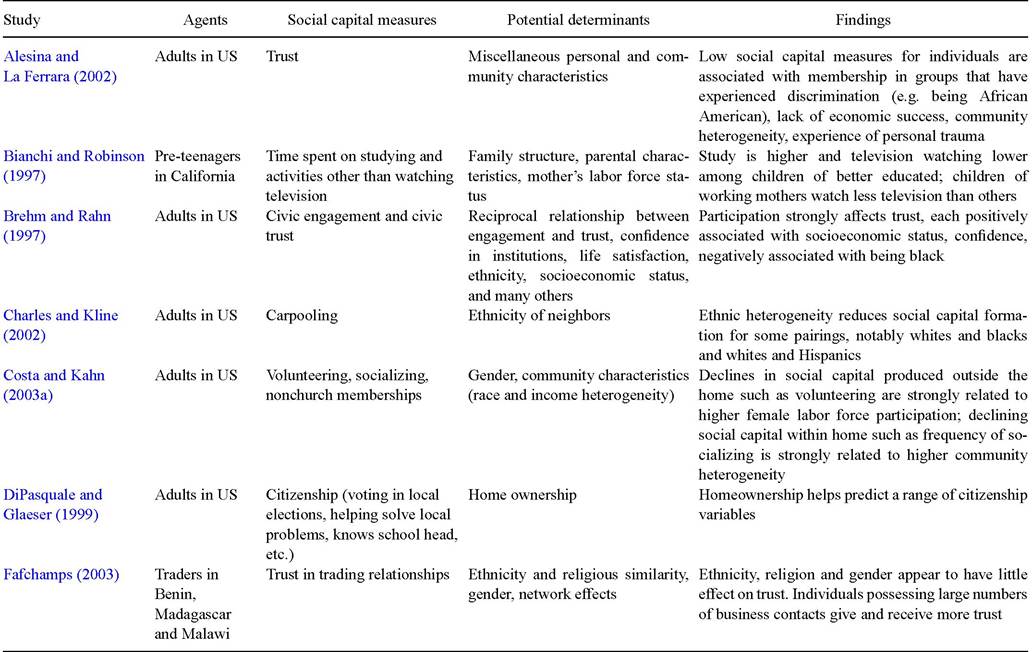
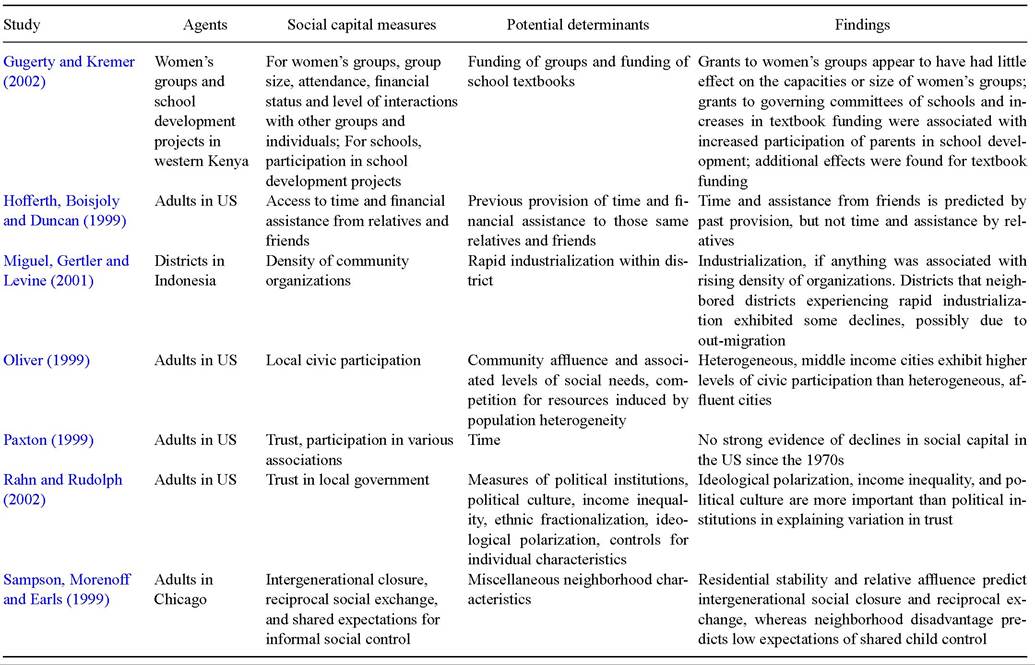
Interest in the effects of social capital has spawned a related literature of the level of social capital and how this level is determined. Table 4 lists a range of studies that have explored this issue.
It is worth noting that while attention has been given to questions of model specification and identification for models in which social capital is a causal determinant of various outcomes, we are unaware of any formal analysis that have been applied to models of social capital formation. Our conjecture is that the arguments applied to models of social capital effects can be extended in a straightforward fashion to models of social capital determinants, but this remains to be done.One important question in the literature on the formation of social capital has been whether the extremely prominent claims by Putnam (1995, 2000) that social capital in the US has experienced a major decline are correct, and if so, whether this decline can be attributed to those factors he has described, namely, increased watching of television and the passing of the World War II generation. It appears that many of Putnam’s claims have not withstood careful scrutiny. Paxton (1999) shows that there is little evidence of secular declines of trust or overall associational activity in the US. Bianchi and Robinson (1997) find little evidence that patterns of television viewing have much relationship to maternal employment status or other family factors often asserted to lead to lower social capital. Costa and Kahn (2003a), using more disaggregated measures of associational activity, find declines in social capital measures that are qualitatively similar to what Putnam has claimed. However, they find rather different explanations. Their analysis concludes that the decline in social capital produced ‘outside the home’ such as volunteering is explained to a large extent by the rise in female labor force participation in the last 4 decades.
This study also finds that declines in social capital produced ‘inside the home’ such as frequency of socializing is strongly related to increases in neighborhood heterogeneity. One important implication of this work is that it places claims about a decline in US social capital in a different normative light. If increasing female labor force participation is due to the breakdown of discriminatory barriers against women in labor markets and if increasing neighborhood heterogeneity reflects a breakdown of the levels of social and ethnic segregation in the US, then perhaps declines in social capital are best thought of as an unfortunate but necessary side effect of a movement towards a more just society and so should not be mourned.One important aspect of this research is the move towards a causal understanding of the processes by which social capital is formed. One interesting example of such work is Brehm and Rahn (1997) who employ General Social Survey data to study the reciprocal interaction of community involvement and trust in others. Their analysis finds a stronger
Table 4
Studies of social capital formation and the level of social capital
1686 S.N. Durlauf andM. Fafchamps
Table 4
(Continued)
Ch. 26: SocialCapital 1687
causal relationship between community participation to trust than the converse. This finding is indicative of the empirical importance of Dasgupta’s (2003) argument that social capital should be modeled as a network.
Other studies have focused on identifying predictors of trust. For the US, Alesina and La Ferrara (2002) find that trust in others is negatively associated with community heterogeneity. Rahn and Rudolph (2002) extend work of this type in an analysis of the determinants of trust in local government.
This paper finds that political culture and community heterogeneity play an important role in explaining trust. Interestingly, trust does not appear to be influenced by the form of local government as trust levels are not predicted by whether a community has a mayor or city manager (the latter implying less popular control of local government). These studies are best regarded as reduced form analyses in that issues of causality are not specifically addressed.An especially important effort to understand the formation of social capital is the Project on Human Development in Chicago Neighborhoods (PHDCN). This is a remarkably detailed data collection project that covers several hundred neighborhoods in Chicago. These data are proving to be very useful in delineating the detailed social structure of neighborhoods. As described in Sampson, Morenoff and Earls (1999, p. 639), the available data include responses to questions such as “About how often do you and people in your neighborhood do favors for each other?” and the likelihood that one’s neighbors would intervene if one’s child were observed skipping school.
Sampson, Morenoff and Earls (1999) use the PHDCN to study a range of social aspects of neighborhoods. In particular, they distinguish the social capital of a neighborhood as “the resource potential of personal and organizational networks” (p. 635) from the collective efficacy of a neighborhood, “a task-specific construct that relates to the shared expectations and mutual engagement by adults in the active support and social control of children.” (p. 635). The purpose of this distinction is to differentiate general notions of neighborhood social resources from the use of these resources. By delineating how neighborhood members help one another, for example through monitoring one another’s children, Sampson, Morenoff and Earls (1999) give a rich portrait of how neighborhoods benefit their members, illustrating how help in childrearing or trust among neighbors are important mediating variables in understanding why poor neighborhoods have adverse effects on their members. By uncovering specific mechanisms by which neighborhoods matter, this study moves beyond the common use of social capital variables in which the link between the variable and a behavioral outcome is metaphorical and all too often a black box.
7.