Human Interactions: A Macroscopic Microeconomic Feedback Loop
The master equation used in quantum physics, i.e., a state transition equation in physics, implies the existence of an in-flow and out-flow rate, describing the forces of attracting and repelling.
These rates can be implemented by the multinomial logit typed utilities, which is discussed further in Chap. 2. The equation can be used to depict the successive processes of social decision-making reflecting different kinds of heterogeneous interaction. This is basically the economic implication of sociodynamics in terms of moral science, developed by Weidlich-Haag in Stuttgart in Weidlich and Haag (1983), and means that we can argue the formation of solidarity in connection with a genuine historical path. In other words, sociodynamics, in terms of the system of mutual benefit in line with Mohist thought, implies the feasibility of numerical analysis, instead of the system of representative agents equipped with invisible hands.As society becomes more complicated, the more the market environment itself evolves voluntarily. It seems strange to believe a modern form with the same name must guarantee the same function on an evolved system, but more efficiently. A smart grid system may be one such modern form. Following Mainzer (2010, pp. 219-219), I illustrate a typical smart grid system.
Smart grids combine energy systems and information and communications technology as a symbiosis. One of the problems with wind wheels and solar cells is the unpredictability of production. In intelligent networks the need in high degree can be satisfied locally. In addition, assume the following model with concrete basic ideas:
1. The demand exists either within a local (regional) subnet or between subnets. Only in exceptional cases is a reserve capacity taken up. See Fig. 1.7.
2. Energy reconciliation takes place between different levels instead of or between balanced groups on the same level.
3. Producers are also consumers, and vice versa.
4. Negotiations over local current supply are accomplished automatically by producer and consumption agents. They are coordinated by the accounting grid manager (balanced group manager), who works in a time-synchronized way on each level. Figure 1.8 shows three such balanced levels.
5. In the model, the negotiations begin every 0.5 s, and have a clear end-point. Bids arriving in the meantime are negotiated in the next period.
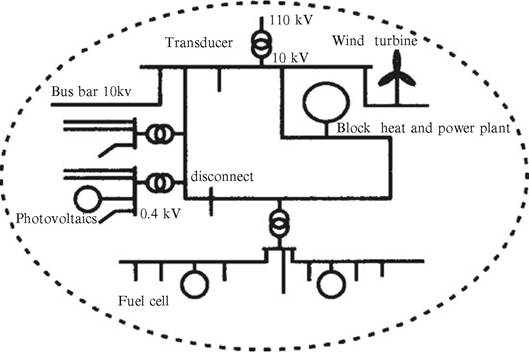
Fig. 1.7 A smart grid circuit. Cited from Mainzer (2010, Fig. 20) with slight modifications
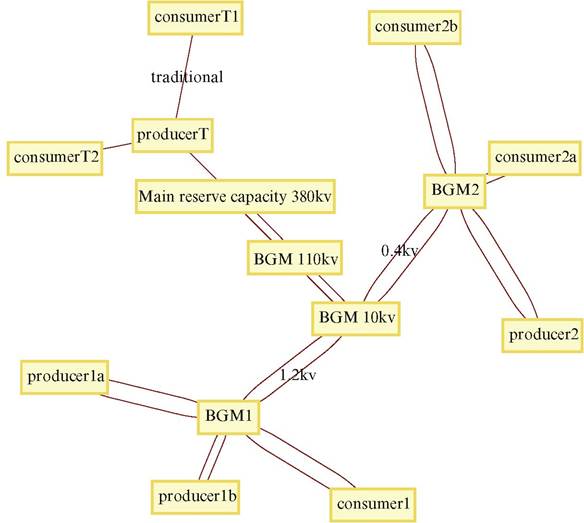
Fig. 1.8 A smart grid network model. aBGM is the Balancing Group Manager. bThe model shows three regional BGMs as well as a layered structure originating from BGM 110kv. cExcept for the traditional circle {producerT, consumerT1, consumerT2}, the remaining part corresponds to the smart grid system
6. At the beginning of each period, each customer determines whether they wish to participate as a producer or consumer or not join in the negotiations, according to the current situation.
7. Sales offers and bids happen within price frameworks, considering redemption and maintenance costs. There are no long-term contracts with discounts for large and future purchases, which often arise in reality.
As seen in Fig. 1.8, this model forms a layered network, in which we cannot assume a plane-like homogeneous field. First, the negotiation within the smart grid system is by genetic algorithms. In later chapters, I will discuss genetic algorithms further, as well as artificial intelligence (AI). 0.5 s is outside human control. In standard economics, all that matters in negotiations is whether the time is logical. In the real world, however, the practical time taken for processing must matter.
A delay in processing indicates inferiority. The smart grid system is managed by the negotiation algorithm, a kind of genetic algorithm, not by humans, as humans cannot operate at machine speed. But negotiation in a game theory situation is different from the negotiation algorithm by AI. Even if standard economics could include optimization in the negotiation process, its algorithm would require a loser, because the idea of optimization is not valid in the landscape of complex interactions of heterogeneous agents at high speed and/or frequency. The same problem also applies to the stock exchange. The actual world dispenses with optimization. Because it keeps moving rapidly, there is no need to fix the present to a particular equilibrium. The stylized facts of economics do not correspond to reality, and in particular to the emerging ICT society. The economic agent must be independent to pursue his own private profit. It is impossible to imagine such an independent node if we regard society as an evolving network. A pressing subject must be the design or construction of the network.Much of the academic community retains some stubborn belief in invisible hands. The efficient market hypothesis (EMH) is a typical variant of this belief. For example, faced with the global economic crisis, Robert Lucas, a Nobel laureate, in defending economics (The Economist print edition, August 6,2009), asserted that the current crisis strengthened the credit of the efficient market hypothesis. As Chen (2008, p. 84) pointed out, however, the fundamental assumption behind the EMH is that financial markets are ruled by random walks or Brownian motion. If this theory were true, then the markets would be very unlikely to have large price movements like financial crises. Orthodox economics may no longer derive any prescription for this crisis from its own traditional theory (Chen 2013, pp. 9-10).
It therefore seems important that we should disengage from the EMH swiftly. Current financial markets are filled with substantial secondary noise that could offset primary efforts to regulate demand and supply.
Real financial markets are surrounded by too many non-market factors typical of the traditional stock exchange. The so-called sub-prime crisis was essentially irrelevant to the traditional stock exchange system, since it happened outside it, although influencing it heavily and therefore amplifying fluctuations. For example, in the currency exchange market, it is quite normal for professional traders to have mutual exchanges using private information, even though this seems like insider trading.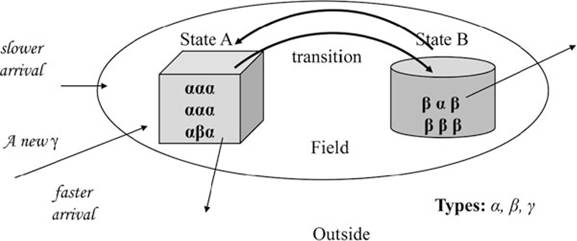
Fig. 1.9 An image of a master equation. Source: Aruka (2011, p. 23, Fig. 1.11)
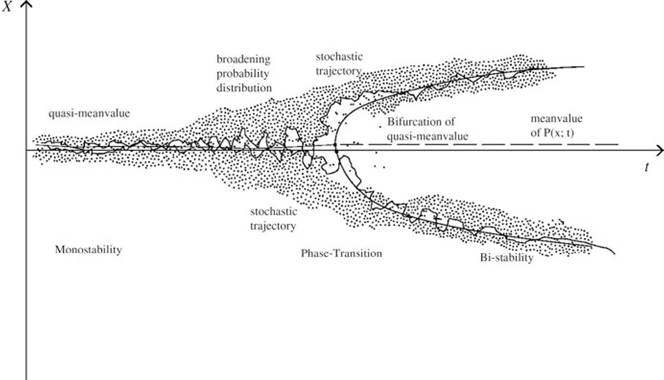
Fig. 1.10 Stochastic trajectories, probability distribution and quasi-mean values. Source: Weidlich (2010, EIER vol 6(2), p. 336)
1.11.1