Introduction
People in countries like the United States are richer by a factor of about 10 or 20 than people a century or two ago. Whereas U.S. per capita income today is $33,000, conventional estimates put it at $1800 in 1850.
Yet even this difference likely understates the enormous increase in standards of living over this period. Consider the quality of life of the typical American in the year 1850. Life expectancy at birth was a scant 40 years, just over half of what it is today. Refrigeration, electric lights, telephones, antibiotics, automobiles, skyscrapers, and air conditioning did not exist, much less the more sophisticated technologies that impact our lives daily in the 21st century.[4]Perhaps the central question of the literature on economic growth is “Why is there growth at all?” What caused the enormous increase in standards of living during the last two centuries? And why were living standards nearly stagnant for the thousands and thousands of years that preceded this recent era of explosive growth?
The models developed as part of the renaissance of research on economic growth in the last two decades attempt to answer these questions. While other chapters discuss alternative explanations, this chapter will explore theories in which the economics of ideas takes center stage. The discoveries of electricity, the incandescent lightbulb, the internal combustion engine, the airplane, penicillin, the transistor, the integrated circuit, just-in-time inventory methods, Wal-Mart’s business model, and the polymerase chain reaction for replicating strands of DNA all represent new ideas that have been, in part, responsible for economic growth over the last two centuries.
The insights that arise when ideas are placed at the center of a theory of economic growth can be summarized in the following Idea Diagram:
Ideas ⇒ Nonrivalry ⇒ IRS ⇒ Problems with CE.
To understand this diagram, first consider what we mean by “ideas”. Romer (1993) divides goods into two categories: ideas and objects. Ideas can be thought of as instructions or recipes, things that can be codified in a bitstring as a sequence of ones and zeros. Objects are all the rivalrous goods we are familiar with: capital, labor, output, computers, automobiles, and most fundamentally the elemental atoms that make up these goods. At some level, ideas are instructions for arranging the atoms and for using the arrangements to produce utility. For thousands of years, silicon dioxide provided utility mainly as sand on the beach, but now it delivers utility through the myriad of goods that depend on computer chips. Viewed this way, economic growth can be sustained even in the presence of a finite collection of raw materials as we discover better ways to arrange atoms and better ways to use the arrangements. One then naturally wonders about possible limits to the ways in which these atoms can be arranged, but the combinatorial calculations of Romer (1993) and Weitzman (1998) quickly put such concerns to rest. Consider, for example, the number of unique ways of ordering twenty objects (these could be steps in assembling a computer chip or ingredients in a chemical formula). The answer is 20!, which is on the order of 1018. To put this number in perspective, if we tried one different combination every second since the universe began, we would have exhausted less than twenty percent of the possibilities.[5]
The first arrow in the Idea Diagram links ideas with the concept of nonrivalry. Recall from public economics that a good is nonrivalrous if one person’s use of the good does not diminish another’s use. Most economic goods - objects - are rivalrous: one person’s use of a car, a computer, or an atom of carbon dimishes the ability of someone else to use that object. Ideas, by contrast, are nonrivalrous. As examples, consider public key cryptography and the famous introductory bars to Beethoven’s Fifth Symphony.
Audrey’s use of a particular cryptographic method does not inhibit my simultaneous use of that method. Nor does Benji’s playing of the Fifth Symphony limit my (in)ability to perform it simultaneously. For an example closer to our growth models, consider the production of computer chips. Once the design of the latest computer chip has been invented, it can be applied in one factory or two factories or ten factories. The design does not have to be reinvented every time a new computer chip gets produced - the same idea can be applied over and over again. More generally, the set of instructions for combining and using atoms can be used at any scale of production without being diminished.The next link between nonrivalry and increasing returns to scale (IRS) is the first indication that nonrivalry has important implications for economic growth. As discussed in Romer (1990), consider a production function of the form

where Y is output, A is an index of the amount of knowledge that has been discovered, and X is a vector of the remaining inputs into production (e.g. capital and labor). Our standard justification for constant returns to scale comes from a replication argument. Suppose we’d like to double the production of computer chips. One way to do this is to replicate all of the standard inputs: we build another factory identical to the first and populate it with the same material inputs and with identical workers. Crucially, however, we do not need to double the stock of knowledge because of its nonrivalry: the existing design for computer chips can be used in the new factory by the new workers.
One might, of course, require additional copies of the blueprint, and these blueprints may be costly to produce on the copying machine down the hall. The blueprints are not ideas; the copies of the blueprints might be thought of as one of the rivalrous inputs included in the vector X.
The bits of information encoded in the blueprint - the design for the computer chip - constitute the idea.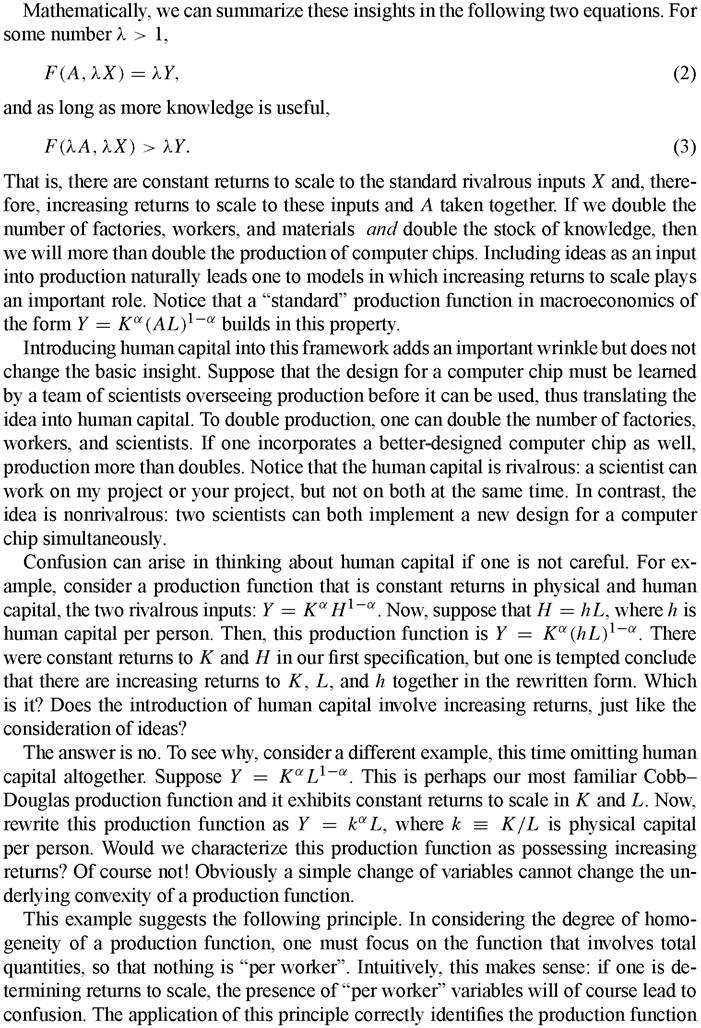
based on human capital as possessing constant returns. Introducing ideas
into the production function leads to increasing returns because of nonrivalry.
Finally, the last link in our diagram connects increasing returns to scale to “Problems with CE”, by which we mean problems with the standard decentralization of the optimal allocation of resources using a perfectly competitive equilibrium. A central requirement of a competitive equilibrium is that factors get paid their marginal products. But with increasing returns to scale, as is well known, this is not possible. Continuing with the production function in Equation (1), the property of constant returns in X guarantees that[6]

That is, paying each rivalrous factor its marginal product exhausts output, so that nothing would be left over to compensate the idea inputs

If the stock of knowledge is also paid its marginal product, then the firm would make negative profits. This means that the standard competitive equilibrium will run into problems in a model that includes ideas.
These two implications of incorporating ideas into our growth models - increasing returns and the failure of perfect competition to deliver optimal allocations - are the basis for many of the insights and results that follow in the remainder of this chapter. This chain of reasoning provides the key foundation for idea-based growth theory.
The purpose of this chapter is to outline the contribution of idea-based growth models to our understanding of economic growth.
The next section begins by providing a brief overview of the intellectual history of idea-based growth theory, paying special attention to developments that preceded the advent of new growth theory in the mid-1980s. Section 3 presents the simplest possible model of growth and ideas in order to illustrate how these theories explain long-run growth. Section 4 turns to a richer model. This framework is used to compare the allocation of resources in equilibrium with the optimal allocation. The richer model also serves as the basis for several applications that follow in Sections 5 and 6. Section 5 provides a discussion of the scale effects that naturally emerge in models in which ideas play an important role and reviews a number of related contributions. Section 6 summarizes what we have learned from growth accounting in idea-based growth models, considers a somewhat controversial criticism of endogenous growth models called the “linearity critique”, and briefly summarizes some of the additional literature on growth and ideas. Finally, Section 7 of this chapter concludes by discussing several of the most important open questions related to growth and ideas.It is worth mentioning briefly as well what this chapter omits. The most significant omission is a careful presentation of the Schumpeterian growth models of Aghion and Howitt (1992) and Grossman and Helpman (1991) and the very interesting directions in which these models have been pushed. This omission, however, is remedied in another chapter of this Handbook by Aghion and Howitt. Probably the next most important omission is a serious discussion of the empirical work in what is known as the productivity literature on the links between R&D, growth, and social rates of return. An excellent overview of this literature can be found in Griliches (1998).
2.