A Makeshift Idea of Compensated Demand and Income
We denote a demand at price p by f(p). There are then two distinct price vectors p1 and p2:

i.e.,

This is the demand law.
When an income variation x derived from price changes is taken into account, the tentative formulation is called the Pareto-Slutsky equation:
In other words:
• demand change = substitution effects C income effects
j and k are indices of goods. f is the demand for good k. hj∙ is the compensated demand for good j. x is income level. Demand for a good depends on the price of goods pk including the good itself (pj∙) and also on income. Income x is measured in terms of goods. Therefore, income may be changeable depending on price variations ∆p. A change in income naturally induces a change in demand. However, the sign of a change in income is not decisive. This is a complicating factor in establishing the demand law. Consequently, economists were not successful in confirming the sign of the income effect until a new assumption was made by Hildenbrand (1994). It therefore took about 90 years to solve this problem.
Compensated demand is a sophisticated idea. This demand h always has a negative sign with respect to a price rise. h is a special form that only reacts to price variation but not to income level, to guarantee the same level of satisfaction by supplementing a new injection of income if short or reducing it if long.
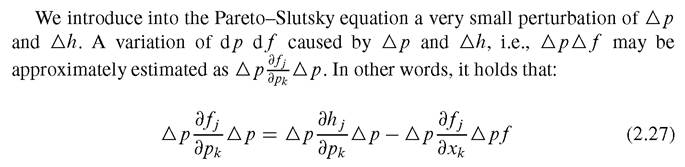
There is no reason for the first item to always be equal to the second. If the second item is negative, the total variation caused by Δpk could be positive, leading to the reverse of the demand law. The Pareto-Slutsky equation, as it stands, is therefore not able to guarantee a definite analytical relation. A so-called Giffen effect cannot be removed.
In Fig. 2.4, we can show a demand change within the desired range, supporting the demand law, if prices are arbitrarily assigned. However, in Fig. 2.5, if the same prices are presumed, we cannot control the demand within the desired range of the Pareto-Slutsky equation.
2.2.2