The Motivations for Social Ownership
The motivations for social ownership are to be found primarily in the social vices that socialist critics have attributed to a free enterprise system. Indeed, the best place to find widespread, if not unanimous, agreement among socialists about the good society is in their critiques of the free enterprise system.
A widely shared socialist vision of the good society is in part negatively defined by the systemic evils socialists have attributed to free enterprise systems. And perhaps the best place to begin a discussion of those evils is Marx’s radical critique of capitalist society. Though socialists have disagreed with Marx about how to conceptualize the notion of class, about the dynamics of class societies, and indeed about a whole host of other matters, most socialists seem to be broadly sympathetic to his views about what is wrong with the capitalist (free enterprise) economic system and, by implication, capitalist society.Marx’s critique attributes basically two systemic evils to capitalism’s economic system: alienation and exploitation. In another work, I have reconstructed and critically evaluated Marx’s arguments for attributing these evils to that type of economic system (Arnold 1990, chaps. 2-5). The purpose of the first three parts of this section is not to summarize and assess these arguments. Rather, it is to identify those elements of his critique of capitalist economic systems for which a plausible prima facie case can still be made. This is done as a way of motivating the features of market socialism identified above in elements 2-4. To that end, this section also explains in each instance how or why it might be thought that market socialism would eliminate or significantly ameliorate these problems. The larger purpose of this section is to sketch or outline a stout defense (in the sense defined in chapter 1) of this type of economic system.
To put it more simply, the purpose of this section is to explain why this type of economic system looks intellectually attractive from a socialist perspective.23The End OfAlienation in the Workplace
According to Marx, two types of alienation that are endemic to capitalist society are the alienation of the worker from his or her labor and the alienation of the worker from his or her product. The latter manifests itself in the phenomenon of commodity fetishism and a variety of so-called market failures; it will be discussed in the next subsection. The former, which is the subject of this subsection, most prominently manifests itself in worker dissatisfaction with—and on—the job. As Saul Estrin has said,
Workers have no say in the major decisions affecting their working lives: the production processes used, the pace of manufacture, the noise levels, manning arrangements, the layout of the plant, the decision to increase or reduce the labour force or even to close the factory. Their dissatisfaction
comes out in a number of ways: their attitude toward work,... to management in general, and to the owners is often highly negative—the “them versus us” mentality. If the labour force is not unionized, this often leads to uncooperative attitudes, inflexibility with regard to work practices, high rates of absenteeism, shirking, and labour turnover. If it is unionized, [it leads to] unions’ militancy, industrial action, and strikes. (1989, 170-71)
These manifestations of alienation are explained by the fact that management rights (in particular, ultimate decision-making authority) and income rights (rights to the residuals) are not held by the workers themselves.24 The residual claimants, who also control the means of production, seek to maximize their profits, so they drive the workers as hard as they can. They only show concern for what the workers think and want to the extent that maintaining their profits demands it.
Not coincidentally, the reason why these problems would be ameliorated in market socialism is to be found in the structure of management and income rights that characterizes the cooperatives.
Since self-management is self-management by all of the workers, and not just some, management rights are to be held collectively. This means that important decisions about matters of the sort mentioned will be made via participatory and democratic procedures. Though workers may delegate some day-to-day managerial tasks to specialists, they cannot delegate too much decision-making authority without losing control of their productive lives.Moreover, since the workers have income rights, as well as management rights, in the firm, it will be up to them to decide what trade-offs between income and other values are acceptable. Suppose there is a drop in demand for the product a firm produces. Under market socialism, workers may respond by collectively deciding to take a pay cut, to work longer hours, to reorganize production in less intrinsically satisfying but more productively efficient ways, or to defer new investment—or some combination of these options. Capitalist firms have all of these options as well, but in a capitalist system, unlike a market socialist system, those most directly affected—the workers—do not decide which of these strategies will be adopted. Instead, these decisions are made by others, namely, the bosses. Finally, because of their income rights in the firm, workers have a bigger stake in the firm’s health and survival. This eliminates (or at least significantly dampens) the “them versus us” mentality noted by Estrin.
A dealienated or unalienated workforce and what that implies is clearly part of the socialist conception of the good society. Strikes and industrial actions would be rare or nonexistent, and job redesign would ensure more meaningful work—or at least, the workers would have consciously chosen the greater income that goes with more alienating labor. Absenteeism, shirking, and job turnover would be minimized. Estrin and others who favor market socialism do not explicitly promise that workers’ control over their own productive lives, ensured by the management and income rights they hold in the firm, would eliminate all of these problems (see, e.g., Hor- vat 1982, 190).
Some of them may never go away entirely. But they do hold out prospects for significant amelioration of these manifestations of alienation.The Elimination of Commodity Fetishism and the Attenuation of the Irrationalities of the Market
Another form of alienation in a capitalist economy that Marx discusses is the alienation of the worker from the product of his labor. Not only does the worker not own the product of his labor, but when it is sold in the marketplace, it becomes part of a larger alien system, what Marx calls a system of commodity production. What he means by this can be best understood by way of his most fundamental distinction among types of economic systems: the distinction between systems of commodity production (i.e., production for exchange) and systems of production for use.
In precapitalist nonexchange economies, the producer either is the consumer or is part of the same relatively small social group to which the consumer belongs (e.g., the family, the feudal manor). Production decisions are guided by the need for particular producer or consumer goods (what Marx calls ‘use-values’), though, of course, not always for use-values that meet the needs of the direct producers. By contrast, capitalism is a system of commodity production, or production for exchange, in which the purpose of production is to get exchange value in the marketplace. The need for usevalues only contingently and indirectly determines production.
Characteristic of a regime of commodity production is the phenomenon of commodity fetishism in which relations among producers masquerade as relations among the products of labor. What Marx means by this can be explained as follows: since the overriding purpose of production in a system of commodity production is to get exchange value, relative exchange values determine how social labor gets apportioned among the various lines and branches of production. To put this point in the fetishistic language of economists and businessmen, productive resources go where there are profits to be made.
This deployment of productive resources happens automatically and behind the backs of the direct producers, so to speak. No one decides that there will be X number of steel mills or Y number of automobile manufacturers; that is just the way it works out. The market serves as an automatic and impersonal device for the coordination and allocation of social labor, which entails that the large-scale social organization of production is not determined by, or subject to, the conscious control of anyone, most especially the direct producers.By contrast, in systems of production for use, production is directly determined by the need for particular use-values and is not mediated and mystified by the market. Of course, production under, say, feudalism is not the realization of a harmony Ofinterests between serf and lord; the serf, after all, is being exploited. But this fact is completely clear in such a system (in contrast to capitalism, where exploitation is obscured by the wage contract). The social division of labor in systems of production for use has a kind of transparency and permits a kind of social self-understanding that is lacking in a regime of commodity production.
Marx seems to have regarded the lack of social self-understanding and control that this involves as an intrinsically bad thing. However, he also believed that it had bad consequences. A system of commodity production unleashes forces that have a devastating and unpredictable impact on people’s lives and livelihoods. For example, as Marx points out in The German Ideology, a machine can be invented in England that deprives countless workers of their livelihood in India and China and completely overturns these societies ([1848]1976, 51). This happens even though it was no part of the intention of the inventor to cause this disruption. Technological developments, shifts in demand, discoveries of new sources of supply, and so on and so forth, whipsaw firms and workers alike, enriching some and dispossessing others.
Commodities are, in effect, loose cannons on society’s deck. In a related vein, since a regime of commodity production is guided by no overall plan, coordination among independent producers can and does break down, leading to recession or depression with associated massive unemployment. The tremendous dislocations and suffering this involves are what Marxists have in mind when they speak of the “anarchy of the market.”For all these reasons, Marx maintains that the worker’s product confronts him as a hostile force in a regime of commodity production. And what makes that hostile force an alien force is the fact that the producers are linked together in ways that they neither understand nor control.
On the face of it, it would seem that all of these problems would face a market socialism, since it is a regime of commodity production in the sense that production decisions are based on market signals. However, its proponents would argue that certain features of this system prevent commodity fetishism and the other unfortunate consequences of the alienation of the worker from his or her product. They would maintain that Marx’s blanket condemnation of commodity production is unwarranted.
One of the crucial differences between a capitalist system and a market socialist system is that market socialism involves state planning of most new investment. Under capitalism, there is no economywide plan for new investment. Marx’s radicalism led him to believe that only the abolition of the market as a coordinating mechanism could solve the problems to which he called attention. For reasons discussed in the first section of this chapter, market socialists believe that would be unwise. They believe that market forces should be harnessed, not abolished; just as engineers harness the power of a river by building a dam, a market socialist society harnesses the power of the market by controlling the rate and direction of economic development through its control of new investment, funded by the capital usage fee (Schweickart 1980, 108-10, 114-15; Horvat 1982, 230).
As noted in the last section, the level at which the capital usage fee is set determines the overall rate of growth because it is the primary generator of funds for new investment. The direction of development is determined by the details of the investment plan. This can be done in a variety of ways. One way, which respects the complexity of a market economy, is to direct different percentages of the social investment fund to various sectors of the economy or to various geographical areas. Political representatives at the national level need not determine which firms get what funds; that can be left to the banks or investment firms through which the funds are channeled. They simply set the broad priorities with the advice and assistance of planners. Since this is accomplished by and through the democratic state, it represents a collective choice that society makes and not something that just happens, as in the case of free enterprise systems. As Schweickart says, “Governmental control here does give, in an important sense, control over the whole economy. That is precisely what we want. We want political control over investment to head off the anarchy of the market, to subject the growth of the economy to human direction, to eliminate the boom-bust cycles of capitalism. The appeal here is to efficiency, material well-being and autonomy” (1980, 143).
In this way, a market socialist system dispels the fog of commodity fetishism. This quotation from Schweickart hints at some related advantages that a market socialist economic system is supposed to enjoy in comparison to a free enterprise system. Despite their appreciation for the virtues of the market, market socialists are characteristically quick to point out the vices of the market as it is found in free enterprise systems. Commonly cited defects and problems include positive and negative externalities, monopolistic and oligopolistic pricing, and irrationalities in the structure of production caused by the grossly unequal distribution of income.25
Three examples will illustrate. First, the pollution problems of capitalist society stem from the fact that pollution is a negative externality; that is, it is a negative effect on third parties, which is not taken into account by the owners of the polluting factory or their customers. Second, it is often maintained that oil companies make extraordinary profits in times of international crises because they comprise an oligopoly or at least have considerable market power. Third, a great many urgent needs, such as health care for the poor, go unmet while significant resources are devoted to the production of luxury goods.
These and other systemic defects of the market in a capitalist system could be elaborated in much greater detail, but the basic problem, as many socialists see it, is that the commitment to the market as it is found in societies with a free enterprise system is a commitment to procedures at the expense of outcomes.26 According to market socialist critics of the free enterprise system, this means accepting the “social irrationalities” (as they might be called) that emerge from the blind operation of market forces. The willingness to accept these irrationalities might be called “market fetishism.”
Defenders of a free enterprise system can often be talked into qualifying their defense by allowing for some government intervention to correct or otherwise compensate for some of these social irrationalities. However, these interventions are hard to defend in a principled way, so they usually feel badly about it afterward. No such regrets cloud the socialist mind. If the market produces some social irrationality, that irrationality can and should be corrected by state intervention in the economy. For example, it may happen for some exogenous reason (e.g., historical circumstance) that there is not enough low-cost housing or decent medical care in a certain geographical area. Or perhaps there are too many luxury goods being produced, given that some urgent needs are unmet. Society must have an ultimate recourse available to correct these fortuitous imbalances thrown up by the market. For the market socialist, that recourse is the state. The state can correct these imbalances by providing the goods or services to those who need them, either free or at subsidized prices; it can tax companies that make windfall profits or impose price controls on them; it can prohibit pollution; or it can use its control of new investment or interest rates to nudge the market in the right direction.
All of these things are done by the state in a existing free enterprise systems, but they are often done in a half-hearted way and only after the problems have become particularly egregious or pervasive. From a socialist perspective, much of the explanation for the state’s lackluster performance is to be found in the society’s ideological commitment to respecting private property rights and thus the irrational outcomes that result from permitting market forces to work themselves out.
By contrast, though there is some presumption in favor of the market in a market socialist system, there is no principled opposition to bypassing it when some social irrationality demands it. Indeed, there is a principled commitment to do just that. Market socialists are not thereby committed to the belief that the state is infallible in discerning or dealing with these irrationalities. But there is a readiness to use the state as an instrumentality for dealing with the various failures of the market that is just not in the hearts and minds of those who favor a free enterprise system. These social irrationalities are consequences or manifestations of the alienation of the worker from his or her product in a free enterprise system. Market socialism promises the elimination or significant amelioration of these irrationalities—these social vices of the free enterprise system.
Another reason why a market socialist system might be expected to do better on these social irrationalities than societies with free enterprise systems is that the market socialist state would have proportionately more resources at its disposal to address these problems. States in free enterprise systems cannot tap the funds used for new investment in the way that a market socialist state could, since all that the former has at its disposal are revenues raised through (ordinary) taxation. The market socialist state has this source of revenue, but it can also use its control of funds for new investment to deal with these problems. This is a vast store of social wealth to which the state in a free enterprise system has no direct or easy access.
Finally, in a market socialist system, just as new investment is not something that just happens, so too the market is not the way production just happens to be organized. Instead, it is something that is consciously, collectively, and democratically chosen. As David Miller has said, “The market must appear as an expression of collective will. People must both understand the reasons for having markets and act on those reasons when they legislate for their existence through a democratic assembly. Moreover, this decision must always be open to reversal.... Only in this way can we conceive of overcoming alienation” (1989a, 223). Clearly, this is not how people in capitalist society view the market; nor is it how the market is viewed by those who defend the free enterprise system, however limited or qualified that defense is. In capitalist society, people are the playthings of market forces they neither control nor understand. By contrast, Miller’s conception of how people in a market socialist society conceive of the market implies a social selfunderstanding incompatible with commodity fetishism and the blind acceptance of the market that entails. An analogy would be the contrast between the immigrant who consciously chooses to become a citizen of another country and the native who is born into the society and citizenship. The immigrant is much more likely than the native to be aware of the country’s strengths and weaknesses and to have made the choice in light of this knowledge. On the other hand, the choice has already been made for the native. In a similar manner, in a market socialist system, since people collectively choose the market and understand the reasons for doing so, they are not subject to forces they neither understand nor control. This is another reason why the fetishism of commodities that afflicts capitalist society would not afflict market socialist society.
To summarize in the language of chapter 1, commodity fetishism and a whole range of social irrationalities are social vices attributable to free enterprise systems. Although a market socialism is a market economy, it does not suffer these vices. Commodity fetishism is suppressed for two reasons: First, the market is collectively and consciously chosen as the basic method of coordinating production; it is not a system under which people just happen to find themselves living. Second, because the state controls new investment, the rate and direction of economic development (and ultimately the entire structure of production) is a matter of social choice and not something that just happens to a society. In addition, the social irrationalities that would otherwise emerge from the unfettered market are also suppressed (eliminated or attenuated) by state action in a market socialist system. The verdict of the market is not sacrosanct; rather, it is subject to appeal in a way in which it is not in a free enterprise system. For all of these reasons, this type of market socialist system does not suffer the social vices of the free enterprise system that arise from the separation of the worker from his or her product.
The Elimination of Exploitation
Another generic defect of capitalist society that Marx traces to its economic system and that market socialism is supposed to eliminate is exploitation. It is a standard socialist criticism of capitalism that the workers are systematically exploited by the capitalists. Historically, the most important argument
for this comes from volume 1 of Marx’s Capital ([1863] 1977, chap. 1). Although this argument has at least one serious problem, contemporary socialists have tried to reformulate it so as to avoid this difficulty.27 It will prove instructive to take a brief look at Marx’s argument if only because it has the general form that most socialists think an argument of this sort should have. Moreover, this argument also provides some insights into the concept of exploitation that will prove useful in chapter 3, which develops an independent account of exploitative exchange.
Early in volume 1 of Capital, Marx establishes to his satisfaction that the value of a commodity is just the quantity of socially necessary labor required to produce it. This is the labor theory of value. This implies that the surplus value the capitalist realizes as profit comes from the worker. Despite the fact that the capitalist in his role as capitalist does not labor, he is nonetheless able to capture this surplus value on a regular basis. What explains this phenomenon is a complex set of facts. In the wage bargain, what the capitalist buys from the worker is not his labor but his labor power. Labor power is a commodity like any other commodity, so its value is just the quantity of socially necessary labor required to produce it. This is represented by the subsistence wage. However, when this labor power is discharged, the value (i.e., embodied socially necessary labor) that goes into the product is greater than the value of his labor power. In effect, then, for part of the working day the worker works for free. This fact is obscured by the wage contract, which represents the wage as payment for labor instead of for labor power. Marx’s theory of surplus value states that the surplus value that accrues to the capitalist as profit represents the difference between the value added by the worker when he works for the capitalist and the value of the labor power that the capitalist purchases. Because capitalists own nearly all the means of production, the worker is effectively forced to participate in this arrangement. The exploitation of the worker by the capitalist consists in this systematic appropriation of surplus value by means of this coercive or quasi-coercive relationship.
The fatal flaw in this account is that the labor theory of value is not true.28 The value of a commodity is not just so much “congealed” or “ossified” (socially necessary) labor, to use Marx’s terms. Given that, one cannot conclude that the surplus value that accrues to the capitalist comes out of the hide of the laborer, so to speak. Suppose for a moment, however, that the labor theory of value is true and that Marx’s account of exploitation under capitalism is basically correct. In what exactly does the exploitation consist?
Part of the answer seems to be that there has been a breakdown or failure of reciprocity in the relationship between the capitalist and the worker. Reciprocity requires that one return “good for good,” proportionately.29 In a joint undertaking, what this means is that the benefits each person receives from the undertaking must be proportional to that person’s contribution. In a commercial venture, where benefits and contributions are conceived of primarily in economic terms, this means that the value each person realizes must be proportional to the value of that person’s contribution. If that proportionality does not hold, then the failure of reciprocity requisite for exploitation exists.
On Marx’s account, the capitalist in his role as capitalist contributes no value at all. He simply buys labor power, sets it to work on the means of production that he owns, and reaps the profits. It is true that the means of production that the capitalist provides are wholly or in part used up in the process of production. Some of the value received when the product is sold goes to replace that. But the capitalist gets something over and above that replacement value—a positive return on his investment. And that, according to Marx, is the something that he gets for nothing.
There is, therefore, a massive and systematic failure of reciprocity. (Comparable failures of reciprocity can also be found in the master-slave and lordserf relationships, which are also exploitative.) Capitalists are able to do this because of their monopoly control of the means of production; consequently, the worker has no choice but to sell his labor power to the capitalist. One way of understanding this charge of exploitation, then, is that the worker is compelled to be a party to a relationship that systematically fails to be reciprocal. As was pointed out, contemporary socialists have tried to argue, without presupposing the labor theory of value, that these two conditions are, in fact, met in contemporary capitalist society. As for the failure of reciprocity condition, somehow, the crucial fact is the existence of interest income (the returns to capital) that goes to the capitalist—a nonworker—simply in virtue of his ownership of the means of production. A number of thinkers have maintained that this fact indicates that the worker is working more hours than it takes for her to earn the goods she buys with her wage and that this is what makes reciprocity fail.30
G. A. Cohen (1979) has taken a similar line in what he calls the Plain Argument. According to the Plain Argument, the failure of reciprocity in the worker-capitalist relationship consists in the fact that the worker creates the product—the thing that has value—while the capitalist (in his role as capitalist) creates nothing; he simply allows “his” capital to be used. The worker is the producer, and the capitalist is not. However, the latter receives some of the value of the product in the form of interest income. Once again, it is a classic case of getting something for nothing, and so there is a breakdown or failure of reciprocity between the worker and the capitalist. On Cohen’s Plain Argument, there is no need to suppose that all value is created by the worker. Maybe value is not created at all, as the subjective theory of value holds; maybe it is created in some other way. The charm of this argument is that it is independent of what the source of (exchange) value is.
Most writers have maintained that the “forcing condition” for exploitation also holds; that is, the workers are forced to work for the capitalists.31 However, there has been some dispute about this or about how best to understand this forcing condition (Cohen 1983; Brenkert 1985; Gray 1988). Cohen (1983), for example, maintains that the workers are individually free but collectively unfree to leave the ranks of the proletariat. Nevertheless, there seems to be agreement among socialists at least on the proposition that for the vast majority of workers, there is no feasible alternative to participation in the capitalist system. This fact, however it is described, coupled with the failure of reciprocity, is what makes the workers exploited in the capitalist economic system.
The point of this rather compressed discussion of the charge of exploitation is to make it clear that the failure of reciprocity is central to the concept of exploitation employed by all of these authors. This is not the only way to understand exploitation, but some variation on this theme seems to be the dominant view in contemporary writings on exploitation.32
Given this account of exploitation under capitalism, it is easy to see how it could be argued that exploitation would be abolished in the market socialist community. Recall that the workers—and only the workers—have both income rights and management rights in their firms and that the returns to capital go to the state. This means that there is no class of nonworkers with a claim on either the net income of the firm or on the returns to capital. Furthermore, the returns to capital (in the form of the capital usage fee) go to the state, which represents society as a whole. These monies are used to finance new investment, which ultimately benefits society as a whole. To some extent, this represents an intergenerational transfer of wealth from the present to the future, but such transfers could be defended as payment for the benefits of capital accumulation by previous generations. (Somewhere in here might be an argument for not increasing dramatically the rate of capital accumulation.)
In light of these considerations, one can see why the systematic failure of reciprocity alleged against capitalist society would not exist in a regime of market socialism. And since the firms are self-managed, workers would not be forced to deal with others who control the means of production. As members of the cooperative, they are full partners in the firm. On this basis, it could be argued that the workers are not exploited under market socialism.
The Achievement of Relative Equality of Material Condition
Perhaps the most widely shared aspect of the socialist vision of the good society is that it achieves some measure of real equality of material condition. One’s material condition is determined by what the economic system provides. This includes not only material goods in the narrow sense of the term but also services such as medical care and education. What makes something material, in this sense of the term, is that it is something of value that can be provided by the economic system. In short, it is an exchangeable good or service.
There are many interesting theoretical and conceptual problems about equality that have been discussed by philosophers in recent years. For example, there has been a dispute about whether the appropriate ideal is equality of wealth, of income, of opportunity, of resources, of needs satisfaction, or of well-being.33 For the purposes of this section, these disputes can be sidestepped, however. Whatever disagreements there are among contemporary socialists, there does seem to be substantial agreement on at least two matters. First, one of the social vices of societies with a free enterprise system is substantial inequality of material condition (see, e.g., Plant 1989, 54; Miller 1989b, 31-32; Roemer 1988, 152; Levine 1984, 133-34; Schweickart 1980, 93-94). Second, and not coincidentally, whatever their ultimate goals or values, most socialists believe that reducing the range of inequality of material condition (possibly, but not necessarily, to zero) is a desideratum for a socialist society (Selucky 1979, 139, 180-82; Horvat 1982, 190; Le Grand and Estrin 1989b, 4, 7; Nove 1983, 215-16; Nielsen 1985; Bowles and Gintis 1986, 206-7; Bonin and Putterman 1987, 6; Miller 1989a, 327-30; Estrin and Winter 1989, 115; Winter 1989, 162). More precisely, it is a necessary condition for most socialist conceptions of the good society.
The explanation for this vice of existing free enterprise systems is to be found in the blind operation of market forces. There are no effective limitations on either the amount of income a person can make or the amount of wealth that can be accumulated. Beginning with Marx’s insights about the close connection between production and distribution in a market system ([1875] 1971, 18), socialist critics of the free enterprise system have argued that the distribution of wealth and income cannot be significantly affected without fundamental change in the relations of production. Whether the state is viewed as the executive committee of the ruling class or as a Semiautonomous entity constrained by the fundamental interests of the ruling class,34 socialists have long argued that relative equality of material condition cannot be achieved by state-mandated redistribution of wealth or income so long as there is private ownership of the means of production. Those who have great wealth and the power that accompanies it have both the will and the means to block measures that would significantly redistribute wealth and income in the direction of greater equality. This is one of the main motivations for the kind of fundamental social change socialists advocate.35
How is the social vice of material inequality, as it is found in existing free enterprise systems, to be avoided, and how is relative equality of material condition to be achieved under market socialism? Or, to put it another way, how are inequalities of material condition to be held within a tolerable range (however ‘tolerable’ is defined) in the market socialist community? The primary way this is supposed to happen is through the mechanisms by which workers’ income is determined, mechanisms that are built into the structure of the market socialist economy. Recall that workers’ income is the income of the firm net of nonlabor expenses, including the cost of capital. The fact that there is no nonlaboring class receiving the returns to capital removes one major source of material inequality found in free enterprise systems. The returns to capital go to the state. Because the workers collectively receive the residual income of the firms, these residuals would be spread much more widely throughout society than under a free enterprise system where they go exclusively to the owners of capital. Additionally, it is envisioned that the net income of each firm would be divided up relatively equally among the membership. As Saul Estrin has said,
The distribution of income between people of different skills within each enterprise becomes a matter for internal debate and vote under self-management.... While the outcome will still reflect to some extent the market position of those with special skills, it is likely to be more egalitarian than pertains in capitalist firms. In particular, it seems unlikely that the very high salaries and other perks accorded to themselves by top managers would survive open scrutiny and democratic vote by other employees. (1989, 171)
What Estrin and others envision is a democratic determination of the division of the firm’s income (e.g., Horvat 1982, 270). It is not necessary that each worker receive the same income. As the quotation from Estrin indicates, it may well happen that those with especially valuable skills or abilities will make more because of their recognized value to the firm. However, for the reasons cited by Estrin, the range of inequality in incomes would likely be much reduced relative to what one finds under existing free enterprise systems.
The collective structure of management and income rights also prevents workers’ cooperatives from making extensive use of hired (i.e., wage) labor on a permanent or even temporary basis. That would create a group of second-class workers (proletarians, if you like) who, as wage laborers, would not be entitled to a share in the firm’s net income and whose productive lives would be controlled by others. No genuinely socialist society can tolerate that phenomenon except at nonsignificant levels.
There is one final source of inequality in income that has to be taken into consideration. In any market economy, some firms will be more successful than others, which means that there will be interfirm variations in income. How would a market socialist society deal with these variations? Proponents of this version of market socialism favor (or at least do not oppose) inequalities that arise in this manner, but only up to a point. After all, the possibility of making these profits and the larger income that entails is supposed to be an incentive for cooperatives to produce efficiently. However, no socialist society can remain indifferent to income inequalities that fall outside a certain range. How are these to be dealt with? One obvious solution is for the state to levy a progressive income tax on individuals or on firms; the steepness of the progressivity of this tax could be determined by whatever range of income inequality is deemed to be socially acceptable (Miller 1989a, 153). This would be much easier to do in a society not antecedently committed to whatever outcome emerges from the operation of the market.
Recall that a social vice is any feature of a society that is a sufficient condition for that society not to be a good society. Since a good society is, by definition, something that it is reasonable to hope could exist, social evils must be elim- inable or at least capable of being attenuated to the status of social blemishes. It was fashionable in the 1960s to blame every social ill on “the capitalist system.” Taken with its original Marxist connotations, this would mean that all social vices are ultimately traceable to the economic system of Western society. Not a very plausible view, then or now. However, it is a plausible view that a society’s economic system, in virtue of the type of system that it is, is responsible for some social vices (sufficient conditions for a society not to be a good society) or social virtues (necessary conditions for a good society).
The main purpose of this last section has been to identify the social vices that socialists have attributed to a free enterprise system, qua free enterprise system, and to sketch some of the reasoning or explanations that connect that type of economic system to these social vices. This section also contains a prima facie case linking the absence of these vices, and/or the presence of various virtues, to the structure of the type of market socialist economic system that has been outlined in the preceding two sections.
The story of this section and the first section can be summed up as follows. An economic system composed of worker cooperatives characterized by collectively held management and income rights, together with an activist state that controls most new investment, would realize the following social virtues:
1. the achievement of a reasonable standard of living, which is to be understood in terms of satisfactorily meeting people’s basic material needs36
2. the end of alienation in the workplace
3. the elimination of commodity fetishism through control of the rate and- direction of economic growth and development
4. the prevention or correction of the social irrationalities that would otherwise emerge from the operation of the market
5. the prevention of economic exploitation of the workers
6. the reduction Ofinequalities of material condition to a tolerable range.
The realization of these elements of the socialist vision of the good society would be ensured by the following four features of a market socialist economy:
a. The market is used to determine the price of and to allocate both factors of production and consumer goods.
b. The firms are worker-controlled cooperatives, which means that all and only the workers in the cooperatives have management rights and income rights (rights to the firm’s net income) in the cooperatives.
c. The state owns society’s capital and rents it to the cooperatives. This requires the cooperatives to pay a capital usage fee to the state; they must also properly maintain the capital goods they are entrusted with, and they must pay into a capital reserve fund, which is used to replace capital goods as the latter are used up.
d. The state controls most new investment.
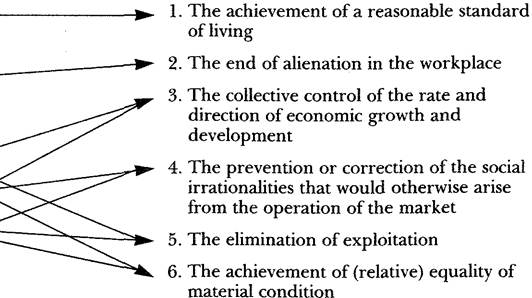
The causal, or at least the explanatory, connections between institutional means a-d and socialist ends 1-6 are schematically indicated in Figure 2.1.
INSTITUTIONAL MEANS
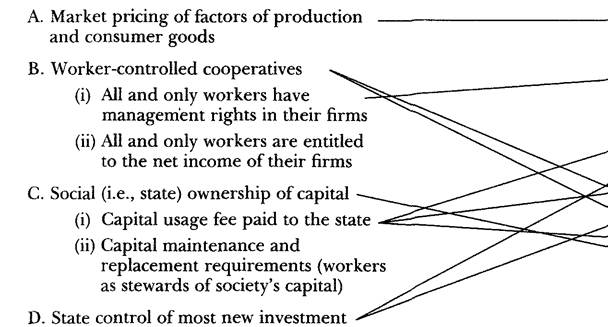
Figure 2.1 Relationships between Institutional Means and Socialist Ends
1 is explained by A
2 is explained by B (i)
3 is explained by C (i) and D
4 is explained by C (i) and D
5 is explained by B and C (i)
6 is explained by B and C
SOCIALIST ENDS
The discussion of this section appeals to widely shared elements of the socialist vision of the good society. To be sure, this vision as it has been revealed here is incomplete in at least two important respects. First, there are social virtues and vices that either have nothing to do with a society’s economic system or are only partially rooted in it. The consumerist mentality found in contemporary societies with a free enterprise system might be an example of a vice only partially rooted in the economic system. The latter may be partly responsible for this; but the available evidence suggests that this mentality is quite widespread and is probably due as much to technology and its perceived benefits as it is to the free enterprise system. Second, there are undoubtedly social vices in existing societies with free enterprise systems that are traceable to other, noneconomic social institutions such as the political system (insofar as it can be distinguished from the economic system) or even possibly the modern family. A discussion of these vices and how they might be dealt with in a socialist society would take us far afield.
Even in a limited and partial way, however, it is perhaps misleading to speak of “the” socialist vision of the good society, since there are clear and serious differences among socialists about what makes a society a good society. Yet there are some elements that while perhaps not universal, are at least widely shared among those who have advocated socialism, both today and in the past. These elements of the socialist vision of the good society come out of a socialist critique of free enterprise (capitalist) economic systems and a recognition of the main failing of existing socialist economic systems. The main purpose of this section has been to identify these elements and tell some plausible stories about how they might be connected to a certain type of market socialist economic system.
It would be a philosophically interesting task to elucidate these elements of the socialist vision of the good society more clearly and to provide some philosophical argumentation in support of them by reference to some fundamental values or moral/political principles. Why, for example, is equality of material condition a social desideratum? Philosophers characteristically leap to this task, ignoring most of the details of the economic institutions that are supposed to realize these values and principles.37 By contrast, the emphasis of this book has been and will be on the empirical arguments and explanations that link institutions (specifically, an economic system conceived of as a system of property rights) and elements of a socialist vision of the good society.
However, a substantive discussion of these arguments requires an appreciation of some of the complex conceptual issues that most interest philosophers. Consequently, the next chapter concerns philosophical questions about exploitation. It aims to elucidate a philosophically defensible conception of exploitative exchange. This is a necessary preliminary step toward developing both a critique of the type of market socialist economic system discussed in this chapter and a limited defense of a free enterprise system, two closely connected tasks that will be executed in chapters 4-7.