The Three Pillars of Income Security
The Three Pillars are the backbone of the New Physiocrats’ plan for providing economic support for the population, intended to replace the minimum wage and a host of complex social programs that exist today.
In conjunction with the rest of platform, it would ensure an economy at full employment, maximum incomes, and the greatest possible purchasing power.• National Dividend (ND) — provided to all adult citizen-residents
• National Income Supplement (NIS) — provided to all those in the labor market, plus homemakers
• Assisted Savings Program (ASP) — a mechanism to magnify savings and pension investments
There must be three pillars of income security in a New Physiocratic regime. The first is the National Dividend, comprised of revenues gained from levies on common property (except land; whose revenues go to fund general expenditures). The second pillar is be the National Income Supplement; mainly comprised income tax revenues in their entirety (in addition to some other sources, to underwrite labor costs). The final pillar is be the Assisted Savings Program, where savings and investments are topped up from capital gains taxes and small financial levies, such as those on short-term capital inflows.
Paystubs under the New Physiocrats would look like this for an average-, low- and high-income workers:
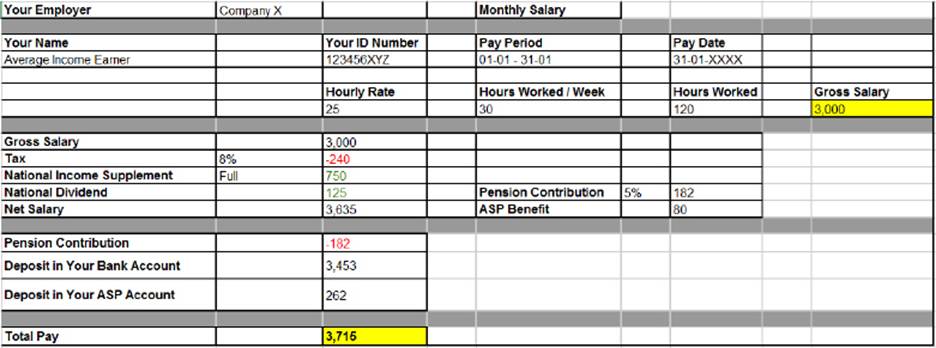
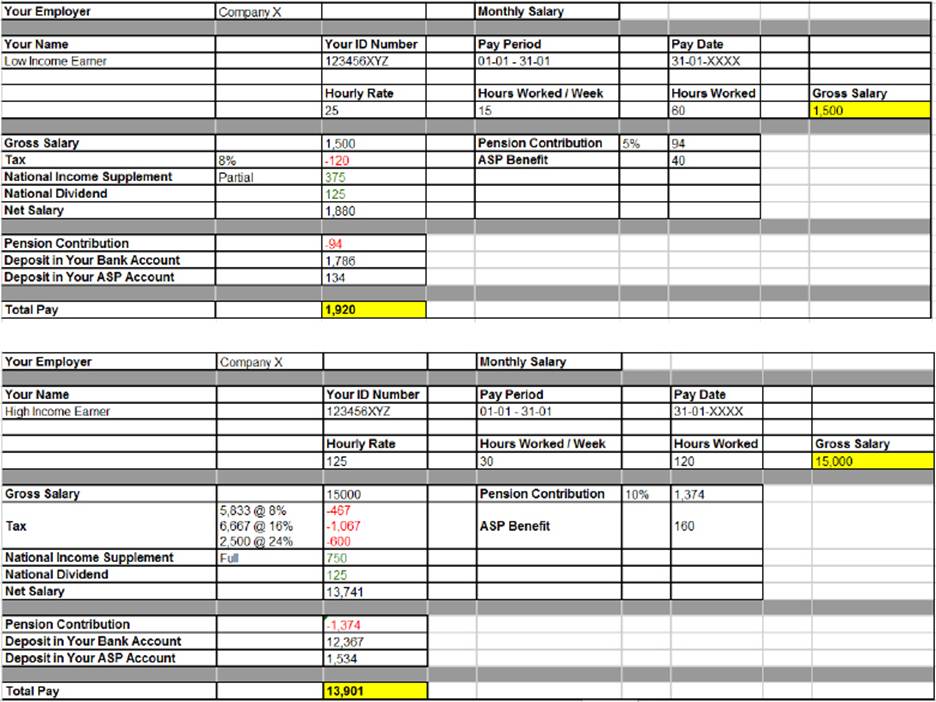
The paystubs of average-, low-, and high-income earners under a New Physiocratic administration. The National Dividend (ND) amount is paid in full to all citizen-residents, regardless of employment status. The National Income Supplement (NIS) amount would be paid in full for those earning average incomes or higher, and prorated for those earning less. The Assisted Savings Program amount is paid based on contribution amounts, up to a maximum value based on median income.
Estimated values are based on Canadian, U.S., and U.K. tax revenues and incomes.
Under the Three Pillars program, lower and middle class income earners pay a steeply negative net rate of income tax, while high-income earners would pay a rate that approaches zero. Meanwhile, relative living expenses under the New Physiocrats’ regime would fall considerably, the reasons for which are discussed later.
As with the other Three Pillars, the National Dividend payment would vary from month to month, as the value is based on the revenues raised. However, it would be offered to everyone regardless of employment status, and it would provide stability and bargaining power for workers. The National Income Supplement would supercharge earnings for those in the labor market (replacing the minimum wage and collective bargaining), encourage entry into the workforce, and effectively subsidize wages for employers. The Assisted Savings Program would amplify citizens’ savings and pensions, replacing bankrupt state pension systems. All of the Three Pillars would be direct cash transfers, without the need for deficits nor excess bureaucracy. This is only possible with general government revenues relying on the Unified Location Tax and Sustainable Value Added Tax, which are discussed below. However, the Three Pillars and other New Physiocratic programs would eliminate the need for some of the current governments’ largest expenditures, such as state pensions, unemployment benefits, and other social programs.