5 De Gaulle Redux
Winston Churchill stays sexy – Kiplingesque imperialist, Second World War hero and Cold War peace-maker. Why, then, does the dinosaur-like General Charles de Gaulle still attract interest? Unlike Russian President Valdimir Putin, he wasn’t a scuba-diving, Siberian bear-hunting, bare-chested equestrian.
The most celebrated of de Gaulle’s ministers, author Andre Malraux, remarked that only three people in France would outlive the twentieth century: de Gaulle, Picasso and Chanel. In 2009 France’s baccalaureat syllabus listed a volume of the general’s memoirs – assigned for literature, not history. No other twentieth-century head of state continues to be discussed for what he wrote rather than what he did. The devil’s own luck in escaping assassination enhanced his fame – the towering, uniformed, kepi-wearing figure marching amid sniper fire into Notre-Dame cathedral for a solemn Te Deum in August 1944. Ambushed at Petit-Clamart in suburban Paris in August 1962 he cheated death by centimetres. Part of the fascination is that the general said ‘Non’, and got away with it – Adolf Hitler 1940, British premier Harold Macmillan 1963, and Parisian students 1968. Saving his country three times – 1940, 1944 and 1958 – gives the French leader a stronger claim to renown than Churchill. Without his presence in 1944 the Liberation might have turned nasty. Over sixty years on, de Gaulle’s Fifth Republic stands firm.Gaullism’s mainsprings predated 1940: passion for the greatness of France, confidence that its interests overrode all others, a quasi-mystical self-selection as a saviour on the model of Joan of Arc and Clemenceau, allied to a belief that rulers, to be effective, had to be aloof. The war added the conviction that a leader should have a direct relationship with the people.
Leadership of the Free French movement and the Provisional Government of 1944 formed the general’s outlook on the Western alliance and European unity.
Labelling him a political dinosaur misses an essential truth – his wide domestic and international support. Even British Labour Party members had ‘a sneaking admiration … They would have liked to see Britain also putting national interests first’.1 The pursuit of greatness was profoundly realistic, designed to bind together a riven nation, emphasizing ‘what Frenchmen had in common by bringing them into confrontation with the “foreigner”’.2In June 1940 de Gaulle’s claim to represent the French state and the continuation of the war sounded totally bizarre. An obscure junior general with a stage army defied France’s ruler Marshal Philippe Petain, senior statesman, hero of Verdun, endorsed by most of France’s political and military elite. A Gaullist aide observed: ‘if Hitler was looking through the keyhole at … this temporary general claiming: we are France, he would surely think that we were ready for the padded cell’.3 Against all the odds a refugee without resources operated successfully in an alien culture, in a language that he spoke imperfectly, with Allied leaders eager to oust him. ‘Extreme weakness’, remarked his legal adviser Rene Cassin, ‘imposes extreme intransigence’.4
What was de Gaulle like? A disconcerting habit of referring to himself in the third person as ‘de Gaulle’ discouraged intimacy. A bullying streak turned highly strung foreign minister Bidault into a terrified rabbit. Angry with his information minister the general ‘grabbed him by the shoulders and literally threw him out’ – at 2 in the morning.5 A loner from childhood he thought highly of himself – writing at fifteen a school essay about a nation saved from military humiliation by ‘General de Gaulle’. He liked to surprise others but took exception when US President John F. Kennedy telephoned him unexpectedly. The White House was informed that in future the general required at least an hour’s notice. Resistance to wearing spectacles in public brought comic relief. ‘Good day, vicar’, he said, shaking hands in a crowd.
‘But, General, I’m one of the gorillas [bodyguards].’ ‘Then Good Day, Mr Gorilla!’.6 Myopia forced him to memorize speeches. On a state visit to Britain in 1960 his classical political oratory – every phrase carefully picked and polished – held a capacity audience from both houses of parliament spellbound.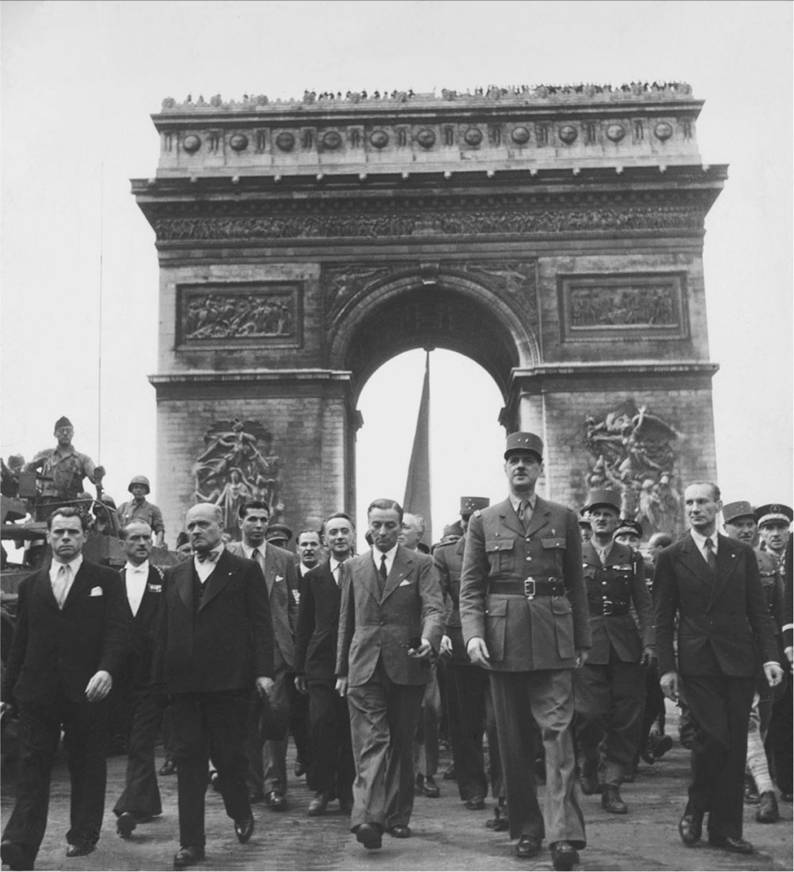
Figure 5.1 General de Gaulle walking down the Champs Elysees, Georges Bidault a step behind on left, 25 August 1944.
An unsmiling public face concealed a prankster with a wry sense of humour. On Monnet: ‘he makes a very good cognac. Alas, that doesn’t satisfy him!’ – a dig at the family cognac business. In January 1963 elder statesman Paul Reynaud, the general’s patron in the 1930s, condemned the veto of Britain’s EEC application. Shortly after, a letter arrived, addressed to Reynaud in the general’s handwriting, but the envelope was empty. On the back it said: ‘If away, forward to Agincourt or Waterloo.’7 In wartime London he starred in a Free French group which mimicked Vichy leaders. In the run-up to the 1965 presidential election advisers urged him to personalize his TV appearances –‘you really want me to stick myself in front of the screen and say: my name is Charles de Gaulle and I am seventy-five years old! I’d be a laughing stock!’8 The general did not party. At the end of a cheerless reception a guest observed, ‘Things dreaded were not usually as bad as one expected but this had been even worse’. He ran a tight ship. On a private cruise to the Pacific in 1956, a young journalist invited an Australian girl to his cabin. Within minutes the General’s aide de camp knocked loudly on the door, ‘Jean, you are part of the general’s suite – no girls ever please’.9
The wilderness years from 1946 to 58 confirmed de Gaulle’s belief that the hexagon needed a strong executive under a new constitution. Rejecting superpower hegemony, supranationality and federalism, he insisted on the primacy of the nation state, envisioning French leadership of a confederal Western Europe.
Consequently, he opposed the ECSC, EDC and EEC. For six years from the end of the Algerian war in July 1962 to the barricades of May 1968 de Gaulle was master of the house. Making France top nation in Western Europe required vision and a firm grasp of economic issues. His genie and indispensability as the one person capable of uniting army and nation gave him a strong hand. No other contemporary European leader had such allure. In his valedictory dispatch Britain’s Paris ambassador Sir Pierson Dixon paid tribute: ‘During 1964 de Gaulle dominated the political scene, like Pharaoh on a frieze of the Temple of Luxor, enjoying a secure base of national prosperity and personal popularity.’10De Gaulle and grandeur are almost synonymous. ‘France’, he declared in 1961, ‘must fulfill her mission as a world power. We are everywhere in the world. There is no corner of the earth, where, at a given time, men do not look to us and ask what France says. It is a great responsibility to be France, the humanizing power par excellence’.11 In The Choice for Europe (1998) Andrew Moravcsik argued that economics more than grandeur drove the general’s statecraft. But the argument was a bit of a red herring. Gaullist statecraft blended grain and grandeur – the visionary was also a realist. Disentangling the strands defies definitive analysis. In 1958 the general confounded critics by abandoning opposition to the EEC. Arguably, without de Gaulle’s support for the Community, deeply protectionist French business interests would have resisted the liberalization measures of the Treaty of Rome. A beefed-up executive imposed the economic and fiscal measures required for Community membership.
The honeymoon years with Brussels between 1958 and 1962 helped validate a claim to leadership. Similarly, following the Algerian war de Gaulle built up friendly relations with the newly independent state. Pursuing reconciliation with Germany in 1958 after three German wars represented a hard-headed bid for a strong continental ally.
The creation of a global Francophonie community of newly decolonized francophone states brilliantly repackaged retreat from empire. Flexibility in day-to-day diplomacy belied dogmatic pronouncements. Approaches to the Community, for example, exposed a significant gap between what de Gaulle said and what his representatives did in Brussels. ‘French policy in practice’ accepted ‘a level of supranationality that had been verbally rejected by the General’.12 Officials made the best deals they could to maximize national interests.Modernization and economic expansion fired primacy. Population jumped 12.3 per cent from 44.8 million in 1958 to 50.3 in 1969. Between 1949 and 1959 GNP grew at 4.5 per cent – Britain averaged only 2.4 per cent in the same period. An annual 5.8 per cent economic growth rate after 1960 made the economy one of the fastest growing in the EEC. The resistance myth cemented domestic cohesion. The apotheosis of de Gaulle’s takeover of the myth came in 1964 with the transfer of the remains of hero Jean Moulin to the Pantheon. Parachuted into occupied France Moulin unified resistance groups under de Gaulle’s authority until captured and killed by the Gestapo. At the ceremony de Gaulle positioned himself on the steps of the Pantheon by the casket ‘so that the parade could “salute in one single motion both the mortal remains of Jean Moulin and the President of the Republic.”’13
‘What an immense advantage de Gaulle has over me’, bemoaned Macmillan in May 1961. ‘No parliament and a press that carries little influence’.14 The Fifth Republic’s constitution of October 1958 provided for the direct election of the head of state, and gave the executive extensive powers over the National Assembly – control of agendas, and ways of ensuring the adoption of legislation without discussion. The government determined the policy of the nation; in practice foreign and defence issues constituted a reserved presidential domain. The Elysee palace interpreted this liberally – annexing the hot button issue of the moment.
The general wrote his own speeches and decided what he said to the press. He retreated from his micromanagement of 1944–6, allowing foreign minister Couve a longer leash than Bidault. Unlike his successors, he did not indulge in a parallel Elysee diplomacy.‘All goes well for France’, boasted de Gaulle in April 1963, claiming that only the United States, the Soviet Union and France counted.15 The general made a special claim for France’s moral leadership in the developing world. France stood for racial equality and the rights of man and nations. ‘France’s vocation’, he claimed, was ‘more disinterested and more universal than any other country’s’. Other states tried to impose their interests, but France, ‘the light of the world’, worked ‘for the interest of all’. De Gaulle, declared novelist François Mauriac, reminded France of her greatness – ‘to serve France, “the irreplaceable nation”, is to serve the world’.16
The hiring of ministers based on technical competence rather than political clout made for stability. Ministers did not have to be members of the legislature. Embedded in their specialties they shied away from larger concerns. Louis Joxe, justice minister in 1968, described himself and colleagues as ‘simply executants. They did their jobs, but … had no possibility of independent thought on major issues’.17 One third came from the senior civil service, compared to 12 per cent under the Fourth Republic. Freedom from parliamentary and constituency cares meant more time for their departments. When giving instructions to ministers the general avoided smiling for fear of suggesting a collegiality between them. The obsequiousness of the prime minister and foreign minister amazed American secretary of state Dean Rusk: ‘I watched … as the prime minister walked up to de Gaulle, gave a little schoolboy bow, clicked his heels and presented himself much like a cadet at St. Cyr. The foreign minister did the same’.18 Bootlicking had limits. Jean-Bedel Bokassa, president of the Central African Republic, went too far, clicking his heels, and saying ‘Good Day, Father’. A vexed de Gaulle told him not to say father. Bokassa replied, ‘Yes, papa’.
An authoritarian regime, but not autocratic. Prime minister Georges Pompidou had a mind of his own. Well-connected in avant-garde society and a collector of abstract painting, his banking background and lack of wartime resistance credentials distanced him from career politicians. Threatening to resign, Pompidou successfully opposed the execution of General Edmond Jouhaud of the OAS, the ultra right terrorist organization fighting to keep Algeria French. Reluctantly, de Gaulle exercised clemency. The premier’s firm handling of the May ’68 troubles enhanced his authority and popularity while the president’s approval ratings slumped.
Decision-making operated on three levels: weekly cabinets chaired jointly by the president and prime minister; ad hoc committees of ministers and officials (conseils restreints) convened by the Elysee secretary general or the prime minister’s office; standing interministerial committees with permanent secretariats. The weekly cabinet was a starchy affair in which a frown from the general daunted all but the bravest. Admonished for expressing opinions on matters outside his departmental remit, finance minister Antoine Pinay protested that there was nowhere else he could air them. Pre-cabinet one-on-one discussions usually settled agenda items in advance of meetings. ‘It was always extremely difficult to penetrate General de Gaulle’s mind’, confided agriculture minister Edgar Faure; ‘the general would summon him and ask for his views on a problem … but if he then asked for the general’s views on another question … the general would give no clear answer’.19
Cabinets followed a set ritual. The agenda invariably listed ‘Communication of the foreign minister on the international situation’. A barely audible, monotone summary of current issues by Couve would be immediately followed by the next item of business. No discussion took place. Ministers with items on the agenda spoke to them, replying briefly to comments, then prime minister and president wound up. At a cabinet two days after de Gaulle’s 14 January 1963 press conference vetoing British membership, Couve’s summary of international events ignored the veto. As ministers prepared to leave de Gaulle spoke – almost as an afterthought, ‘It’s a strange age, gentlemen, when one cannot say without provoking an uproar that England is an island,20 and America is not Europe’. For political hot potatoes like British entry into the EEC de Gaulle went round the table soliciting opinions, but avoiding general discussion. However, the cabinet was not consulted about the decision to withdraw from NATO’s military command, and the president kept his own counsel on most matters.
American ambassador Chips Bohlen quizzed at least ten ministers about the veto on UK entry; ‘I received widely different interpretations and concluded that de Gaulle kept them in ignorance of what he was doing’.21 In January 1962 Premier Michel Debre protested that the Elysee summoned ministers and sent instructions to his own staff without his knowledge: ‘I reproach you’, he told de Gaulle, ‘for summoning a minister to see you behind my back about a problem which I have not discussed with you’.22 After imposing ministerial solidarity, the general switched position without notice. The practice came to a head in 1962 when de Gaulle at his 15 May press conference poured scorn on supranationalism: ‘The only Europe possible is that of states.’ Six Christian Democrat ministers (MRP) resigned in protest – invoking a presidential commitment that the cabinet would have an opportunity to debate the issue. By contrast, the relative informality of ad hoc committees and one-on-one consultation allowed for give and take. At a meeting in October 1967 about Britain’s second membership bid, de Gaulle suggested making an offer to review the position in 1970. He retreated when three senior ministers advised that the offer might be perceived as an advance commitment to enlargement.
Presidential oversight of defence and foreign affairs went unchallenged. The power to call referendums and the introduction of direct presidential election by universal suffrage from October 1962 buttressed the Elysee. Strong referendum majorities strengthened the presidency: new constitution 79.2 per cent; Algerian self-determination 75.2 per cent; direct election of the president 61.7 per cent. Even the April 1969 referendum which triggered resignation gave the general 46.8 per cent of the vote. The stately presidential tours of the Third and Fourth Republics became intensive regional crowd baths. The general was the last head of state to draw large crowds.
How did the general’s day go? A list of appointments and a selection of foreign ministry telegrams and press summaries awaited him on entering his office shortly before 10am. Compacting appointments into two afternoons in the week maximized reflection time. The schedule included twice-weekly consultations with the prime minister, weekly with the foreign minister. About 6pm the general conferred in turn with top advisers – Elysee secretary general, the chief of his private office, secretary general for African and Madagascan affairs, and the head of military staff. Shortly before the prime time 8pm TV news – France’s ‘High Mass’ – de Gaulle picked up his black leather briefcase, rang for the duty ADC, and shook hands, telling him to make sure all the lights were switched off. The president guarded his privacy and rest. ‘Don’t disturb the president except in the event of a world war’ ran one version of night duty instructions. Lavish entertainment was not on the menu. Minimalism reigned. At presidential receptions guests arrived around 9.30–10pm and left at 11.30. Weekends and holidays were spent at the family house of La Boisserie, Colombey-les-Deux-Eglises, about 160 miles east of Paris in the Haute Marne – walking, solitaire and reading Westerns formed the main relaxations.
De Gaulle made his own decisions. Occasionally, he asked, ‘So, what are they saying?’ Sometimes to form an opinion he provoked a response by taking an extreme position on a particular issue. Even the secretary general hesitated to challenge a decision once made. Insistence on written notes gave the president more thinking time and greater control. The procedure, however, allowed top advisers to screen out inputs and limit informal exchanges. As well as determining the broad lines of policy the president kept an eye on detail. Newly appointed ambassadors received precise instructions which Couve confirmed in a follow-up interview.
The president cultivated an image of Olympian detachment while keeping an ear close to the ground. ‘Keep me informed’, he instructed Elysee secretary general Bernard Tricot. Polls, fan mail, media comment, police reports and wiretaps could not replace live contacts, however. Accordingly, afternoon audiences targeted a wide cross section of elites. Gruelling four- to six-day roadshows replaced the presidential tours of the past, enabling him to keep a finger on the popular pulse.
With a far smaller staff than leading foreign embassies in the capital, the Elysee Palace lacked the resources to function as a second government. A handful of foreign policy advisers depended on the Quai for information and guidance. At the Hotel Matignon the prime minister and secretary general of the government kept a firm grip on the administrative backbone – the interministerial committees. About seventy officials ran the presidential secretariat, private office and secretariat for African and Madagascan affairs. Bonded by wartime comradeship in the general’s Free French movement they were loyal to a fault. Pierre Lefranc, one of the nabobs of Gaullism, as well as adopting de Gaulle’s views on most subjects actually dressed and talked like him. The secretary general convened committees, and liaised with ministers and the government secretary general. He was not a super cabinet secretary on the lines of the legendary Sir Humphrey (Nigel Hawthorne) of the BBC’s satirical sitcom Yes, Prime Minister. De Gaulle played master puppeteer: hiring, firing and reassigning collaborators. Secretary generals advised, but did not control policy.
Ministers clung to fig leaves of independence. When secretary general Tricot responded optimistically to a journalist’s question about prospects for a renewal of UK entry negotiations, an angry Couve telephoned: ‘Who is foreign minister, you or me?’ Premier Georges Pompidou insisted, ‘I’m the first adviser of the general, the secretary general should not have ideas’. Tricot demurred, pointing out that while the secretary general should not have his own policy he had to have ideas and be able to discuss them with the president.23
State media turbocharged the Citroën. Skilful tuning of radio and television constructed a supportive public. ‘I cannot accept’, proclaimed the general in 1964, ‘that French radio and television be put at the disposal of a critic or an author taking de Gaulle as his subject without my consent.’24 The head of television news expressed it more succinctly: ‘a journalist should be French first, objective second’.25 RTF (Radiodiffusion-Television-Française) and its successor from 1964 ORTF (Office de radiodiffusion-television française) had a virtual broadcasting monopoly. Government influence on the media was an established feature of the Third and Fourth Republics.
As minister of information in 1947, socialist François Mitterand called for broadcasting to undertake a ‘national policy of defending the interests of France’ – as determined by the government.26 During the strike wave of 1947 the government instructed RTF to label workers as demonstrators, not strikers, and to target Communist union leaders. A ‘black notebook’ in the RTF newsroom ‘listed off-limit subjects’ and prescribed appropriate language for the handling of politically sensitive topics.27 In 1956 Socialist premier Mollet recommended the employment of party faithful to vet radio and TV news bulletins. From the founding in 1947 of the Gaullist party RPF (Rassemblement du people français) the Fourth Republic kept de Gaulle off the air, refusing to relay his speeches.
The general’s grip on the media, reinforced by radio chats and televised press conferences, gave him the advantage over British leaders. News channels suppressed anti-Gaullist criticism. Electoral campaigns had to be covered, but choice of camera angles disadvantaged opposition candidates – television pictures of the Socialist mayor of Marseilles, Gaston Defferre, showed him only from behind. During the president’s visit to the United States in April 1960 a radio news bulletin announced: ‘In the absence of General de Gaulle there is no political news in France today.’28 News bulletins were a mishmash of official ceremonies, interviews with ministers, tendentious political reporting, dog shows and beauty contests.
Information minister Alain Peyrefitte oversaw radio and television. His predecessor advised him to telephone every day ‘about 5pm to decide the main lines of the evening news … Don’t leave your office before … 8.30pm. After the television news, your colleagues will call to blame you for what has displeased them’.29 Minister and state broadcasting co-habited. Civil servants occupied the upper floor and the minister’s desk had a row of buttons to summon senior RTF management. Peyrefitte described state radio and television as ‘the government in every Frenchman’s dining-room’.30 Prime minister Pompidou reminded him that he served two masters: ‘You are the spokesman of the government, that means both of the general and of me. When the Cabinet is over he’ll give you his instructions … You will see me every morning and I’ll give you mine. You’ll be between a rock and a hard place’.31 Peyrefitte initiated off the record press briefings – conferring privately with de Gaulle before the briefing. As information minister and government spokesperson he was authorized to take notes of cabinet discussions.
Media management fell far short of totalitarian ruthlessness. Peyrefitte waited until 1963 before setting up a coordinating agency for government information services – SLII (Service de liaison interministeriel pour l’information). It organized daily meetings with representatives from the main ministries but encountered resistance from some officials and agencies.32
Peyrefitte’s biographer claimed that the minister would have preferred a more liberal Anglo-Saxon model – citing the transformation in 1964 of the state-owned RTF into a seemingly more independent ORTF.33 But ORTF’s independence was more nominal than real. Media baron Christian Chavanon’s career illustrates the tightness of the state–media embrace: secretary general for information 1958; director general RTF 1958–60; president of state news agency, Havas, 1960–73. Premier Debre recommended him to de Gaulle as a safe pair of hands for the Havas presidency: ‘he has been very loyal during this time … I consider that [he] will be loyal to you.’34
Gaullist censorship met its match in the grande dame of British politics, octogenarian Violet Bonham Carter, friend of Winston Churchill and daughter of Liberal prime minister Herbert Asquith. In December 1967 ORTF invited her to join a panel of French academics for a television discussion about the making of the Entente Cordiale. A few weeks earlier the general’s second veto registered a new low in the Franco–British diplomatic war. Bonham Carter pleaded for the renewal of the Entente, reminding viewers of Churchill’s offer of union in 1940 and attacking de Gaulle’s narrow and ‘dying’ nationalism. The producer tried to take her off the air – telephoning the presenter ‘on a little black telephone under the table’. Cocking a snook at the general brought her a large fan mail – mostly French. Britain’s ambassador congratulated her: ‘you made a tremendous impression … it is of course quite exceptional for the French public to hear frank speaking of this kind’.35
The Quai frequently cracked the whip: preventing ORTF from commemorating the tenth anniversary of the Suez affair and the Soviet Union’s suppression of the Hungarian rising; blocking a documentary on President Nasser of Egypt for fear of compromising Franco–Arab relations; banning an interview with Soviet Communist Party Secretary Nikita Khrushchev about the Battle of Stalingrad because it clashed with the signing of the Franco–German treaty of January 1963. The government blacklisted films and documentaries perceived as endangering policies and official myths, chiefly Gillo Pontecorvo’s Battle of Algiers (1966) and Marcel Ophuls’s television documentary Le Chagrin et la Pitie (1969). The first response of state media to the May ’68 student protest was to ignore it. A BBC Panorama programme of 10 May about the troubles was suppressed. Government propaganda achieved a major triumph in priming opinion for the recognition of the People’s Republic of China in January 1964.
Television was the great success story. ‘The press is against me,’ the general declared, ‘television is mine’.36 The press lost its centrality in political life, in part because the presidential regime diluted traditional links between newspapers and deputies. Readership did not keep pace with a 12 per cent population rise in the decade 1959–69, falling well below British and American levels. Between 1946 and 1952 the number of daily newspapers dropped sharply from 203 to 131 and circulation fell from 15 million to 9.5. Television’s rapid expansion in the 1960s – from 13 per cent of homes in 1960 to 70 per cent in 1970 – gave the president an unprecedented opportunity. Dubbed the ‘first viewer of France’, the general introduced two innovations: televised presidential press conferences (eighteen in ten years); and regular broadcast talks. In a pre-teleprompter age his first appearances had a comic appeal. The general read on camera from a script as in a radio address, caricaturing himself in the process – head, hands and arms thrashing about as in a seizure. The president quickly learnt how to make the most effective use of the new medium: memorizing lines, applying make-up and appropriate body language – coached in all probability by a Comedie-Française actor. Though politicians had for many years briefed the press and made broadcasts, de Gaulle transformed press conferences into cleverly choreographed performances, ostensibly retaining a question/answer format while actually constituting de Gaulle’s conference to the press. Questions had to be submitted in advance, with answers sometimes running to twenty-five minutes. Wonderfully crafted political theatre attracted a world-wide audience of millions. A thousand guests assembled in the banqueting hall of the Elysee Palace; at 3pm precisely a drawn red curtain revealed the general at a desk on a raised platform, flanked on one side at a lower level by the whole cabinet seated according to seniority, on the other by presidential officials. Script and setting radiated authority, assurance and hierarchy. All State channels repeated the event.
Ex cathedra-style pronouncements on the international scene – two-thirds of the conferences concerned foreign policy – gave de Gaulle the persona of a prime mover in world politics. Momentarily, France monopolized global attention. Conferences launched new policy initiatives – new not only to the public but to ministers, notably the veto on British membership of the Community. The tone of presidential discourse expressed a sense of finality and closure of public debate. Over a decade the general delivered fifty-two radio talks – more than most heads of state. At a time of rapid cultural change with demotic language in vogue the general’s classical oratorical style evoked continuity and greatness. ‘Nobody has spoken like that in France since Louis XIV’, quipped an anti-Gaullist. Success flowed from an artful blend of body language – expressive movement of arms and hands – and personal appeals: ‘I need, Yes I need! to know what is in your hearts and minds’, and repetition of emotive core words: France, country, state, world, people, nation, progress, peace.37 Statements could be sardonic and entertaining. Alluding to Britain’s second bid of November 1967 the president ‘denied that he had ever wanted to see Britain “stripped naked”. “For a beautiful creature”, he said, “nakedness is natural enough. For those around her, it is satisfying enough. But I have never said that of England”.’38
More influential than press conferences and state media management was the marketing of French culture. The 1960s marked the Indian summer of France’s cultural ascendancy. Cleaning the façades of the capital’s sooty public buildings in the early 1960s attracted global interest and enhanced the legendary ‘city of light’. Avant-garde artists and intellectuals confirmed creative leadership – philosopher Louis Althusser, semiotician Roland Barthes, cultural theorist Jean Baudrillard, philosopher Jacques Derrida, sociologist Michel Foucault, and fledgling movements like Oulipo. New wave film-makers Jean Luc Godard, François Truffaut and disciples, together with nouveau roman authors Marguerite Duras, Alain Robbe-Grillet and others, shaped global fashions.
Selling France soaked up half of the foreign ministry’s budget. The most important innovation was the grouping together of newly independent French-speaking countries in la Francophonie (OIF). Expanded cultural and technical programmes established fifty-nine institutes, 150 cultural centres, nearly 180 French schools and over 800 Alliance française committees in eighty-four countries. Grand gestures like the loaning for the first time of the Louvre’s Mona Lisa to the United States in 1963 made world news. Patronage of the arts grew by leaps and bounds, starting with de Gaulle’s appointment of writer and resistance leader Andre Malraux as France’s first minister for cultural affairs (1959–69). Malraux proposed to make France a ‘cultural third force’ between the Soviet and American giants. But the attempted democratization of culture through the creation of maisons de la culture in France ran out of money, leaving only seven constructed in ten years.
Campaigning for the leadership of the EEC the French artfully presented themselves as quintessential Europeans, embodying the best of European values. The French-led European Community of the 1960s and 1970s supplied a last redoubt for the defence of the language. French was the first language at the Community’s Brussels headquarters. Declining numbers of French speakers outside francophone countries threatened to marginalize the language. The vulnerability of the language strengthened France’s resistance to enlargement. Britain’s ambassador to the Community felt that it was ‘becoming increasingly a major reason for our exclusion … seldom referred to in public; but it loomed and swelled in the background’.39
Defending the language had comic effects. The film Death on the Nile (1978), based on Agatha Christie’s novel, had subtitles for francophone countries. At one point Peter Ustinov [playing Hercule Poirot] broke into French, quoting Moliere, upon which David Niven, playing an English colonel, protested, ‘My God, can’t you speak some civilized language?’ The subtitle read: ‘Would you please translate?’
Americanization, globalization and the clash of Cold War empires compromised the notion of a unique and universal cultural mission. Flying home from a South American lecture tour in 1949, Camus glimpsed a shrinking world; ‘the faster the airplane flies, the less important are France, Spain, and Italy. They were nations, now they are provinces … the future is not ours.’40 Loaning the Mona Lisa to America in 1963 brought praise from President John F. Kennedy for ‘the leading artistic power in the world’.41 In reality, New York had dethroned Paris as world art capital. American-led globalization and the relentless advance of the English language presented policy-makers with an insoluble problem – how to sustain a credible cultural presence in a superpower-dominated show? The tight budgets of the 1950s prioritized language over culture. But global relevance was no longer a given – the Alliance française now had to make a case for the beauty and utility of French as a living universal language.
The retreat of the language and culture brought whistling in the dark. ‘If English is becoming more and more the language of business,’ asserted international relations specialist Jacques Vernant, ‘French remains the language of culture’.42 Some officials gave up the fight – considering it chic to speak English. In 1988 Maurice Allais won France’s first Nobel Prize in economics. The long-delayed recognition reflected the laureate’s reluctance to use English until quite late in his career. An encounter between French mountaineers and Nepalese villagers in 1950 illustrates what the French were up against. In June 1950, after conquering the Himalayan peak Annapurna, the mountaineers met local villagers: ‘American?’ ‘No, French’. Villagers nodded approval: ‘American!’ ‘No, there are Americans, and there are Englishmen, but we are French’. ‘Oh Yes! But you’re Americans all the same!’43
Seismic shocks demolished the Gaullist model. The convulsions of the 1960s brought a crisis of legitimacy for the language, the regime and its version of high culture. The British musical skit Oh What A Lovely War (1963) satirized France’s self-representation, ‘La belle France, the seat of reason, and the centre of world civilization, culture and l’amour’. The student explosion of Paris May 1968 threatened to overturn the Republic. The counter-culture with its emphasis on individualism, authenticity and diversity mocked the ‘one size fits all’ export model of high culture. As early as 1946 the elitist absurdity of a South American lecture tour shocked the writer Jean Guehenno – speaking only to the ‘happy few’.44 For soixante-huitards the state’s version of high culture was as dead as a dodo. The vogue for self-realization, multiple cultural sites and regional identities torpedoed the cultural monolith.
Culture wars erupted. Rejecting the universality of moral and political values, postmodernists contested the state’s cultural construct. The changing face of the nation as a result of Muslim immigration, together with the revival of regional identities and local languages such as Breton, fuelled polemic about French identity. Defining the cultural patrimony provoked passionate debate. Historian Pierre Nora’s ground-breaking Les Lieux de memoire (1984-1992) mirrored the controversy. A highly centralized and homogenized state culture which had always targeted French-speaking global elites struggled to come to terms with a pluralist multicultural world.
The Quai housed the main arsenal of soft power. The pick of its diplomats more than matched Britain’s brightest. Of the French forwards the fastest was Olivier Wormser, director of financial and economic affairs. After a talk with Wormser, Treasury mandarin Frank Lee observed: ‘I have rarely seen a more consummate display of playing all the bowling with a dead bat.’45 Super-smart, subtle and tenacious, scion of a wealthy banking dynasty, Wormser joined de Gaulle in 1940. In wartime London he had an affair with Iris Murdoch. A pipe smoker with a soft spot for his Cairn terrier, he spoke excellent English, bought his suits in Savile Row and had family in London. Awed British diplomats treated the economic policy czar as a grey eminence, and his colleagues delighted in offering conflicting advice on how best to handle him. Though the Paris embassy labelled him an Anglophobe, others defended him, praising his chairing of international meetings. His donation to the National Gallery of an Edouard Vuillard painting of himself and his sister as children suggested some affection for Britain.
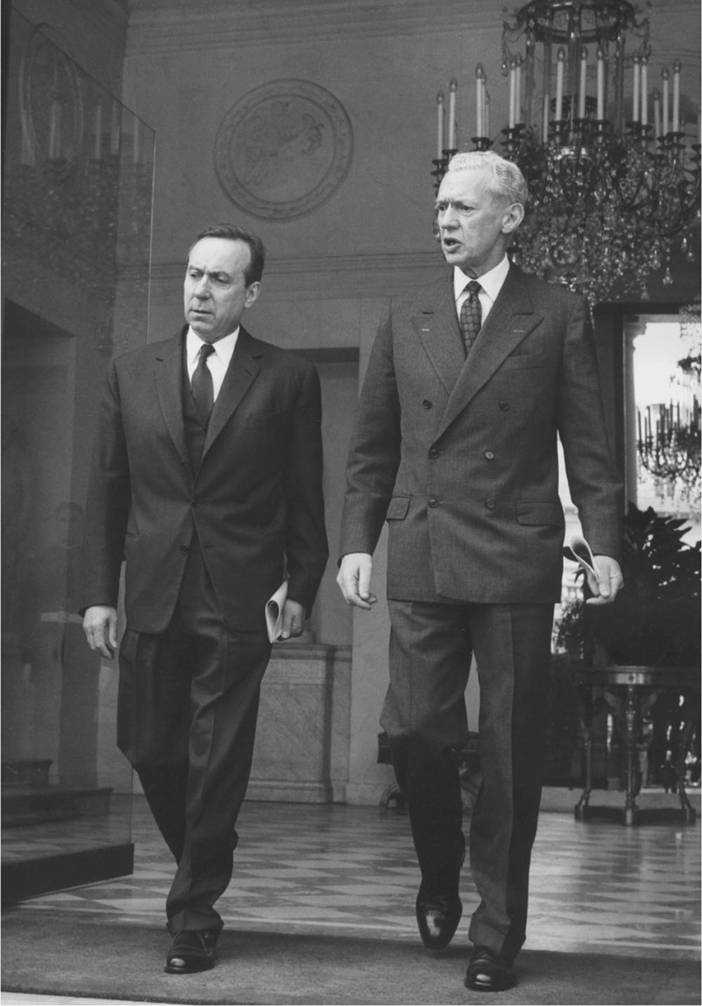
Figure 5.2 Foreign Minister Michel Debre with his predecessor Maurice Couve de Murville, 2 June 1968. Credit: Interfoto / Alamy Stock Photo.
Lengthy stints for senior diplomats in major capitals maximized experience and skills. London had three ambassadors in twenty-eight years: Rene Massigli (1944–55); Jean Chauvel (1955–62); Geoffroy de Courcel (1962–72). Over the same period six British ambassadors in Paris averaged a tad over four years each. No Whitehall permanent secretaries got close to Alphand’s seven-year term as Quai secretary-general (1965–72). Wormser’s twelve-year innings as director of economic and financial affairs (1954–66), followed by the nine-year stint of successor Jean-Pierre Brunet (1966–75), gave outstanding continuity. The long service of two top officials contributed decisively to France’s ascendancy in the European Community: Jean-Marc Boegner, permanent representative in Brussels (1961–72); Emile Noël, secretary general of the European Commission (1958–87). By contrast, the UK went through foreign secretaries like football managers: six in all during Couve de Marville’s reign at the Quai – three of them in fifteen months (1964–5) – a higher ministerial turnover than in the maligned Fourth Republic. That said, long postings could bring boredom and burnout. Wormser confessed to being bored stiff with his work and having no deep convictions on Europe and international politics, comparing himself to a barrister making the best case for a client.46
Couve, the general’s ace, was the longest serving French foreign minister since the eighteenth-century ancien regime. His loyalty and skill upheld French influence world-wide. The minister claimed ‘a kind of spontaneous and instinctive agreement’ with the president.47 Only one important issue caused dissension – how best to withdraw from NATO. An inspecteur des finances, the cream of the grands corps, Couve played his master’s voice to perfection. Cold in manner, calm and poker-faced, he served Vichy as director of external finances and negotiated the financial clauses of the Franco–German armistice in 1940. Switching allegiance to de Gaulle in 1943 fast tracked him – Quai political director 1945, then ambassadorships to Egypt, the United States and West Germany. ‘How little like a Frenchman Couve is,’ mused a Canadian diplomat, ‘with his reserved, cool manner and his English clothes, but perhaps the difference is only skin deep or perhaps it is because he is a Protestant’.48
Savile Row tailoring and British-like phlegm did not make an Anglophile. Couve’s experience as a young man tutoring the sons of diplomat and writer Harold Nicolson may have influenced his attitude towards Britain. Dining with ambassador Massigli, Nicolson recalled how in 1928 twenty-one-year old Couve, ‘a shy youth, brittle as a biscuit, dressed in midsummer tweeds … came to Long Barn expecting the grandeur of Chatsworth and the intellectual stimulus of Madame Geoffrin’s salon, to find that he had to act as tutor to two schoolboys in a cottage. It was a misunderstanding’. ‘Oh, that explains’, replied Massigli, ‘why Couve is always so anti-British’.49
The tutor is unlikely to have earned the devotion of his young charges. Most found the minister a cold fish – arrogant, off-putting and serving up icy discourtesies. Armed with a pipe and ‘installed comfortably in his armchair, he lit up with a prudent slowness. A cloud of smoke formed a second screen behind which he reflected. Many were put out by his silences and caustic remarks’.50 A workhorse hardly ever taking holidays, even writing his own speeches, Couve brilliantly defended French theses. Command of the Quai’s resources saved him from being a complete cipher. The first career official to lead the ministry for over a century, he knew the house inside out and concentrated 100 per cent on the job. The minister took France’s Community commitment seriously, spending two days a week in Brussels with the French delegation. In the early 1960s he vigorously defended his corner against premier Debre who wanted a stronger say in policy-making.
Couve deployed smokescreens to keep opponents guessing. Shortly before the veto of Britain’s first bid he spoke in reassuring terms to UK chief negotiator Edward Heath and US Under-Secretary of State for Economic Affairs George Ball. Close to the second veto in November 1967, he confirmed to foreign secretary George Brown that Britain was bound to enter the Community. Asked when talks might begin he answered, ‘certainly before the end of the year’.51 Although the minister does not seem to have resented playing second fiddle, Parisians joked about a smart dinner party where everybody lamented the alarming state of France’s international relations, upon which Couve exclaimed, ‘Ah, if only I were foreign minister!’
Until May 1968 France’s prestige stood higher than at any time since 1919. The Quai basked in the radiance. An ambassador to the United States recalled the respectful silence that greeted his arrival at Washington parties: ‘I was a celebrity.’52 Strength was also weakness. The general’s control of external policy accelerated the Quai’s loss of autonomy – already undermined by globalization, technology and multilateralism. Dissenters were marginalized. Presidential advisers meddled in the ministry’s affairs. Jacques Foccart, secretary general for Africa and Madagascar, operated as an uber minister, plotting the removal of the Quai’s director for Africa and Madagascar, and rumoured to have had Couve followed.
While president and foreign minister strutted their stuff, secretary general Alphand minded the shop: ‘I feel rather useless … I stay at home … but for what?’.53 Leisure, perhaps, to polish his superb mimicry – a hilarious send-up of a conversation between former secretary general Chauvel and ambassador Massigli topped Alphand’s repertoire. Chauvel mumbled inaudibly into his tie while Massigli’s machine gun delivery made him difficult to follow. Alphand felt marginalized by the imperialist ways of the minister’s private office chief, Jean-Yves Haberer. Diplomacy’s dethronement as number one public career impacted on recruitment. Public service under the Fifth Republic offered attractive career opportunities at home without the stress on family and personal life of lengthy absences overseas.
Gamesmanship was a poor substitute for the Quai’s eroded autonomy. In Frederick Raphael’s novel A Double Life a French diplomat recalls the Franco–British guessing game of the 1960s: ‘The purpose of our duplicity was not so much to confuse the British as to leave evidence that, whatever the eventual outcome, it was a triumph for French diplomacy.’54 Clever footwork kept the Tricolore flying in Brussels and elsewhere – at the cost of strategic reflection and independence. In 1960 a survey of great power diplomacy criticized the Quai for ‘excessive formalism … when the desire to play the diplomatic game correctly becomes a substitute for hard thought’.55 An official acknowledged that ‘There was a complete vacuum whenever de Gaulle’s wishes and intentions were unknown’.56 One of the most talented and resourceful foreign services in the world was under-used. In June 1962 the Quai’s director of European affairs, Jean-Marie Soutou, advised the new prime minister Pompidou that Britain’s membership of the Community was inevitable and desirable. The premier accepted the argument but suppressed the paper, instructing Soutou not to speak to de Gaulle.
Did de Gaulle speak for France? Anglo-Saxon critics treated French external policy as a solo performance – implying that sans general the Western powers might have lived happily ever after. In reality, de Gaulle enjoyed substantial popular and elite support. But support was nuanced. Historians have simplistically assumed voter indifference towards international affairs. Polls, despite shortcomings, tell a different story. Should France be ‘a leading world power’ or accept ‘a more modest role?’, asked a 1964 poll. Respondents divided equally: 42 per cent wanted a world role, 42 per cent a more modest role. But the terms ‘leading world power’ and ‘more modest role’ were undefined and ambiguous.57 Nearly two-thirds of the electorate in a poll of March 1968 expressed satisfaction ‘with France’s role in the world’.58 Far from being a blast from the past, the notion of a world role still resonated.
Opinion fluctuated over time. Responding in September 1965 to the question ‘What is the most important problem for France at this time?’, ‘The Common Market, Europe’ topped the list (18 per cent), then ‘salaries, standard of living’ (14 per cent). Five months later, in February 1966, ‘Peace, international relations’ came first (12.2 per cent) above ‘stability of prices’ (10.5 per cent) and ‘housing’ (6.4 per cent). There was no blanket approval for foreign policy decisions. In January 1963 approval ratings for policies towards the USA, West Germany and Britain varied appreciably: United States: 47 per cent; West Germany: 54 per cent; Great Britain: 40 per cent. Despite official reticence, public interest in international affairs grew. The Six-Day War in 1967 unleashed an intense public debate about France’s Middle East stance in which domestic and international concerns were closely meshed.59
The state sought endorsement for its policies, not citizen engagement. Fencing off the presidential domains of foreign affairs and defence deliberately distanced citizens. A December 1964 poll went to the heart of the matter. ‘Regarding foreign policy,’ it asked, ‘in your opinion, how is it generally determined – essentially by governments without too much public influence or with a good deal of public involvement?’ It elicited the following replies: government decision without public influence: 58 per cent; government decision with a good deal of public influence: 27 per cent; no opinion: 15 per cent.60 Discouraging public involvement sowed distrust and alienation. A state radio and television poll in 1963 found that only 9 per cent of the public trusted radio and TV news.61 ‘I listen to the news every night, true or false, good or bad,’ declared a Toulouse metal worker, ‘without believing what they say just to know what they are trying to make us believe’.62 The iconic May 1968 poster of a helmeted policeman in silhouette with the caption ‘L’ORTF – it’s the police talking to you [c’est la police qui vous parle]’ epitomized the distrust.
The pace and scale of global change disoriented rulers and people. Globalization rendered hard and fast distinctions between internal and external issues redundant. France’s burgeoning arms trade integrated foreign and domestic concerns. Making and selling arms world-wide reconciled ‘security and welfare [domestic] imperatives by stimulating … socio-economic and political modernization’.63 Determined to preserve control over external policies, governments of the Fourth and Fifth Republics made no attempt to create an informed public. The United Nations was a case in point. Making sense of an expanding and complex international organization required top-down initiatives. Government failed the challenge. Asked in 1960 what they thought of the UN, 36 per cent of respondents had no opinion. In a January 1965 poll, 64 per cent did not know the United Nations was headquartered in New York.64
The game finally vanquished the president. From the summer of 1967 presidential ratings slipped. Students clipped de Gaulle’s wings. Panicked by the bedlam of May 1968 into a secret helicopter dash from the capital to seek support from general Jacques Massu, commander of French forces in West Germany, the president departed without informing his prime minister. ‘The government’, he complained, ‘does not follow my directives … I’ve practically lost control of the executive’.65 Fresh elections brought a vote of confidence and an apparent return to normality. In reality, the quake left the country badly shaken. Strong aftershocks followed – pressure on the franc, renewed student agitation spreading to lycees, and the Warsaw Pact invasion of Czechoslovakia in August.
Dismayed by the regime’s loss of momentum, foreign minister Debre shared anxieties with Elysee secretary general Tricot.66 The general was part of the problem. Symptoms of ageing multiplied from 1965 – deteriorating eyesight, shorter working days, time increasingly spent with the family or watching television. The septuagenarian allowed his prime minister a larger discretionary role; the secretary general held back lengthy and complex items of business until sure of the general’s full attention. Deceleration induced depression – deepened by the belief that American, British and Israeli intelligence services had exploited student disturbances in order to hasten his departure. The outcome was a long overdue rethinking of international policy resulting in an offer to Britain of secret talks – the Soames affair of 1969.
What had the general achieved? His astute exploitation of geopolitics and prosperity won kudos. France tailored the Pax Americana to its advantage. America’s European hegemony was an empire by invitation, offering a consensual relationship. Washington’s need for a stable Paris–London–Bonn triangle allowed European allies sufficient wiggle room to fashion a comfortable connection. The originality lay in de Gaulle’s ability to reset the nation’s sense of identity and purpose.67 The verdict of UK technology minister Tony Benn on the 1967 Paris International Air Show would have given de Gaulle a sense of mission accomplished: ‘the French do these things in a fantastic way – far better than we do. The Farnborough Air Show is just a pre-First World War country cricket match compared to Paris … Of course the French planes and French technology dominated. The F–111 came over, folding its wings … Concorde was presented as a French plane – it was a marvelous example of the glory of France being exploited.’68 An old man in a hurry attempted too much. In the film Sleeper (1973), doctors wake up Woody Allen 200 years after a hospital mishap. They show him mid-twentieth century celebrity photos: Charles de Gaulle? Allen: ‘Oh, he was a very famous French chef, had his own television show – making souffles.’ Like souffles, the general’s foreign policy confections had a short life.