Appendix 6A Spurious Negative Quadratic Influence in Estimation Based on Related Linear Equations
This appendix demonstrates algebraically that when there is a negative relationship between a dependent variable (such as economic growth) and an exogenous variable (such as the level of per capita income), but a positive relationship between another variable (such as financial depth) and the same exogenous variable (per capita income), a regression of the dependent variable on a quadratic form of the other variable (financial depth) will tend to force a negative coefficient on the quadratic term of that variable.
Suppose the basic relationship of the dependent variable of interest, y, to the exogenous variable, x, is negative and linear, such that:
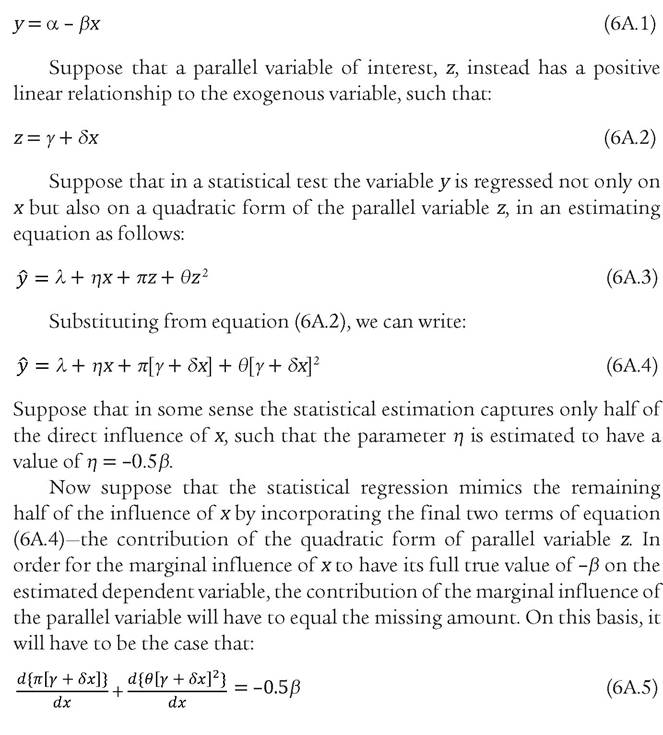
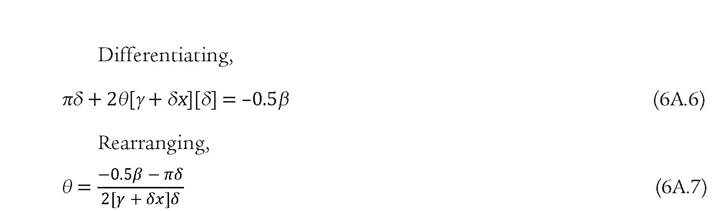
We know that the parameters β and 5 are positive. Suppose that the exogenous variable x is such that it is also always positive (for example, the logarithm of per capita income). Suppose further that the parallel variable z is such that it is always positive even as the exogenous variable x approaches zero, such that γ is positive. Then the right-hand side of equation (6A.7) is strictly negative. As a consequence, the parameter θ on the quadratic term of the parallel variable, or z2, is strictly negative.
In this system, then, when a regression of a variable bearing a negative linear relationship to an exogenous variable is conducted in an equation including not only that exogenous variable but also a quadratic formulation of a parallel variable that itself is a positive linear function of the exogenous variable, the result will be to estimate a positive linear coefficient and a negative quadratic coefficient on that parallel variable.[241]
The fundamental problem is that although the estimating equation (6A.3) is treated statistically as if the variable z were independent of variable x, equation (6A.2) requires that they are not independent. Correspondingly, any inference of a causal influence of z on y specified as strictly marginal (i.e., interpreted as the change in y resulting from a change in z when there is no change in x) will be spurious.