Appendix 5A Systemic Implications of Problems at a Major European Bank
Since the financial crisis in the United States and Europe, banks on both sides of the Atlantic have been subjected to stronger supervision and regulation as well as tougher requirements on capitalization.[181] Yet recent events suggest that vulnerabilities may remain in some of the largest financial institutions, especially in Europe.
In the period from October 2015 to October 2016, equity markets severely punished the share price of Deutsche Bank, the third-largest bank in Europe.[182] Although the system did not return to the brink of a Lehman- style crisis,[183] it is useful to consider the implications of these difficulties of this global systemically important bank (G-SIB).
Areas of lingering concern about the large banks, especially in Europe, include opacity in the valuation of assets, especially for derivatives, and possible understatement of risk-weighted assets in internal risk models. Potential shocks from legal fines have been highlighted by the fine imposed by the US Department of Justice on Deutsche Bank because of the sale of questionable mortgage-backed securities before the recent crisis. Another problem has been market destabilization from selloffs of contingent debt issued to meet the new rules on total loss-absorbing capacity (TLAC) imposed by the Basel III regulatory reforms. Hovering over all of these concerns is the seeming additional evidence that Europe lags the United States in restoring bank stability.
A broad implication of Deutsche Bank's difficulties is that they provide further support for additional bank capital beyond Basel III targets established in 2010 and to be fully phased in by 2019 (BCBS 2010b). Higher equity capital provides a larger cushion against insolvency in the face of shocks. With equity providing a larger share of the TLAC target of 18 percent of risk-weighted assets under Basel III, an additional benefit would be the resulting reduction in the need for contingent (additional tier 1) capital, which has proven to be a source of market instability when investors fear write-downs on (or conversions of) such obligations.
But low market valuations mean that banks would need to raise additional equity over time through retained earnings rather than immediately through new issuance when share prices are depressed. This problem is currently more severe for large banks in Europe than in the United States. Banks may also need to change their basic business models and downsize their balance sheets gradually until share prices rise toward book values.Deutsche Bank warrants special attention for systemic reasons because of its size and extensive interconnections with financial institutions through its investment and investment banking units.[184] In June 2016 the International Monetary Fund found that among G-SIBs, Deutsche Bank was “the most important net contributor to systemic risks” (IMF 2016b, 29). It is important to recognize, however, that this diagnosis did not turn on any weaknesses in the bank's balance sheet or capitalization but on its high degree of “connectedness” with other financial institutions.[185]
The proximate cause of the recent pressure on Deutsche Bank was the September 2016 announcement by the US Department of Justice of a $14 billion fine for misleading investors in the selling of risky mortgage-backed securities. Previous such fines had amounted to $16.5 billion at Bank of America in 2014 and $5 billion at Goldman Sachs in April 2016.[186] Some accounts suggest the Royal Bank of Scotland could face even higher fines for such activities.[187] Such penalties feature prominently in the category of “operational risk,” for which banks need to hold capital in addition to that for credit risk on loans and market risk on traded assets marked to fair value.
At its late September 2016 low, Deutsche Bank's stock price had fallen 63 percent from its late-2015 high and 77 percent from its post-Great Recession high in early 2014.[188] The price fell about 25 percent from its level on September 9 before the announcement of the $14 billion (€12.4 billion) fine, which by itself would represent 20 percent of Deutsche Bank's shareholder equity of €62.7 billion at the end of 2015 (Deutsche Bank 2015, i).
But the gap between market value and book value was much larger. On September 29 the ratio of share price to book value stood at only 0.23, compared with about 0.6 for euro area peers BNP Paribas and Banco Santander, 0.6 for Citigroup, 0.9 for Goldman Sachs, and 1.0 for JPMorgan Chase. Market capitalization of Deutsche Bank stood at only €14.1 billion. Even with the modest recovery by late October, its price-to-book ratio remained at only 0.29 (all data are from Bloomberg).A price-to-book ratio of only 0.2 to 0.3 for a G-SIB cannot be a good sign for the financial system. In the most optimistic interpretation, such a ratio might simply represent the fickleness of stock market valuations. The pessimistic interpretation would be that the market has priced the bank's equity correctly and that the book value is out of date. If the market is wrong and book value right, it would be in shareholders' interest to systematically downsize both sides of the balance sheet and use the profits from the sale of assets at prices higher than expected by the market to repurchase shares.
Figure 5A.1 shows the path of market price-to-book value ratios for six G-SIBs over the past decade. Before the Great Recession, the ratios were in the range of about 1.5 to 2.5. Thereafter the ratios tended to be in the range of 0.5 to 1.
Anemic price-to-book ratios have not been unique to Deutsche Bank, but from late 2015 to late 2016 the bank's relative weakness on this measure became more acute. For example, from October 2015 to late October 2016 the ratio fell from about 0.8 to 0.7 for Banco Santander and Citigroup, and it did not fall for BNP Paribas. Having dropped from 0.55 to 0.29 over the same period, the ratio for Deutsche Bank declined much farther and stood markedly below those of most of its peers (all data are from Bloomberg).
From the systemic standpoint, there may be some comfort in the fact that whereas contagion from Deutsche Bank in early 2016 depressed share prices of other major banks as well, the most recent round of pressure on the bank did not further reduce the prices of other major bank stocks.
In both January-February and September 2016, the decline for Deutsche Bank was prompted by the specter of losses to additional tier 1 (AT1) bonds thatFigure 5A.1 Ratio of market price to book value for selected large US and European banks, October 27,2006 to October 26,2016
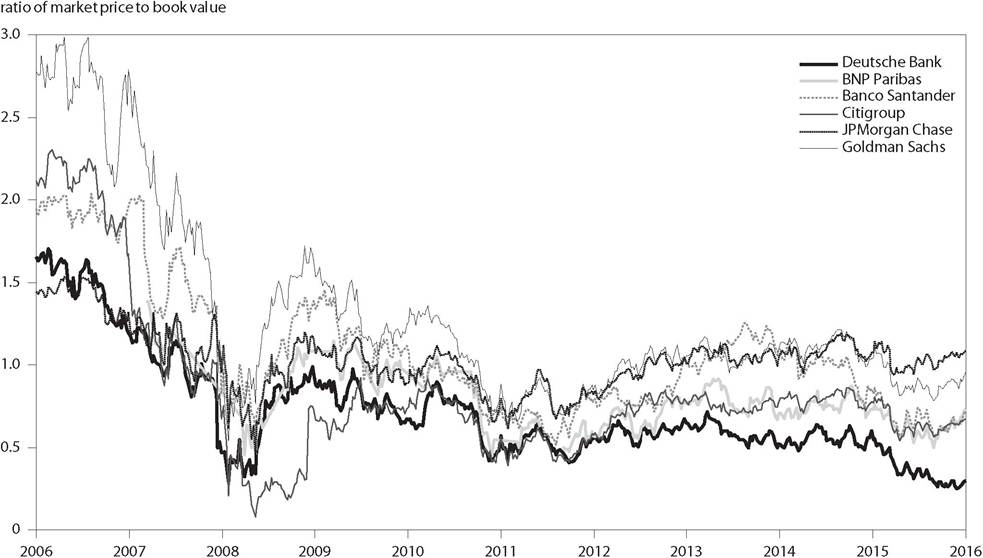
Source: Bloomberg.
count toward TLAC.[189] Thus, in early 2016, when it became a concern that the bank's net loss of €6.8 billion in 2015 might cause it to miss a coupon payment on these obligations, the price of its largest AT1 bond issue (€1.75 billion) fell from 95 cents to 70 cents. After recovering to an average of about 80 cents in March-August, the price fell to 73 cents in late September before partially recovering.[190]
Another pattern evident in figure 5A.1 is that US G-SIBs have tended to perform better than G-SIBs in Europe. Table 5A.1 confirms this pattern for 14 European and 8 US G-SIBs.[191] The average price-to-book ratio as of late October 2016 was 0.66 for the European banks but 1.04 for the US banks. More than half of the European banks had a ratio below 0.66, whereas none of the US banks did. Among the European G-SIBs, only UniCredit Group rivaled Deutsche Bank for the lowest ratio.
The outcome for European banks is poorer for two principal reasons. First, US and euro area monetary policies diverged. Recourse to negative interest rates as well as further quantitative easing likely worsened outcomes in the euro area compared with the United States. Banks cannot easily negotiate negative interest rates for depositors, a key source of their funding, and quantitative easing flattens the yield curve. Because banks are in the business of maturity transformation, the flatter yield curve erodes profits in the main business line (although there may be offsetting gains from faster growth of the economy and capital gains on long-term assets).
Second, market voting shows greater confidence that US banks have improved their capitalization and economic strength compared with European banks. In the United States, G-SIBs must hold 6 percent of total assets in capital. European banks have not been subject to a corresponding
Table 5A.1 Ratio of share price to book value for global
systemically important banks (G-SIBs) in Europe and the United States, October 26, 2016
| European G-SIBs | Ratio | US G-SIBs | Ratio |
| Nordea | 1.24 | State Street | 1.44 |
| UBS | 0.96 | Wells Fargo | 1.29 |
| ING Bank | 0.94 | Bank of New York Mellon | 1.27 |
| HSBC | 0.79 | JPMorgan Chase | 1.08 |
| BNP Paribas | 0.73 | Goldman Sachs | 0.96 |
| Santander | 0.72 | Morgan Stanley | 0.93 |
| Credit Suisse | 0.63 | Bank of America | 0.69 |
| Standard Chartered | 0.58 | Citigroup | 0.67 |
| Groupe Credit Agricole | 0.54 | ||
| Barclays | 0.53 | ||
| Societe Generale | 0.49 | ||
| RBS | 0.43 | ||
| UniCredit Group | 0.3 | ||
| Deutsche Bank | 0.29 | ||
| Average | 0.66 | 1.04 |
Source: Bloomberg.
leverage ratio, and the new European requirement soon to be introduced under Basel III is expected to be only 3 percent (EBA 2016). In the United States, the Collins Amendment to the Dodd-Frank Wall Street Reform and Consumer Protection Act requires that risk weighting of assets be no more lenient than the Basel standard model weight for the asset category. European banks have been able to rely on internal model weights even if they are lower. US banks appear to have made more progress cleansing their books of weak loans than have European banks.[192] European banks reportedly paid out nearly €200 billion in dividends in 2007-14, whereas their accumulated retained earnings remained almost unchanged during that period.[193] In contrast, for the eight US banks listed in table 5A.1, total shareholder equity rose from $738 billion at the end of 2008 to $1,044 billion in 2014 (data are from banks' annual reports).
From a systemic viewpoint, one of the worst side effects of the low market valuations of major bank stocks is that they make it extremely costly to raise capital through the issuance of new equity. If the true value of the equity is $100 per share but the current market price is only $50, then issuing new shares amounting to 10 percent of the amount outstanding will impose a value loss of 4.5 percent on existing shareholders.[194] Under these circumstances, banks are very reluctant to raise capital through new issuance. The alternative of building up capital through accumulation of retained earnings is far more attractive but also considerably slower.
Returning to Deutsche Bank, it is useful to consider the degree of capital adequacy as a possible explanation for low market valuation. At the end of 2015, total assets were €1,629 billion (Deutsche Bank 2015, 64). The €62.7 billion in shareholder equity amounted to 3.8 percent of total assets, a seemingly low level. However, under International Financial Reporting Standards (IFRS) accounting, derivatives are included in assets, whereas under US Generally Accepted Accounting Principles (GAAP) only their value after netting out is included. The market (not “notional”) value of Deutsche Bank's derivatives was €515.6 billion on the asset side and €494.1 billion on the liability side, for a net of €21.5 billion. (The notional value was far larger, at €41.9 trillion [Deutsche Bank 2015, 157]). So a GAAP approach using netting would place total assets at €1,629 billion - €516 billion + €22 billion = €1,135 billion. This figure implies that the GAAP-consistent ratio of shareholder equity to assets would be 5.5 percent, a more comfortable level.
However, the sharp decline in the bank's shares implies that the market distrusts the accounts, in magnitudes that go well beyond the potential Justice Department fine. One place to look for a major gap between market valuation and book value would seem to be derivatives, which can be difficult to value (e.g., requiring internal model valuation using market inputs, level 2 assets, or, using strictly hypothesized inputs, level 3 assets). Deutsche Bank has a reputation for being especially active in derivatives. Its €42 trillion notional value of derivatives compares with $56 trillion each for Citigroup and JPMorgan Chase and $52 trillion for Goldman Sachs.[195] Using €1.14 trillion for Deutsche Bank's assets on a derivatives-netted rough GAAP-equivalent basis, the ratio of notional value of derivatives to GAAP assets is 37:1. The corresponding ratios are about 23:1 for JPMorgan Chase (assets $2.4 trillion), 31:1 for Citigroup (assets $1.8 trillion), and 60:1 for Goldman Sachs (assets $860 billion). By implication, if derivatives are the problem, one might want to keep an eye on Goldman Sachs (and perhaps also Morgan Stanley, with $31 trillion notional derivatives[196] and assets of $808 billion, for a ratio of 38:1).
If derivatives were the core problem for Deutsche Bank, what degree of overoptimism in accounting would have to be present to make the recent market price trough accurate? The gap in equity between accounting and market valuation reached €62.7 billion - €14.1 billion = €48.6 billion. Considering that there are about €500 billion on both the asset and liability sides of derivatives, this figure implies about 5 percent excessive optimism in accounting valuations on both sides (abstracting from the Justice Department fine). As a rough approximation, this exercise suggests that 5 percent excessive optimism in pricing derivatives overstates net assets by about 0.12 percent of notional value (50/42,000).
If Deutsche Bank is just the tip of the iceberg for possible problems in derivatives, it could be informative to apply this parameter to other large banks. For JPMorgan Chase (with $254 billion in shareholder equity) and Citigroup (with $228 billion in shareholder equity), a corresponding 5 percent overoptimism in valuations would result in an overstatement of net assets of about $67 billion each.[197] For Goldman Sachs (with shareholder equity of $87 billion), the overstatement would amount to about $62 billion. The implied hit to equity would be about the same at Goldman Sachs (71 percent) and Deutsche Bank (75 percent) but considerably more moderate at Citigroup and JPMorgan Chase (29 and 26 percent, respectively). Of course, market valuations could be interpreted as making the judgment that at these institutions, the quality of the derivatives portfolio is considerably higher than that at Deutsche Bank.
Unlike Lehman Brothers, Deutsche Bank is solvent and has access to central bank support. Ironically, to the extent that the derivatives activity of the large US banks occurs mainly in the nondepository subsidiaries of their bank holding companies, there are relatively strict limits on what the depository subsidiary can lend to them, and liquidity support would have to go through the now-constrained Federal Reserve Article 13(3) rather than flow in the form of direct discount lending (Scott 2016).
Basel III's leverage ratio is 3 percent of exposure, which includes derivatives only after netting. Using the €1,135 billion figure as the exposure basis for the leverage ratio for Deutsche Bank implies an equity capital target of €34 billion. If recent market price troughs were accurate, the implication would be that Deutsche Bank would need to raise €19.9 billion in new equity (€34 - €14.1). But regulatory decisions are not, and should not be, based on current stock market values. Even so, a potential need for Deutsche Bank to raise €20 billion in new capital if the market's recent pessimism proves right may serve as a meaningful cautionary benchmark.
Deutsche Bank has not been forced to write down its AT1 bonds, nor has it reached the point of missing a coupon payment on them. Some press reports place their total value at €4.6 billion.[198] However, this amount appears to refer only to issues in 2014. If issues in 2007-08 are included, the total rises to €10.9 billion.[199] They are subject to a write-down if certain capital thresholds are not met.[200] But even if their value were written down by half, they would provide only about one-fourth of a €20 billion hypothetical gap.
These instruments do seem to raise questions. Their coupons are in the range of 6 to 8 percent (Deutsche Bank 2016a). They are perpetuals (i.e., they have no maturity date). Considering that the current interest rate on 30-year AAA European sovereign debt stands at only 0.8 percent (ECB 2016), their risk spread even at par is extremely high. At a market price of only 70 cents on the euro, what I call the loss equivalent probability would stand at a remarkable 92 percent, meaning only an 8 percent chance of paying face value and a 92 percent chance of paying nothing at all.[201] These odds are more characteristic of high-risk gambling than long-term investing.
The illustrations above assume that Deutsche Bank's problems lie entirely in derivatives. The problems, however, may be more dispersed, perhaps reflecting the greater scope for mischief in the European banks' reliance on internal models in determining risk weights. It is worth considering that 78 percent of Deutsche Bank's derivatives are interest rate related (Deutsche Bank 2015, 157). On the one hand, this fact might be a source of comfort: One would think interest rate swaps would be much more plain vanilla than some other derivatives and hence much less vulnerable to mispricing. On the other hand, one might worry that the shift to a negative interest rate regime in the euro area might not help Deutsche Bank's derivatives position related to interest rates. Another 15 percent of derivatives are currency related, perhaps another source of comfort, because they are not necessarily esoteric. Of the non-Level 1 fair-value assets, by far the largest amount is Level 2 (about €700 billion on the asset side and €550 billion on the liability side), where market data inputs determine model results. The less reliable Level 3 valuations are much smaller, €32 billon on the asset side and €10 billion on the liability side (Deutsche Bank 2015, 296).
One interpretation of these decompositions would be that Deutsche Bank's problems may not be primarily in derivatives. The contrast between the low price-to-book ratio for Deutsche Bank and the near-unity ratio for even more derivatives-dependent Goldman Sachs might also be interpreted as indicating that derivatives may not be the primary source of Deutsche Bank's problem. An alternative interpretation is that because of the opacity of derivatives, there is downside risk for market perception once there is some negative shock. Contrasts with other high-derivative institutions may reflect the absence of such shocks at those institutions as much as, or more than, the inherent reliability of derivatives valuation. On balance it would seem prudent for regulators to take special care with asset valuations in derivatives, which might be playing a significant role in the Deutsche Bank case in view of the illustrative calculations.
Part of the problem seems to be a decline in franchise value as Deutsche Bank's business model is increasingly in doubt. Sarin and Summers (2016) suggest that the general malaise in market valuations of banking sector stocks likely reflects this influence. The chief executive officer of Credit Suisse recently stated that European banks are “not really investable as a sector” because of legal liability and regulatory uncertainties and “a lot of doubt” about whether the business model is viable.[202] Deutsche Bank may simply represent an unusually severe case of such doubts.
Deutsche Bank is not insolvent, and it would not have been even if the full $14 billion fine had been levied.[203] From its September 29 low of $11.48, the bank's share price rose 27 percent to $14.62 by the end of October, and by a cumulative 71 percent by February 1-10, 2017 (to an average of $19.6 per share).[204] In early October the bank was able to issue $4.5 billion in new senior debt, albeit at a relatively expensive spread of 290 basis points above US Treasuries.[205]
The bank's recent predicament should nonetheless help focus policymakers' minds on the broad question of whether banking sector reform after the financial crisis is on track. The new shocks from large legal fines add to concerns about capital adequacy. Low stock market prices may further reflect doubts about asset valuations, especially for derivatives, and about risk weightings using internal models.
The overall implication of Deutsche Bank's difficulties is that additional bank capital beyond Basel III targets is desirable. That implication is consistent with the finding in chapter 4 that optimal capital requirements should be 7 to 8 percent of total assets (12 to 14 percent of risk-weighted assets)—about one-third higher than the G-SIB target in Basel III.
A higher equity capital component in TLAC would also make it possible to reduce the role of contingent convertible instruments in the TLAC target, a salutary shift in view of the experience of their market contagion risks. However, the predominance of equity prices below book value could mean that it would take time to phase in more ambitious equity capital targets, through accumulation of retained earnings rather than new issuance. Another implication is that it remains unclear whether fundamental changes will be necessary in the large banks' business models, or whether instead their equity price performance will tend to recover even without such changes as more normal monetary policies return and memories of Great Recession traumas fade. Still another implication is that shareholders would benefit from a gradual downsizing of large banks with extremely low price-to-book ratios, as long as the book valuations are correct, and that in this process it could be salutary to use the resulting profits to repurchase shares until their prices reach much closer to book value.