EMPIRICAL STUDY: THE IMPACT OF KNOWLEDGE ON THE ECONOMIC DEVELOPMENT
The relationship between the economic development and the knowledge related indicators have been emphasized in the papers of many authors.
Bandyopadhyay (2006) shows that knowledge is a key driver for economic development and growth and also there is an association between knowledge indicators and specific development indicators like corruption and economic inequality.
Eliasson (2000) emphasizes the role of knowledge in economic growth through competitive selection, as the investment in R&D could raise the competitive advantages of the companies and raise the opportunities in a competitive globalized market.
Hanushek and Woessmann (2008) showed that cognitive skills are related to economic growth with education playing a crucial role in economic development.
Bassanini, Scarpetta, and Visco (2010) point out that the contribution of the information and communication technology to output and productivity growth can accelerate productivity growth in the ICT-producing sectors themselves with an increase of their weight in the economy. They also contribute to capital deepening as driven by rapid investment in ICT equipment. The third effect mentioned by Bassanini et al. (2010) relates to ICT-using sectors do enhance their efficiency by harnessing new technology.
For our purposes, we have linked the knowledge related variables to GDP and economic growth for EEE and Arab countries.
2.1. Data and Methodology
In order to assess the impact of knowledge related variables to economic development (or economic
growth), we used data from the World Bank for the following countries:
• EEE Countries: Romania, Bulgaria, Czech Republic, Hungary, Poland, Estonia, Latvia, Lithuania
• Arab Countries: Algeria, Morocco, Egypt, Jordan, Saudi Arabia, Tunisia.
The following indicators were used in order to describe the knowledge in the analysed countries:
• TE: Enrolment in tertiary education(as a percentage of total enrolment).
• PAT: Patents applications by residents.
• STJ: Scientific and technical journal articles.
• HTE: High-tech exports as a percentage of total exports.
• EDEXP: Education expenditures as a percentage of GDP.
In order to insure comparability among countries, the following variables were normalized by dividing them to the number of population for each country in the sample:
• Patents applications by residents.
• Scientific and technical journal articles.
In addition, as a dependent variable, we used either real economic growth or real GDP per capita expressed in 2000 US$ at PPP standard.
Our data sample covers the time period 20002009, so the results are inconclusive in respect to the financial crisis.
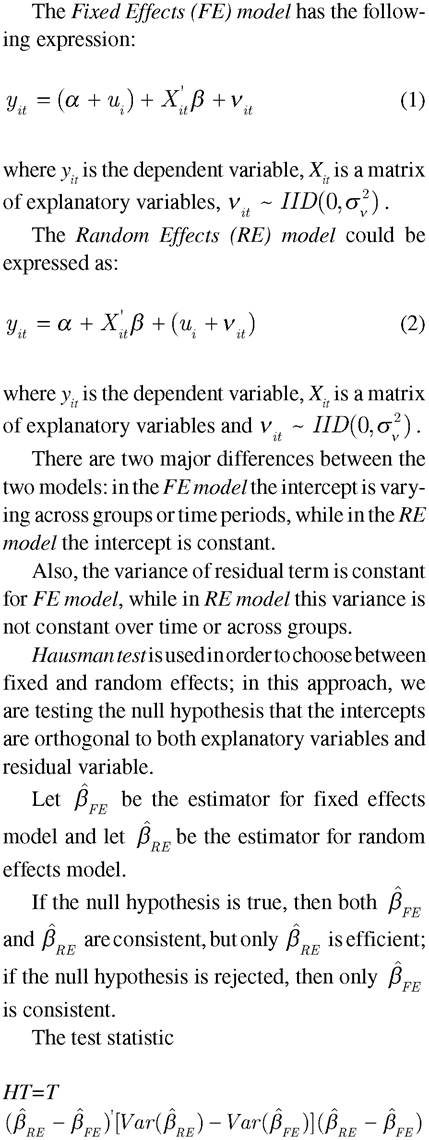
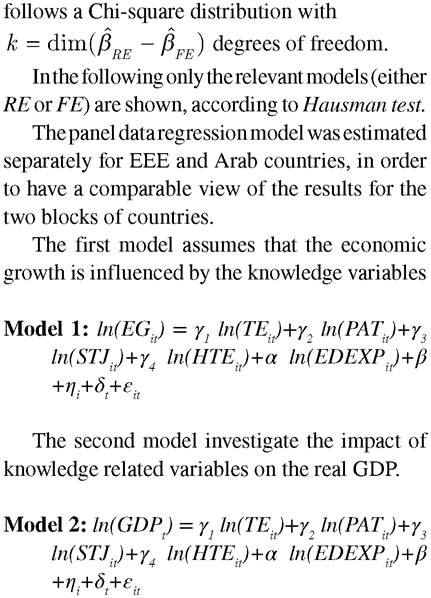
As our database has both temporal and spatial variability, a panel data regression model was used in order to evaluate the impact of knowledge variables to output variables (real economic growth - EG or real GDP). In order to estimate such a model, we need to choose between the fixed or random effects formalizations.
2.2. Results
In order to decide which estimates for the previous models are the most appropriate for our data, the Haussman test was used in order to test the null hypothesis of random effects. Since in all cases the null hypothesis is rejected at a significance level of 0.01, the best estimates are obtained if we consider that the models have fixed effects.
The explanatory power ofthe estimated models is very high, with high R square values.
These results are interesting with respect to the similarities and differences among EEE and Arab countries. In the past years, the countries from Central and Eastern Europe have experienced a high level of development, in all the areas of economy, and knowledge related factors are triggers for economic growth.
For Arab countries, the situation is slightly different in terms of economic development and improvement of educational system (Table 5).
Table 5.
Panel data regress ion estimates| EEE | Arab | |||||
| Variable | Estimate | Standard Error | P-Value | Estimate | Standard Error | P-vaLue |
| Model with Economic Growth as Dependent Variable | ||||||
| Intercept | -2.46 | 27.33 | 0.93 | 17.9 | 40.29 | 0.66 |
| Expenditures on Education | -5.07 | 3.95 | 0.2 | -2.27 | 22.57 | 0.92 |
| Enrolment in Tertiary Education | 6.87 | 3.78 | 0.07 | 5.57 | 11.39 | 0.63 |
| High-Tech Exports | 1.01 | 1.26 | 0.43 | -0.34 | 0.82 | 0.68 |
| Patents | -4.63 | 2.23 | 0.04 | -2.27 | 1.78 | 0.22 |
| Scientific and Technical Journals | -0.54 | 3.35 | 0.87 | -5.39 | 3.14 | 0.1 |
| R-Square | 0.7969 | 0.5265 | ||||
| Model with GDP/Capita as Dependent Variable | ||||||
| Intercept | 21.63 | 0.88 | is the major driver and engine of ensuring performance. These industries require continuous updating and monitoring such that they keep up with progress in technologies and knowledge. This term is used in opposition to industries that have more inertia in adopting new knowledge and where a lag is observed in relation to their technologies. Potential Investors: In the context of the present chapter, this refers to those who are attracted by an economy for which they have a high willingness to invest. Role Model: EEE economies can serve as a role model for Arab countries as they are at different stages of their transition to more open and free economies. Social Media: A growing field in the area of ICTs now used to characterize the positioning of countries and communities in the knowledge sphere. Technological Advance: Technological progress as measured by different economic models but also used as ways of attaining the production frontier as state of the art in producing and providing commodities and services. The Eurostat Definition: Includes high to medium tech manufacturing and communications, financial and business services, health, and education. Eurostat also includes recreational, cultural, sporting, and some travel services (sea and air) that the OECD excludes. Eurostat also breaks the knowledge service sector down into four groups: high tech services (R&D and computing), financial services, market knowledge services (communications, travel, and business services), and other knowledge services (health, education, and recreational and cultural services). The OECD Definition: The knowledge-based economy is an expression coined to describe trends in advanced economies towards greater dependence on knowledge, information, and high skill levels, and the increasing need for ready access to all of these by the business and public sectors. Virtual Infrastructure: All the physical and virtual equipment and routes that are devoted to supporting the provision of information and communication technologies and services. This work was previously published in Knowledge-Based Economic Policy Development in the Arab World, edited by Ahmed Driouchi, pages 85-103, copyright 2014 by Business Science Reference (an imprint of IGI Global).
More financial literature on Economics.Studio
More on the topic EMPIRICAL STUDY: THE IMPACT OF KNOWLEDGE ON THE ECONOMIC DEVELOPMENT:
-
Conflictology -
Ecology -
Economy -
Finance -
History -
Law -
Medicine -
Philosophy -
Religious studies -
| |||