LITERATURE REVIEW
Extensive research works on stock market have been done in field of financial science and information systems. Scholars have identified the factors that influence the individual’s decision to adopt e-commerce platform for transaction.
To this online trading service has been described as more of an information system phenomenon (Gefen et al., 2003a; Kolekofski et al., 2003). Consequently recent studies on online financial trading have employed technology adoption model as their theoretical framework. As Pavlou (2003) noted information technology adoption and usage model has found wide application in the field of electronic finance, which is an integration of technology adoption with finance concepts. Specifically, technology adoption model has been employed in studying the adoption of online financial trading. A review of relevant literatures to the study’s objectives will be presented on technology acceptance theories and models.This study will critically examine extant literatures on eight (8) influential technology acceptance models as follow: Innovation Diffusion Theory (IDT), Social Cognitive Theory (SCT), Theory of Reasoned Action (TRA), Decomposed Theory of Planned Behavior (DTPB) Technology Acceptance Model (TAM), Technology Acceptance Model 2 (TAM2), the Unified Theory of Acceptance and Use of Technology (UTAUT) and Theory of Planned Behavior (TPB). Table 1 presents a brief discussion on this:
Table 1. Summary of theories of technology acceptance
| Theory | Founder | Constructs | Theory Core |
| IDT | (Rogers,1950) | 1. Knowledge,(Socioeconomic, Characteristics, Personality variables, Communication, Behavior), 2. Persuasion (Relative advantage, Compatibility, Complexity), 3. Decision4. Implementation 5. Confirmation | IDT has been used to describe the Innovation-decision process. |
| SCT | (Bandura, 1986) | 1. Behaviour, 2. Perseption Factors, 3. Environmental Factors | SCT deals with man’s manner of inferring his/her behavioral outcomes that enlightens and modifies his/ her environment and personality leading to changes in subsequent behaviors. |
| TRA | (Fishbein et al., 1975) | 1. Behaviour, 2. Intention, 3. Attitude Toward Behavior 4. Subjective Norm | The basis of existing research related to the relationship between attitude and behavior is found in this model.. |
| TAM | (Davis 1986b) | 1. Behaviour, 2. Behavior Intention, 3. Attitude Toward Behavior, 4. Percived usefulness 5. Percived Ease of Use, 6. External variables | TAM, which forms the base that explains the relationship between PU and PEU, on the one hand, with the user’s intent and actual behavior in using the computer, On the other. |
| TAM2 | (Venkatesh et al., 2000) | 1. Behaviour (Actual Usage), 2. Behavior Intention 3. Attitude Toward Behavior, 4. Perceived Usefulness 5. Perceived Ease of Use, 6. Voluntariness, Experience, 7. Image, 8. Subjective, 9. Result Demonstrability | TAM 2 aims to present a theoretical explanation to PU and the user’s intent based on his/her social and cognitive influences. |
| DTPB | (Taylor & Todd, 1995b) | 1. Actual Behavior, 2. Behavioral Intention 3. Attitude Toward Behavior, 4. Subjective Norm, 5. Percived behavioral control, 6. Percived Usefulness7. Percived Ease of use, 8. Compatability, | This model investigates the roles of mannerism, principles, society and perceived behavioral control by classifying them into various belief divisions. |
| UTAUT | (Venkatesh, et al., 2003) | 1. Performance Expectance, 2. Effort Expectancy 3. Social Influence, 4. Facilitating conditions | UTAUT was found to provide a clear comprehension of the gradual evolution of the determinants of intention and behavior. Also, it should be notable here that a large part of the main associations in this model are moderated. |
| TPB | (Ajzen, 1985) | 1. Actual Behavior, 2. Behavioral Intention, 3. Attitude toward Behavior(behavioral beliefs) 4. Subjective Norm (Normative Beliefs) 5. Percived Behavioral control | The literature review revealed that this theory (TPB) was implemented in extensive empirical research works relating to behavioral science in order to forecast and comprehend man’s behavior in diverse circumstances. |
The technology acceptance and behavioral adoption model has been the main theoretical model underpinning extant works, in predicting factors influencing individual’s intention to adopt new technology. Of significance are the Theory of Reasoned Action (TRA) (Ajzen et al., 1980), Theory of Planned Behavior (TPB) (Ajzen, 1985), and Technology Acceptance Model (TAM), which has emerged to be the most important and pertinent model. TAM primarily considers the effect of perceived ease of use and perceived usefulness in predicting individual’s intention to adopt new technology (Davis, 1989a; Davis et al.,1989b). A brief description of these intentional models is as follows.
Theory of Reasoned Action (TRA)
Fishbein and Ajzen (1975) developed the theory of reasoned action (TRA) by studying attitudinal and normative influences on behaviour.
The theory demonstrates how individual’s intention is transformed to an act that is behaviour. Ajzen (1991, p,116) stated that “Intentions are assumed to capture the motivational factors that influence a behavior; they are indications of how hard people are willing to try, of how much of an effort they are planning to exert, in order to perform the behavior.”Also, TRA has found wide application across diverse field. For example, researchers in social psychology have drawn on it in analyzing and comprehending individuals’ social behaviour. Basically, the theory reveals that an individual’s Behavioral Intention (BI) ascertains his specific behavior. Thus, an individual’s Attitude (At) along with the Subjective Norm (SN) ascertains the Behavioral Intention:
BI= At + SN (1)
As Ajzen (1985) asserts, an individual’s intention to behave in a certain way is a linear function of two factors, which are the attitude towards behavior (At) and the subjective/social norm.
Technology Acceptance Model (TAM)
Technology Acceptance Model (TAM) was conceptualized to explain individuals’ behaviour when working with computers (Davis, 1989). The model offers clarification on the factors which lead to the acceptance of computer, by providing a clear account on the behaviour of the users towards adopting diverse computing technologies. TAM is actually an extension or modification of the Theory of Reasoned Action (TRA), which has been the fundamental to most studies on the adoption of Information systems (IS). Researchers have employed the model in examining the behaviour of individuals towards adopting Internet platform (Davis, 2000).
The main concept behind the model is that ‘attitude predicts intention, while intention predicts behaviour’ (Davis, 1989a). Davis also went further to state that the behaviour of a user of a system is influenced by his or her intention to use it, which in turn affect his or her attitude (see Figure 1). Two main factors are identified as below;
1.
Perceived usefulness of the system (PUS).2. Perceived ease-of-use of the system (PEU).
Perceived Usefulness (PUS) explains how the use of a technology could enable and enhance a person’s performance on the job. On this, some researchers argue that there exists a direct link between the rate of employing an application and the successful outcome in facilitating a better performance on the job (Davis et al., 1989b; Pavlou, 2003).
Figure 1. TAM model by Davis (1989a)
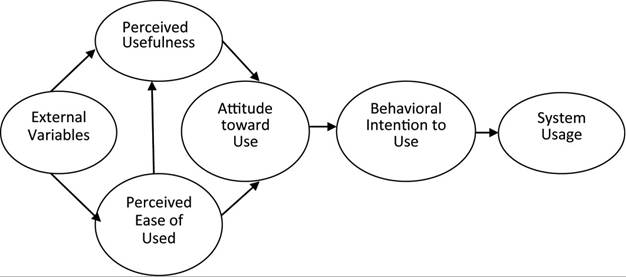
Although perceived ease of use (PEU) measures the user’s evaluation on whether an application can be used in his or her work, yet, Davis et al.(2000) suggested an alternative measure. They explained that PEU is actually the user’s perception on how easy it was to use a given application when performing his or her work. Equally, the model also recognized the effect of external variables on the perceived ease of use (PEU) and perceived usefulness (PUS). These variables include users support, training, system attributes and documentations (Davis, 1989a).
Most of the studies on Technology Acceptance Model (TAM) have been in the field of information systems, especially in investigating the adoption of Internet, e-finance and e-commerce. Findings have also confirmed both PUS and PEU as strong predicators of attitude, while the latter has been found to be influenced by the former, as well as other extrinsic factors. On the other hand, only the extrinsic factors have been discovered to influence PUS.
TAM’s uniqueness is in the application of fewer numbers of theories to make predictions on user’s intention (Agarwal & Prasad, 1999). Several scholars have deployed the model in an attempt to identify and explain the factors, which influence user’s intention to accept/adopt technology (Siriluck, 2006; Chi- Shing et al., 2007; Jeanette- Taft, 2007). Venkatesh et al. (2003) underscored the need to clarify the difference between user’s intentions to adopt and behaviours towards adopting a technology.
Theory of Planned Behaviour (TPB)
Theory of Planned Behavior (TPB) gained prominence in the 1980s, as the most pertinent cognitive model to analyze and forecast individual’s distinctive behavior (Ajzen, 1985). Even though it originated from the field of social psychology, however, it has received significant attention across various fields. Fishbein & Ajzen (1975) described it has a comprehensive version of the TRA, which has contributed in resolving the latter’s limitation in explaining the spontaneous behavior of individual. TPB is based on the assumption that people behave according to their intentions, which are the result of their personal thoughts, standards and their behavioral control.
Behavioral intention is expressed in terms of attitude, subjective norm and perceived behavioural control. Succinctly, a positive attitude and favorable subjective norm along with increased perceived control are expected to exert a positive influence on a person’s intention to behave in a certain way. Thus, a combination of attitude, SN, and PBC will constitute an individual’s behavioral intention, which in turn shapes behaviour. The TPB model is shown in Figure 2:
Figure 2. Constructs of TPB (adapted from Ajzen, 1985)
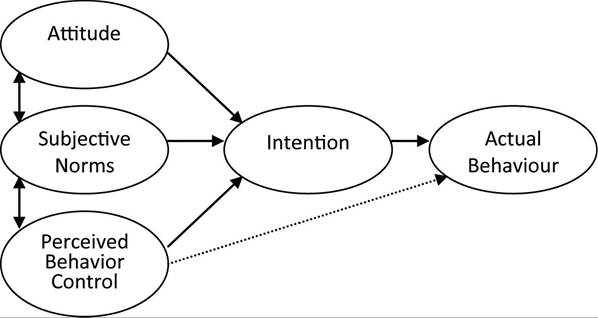
Based on the relationship among attitudes, SN, PB C, intention and actual behaviour, Aj zen (1985) suggests the following equation to capture TPB;

Accordingly, TPB (Ajzen, 1985, 1991) proposes that intention and PBC determine human behaviour, while intention is in turn affected by AT, SN, and PBC. TPB has been employed in studying the behaviour of consumers towards online platform (Bhattacherjee, 2000a; Joo Enget al., 2003; Ramus et al., 2005; Shim et al., 2001).
Application of TAM and TPB Theories in Prior Research
Extant works on Information Systems within the financial domain have drawn from TPB and TAM in order to explain investors’ behaviours and attitudes, relating to the adoption of online stock trading, word processing application, intentions to use Internet in financial transaction, as well as adoption of IT outsourcing (Ajzen, 2005; Lee-Pi et al., 2003; Michelle, 2005). Studies on the adoption of online services have also employed either TAM or TPB, in order to forecast and understand user’s insight on the choice guiding the intention to use a system (Lina Zhou, et al., 2007; Chi-Lee, 2009b). TAM and TPB have been leveraged in attempts to observe and analyze the likelihood of using the Internet for executing trading transactions (Lee & Turban, 2001; Tebboune, 2003). A brief summary on prior studies related to these theories is presented in Table 2.
Based on the comprehensive review of literature, the need to clarify the effect of diverse factors on investor’s intention to adopt online trading service has been less explored. For instance, limited or no attempt has been made within the e-finance domain to develop an integrative model, which can be applied in assessing the effect of diverse factors in predicting user’s intention to adopt online stock trading. Specifically, this study aims to bridge the gap in knowledge on the antecedents of individual’s adoption of online stocking trading.