The Rise of Mortgage Securitization
The disaster of the collapse of the savings and loan industry could have been much worse. The collapse could have led to American households being unable to finance their homes at all.
But if one examines Figure 2.1, one can see that even as the industry was collapsing, homeownership rates remained steady. This meant that from the point of view of American households, the crisis was alarming but not very consequential for the economy or the ability of citizens to get mortgages. Indeed, the collapse of the savings and loan industry affected GDP growth by less than 0.3 percent per year from 1985 to 1993 (Caprio and Klinge- biel, 1996) and did not cause a recession. The recession of 1990-1992 was caused by a combination of factors that included the tightening of monetary policy, the Gulf War, and a decrease in consumer spending (Walsh, 1993).The main reason that there was not a more substantial crisis, particularly in the ability of households to get mortgages, was that an alternative set of institutions was already in place to take the market over from the savings and loans. Whether one views this outcome as luck or serendipity, the GSEs and the burgeoning mortgage securitization market rapidly took up the slack of the failed savings and loans (McConnell and Buser, 2011). This process accelerated beginning in 1985, and the new business model for getting mortgages was solidly in place by 1993. Figure 2.2 documents the rapid decline of the savings and loan banks and the rise of the GSEs and the commercial banks as the providers of mortgages in the United States over this period. The GSE share of mortgages rose from around 10 percent in 1980 to 35 percent in 1990.
The rise of mortgage securitization meant a huge transformation in the identity of the businesses that came to dominate the mortgage industry. The collapse of the savings and loan industry meant that there was an opportunity for a whole new set of firms to rise and dominate the mortgage market.
This was a revolution, not just in how mortgages were to be funded but in who were going to be the dominant players in doing the funding. The savings and loan collapse produced the conditions for a multitude of new market niches to form. It is to this story that I now turn.The basic business model of the savings and loan banks was to borrow and lend funds locally. But even during the Great Depression, the government worried that the savings and loan industry would be unable to provide enough capital to satisfy the demand for housing. The main issue was that capital that would be made available for local mortgages might be unevenly distributed across the country. This would leave some parts of the country starved for capital and others flush. The FHA and Fannie Mae were established to create a national market for capital to be used for mortgages all over the country. They would do this by seeking out other kinds of investors in the housing market in order to ensure that capital might flow to parts of the country that were underserved by the local savings and loan banks. As can be seen in Figure 2.2, these investors were mainly insurance companies and commercial banks.
The FHA played three important roles in this process. First, it was instrumental in defining a conventional mortgage, allowing the production of a standard product. Second, it provided mortgage insurance to buyers in order to attract investors. This insurance meant that the government acted to guarantee that the mortgage would be paid off no matter what, thereby guaranteeing that investors would not lose their money. Finally, it originated mortgages using borrowed money. It was particularly effective at providing funding for mortgages for multifamily housing from 1945 to 1960.
Fannie Mae was created to operate what was called a secondary market for mortgages. Its job was to find investors to buy the mortgages that were insured by the FHA. In doing so, they took on a role as an intermediary between mortgage originators and mortgage investors in the market for conventional mortgages backed by insurance from the FHA.
Mortgage originators could be savings and loan banks, commercial banks, mutual savings banks, or local mortgage brokers, while investors were mainly commercial banks and insurance companies.Fannie Mae's activities were relatively small scale from 1938 until 1968. In practice, it mostly bought loans that the FHA had originated and held on to them as investments, using money it borrowed to fund them (Sellon and Van- Nahmen, 1988). However, one can see the nascent outlines of the modern GSE in its organizational design. The creation of a secondary market where mortgages would move from the hands of originators to investors with the oversight of a government-backed agency would be the same modern role played by the GSEs. There were, of course, two big differences between the modern GSEs and their forerunner. Until 1970, the product that was exchanged in this secondary market was individual households' mortgages, not MBSs. Moreover, this system was never intended to replace the savings and loan banks. Instead, it was viewed as a way to supplement the actions of the savings and loan banks by making sure capital would be made available to parts of the country that might have been capital starved. But by 1993, the GSEs and the market for mortgage securitization had replaced the originate-and-hold model of the savings and loans.
It is useful to put the problem of the availability of capital for different kinds of investments into a larger perspective. If one conceives of all available capital in a society, then it follows from standard economic theory that if left unimpeded, it will flow to investments that pay the highest return on a risk-adjusted basis. Economic theory also implies that if there is a strong demand for capital across sectors in a society, interest rates will rise. There were several forces driving up interest rates for investment capital in the 1960s. The 1960s was a period of sustained economic growth, meaning that businesses were busy borrowing money to fund their activities.
There was also an active merger movement going on where companies were borrowing money to buy up the shares of other companies. This meant that borrowing capital in the private economy was relatively expensive.At the same time, the Johnson administration oversaw one of the greatest expansions of government expenditures outside of wartime in American history. The government increased the size of the social safety net by increasing spending on welfare and on health insurance for the poor and elderly (Medicaid and Medicare). They were also involved in an escalating war in Vietnam. As a result, the government was running large budget deficits, which it was funding by borrowing money. The only way it could attract funds to do this was by paying higher interest rates. There was very real worry that the government was potentially crowding out business investment. The demands of both business and the government for capital had to affect funding for mortgages.
Investors looking for investments could buy government bonds or invest in corporate bonds or the stock market. Small savers had less access to these markets, but as interest rates rose, they found ways to move their money into more lucrative investments such as stock mutual funds, money market funds, and time deposits. The first attempt to stem the flow of funds from small savers out of savings and loans came in 1966 with the imposition of an interest rate cap on savings accounts using Regulation Q. But this ultimately proved unsuccessful, as the savings and loan and commercial banks forced the government regulators to allow them to introduce financial products that paid higher, market interest rates as consumers found ways around these limits. In spite of the attempt to contain small savers, money market funds, checking accounts that paid interest, and time deposits grew rapidly over this period.
The Johnson administration was worried that as the baby boom generation aged, the savings and loan banks' credit crunch would mean that getting a mortgage would become more and more difficult (Quinn, 2019).
One idea was for the government to increase its role in the housing market by not just providing mortgage insurance but also directly originating mortgages. But given that the Johnson administration was already running a large budget deficit, they were reluctant to go to Congress to ask for a new, expensive social program aimed at housing. If the government became the lender for households by borrowing money from the private sector, the money lent would add to the budget deficit. Quinn (2019) documents how the political discussion about how to finance housing was mainly focused on avoiding increasing the budget deficit.In response to this dilemma, in 1968, the Johnson administration, working with Congress, passed the Housing and Urban Development Act. The basic idea was to create the GSEs. The GSEs would issue bonds to raise private capital to fund mortgages outside of the federal budget. This ingenious idea would in one fell swoop potentially solve all of the problems of providing more funding for housing. The act split Fannie Mae into two organizations (Quinn, 2019). Functions considered essential to the government were incorporated into a new government agency, the Government National Mortgage Association, or Ginnie Mae. This new agency was authorized to guarantee MBSs issued by approved private companies for mortgages already insured by the FHA or VA. Thus, the new bonds would have two kinds of governmental guarantees. First, the FHA and VA had insured the loans going into the MBSs, and second, Ginnie Mae would guarantee the return of principal and interest (D. Black et al., 1981).
The rest of Fannie Mae was turned into a GSE. A GSE is a financial services corporation created by the United States Congress. They operate to enhance the flow of credit to targeted sectors of the economy such as housing and to reduce the risk to investors and other suppliers of capital. While the GSEs can sell shares in the public markets, they are assumed to be backed by the government.
In the case of the housing GSE, not only could Fannie Mae borrow at rates close to that of the federal government, it was also allowed to have a high degree of financial leverage. Quinn (2019) shows that Fannie Mae was not given a debt-to-equity ratio.In practice, Fannie Mae operated mostly to promote a secondary mortgage market by continuing to use its relationships with mortgage companies, commercial banks, pension funds, and insurance companies to raise capital and fund mortgages and MBSs. They would buy mortgages from originators using borrowed money, turn those mortgages into bonds with the help of investment banks, and sell those bonds to investors. They would also hold on to some of those bonds for their own accounts. The investors for the bonds were frequently commercial banks who might have been the originators of the mortgages. By selling the mortgages to Fannie Mae and having them turned into bonds with the backing of the US government, commercial banks took the risk out of holding on to mortgages as investments. Of course, this was true not just for those who had sold the mortgages to Fannie Mae in the first place but for all investors. In effect, the US government absorbed the potential of a great deal of mortgage market risk but conceded the profits to private shareholders.
In 1970 Freddie Mac was created using the same model as Fannie Mae. It was created under the FHLBB. While Fannie Mae confined its activities to mortgage companies, commercial banks, and insurance companies, Freddie Mac was viewed as the GSE who would help savings and loans create MBSs. The savings and loan industry preferred to work through the FHLBB rather than with Fannie Mae, who had traditionally been aligned with their principal competi- tors—mortgage companies, commercial banks, and insurance companies that purchased FHA- and VA-insured loans. This allowed savings and loan banks to also reduce the riskiness of their mortgage holdings. Freddie Mac took the lead in the issuance of MBSs throughout the 1970s, while Fannie largely stuck to portfolio lending until the 1980s (Sellon and VanNahmen, 1988).
The GSEs were set up to pioneer the modern mortgage-backed securities industry. This produced a set of innovative ideas. The basic notion was to expand the secondary market for mortgages by having the GSEs shift from just brokering investment in mortgages by issuing mortgage insurance to issuing bonds. Given that the market for government and corporate bonds was large and deep, issuing mortgage-backed bonds would be a way to attract some of that capital to mortgages. The idea of a mortgage-backed security implied that instead of investors buying an individual mortgage where a default might occur, they bought a security where the risk of default was spread across a group of mortgages. This made the number and type of investors who might be interested in purchasing such bonds expand dramatically.
The bonds would be registered with the Securities and Exchange Commission, like all other government and corporate bonds. They would be rated by the credit rating agencies, who would examine the riskiness of the underlying mortgages in the bond and provide a rating for the bond. At the bottom of all this was that at the end of the day, the bonds were backed by the government, and this meant that their odds of failure were equivalent to the odds of US Treasury bonds failing. From the point of view of investors, mortgage-backed securities would pay a higher rate of return than US Treasury bonds because of the interest rates paid for by the mortgagors and would be nearly as safe. Investors seeking safety and high returns would be rewarded by MBSs, a clear win for investors.
In practice, this also meant that the cost of capital for the GSEs to fund these bonds would be near to what the federal government paid for funding US Treasury bonds. This gave the GSEs a huge advantage over anyone else wanting to create a secondary market for mortgages. It could borrow more cheaply than anyone else to buy mortgages, borrow more cheaply to hold on to those mortgages for its own accounts, and sell those guaranteed MBSs to private investors to make higher returns on those bonds because of their cheaply obtained capital. Theoretically, if all of this worked, capital would flow more readily into the mortgage market, thereby lowering mortgage rates for individual households. Thus, if the savings and loans could not raise enough capital to provide mortgages for the baby boomers, the GSEs would step in to supplement the market and make sure mortgages were available at the cheapest rates. This meant a win for consumers.
Setting Fannie and Freddie up as private corporations effectively took the GSEs out of the federal government's yearly budget process. The money they borrowed and the bonds they held, bought, and sold would not show up on the government's balance sheets as assets or liabilities. They would not contribute to the national debt. This was true in spite of the fact that the GSEs started out as corporations totally owned by the government. Eventually, the shares in the GSEs were sold to the public, allowing them to become privately owned. When they began to sell shares, this allowed them to raise capital to expand their activities in the securitization market. From the point of view of politicians, the Johnson administration and Congress could be seen as doing something about the housing issue. At the same time, they would be doing it in a way that did not increase the budget deficit or the government's debt. Finally, this produced a clear win for politicians (Quinn, 2019).
From the very beginning, the GSEs had both defenders and detractors. Defenders of the GSEs saw them serving an important function by bringing capital into the mortgage markets and thereby promoting the policy goals of homeownership. These defenders saw a great advantage of using private capital to fund mortgages and at the same time providing homeowners with easy access to credit. Others (mostly economists) saw that by linking the mortgage market to the larger financial markets, the overall efficiency of both markets would be enhanced. Capital would now flow more readily to where it had the highest returns and whatever risk investors were seeking out. Investors could now diversify their portfolios of stocks, corporate bonds, and government bonds to bonds based on mortgages.
Detractors saw the GSEs as intrusive in the mortgage market and against free-market principles. The government-based advantages of the GSEs meant that their low cost of capital prevented competitors from participating in the lucrative market to produce securities. It also guaranteed the GSEs an oligopoly by which they could ensure themselves higher-than-average profits based on their implicit pledge of government backing. Detractors of the GSEs also saw that they meant that the savings and loan banks were at a distinct disadvantage if the GSEs could offer households mortgages at lower cost.
The GSEs and the creation of the MBSs seem like logical ideas that provided a win-win-win for lots of constituencies (except for the savings and loan banks and free-market ideologues!). The first mortgage-backed security was issued by Ginnie Mae in 1970. Figure 2.3 presents an announcement of that event in the Wall Street Journal. But the creation and rise of the GSEs was not assured. Indeed, it took fifteen years before the GSEs actually began to be a significant force in the mortgage market. There were a number of problems. First and foremost, no one had ever tried to bring Wall Street bankers and Main Street bankers together in such a large market. They had very different cultures, were enmeshed
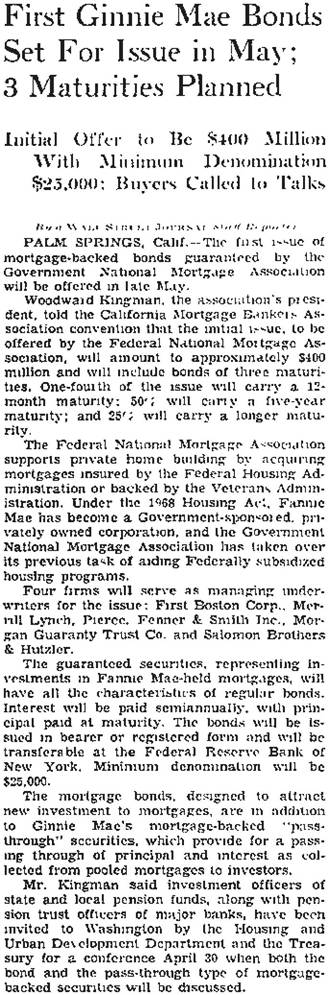
figure 2.3 Anannouncement ofthe first BSBS issued byGinnie Maein 1970.Republished with peemissinn nt Dnw Jnnes & Cn. tenm tθe Wall Street Journal, April 24, 1970, p. 22.
in quite different products and markets, and were making money with their current business models. Because mortgage securities were a brand-new idea, investors were wary of them. Insurance companies and pension funds were very conservative investors that were highly regulated, and no one knew what an MBS was and whether the MBSs were as safe as people claimed.
Indeed, the obstacles to making a market in such securities were gigantic. Creating a new product from scratch is always a difficult business proposition. Figuring out how to make the product, how to find customers, and how to meet the needs of customers is part and parcel of market creation. Convincing investors that a new financial product had great risk-adjusted returns required the sellers of those products to be able to convince the buyers of their merit. The MBS market had the great advantage of large and well-funded quasi-government agencies to begin the market. But the theory of MBSs required a great many practical problems to be solved. Many of the problems would require creating additional legislation that would allow MBSs to be treated like other fixed-income investments.
To make a market, sellers need to find buyers. In this case, the investors were a diffuse group that included institutional investors such as pension funds, insurance companies, and mutual funds, as well as commercial banks and, over time, overseas banks. Many of these investors were quite conservative and preferred government bonds, which were nearly riskless. Investors were wary of the new product and the claim that MBSs were as safe as government bonds. They worried that if they bought the bonds, they would not get the returns they were being promised. There were three big problems. First, the tax situation surrounding MBSs was murky, and this made MBSs a product that could not be sold to institutional investors such as insurance companies and pension funds. Second, for private issuers of MBSs, state laws made it illegal to sell such securities. To solve these problems, in the end, would require federal legislation.
Third, and most importantly, investors were worried about prepayment risk. Mortgagors could pay back their mortgages at any time, and therefore bondholders might have their money returned before they could show a sufficient profit. This made MBSs very uncertain as investments and undermined the argument that they were as safe an investment as government or even corporate bonds. Since mortgagors were the most likely to do this when interest rates were low and they could refinance their loans, investors would find themselves with money they could only invest at lower rates of return.
Finally, I reiterate that from the perspective of 1968 and throughout the 1980s, no one thought that the MBS market was intended to replace the savings and loan model. This doesn't mean that the savings and loan banks and the GSEs were not in competition. The mortgages that the GSEs were going to originate and fund were not mortgages that were “in addition to” those funded by the savings and loan banks. The GSEs and the savings and loan banks were in competition for mortgages from the beginning. But because the savings and loan banks were still the dominant players in the mortgage market, any new way of funding mortgages was going to have to compete with their model. That meant that any attempt to create the MBS market would have to directly confront the savings and loan banks. Solving the problem of convincing investors that the MBS was a good product would be key to making the GSEs real players in the market.
Figure 2.2 shows how from 1970 to 1990 there was a steady growth in the GSE-related market share, mostly at the expense of the saving and loan industry. The graph shows a steady increase in the market share of the GSEs from 0 percent in 1970 to almost 30 percent in 1987 on the eve of the final collapse of the savings and loan banks. When that meltdown occurred, the GSEs and investment banks were able to complete a takeover of the mortgage market. Their model of making the business of mortgages shift from being about origination to being about securitization could take hold and dominate only with the utter collapse of the savings and loan buy-and-hold model of mortgages.
The share of total market originations for the GSEs increased. There was a steady increase in that percentage over the 1970s from 0 percent to about 15 percent in 1980. But the crisis of the 1980s saw the market share for the GSEs of new mortgage originations skyrocket from 15 percent a year to over 50 percent in 1982. As the savings and loan banks had a mild recovery from 1982 to 1984, that dropped back to around 30 percent. But with the shift away from mortgages engendered by the legislative reforms, the market share of the GSEs climbed to over 50 percent from 1984 to 1987. By 1987, one could say that the new model of mortgage securitization had become the dominant model by which American households were now obtaining mortgages.
Solving the problems of selling a new form of security required innovation on the part of both the GSEs and the investment banks. One of the most important people who helped bring the MBS market into existence was Lewis Ranieri, a trader for Salomon Brothers in the 1970s and 1980s (Ranieri, 1996; Lewis, 1990). Ranieri is often credited with coining the term securitization. He tells the following story:
The term securitization has an interesting origin. It first appeared in a “Heard on the Street” column of the Wall Street Journal in 1977. Ann Monroe, the reporter responsible for writing the column, called me to discuss the underwriting by Salomon Brothers of the first conventional mortgage pass-through security, the landmark Bank of America issue. She asked what I called the process and, for want of a better term, I said securitization. Wall Street Journal editors are sticklers for good English, and when the reporter’s column reached her editor, he said there was no such word as securitization. He complained that Ms. Monroe was using improper English and needed to find a better term. Late one night, I received another call from Ann Monroe asking for a real word. I said, “But I don’t know any other word to describe what we are doing. You’ll have to use it.” The Wall Street Journal did so in protest, noting that securitization was a term concocted by Wall Street and was not a real word. So, we have come a long way. (1996: 31)
Ranieri (1996) gives an insider’s account of solving the problems that were plaguing the development of the MBS market. He recounts how in the world of the late 1970s, forty-seven states had laws that made it illegal for private issuers to sell MBSs. This was because it was difficult to assess whether these securities were safe. Ranieri describes his role in pushing for Congress to change the law, which they did in the Secondary Mortgage Market Enhancement Act of 1984. Other accounts of the events support Ranieri’s role. This act gave private MBSs the same investment status as GSE-backed MBSs (Bleckner, 1984; Lewis, 1990; Jaffee and Rosen, 1990).
The tax situation for MBSs was also in question. Basically, MBSs were being taxed twice, once when they were issued and a second time when they paid interest to bondholders. As part of the Tax Reform Act of 1986, a new tax vehicle called Real Estate Mortgage Investment Conduits (REMIC) was created. These vehicles allowed investments to be treated like partnerships. Thus, they would be taxed only when they earned income.
A different problem was the problem of prepayment risk. As I described above, mortgagors had the right to prepay their mortgages without penalty any time they wanted. From the point of view of investors, this uncertainty made MBSs less attractive. If an investor did not know how much they were going to get on their investment, they would not be interested in buying bonds that were unpredictable. Investors who were highly risk averse such as pension funds and insurance companies bought US Treasury bills, which had a fixed end date and a fixed rate of interest. Why would they buy MBSs for a little higher yield if they could not know what their ultimate return was?
The first solution to this problem was to develop rules of thumb about how long the average mortgage would last before being prepaid. The rule of thumb that developed was twelve years. This allowed bond salesmen to price their product to potential buyers. But this solution was not enough to overcome the objections of customers. In order to give certainty to customers, the next innovation in securitization was the creation of the collateralized mortgage obligation, now called the CMO. The CMO takes a different angle on the pool of mortgages in an MBS. Instead of seeing the mortgages as a single group of thirty-year mortgages, the CMO approaches the pool as a series of unique annual cash flows each year for the next thirty years. It recognizes that cash flows can be carved up into separate tranches of maturities from one to thirty years. It also recognizes that cash flows will be heavier early on and lighter later. Each tranche can then carry a separate price at a spread off of Treasuries with the same maturity. This allows investors to choose their level of riskiness of prepayment as well as the level of interest they will be paid.
Ranieri suggests that by solving these three problems, the securitization industry was ready to take off: “We were now in a position to deploy all of the brilliant technology we had developed. The multitranche CMO, bifurcating mortgage cash flows into IOs, POs, inverse floaters, and devices yet to be invented were now all possible market investments. We won total flexibility” (1996: 37).
Ironically, the crisis of the savings and loan banks inadvertently helped grow the market for MBSs and hasten the demise of the savings and loan banks. Savings and loan banks were failing circa 1980 because they had lots of home loans on their books that paid very low interest. At the same time, the cost of raising new capital to make new loans was prohibitively high. As the savings and loan banks began to fail, they needed to raise capital in order to make new, more profitable investments. But how were they going to do that? One tactic was to use the newly raised limits on depository insurance to attract new accounts. Another was to try to shed their assets (i.e., existing mortgages) that were producing low returns on invested capital. There was also a large incentive to do this. As part of the legislation that was crafted to allow them to reorganize their firms, they were allowed to sell their mortgages without paying taxes in order to raise capital (Sellon and VanNahmen, 1988).
Lewis (1990) describes how Ranieri and his colleagues came to take advantage of the savings and loan banks in the early and mid-1980s. Essentially, Ranieri bought up mortgages at a deeply discounted rate. He then repackaged those mortgages into MBSs that were CMO and sold them to investors. This meant that the returns on these mortgages were now much higher given that the price paid for the cash flows left on the mortgages were so low. The investors who frequently bought these MBSs were the savings and loan banks. They would take the money they had just received for the loans and turn around and invest it in higher-yielding but smaller amounts of new MBSs.
This ploy was, for a few years, a business that was the monopoly of Salomon Brothers. The savings and loans were shedding their mortgages so fast that Ranieri and his group found themselves growing their business at an exponential rate. In 1983, Salomon Brothers issued about $4 billion worth of CMO. By 1987, this had ballooned to over $55 billion. Lewis reports that in 1984, the mortgage securities department at Salomon Brothers made more money than the rest of Wall Street combined (1990: 164). The massive success of Salomon Brothers brought the other Wall Street investment banks to realize that they needed to join the market in order to reap the large benefits. They began to hire people who had worked at Salomon Brothers and set up their own mortgage departments. By the late 1980s, Wall Street investment firms had all entered the mortgage securitization business. The shift of investment banks to the securitization industry was being driven by the opportunity to make billions of dollars from creating MBSs from the mortgages being sold at steeply discounted prices by collapsing savings and loan banks.
The chaos engendered by the savings and loan debacle led to a new set of opportunities for other kinds of financial firms as well. Between 1985 and 1993, a set of new niche markets emerged to work with the GSEs in the provision of mortgages and their being made into MBSs and sold to investors. One of the biggest beneficiaries of the collapse were commercial banks. Commercial banks had been undergoing a thirty-year decline in their main market of loaning money to businesses (Davis and Mizruchi, 1999). Large and medium-sized businesses stopped going to commercial banks for loans and instead entered into the public debt markets and issued bonds (Boyd and Gertler, 1994). This left commercial banks looking for new markets to survive (Gorton and Rosen, 1995). In the late 1980s and early 1990s, commercial banks increased their activity in the mortgage sector to pick up the slack for the collapse of the savings and loan banks. They increased their share of mortgage originations from 20 percent in 1982 to almost 35 percent by 1989 (P. Rose and Haney, 1992). They would then sell those mortgages to the GSEs and often purchase the MBSs for their own accounts.
Banks that specialized in originating mortgages grew their market share dramatically as well. They originated about 13 percent of mortgages in 1982, and this rose to over 19 percent by 1989 (Follain and Zorn, 1990). They would originate a mortgage and then sell it off to the GSEs. It also opened up the possibility for mortgage brokers whose sole job was to fund loans and sell them off to Fannie Mae and Freddie Mac for packaging into MBSs. Mortgage wholesalers arose who would act as middlemen to buy from small-scale originators and sell in packages to Fannie Mae and Freddie Mac.
Jacobides (2005) described what happened as a form of vertical disintegration. He argues that there were three phases of this process in the mortgage industry. In the first phase, 1978-1983, the GSEs substituted for the savings and loan banks in the securitization of loans. This also led to the development of a separate class of banks that either only originated loans or gathered loans together with the express purpose of selling them to the GSEs. From 1983 to 1988, the second phase of the disintegration involved the separation of the mortgage brokers from the mortgage wholesalers. Here, loan originators could be very small firms, sometimes only individuals. These firms would sell their loans to wholesalers, who would then sell the loans on to the GSEs. In the final phase, 1989-1993, the rights to service the loans also fell to a new group of firms. By 1993, the mortgage securitization industry had assumed a new, disintegrated form. The distinct parts of the mortgage securitization process were being played by very different firms of very different size classes.
This model of the market would later also be called the “originate to distribute model” (Ashcraft and Schuermann, 2008). The idea behind this term is that the mortgage moved from its origination across firms' exchanges to end up in the portfolio of an investor mostly as part of a security. This chain of firms had no intention to hold on to the mortgage; instead, they passed it on to the next firm in the line to prepare it for its ultimate placement with investors. The value added at each stage would be captured by a fee charged to the customer. A mortgage might go through the hands of an originator, a mortgage wholesaler, one of the GSEs, and an investment bank who would act as an underwriter for the MBS, ending up with an investor who got their monthly distribution of the cash flow from the mortgage payments from a firm that was involved only in servicing the loans. By 1993, the simple saving and loan model of “originate and hold” was now on the decline. The GSEs were now at the center of the new mortgage securitization industry. American households were getting their mortgages in an entirely different fashion, and they did not even know it.