Which Banks Owned MBSs and CDOs, and Who Borrowed from the ABCP Market?
Between 2001 and 2007, investors increased their holdings of American MBSs dramatically (Inside Mortgage Finance, 2009). In this period, US commercial banks increased their holdings from about $700 billion to almost $1.1 trillion, an increase of over 50 percent.
Mutual fund holding more than doubled from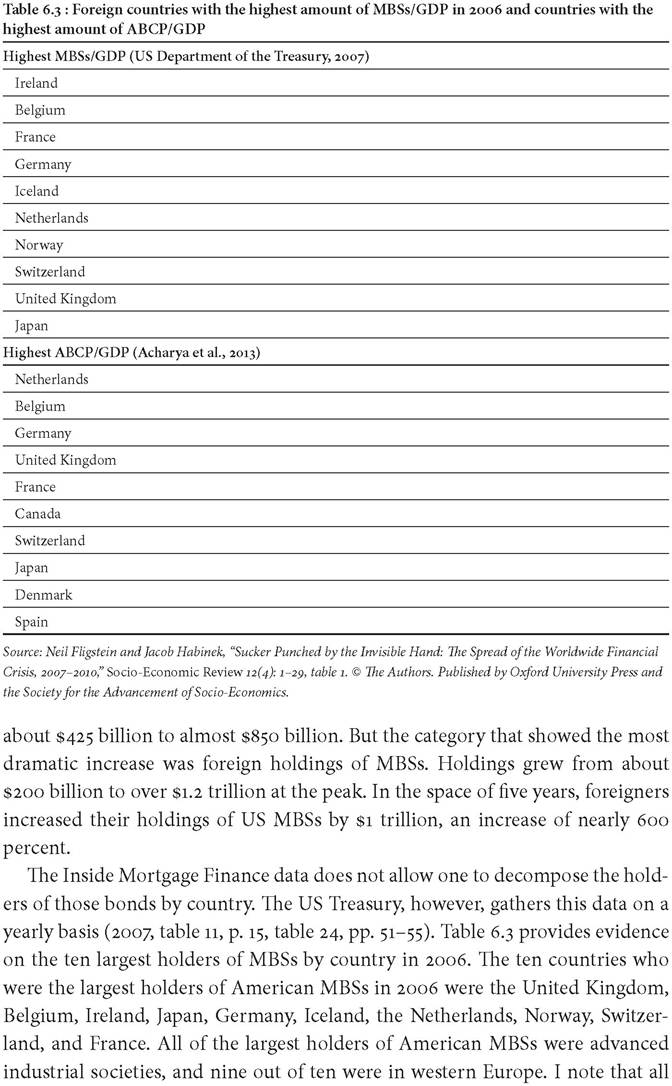
of these countries were at the center of the ensuing financial crisis, and all had serious financial crises.
Unfortunately, neither Inside Mortgage Finance nor the US Treasury collects information about individual bank holdings of US MBSs and CDOs. But the Federal Reserve Bank bought $1.25 trillion of government-sponsored enterprise MBSs during the crisis from thirteen banks including eight foreign banks. Barclays (United Kingdom), BNP Paribas (France), Credit Suisse (Switzerland), Deutsche Bank (Germany), Mizoho (Japan), Normura (Japan), RBS (United Kingdom), and UBS (Switzerland) sold almost $625 billion of MBS-CDOs based on conventional mortgages to the Federal Reserve. These foreign banks all were in advanced industrial countries, and most were in Europe. Beginning in January 2008, the Federal Reserve expanded its short-term loan activities for banks to help them through a “liquidity crisis.” In 2008-2009, the Federal Reserve lent money to 438 banks, of which 156 were branches of foreign-owned banks. Most of the banks (138) were branches of European banks.
A very similar pattern is apparent in the market for asset-backed commercial paper. Table 6.3 also contains information on the countries where the banks resided who were the largest purchasers of ABCP as of January 2007. These include the Netherlands, Belgium, Germany, the United Kingdom, France, Canada, Switzerland, Japan, Denmark, and Spain. We note that this list overlaps with the list on MBSs for seven of the ten countries, implying a link between a country's banks purchasing MBSs and CDOs and the ABCP market.
This provides evidence that foreign banks that were buying MBSs and CDOs did so by borrowing capital in the ABCP market (Acharya and Schnabl, 2010).There is some information on the identities of the largest banks in the ABCP market. Table 6.4 presents the twenty largest foreign banks in that market and the eight largest US players. The foreign list confirms that many of the world's largest banks were substantially involved in the ABCP market. All of these banks except Mitsubishi and the Royal Bank of Canada either were substantially reorganized or went bankrupt during the crisis. On the US list, all of the banks either were bailed out by the government or went bankrupt. We note that both Bear Stearns and Lehman Brothers are on the list. Lehman Brothers' failure was the proximate event that caused the crisis to spike (Swedberg, 2010). Data on the number of bank failures in various countries across Europe shows that many of the countries with the largest number of bank failures were large holders of MBSs and high levels of borrowings in ABCP (Alves, 2012). France, the United Kingdom, Germany, Ireland, Iceland, Switzerland, Belgium, and the Netherlands all appear among countries with high levels of MBSs and ABCP and had the largest number of per capita bank failures.
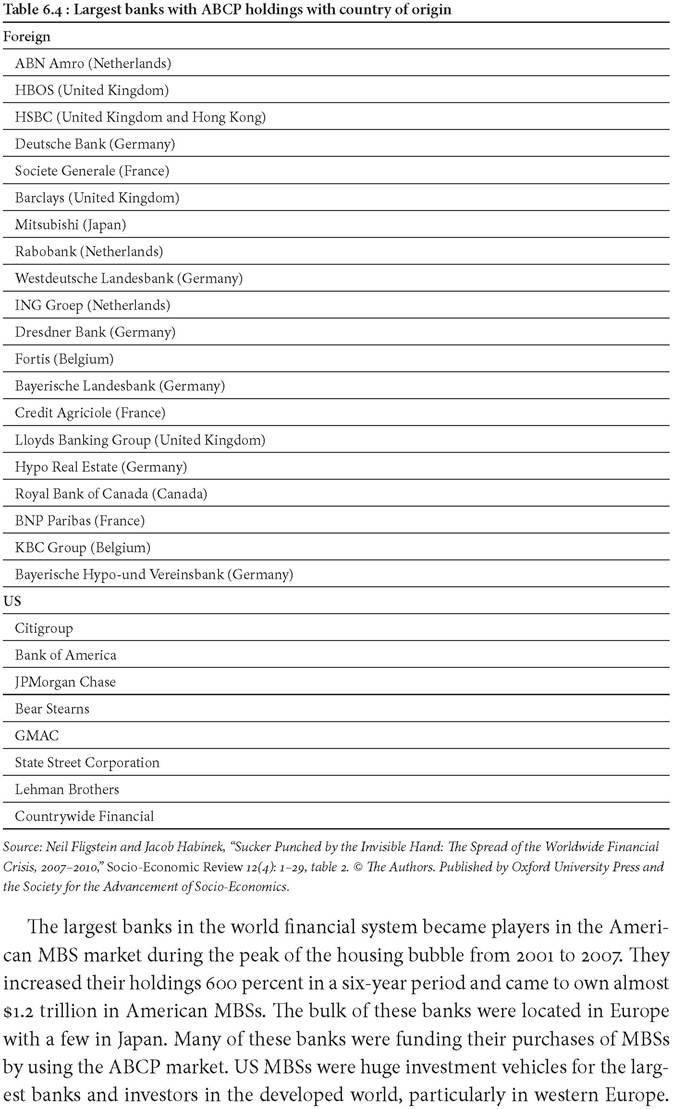
Many of the banks that had participated in these markets eventually failed, causing banking crises in their home countries (Beltratti and Stulz, 2012). Fligstein and Habinek (2014) provide multivariate models that confirm this result.
Conclusion
The Great Recession originated in the United States and spread to western Europe and other parts of the developed world. The main path to the crisis was through the American housing market. The housing price bubble in the United States fueled the production of MBSs and CDOs. These securities were extensively sold and marketed around the world to banks and investors in the richest countries, who funded much of these purchases with ABCP.
Foreign investors increased their holdings of these securities by $1 trillion between 2002 and 2008. As those securities began to lose their value in 2007 and 2008, banks in the United States and in foreign countries began to fail. Hardly anyone saw that securities based on nonconventional American mortgages were the hottest commodity being traded across this system. These failures spurred systemic banking crises in many countries around the world. These crises forced governments in the rich world to intervene aggressively in their banking systems to stabilize them. But the damage was so extensive that a deep recession followed. It was the globalization of the American mortgage-backed security market, the sale of securities backed on American mortgages and financed by the American ABCP market, that set off a worldwide financial crisis and a deep recession in the richest countries of western Europe.