Fact Finding
It will be important for the advocate to know his/her case well and be able to identify and describe the issues. This will allow categorisation of the issues in terms of levels of strengths and weaknesses and simplicity and complexity as well as their importance to the client's overall goal.
First the advocate must elicit facts that are relevant and this will include facts that support and strengthen a case as well as facts that weaken a case. In addition both the civil and criminal procedural rules require cases to be prepared in accordance with the overriding objective. This includes dealing with cases by considering the complexity of the issues or the gravity of the offence. We will look at the overriding objective in more detail in Chapter 4 and again in Chapters 5 (criminal) and 6 (civil). These are all parts of the so-called technical legal skills and abilities that an advocate will need to acquire.How to Obtain Relevant Facts from a Client
2.2.1 Interview Skills
Effective preparation first starts with the gathering of information from the client and this will usually be done at the first client interview. To prepare a case effectively, an advocate must first understand what the client's case is about and what the client wishes to achieve in terms of desired outcomes. Relevant information can be obtained from the client by using a combination of questioning and active listening.
Active listening means not just hearing what the client is saying but observing how they say it. This is done by observing their body language and behaviour and allows the listener to pick up on signals and clues about how the client is feeling, the impact events have had on them and whether there is something more the client would like to say but has not. This method of listening also enables the advocate to be sensitive about when they should respond and when they should remain silent or when the client may need encouragement to continue with their story.
An advocate should be able to elicit relevant information from the client by using a mix of ‘open' and ‘closed' questions. An ‘open' question is one that allows the client to give the information freely and in their own way. An example of such a question is “can you tell me what happened on that day?” A ‘closed' question is used to restrict the length of the answer that the client can give, or to elicit just a ‘yes' or ‘no' response from the client. For example, “when did this happen?” or “was it raining on that day?” It is useful to use closed questioning when fact-checking during the interview.
Taking notes will also help in the retention of information but reading the information back to the client at various stages in the interview also serves to ensure the accuracy of the facts recorded.
2.2.2 Identify the Client's Goals
Before case preparation can begin, it is important for an advocate to identify and understand the client's goal(s). These may arise from the client's personal circumstances or their commercial needs. The client may have several objectives, but these should be identified in order of priority and any constraints or limitations identified. This may mean that you need to explore more than one goal or objective with the client and prioritise these according to an agreed case strategy. For example, a commercial client who is involved in a construction dispute with a long-standing client may have other interests to serve in terms of retaining the goodwill of that client, preserving their own reputation in the industry and finding ways to ensure that the project is completed within a non-negotiable deadline. This may mean that arbitration rather than litigation is the best method forward and many construction contracts include mandatory arbitration clauses for this reason.
In civil cases, it is important to be clear as to whether the client's goals can be achieved by negotiating a settlement rather than proceeding with litigation. It will usually be necessary to consider whether alternative dispute resolution such as mediation, arbitration or conciliation would achieve the client's goals (we will discuss this further in Chapter 3).
This offers an opportunity to explore the issues in a way that will find a resolution that is acceptable to both parties and reduce costs.In civil cases, pre-action protocols and court procedural rules emphasise that parties should seek alternative means of resolution wherever possible (we will consider this in more detail below at 2.8.2). Negotiating a settlement can achieve mutual benefits for both parties in a fair, open and transparent way and might even result in better outcomes than litigation which is itself lengthy and costly. The client's goals may therefore change from one of “what do I want to win by going to court?” to “what am I prepared to settle for to avoid going to court?”
An advocate should be cautious of advising too soon, as obtaining further information may be necessary or the advocate may have to conduct further legal research. It is better to promise to get back to the client with detailed advice rather than promising that you can solve the problem on the spot!
Once the advocate has gathered information and identified the client's goals, he/she should then examine all elements of the client's case in detail to ascertain whether the client's goals are realistic and obtainable. This will mean familiarisation with the case to the point that the advocate becomes knowledgeable about all aspects, including the elements of the charge (criminal case) or claim (civil case) as well as the factual and legal issues. Case analysis and evaluation are essential to the mastery of the arguments needed to persuade the court.
2.2.3 Know the History of your Case
To succeed in a case, an advocate must be familiar with the case including evaluating the strengths and weaknesses of the case with reference to the facts (‘factual analysis'). This means an advocate will have to be able to assimilate information and identify possible consequences for the client in taking different actions. This will involve recognising when further documentation or other forms of evidence are required, when it is necessary to conduct legal research or obtain expert advice and how to interpret legislation and case law and other sources of law.
An advocate may also have to discuss alternative forms of funding or advice with a client, and it is therefore important that an advocate always has an eye on costs.The factual background of a case will contain key dates and events. It is necessary to first understand how the main events unfolded. It is helpful to prepare a Chronology of Key Dates and Events to help with the assimilation of the facts. A version of this can also be included in trial bundles to assist the court.
For an example of how to prepare a Chronology of Key Dates and Events, consider the following set of facts in a civil case:
Case Example 1
Summary of Facts - Civil Case
You act for the defendants (Mr and Mrs Trelorn). On 12 September last year, the claimant (River Interior Designs) agreed to carry out landscaping work at the home of the defendants. River Interior Designs is owned by Jack River who is also a neighbour of the defendants. The defendants allege that during a dinner party at their house on 12 September, the claimant offered to help 'improve' their garden through a redesign. This was to be a gift for the defendants' wedding anniversary. On 16 September, it is alleged that the claimant visited the defendants' home in order to draw up preliminary plans for the redesign of the garden. Both parties agree that during those discussions, the claimant informed the defendants' that the work would involve a cost of £10,000. It is disputed that the claimant made it clear to the defendants that this would be the price they would be expected to actually pay for the work to be carried out. The claimant wrote to the defendants on 23 September enclosing receipts for a total of £2,000 representing materials that had been purchased for the garden. On 28 September the claimant and his wife attended the defendants' wedding anniversary celebrations. The claimant did not arrive with any gifts on that day and so the defendants say that they continued to believe that the landscaping of their garden was to be the claimant's gift to them.
On 9 October the claimant began work at the defendants' premises. On 11 October, work had to be halted after it was discovered that the roots from an oak tree situated in the defendants' garden was causing problems for the groundwork. The defendants allege that they offered to pay the claimant the sum of £1,500for the removal of the tree, as they did not want the claimant to undergo any additional expense. The defendants emphatically deny that this offer constituted any acceptance of responsibility for the overall cost of the landscaping project. The landscaping project was completed on 18 October. On 21 October, the claimant sent the defendants an invoice for £11,500. To this date, the invoice remains unpaid.There is a large amount of information contained in the narrative above. Part of the role of the advocate is to separate the relevant issues from the irrelevant issues and identify the facts that are agreed and the facts that are in dispute. Ordering the narrative by key dates and events helps to highlight the facts in issue.
The events and key dates might be put in chronological order as follows:
| Event | Key Date |
| Oral agreement between the parties (disputed) | 12 September [year] |
| Discussion of contract terms and price (disputed) | 16 September [year] |
| First invoice with receipts (disputed) | 23 September [year] |
| Defendants' wedding anniversary party | 28 September [year] |
| Landscaping work begins | 9 October [year] |
| Interruption to works and defendants' acceptance of cost of £1,500 for additional work | 11 October [year] |
| Completion of landscaping works | 18 October [year] |
| Final invoice of £11,500 sent | 21 October [year] |
Preparing a table of this nature will help to identify the so-called ‘known knowns' (Snowden and Boone, 2007).
In the context of case preparation, these so-called ‘known knowns' in an advocacy situation can be thought of as essentially the undisputed facts of the case that are discernible and easy to prove.The table will also help you to identify the issues that are in dispute and in particular, what additional information you require (the ‘unknown knowns') in order to be able to plan and prepare your case strategy and this may involve obtaining additional information and investigating a number of different options.
2.2.4 Identify the Issues
Identifying the factual and legal issues that are relevant to the case will then help you to separate out the disputed and undisputed facts and to identify relevant authorities (e.g. cases, legislation, books of authority) that you will need to use to help you to prove your client's case.
The factual issues can often be identified by using a very simple questioning structure of, ‘What', ‘How' and ‘Why'. For each issue identified, you should then highlight a corresponding legal issue that may arise.
For example, if we turn back to Case Example 1, a relevant legal issue relates to whether the contract can be said to be a valid one given that it was an oral agreement with unclear terms. This might give rise to a legal issue arising from principles in cases such as Felthouse v Bindley [1862] EWHC CP J35 where it was held that a contract cannot be imposed on a person through their silence and silence does not necessarily constitute acceptance.
Similarly, if we take a tort action such as medical negligence, your ‘What' ‘How' and ‘Why' analysis might look like Figure 2.3.
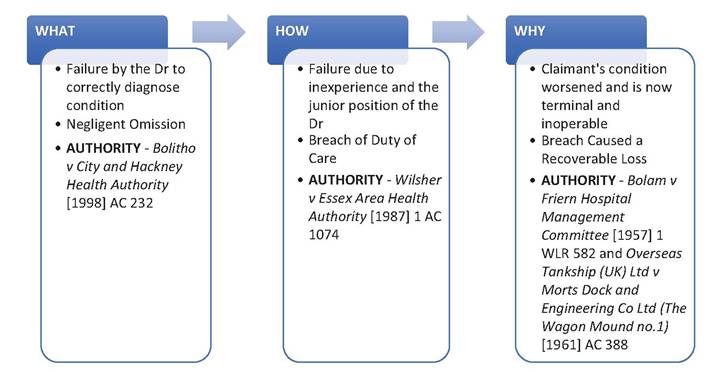
Figure 2.3 What, How and Why Analysis.
Sometimes the issue may be neither a factual nor a legal one but instead an expert one that requires evidence from an expert. It is important to recognise when the determination of an issue is outside of your expertise and where it is necessary to seek additional help in progressing the case. An expert might, for example, include a medical expert, a surveyor or a forensic accountant. This will also require you to undertake further legal research as to the most suitable expert and the nature of the opinion required from them.