Introduction
In writing this guide to advocacy I hope that I have been able to demonstrate how skills and academic knowledge are interconnected and interdependent and how practice and theory can work hand in hand to develop leadership skills and confidence in future advocates.
Whilst this companion textbook is intended to help prepare students for the national Solicitors Qualifying Examinations (‘SQE’), it also provides useful information on evidence and procedural rules that will take students beyond their studies to entry into the profession. It is a companion and reference text that the novice advocate can use whilst in practice by referring to discrete parts and sections of the textbook.
The book also clearly signposts where SQE advocacy assessed skills are covered within the text. Using exercises, problem-based scenarios and case studies, the reader is encouraged to learn by doing and to build their confidence through role-play and ‘confidence exercises’. The textbook emphasises the importance of engaging with the court procedural rules and professional conduct rules throughout the various stages of advocacy.
The skills and knowledge that an advocate will need are explored in the context of criminal and civil litigation only. Therefore, the focus is on the Civil Procedure Rules (‘CPR’) and the Criminal Procedural Rules (‘CrimPR’). Other procedural rules such as the Family Procedure Rules and the Supreme Court Procedure Rules are beyond the scope of this book. The textbook examines how and when the criminal and civil rules may arise in the day-to-day work of an advocate.
An advocate is not expected to learn the procedure rules verbatim, but they are expected to familiarise themselves with the framework of the rules and understand how they connect. This book aims to assist with this task but is not meant to be a definitive summary of the entirety of the rules, which are themselves numerous and are updated on a regular basis.

0.1 What Is an Advocate?
An advocate is a person who conducts a case in a court or tribunal. Part of an advocate’s role is to represent a party in legal proceedings by speaking on their behalf and putting forward evidence and legal arguments. An advocate is expected to advance their whole case at trial and to ensure that they advance the best evidence possible to support and prove that case. However, speaking is only one part of an advocate’s role. Conducting a case also involves preparation, legal research and a focused strategy to achieve successful outcomes. At all times, an advocate is expected to be competent and adhere to certain standards. For this reason, advocacy is a ‘reserved activity’ under the Legal Services Act 2007 and only qualified legal professionals can undertake this role in the court system.
Advocacy is in essence a craft and one in which the public and the judges must have faith. Research by Gillian Hunter and others (2018) found from their interview of 50 circuit and High Court judges, that the judiciary considered the attributes of a good advocate to be an ability to communicate well, to focus on the case by taking a structured and strategic approach and by undertaking detailed preparation in readiness for attendance at court.
0.2 What Does Competence Mean?
Competence is the ability to do something successfully and effectively to an expected standard. In a professional setting, this relates to the ability to provide an appropriate standard of service to members of the public. To reflect the differing levels of competency expected of advocates, the Solicitors Regulation Authority (‘SRA’) have developed a competency statement.
0.3 What Is the SRA Statement of
Solicitor Competence?
The SRA has identified the skills, knowledge and behaviours expected of solicitors (including advocates) and these are set out in the Statement of Solicitor Competence (‘SoSC’), together with the levels (‘threshold standards’) that a solicitor is expected to meet upon qualifying to practice as a solicitor.
The standard for newly qualified solicitors (Level 3) will be competence to an ‘acceptable standard’, rather than an excellent standard of mastery.The Statement of Solicitor Competence helpfully sets out the type of tasks and activities that a competent advocate would be expected to perform (see A-D in Figure 0.1) and these tasks are explored in this book together with other practice skills and knowledge that an advocate will need during case preparation and analysis.
Introduction
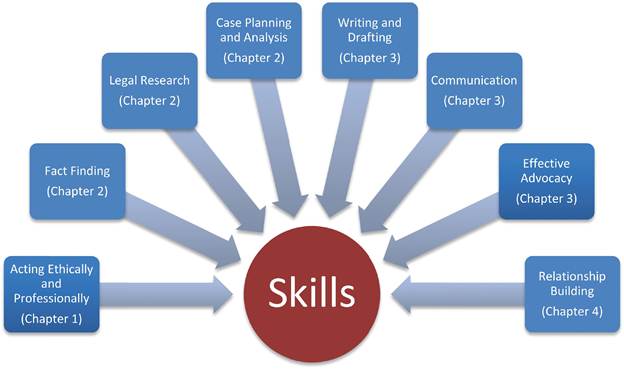
Figure 0.1 Book Skills Content.
0.4 How Do I Use this Book?
The book is divided into three parts. Part A will focus on how to become a competent advocate within the meaning of the SRA Statement of Solicitor Competence. Exercises will incorporate aspects of ‘embodied ‘earning' - loosely defined as a somatic approach to learning that involves the perception of learning through senses, body and mind and responses. This recognises the need to ‘grow' the advocate and that competencies increase with experience rather than being gained immediately. Part B introduces the reader to both civil and criminal litigation put in the context of knowledge-based case studies in order to make interim applications, pre-trial applications and post-trial sentencing and appeals. Part C contains the answers to the exercises and case studies in Parts A and B. At the end of Part B you will find two helpful appendices. The first (Appendix A) cross-references the most common civil and criminal applications to their specific procedural rule and any accompanying legislation. The second (Appendix B) cross-references specific evidential rules to their relevant procedural rule and legislation and a ‘synopsis case' that summarises the origins and key aspects of the rule.
Parts A and B are further divided into individual chapters.
In Chapter 1 we will examine how an advocate acquires professionalism by managing their behaviours and acting ethically.
We will examine the SRA Standards and Regulations and principles which govern the behaviours of legal professionals. These align with the ‘SoSC' A and D.In Chapter 2 we will consider the essential skills necessary to plan, analyse and produce a focused strategy in case preparation including legal research. This section will cover the ‘SoSC' B1, B2, B3, B6 and B7.
In Chapter 3 we will focus on how an advocate communicates with others through effective written and communication skills. We will explore writing, drafting, oral presentation and communication skills of an advocate. These align with the technical legal practice under the ‘SoSC’ B4 (drafting effective and accurate documentation), B5 (effective spoken and written advocacy) and C1 (effective communication).
We will consider the remaining competency aspects of C (C2 and C3) in Chapter 4 when we consider how to work with others by building relationships both with clients, the court, witnesses, experts and other legal professionals and litigants in person.
We will cover various skills within the chapters in Part A as shown in Figure 0.1.
All the advocacy skills that are assessed as part of SQE2 are clearly signposted. However, the book is intended to deal with all skills that an advocacy will be called upon to use during their time in practice. As such, the learning outcomes at the end of each chapter, whilst including the skills examples given by the SRA in the SoSC, focus on all the skills the reader will be expected to have gained at the end of each chapter.
Answers to all exercises (except confidence exercises) can be found in Part C.
In addition, Part A includes some helpful ‘Dos and Don’ts’ for practice and some key practice cases are explored in each chapter together with other relevant cases, legislation and journal articles.
All competencies are further explored in the case studies to be found in Part B of the text. This enables the knowledge gained in Part A to be applied to a practice setting.
We use procedural rules and evidential rules to work through pre-trial applications and interim applications in criminal and civil case scenarios in Part B. Because a competent advocate is also expected to abide by court rules and procedure, we will discuss court procedure in all chapters in Parts A and B.All names, characters and places contained in the exercises and case studies in this book are entirely fictional and are not intended to resemble anyone living or deceased.
I have endeavoured to provide the most up to date information on the law and procedure and this includes all amendments to the civil and criminal procedure rules up to the changes made in 2022. Whilst every effort has been made to ensure the information is accurate, I acknowledge that any errors that may occur are my own. I welcome any constructive feedback, comments and suggestions from practitioners, academics, students, and others to refine the commentary, exercises and case studies for future editions.