An Introduction to Appeals
Where a judge has made a decision that is considered to be either (1) wrong due to errors of law, fact or the exercise of a discretion or (2) unjust due to a procedural irregularities or other irregularities, then an advocate may wish to appeal that decision.
Appeals due to errors of fact, whilst permissible, do have some restraints placed upon them. This is because it is assumed that the original trial judge or jury will be best placed to decide issues of fact as they will have heard the evidence and been able to make assessments about the truthfulness of each witness's evidence. However, examples of where it may be appropriate to allow an appeal based on errors of fact include where the judge has made an important finding of fact that cannot reasonably be explained on the basis on the evidence, or the judge has fundamentally misunderstood relevant evidence or failed to consider critical or important evidence (see Henderson v Foxworth Investments Ltd [2014] UKSC 41).
7.7.1 Appeals in Civil Proceedings
The appeal may be based on a wrong decision at or on an interim application or trial. However, there must be proper grounds on which to appeal. An appeal does not involve a retrial and so witnesses will not be recalled. The appeal is conducted by considering the transcript of the evidence at the original trial. The appeal court does however have a discretion to hold a rehearing if it considers that it would be in the interests of justice - see CPR Part 52.21.
Appeals are made using an application notice (e.g. form N161 for cases on the small track). A skeleton argument is required for all appeals and should comply with CPR PD 52A para 5.1. In addition, the appellant should file a chronology of events (see CrimPR PD para 5.2)

Advocates must comply with CPR Part 52 and Practice Directions 52A (general provisions), 52B (appeals in the County Courts and the High Court), PD52C (appeals to the Court of Appeal), 52D (statutory and special appeals) and 52E (appeals by way of case stated).
The Supreme Court has its own rules for appeals (the Supreme Court Rules 2009 statutory instrument No 1603) and these relate to both civil and criminal cases and are accompanied by practice directions that are published on the Supreme Court website.The Access to Justice Act 1999 (Destination of Appeals) Order 2016 specifies the correct appeal route for decisions of judges (according to their status).
For a first appeal to a court (other than the Court of Appeal) the test is found under CPR Part 52.6 and is whether:
1. The court considers that the appeal would have a real prospect of success or
2. There is some compelling reason for the appeal to be heard.
If a second appeal takes place to the Court of Appeal, then the test under CPR Part 52.7 becomes whether:
1. The court considers that the appeal would have a real prospect of success and
2. The appeal raises an important point of principle or practice or
3. There is some compelling reason for the appeal to be heard by the Court of Appeal.
Examples of the route to appeals can be found in Figure 7.1.
An appeal ‘by way of case stated' is an appeal from a lower court to a higher court to resolve a point of law. The lower court will set out the particular facts and the relevant legal issues arising from it that require resolution. Once the point of law is resolved, the matter is then referred back to the lower court to continue with the hearing and make the final determination. The procedure is covered by CPR PD 52E.
An appeal that takes the form of ‘judicial review' is a challenge to the lawfulness of a decision made by a public body (for example, a local authority, a regulator, etc). There is a pre-action protocol that governs judicial review hearings and the procedure is also set out in CPR Part 54 and CPR PD 54A.
Where permission to appeal is needed this will usually be a paper exercise without the need for a formal hearing but the advocate should follow the procedure in CPR Part 52.4-6 and 52.12-13.
The appeal notice must state that the appellant requires permission to appeal if they are applying for permission from the appeal court. Equally they can apply for permission from the original court whose decision is to be appealed - see CPR Part 52.3(2).Advocates should observe the time limit for filing an appeal notice which is either the time period stipulated by the lower court or 21 days after the date the decision was actually made by the lower court (see CPR Part 52.12). The 21-day time limit runs from the date the decision is formally announced in court (see Sayers v Clarke Walker [2002] EWCA Civ 645) and not from the date the decision was drawn up as an order. If the judge reserves judgment, then it will be the date that the judgment is handed down in open court rather than any earlier date, such as, for example, when the judge circulates a draft judgment to counsel for approval (see Owusu v Jackson [2002] EWCA Civ 877).
If judgment is handed down in open court in the absence of the parties (because a draft judgment has already been circulated and their attendance has been excused by the judge), it is recognised that there may not be an opportunity for a party to make the application for permission to appeal to the original court in accordance with CPR Part 52.3(2). In those circumstances the case of McDonald v Rose and Others [2019] EWCA Civ 4 states that the judge should formally adjourn the hearing after handing down judgment and then the 21-day period to apply for permission will run from then (the application for permission can be made in writing rather than reconstituting the hearing). Equally if the judge announces their decision but then states they will give reasons for their decision at a later date, the case of McDonald confirms the judge should adjourn the hearing and extend the 21-day time period.
The court has the power to vary the appeal time period under CPR Part 52.15 and Part 3.1(2)(a). The advocate will also need to prepare an appeal bundle which will be extensively read by the court to reduce the need for opening speeches.
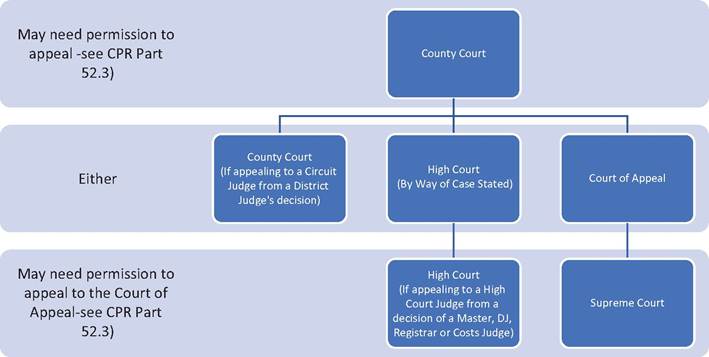
Figure 7.1 Routes to Appeal in the Civil Courts.
7.7.2 Appeals in Criminal Proceedings
In criminal proceedings, appeals are governed by the Criminal Appeal Act 1968 and CrimPR Parts 34-44 as well as the Senior Courts Act 1981 and the Sentencing Act 2020. Appeals are heard in public unless the hearing relates to a public interest ruling.
An appeal from a decision in the Magistrates’ Court is made to the Crown Court under CrimPR 34 and can be made in relation to appeals against conviction, sentencing and other orders. Appeals from a Crown Court may be made to the Court of Appeal in relation to conviction, sentence or verdicts and findings of guilt. Crown Court decisions relating to other orders made are usually made on points of law and referred to appeal either ‘by way of case stated’ (see the procedure in CrimPR Part 35) or by way of judicial review (see Senior Courts Act 1981, s. 29(3)) to the divisional court of the High Court. This procedure can also be used to challenge decisions made in the Magistrates’ Court.
Whilst an appeal court will usually focus only on the evidence that was considered at the trial, s. 23 of the Criminal Appeal Act allows the court to receive fresh evidence in limited circumstances if it is in the interests of justice to do so.
When an appeal is heard by the Court of Appeal it must include a panel of at least two judges, and in some circumstances three judges will be required to sit (e.g. appeals against conviction, applications for leave to appeal to the Supreme Court, appeals against findings of fitness to plead - see Senior Courts Act s. 55(2)). Certain limited cases may be heard by a single Court of Appeal judge (e.g. initial applications for leave to appeal to the Court of Appeal and applications for bail pending an appeal). If a case is extremely complex, then more than three judges may sit as long as the number of judges is kept uneven.
The procedure for appeals in the Supreme Court is governed by the Supreme Court Rules which are outside the scope of this book.
An appeal can be made to the Supreme Court, either by the Court of Appeal certifying that the appeal involves a point of general importance or the Supreme Court giving leave to appeal because the point of law is considered an important one. The procedure for applying for leave from the Court of Appeal to appeal to the Supreme Court is set out in CrimPR Part 43.7.7.3 Appeal Notice
An appeal notice and response notice should follow the format set out in CrimPR
34.2 and 34.3 (appeals to the Crown Court) or CrimPR Part 39.3 (appeals to the Court of Appeal) and specify details of the conviction or finding of guilt, the sentence or the order to be appealed and summarise the issues giving arise to the appeal.
In the case of an appeal from the Magistrates’ Court to the Crown Court, an appellant must serve the notice of appeal on the Magistrates’ Court and the opposing party (Crown Prosecution Service). This must be done not more than 15 days after
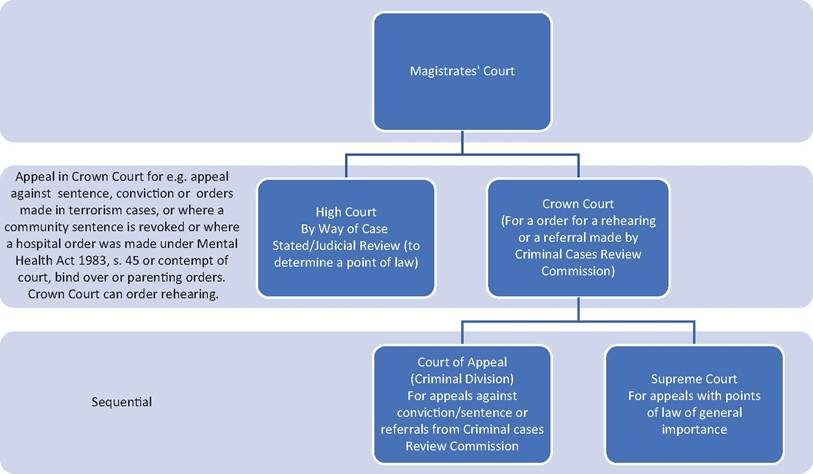
Figure 7.2 Routes to Appeal in the Criminal Courts.
The Litigation Advocate

sentencing (or the date sentence is deferred or the date of committal for sentence) or the making of the relevant order (see CrimPR Part 34.2). An appellant can apply for an extension of the time limit to appeal (CrimPR Part 34.2 (3)). The Magistrates’ Court can grant an appellant bail pending an appeal. The respondent serves a response notice not more than 15 days after service of the appeal notice where the appeal is against a conviction or finding of guilt (see CrimPR Part 34.2(5)).
In the case of an appeal from the Crown Court to the Court of Appeal, the time limit for service of the appeal notice is 28 days after the conviction, verdict, finding, sentence or order (see CrimPR Part 39.2). The respondent then has ten business days to file a response (see CrimPR Part 39.6(4)).
Once the relevant court has received a notice of appeal, it will apply for the transcripts from the lower court to determine whether the application shows substantial grounds for appeal. Under s. 20 of the Criminal Appeal Act 1968, if the Registrar (usually a barrister or solicitor of ten years’ standing) considers that the grounds of appeal do not show any substantial grounds then he/she can refer the matter to the court for a summary determination. The court can dismiss any appeal applications that it considers to be frivolous or vexatious without the need to hold a hearing.
An appellant is expected to assist the court with its case management functions by helping the court to identify relevant witnesses who gave evidence at trial, detail any special measures arrangements made, detail the issues at trial and how they differ from the issues on appeal and also identify any relevant reports and state how long the original trial lasted (see CrimPR 34.3(c)).
7.7.4 Crown Court as an Appeal Court
On an appeal from the Magistrates’ Court to the Crown Court, CrimPR Part 34.11 provides that the hearings should be heard by a judge of the level of a High Court Judge, Circuit Judge or Recorder or a qualifying judge advocate together with no more than four justices of the peace. If the appeal is from a decision in the Youth Court, then eachjustice of the peace must be qualified to sit in a Youth Court. In exceptional circumstances, to avoid a delay in the constitution of an appeal the requirement for four justices of the peace to be present can be reduced to one.
7.7.5 Sources of Potential Miscarriages of Justice
One of the bases for an appeal may be that there has been a miscarriage of justice due to judge’s failure to conduct a proper summing-up of the evidence for the jury. As we have discussed, the admission of certain pieces of evidence might lead to the jury placing undue weight on their importance and/or reliability. The judge therefore has an obligation to guide the jury on how to treat such evidence and the inherent dangers associated with the evidence. The judge must also remind the jury about the burden and standard of proof. In R v Lawrence [1982] AC 510 Lord Hailsham emphasised the importance of the judge’s summing-up task:
A direction to a jury should be custom-built to make the jury understand their task in relation to a particular case. Of course, it must include references to the burden of proof and the respective roles of jury and judge. But it should include a succinct but accurate summary of the issues of fact as to which a decision is required, a correct but concise summary of the evidence and arguments on both sides and a correct statement of the inferences which the jury are entitled to draw from their particular conclusions about the primary facts.
[519]
Another common area leading to potential miscarriages of justice is the use of visual identification evidence, particularly when this is not supported by a second identification through the more formal process of Code D of the Police and Criminal Evidence Act 1984. Visual identification evidence therefore requires caution when deciding how much weight should be attached to its significance given that sightings can be unreliable, misleading or mistaken. The common law has developed a test to be used for identification evidence taken from the case of R v Turnbull [1977] QB 224 known as the ‘Turnbull Guidelines’. Where a case relies wholly or substantially on visual identification evidence that is contested the judge should provide a ‘Turnbull warning’ to the jury of ‘a special need for caution’. This warns the jury of the dangers of relying on such evidence because a convincing witness can still make an honest mistake. The judge therefore directs the jury to examine, assess and evaluate the identification evidence as follows:
1. Assess the quality of the evidence - for example, how long did the witness have the defendant under observation? Did the witness get only a ‘fleeting glimpse’ of the defendant? These and other questions should be asked by the jury when assessing whether the identification is strong or weak.
2. Look at the circumstances that led up to the identification evidence being made - for example, what were the weather conditions? How far away was the witness standing from the defendant at the time of the identification? Was their view of the defendant obstructed or impeded? What were the lighting conditions at the time of the identification? Was it day or night? Had the witness seen the defendant before? These and other questions should be asked when looking at how the identification was made.
3. Consider any discrepancies in the description given by the witness and the defendant’s actual description and whether these are material discrepancies.
4. Be reminded of weaknesses in the identification that have been drawn to the jury’s attention by the judge.
5. Remember that whilst recognition evidence will usually be good identification evidence, mistakes can still be made.
The guidelines provide that if the quality of the identification is merely a ‘fleeting glimpse’ it should not be left to the jury to consider it as evidence unless there is other evidence to support the identification. This might be, for example, a positive identification from a witness during a Code D formal identification procedure or another witness who has also identified the defendant in a statement.
The Turnbull guidelines have been developed for use in voice identification and other forms of identification. You can find more details about the guidelines in the Crown Court Compendium (15).
Another potential source of miscarriages of justice is forensic evidence and an advocate should always be prepared to challenge the science where there is a basis for doing so such as DNA evidence that might not have been stored in the correct climate conditions prior to analysis.
7.8