The Criminal Case Study
In this section you will find documentation relating to three pre-trial applications in the fictional case of R v Vermont. Each application is preceded by a memorandum explaining the task (see Memorandums A, B and C).
You should assume that all dates given are current dates. Where it is indicated in italics that a document is ‘not supplied’, assume that it has been correctly served and does not include any procedural irregularities and can be ignored for the purposes of the fact pattern. Each memorandum will give an indication of the criminal procedure rule that is relevant as well as some relevant case law and legislation. However, you should read the accompanying documents as they may lead you to consider further procedural rules and cases. You should also make use of the tables on procedural rules and evidential rules found at Appendix A and B. You may also find it helpful to re-read Chapters 2 and 3 for a reminder of legal research, case strategy and argument construction techniques.You will find suggested guidance on possible arguments that can be advanced in support of each application in section C. You should however try to work through the exercises first and prepare your own arguments drawing on some of the skills learnt in the chapters in Part A.
You might approach the criminal exercises in the following way:
1. Read all documents through once.
2. Read through all documents a second time but this time highlight any key words or sentences that you think are important.
3. Read any criminal procedure rules mentioned in the documentation.
4. Consider any additional rules that might be relevant (refer to Appendix A).
5. Read any cases mentioned in the documentation.
6. Consider whether any other cases might be relevant - for example, do the cases referred to in the documentation lead you to a research trail of other cases/ legislation?
7.
Start to construct possible arguments - you might want to use a ‘strengths and weaknesses' table similar to the table discussed in Chapter 2.8. Practice making your submissions aloud without heavy reliance on a script (cue or prompt cards are acceptable).
5.7.1 Exercise 1 (Bail)
The following exercise relates to a bail application. You act for the defence and will be seeking to persuade the court to grant bail under the Bail Act 1976 after the prosecution have made submissions as to why bail should not be granted. Memorandum A sets out what grounds of the Bail Act the prosecution will rely on and you should assume that they have made submissions based on those grounds at the hearing that you will attend.
Bail under the Bail Act 1976 refers to the process of release from custody for a defendant who is under arrest. Release is temporary until the trial takes place, or bail is revoked. A defendant can be released with conditions attached to bail or be granted unconditional bail. Both the Magistrates' Court and the Crown Court can grant bail and the procedure is set out in CrimPR Part 14 and the Bail Act 1976 as amended by the Legal Aid, Sentencing and Punishment of Offenders Act 2012.
The prosecution advocate will start by giving a summary of the case and explain why bail is opposed and what part(s) of the Bail Act is/are relied upon (see CrimPR Part 14.5). The prosecution should also anticipate what the defence might say in response and deal with the possible counter arguments. When the prosecution has made all its submissions the defence will then respond to the points made by the prosecution and explain why the exceptions to the right to bail should not apply. The defence can offer suggestions about what bail conditions the defendant might accept - see CrimPR Part 14.11-15 and Bail Act 1976, s. 3.
The Bail Act, s. 4 (and its subsequent amendments) gives a right to bail except in certain circumstances. The exceptions to the right to bail are set out in Schedule 1 Part 1, 1A and 2 of the Bail Act.
If a defendant does not pose a risk as outlined above, then they should be granted unconditional bail. If there is evidence that the defendant is a bail risk, the court should consider whether attaching conditions to bail would alleviate that risk. If not, the defendant should not be granted bail.The Bail Act 1976 is a complex piece of legislation and it is good to practice to read legislation of this nature in order to decide which provisions apply, or do not apply to your client. The Act has been subject to a number of amendments by other pieces of legislation and so it may be necessary to trace some of those amendments back to their original source to fully understand the intention behind each ground. The various grounds/exceptions have been set out below for ease of reference.
The presumption of a right to bail can be rebutted where there are substantial grounds for believing that if a defendant were to be released on bail, they would act in ways contrary to the Bail Act 1976, Schedule 1 Part 1, 1A or 2.
Imprisonable Offences/Extradition Offences (see Schedule 1, Part 1 paras 2-7 of the 1976 Act as amended)
a) Fail to surrender to custody, or
b) Commit an offence while on bail, or
c) Interfere with witnesses or otherwise obstruct the course of justice, whether in relation to himself or any other person (para 2), or
d) The defendant would engage in conduct that would or is likely to cause physical or mental injury to an ‘associated person' or cause them to fear physical (para 2ZA). An ‘associated person' means those in relationships of marriage, cohabitation or personal intimate relationships see s. 62(3) of the Family Law Act 1996,
e) The offence is an indictable or either-way offence and it appears to the court that the defendant was already on bail at the date of committing the offence (para 2A), or
f) In the case of extradition offences, the offence in question would have been an offence if carried out in England and Wales and it appears to the court that the defendant was on bail on the date of the offence (para 2B), or
g) The court is satisfied that the defendant should be kept in custody for his own protection, or if the defendant is a child, that they should be kept in custody for their own welfare (para 3), or
h) The defendant is in custody as a result of a sentence imposed under the Armed Forces Act 2006 (para 4), or
i) The court is satisfied that it has not been practicable to obtain sufficient information for the purposes of taking decisions about bail because of lack of time (para 5), or
j) The defendant was previously granted bail and has been arrested for failing to surrender to bail (para 6), or
k) The defendant has been charged with murder and there is significant risk of the defendant committing an offence whilst on bail that would be likely to cause physical or mental injury to a person other than the defendant or cause that person to fear physical or mental injury (para 6ZA), or
l ) In certain courts where the Secretary of Secretary of State has confirmed that
relevant assessment and follow-up provisions are available, the defendant who is aged over 18 is a Class A drug user and there is a significant risk of him committing an offence whilst on bail (para 6A, 6B and 6C), or
m) The defendant’s case has been adjourned for inquiries or a report and the court is of the view it would be impracticable to complete those inquiries or report without keeping the defendant in custody (para 7).
Imprisonable Offences Under Criminal Justice and Public Order Act 1994, s. 25
a) The defendant has previously been charged with or convicted of one of the offences under the Criminal Justice and Public Order Act 1994, s. 25(2) (murder, attempted murder, rape or specified sexual offences) and there are no exceptional circumstances to justify bail.
Imprisonable Offences Tried Summarily or Low Value Either Way Imprisonable Offences/Extradition Offences (see Schedule 1, Part 1A paras 2-9 of the 1976 Act as amended)
a) The defendant appears to have previously failed to surrender to custody when previously granted bail and the court believes in view of this that the defendant would fail to surrender to custody again if released on bail (para 2), or
b) At the date the offence was committed the defendant was already on bail in criminal proceedings and the court is satisfied that there are substantial grounds for believing that if released on bail the defendant would go on to commit an offence again while on bail (para 3), or
c) The court is satisfied that there are substantial grounds for believing the defendant would commit an offence whilst on bail that would be likely to cause physical or mental injury to an associated person’ or cause that person to fear physical or mental injury (para 6). An ‘associated person’ has the same definition as under Schedule 1 Part 1 from s. 62 (3) of the Family Law Act 1996.
d) The court is satisfied that the defendant should be kept in custody for his own protection, or if the defendant is a child, that they should be kept in custody for their own welfare (para 5), or
e) The defendant is in custody as a result of a sentence imposed under the Armed Forces Act 2006 (para 6), or
f) The defendant was previously granted bail and has been arrested for failing to surrender to bail and the court is satisfied if released would (1) fail to surrender to custody, or (2) commit an offence while on bail or (3) interfere with witnesses or otherwise obstruct the course of justice, whether in relation to himself or any other person (para 7), or
g) The court is satisfied that it has not been practicable to obtain sufficient information for the purposes of taking decisions about bail because of lack of time (para 8), or
h) In certain courts where the Secretary of Secretary of State has confirmed that relevant assessment and follow-up provisions are available, the defendant who is aged over 18 is a Class A drug user and there is a significant risk of him committing an offence whilst on bail (para 9 & Schedule 1 Part 1A para 6A, 6B and 6C).

Non-Imprisonable Offences (see Schedule 1, Part 2 paras 2-6 of the 1976 Act as amended)
a) The defendant is a child/young person or a defendant who has been convicted in the proceedings of an offence and it appears to the court that he failed to surrender to bail when previously granted bail in criminal proceedings and the court believes that because of this the defendant would fail to surrender to bail again (para 2), or
b) The court is satisfied that the defendant should be kept in custody for his own protection or if the defendant is a child that they should be kept in custody for their own welfare (para 3).
c) The defendant is in custody as a result of a sentence imposed under the Armed Forces Act 2006 (para 4), or
d) The defendant is a child/young person or a defendant who has been convicted in the proceedings of an offence and was previously granted bail and has been arrested for failing to surrender to bail and the court is satisfied if released would (1) fail to surrender to custody, or (2) commit an offence while on bail or (3) interfere with witnesses or otherwise obstruct the course of justice, whether in relation to himself or any other person (para 5), or
e) Having previously been released on bail the defendant has been arrested for failure to surrender to bail and the court is satisfied that if released on bail there are substantial grounds for believing the defendant would commit an offence whilst on bail that would be likely to cause physical or mental injury to an associated person' or cause that person to fear physical or mental injury (para 6). An ‘associated person' has the same definition as under Schedule 1 Part 1 from s. 62(3) of the Family Law Act 1996.
When structuring a reply to each ground relied upon by the prosecution, the defence advocate should follow the schedule1, Part 1 para 9 factors from the Bail Act and address the following in their submissions:
1. Nature and seriousness of the offence (including the likely sentence).
2. Defendant's character, antecedents, associations and community ties.
3. The defendant's previous record of fulfilling any obligations on previously being granted bail.
4. The strength of the evidence against the defendant (except where a defendant's case has been adjourned for inquiries or a report).
5. If the court considers there is a bail risk, whether the risk would be by engaging in conduct that would, or is likely to, cause physical or mental injury to a person other than the defendant.
6. If the defendant is a child who has failed to surrender to bail at an appointed time whether the child defendant had reasonable cause for that failure and whether they surrendered for bail as soon as reasonably practicable after the appointed time,
7.
Any other factors that appear relevant.Criminal Case Study - R v Vermont
Document 1
Memorandum A - Defendant
From: Assiah Proctor (Supervising Solicitor)
Date: 9 January (year)
I attended Anytown police station a few days ago to represent a client who we picked up through the police station representation scheme. The client is Mr Grant Vermont and you will see from the charge sheet that he has been charged with a number of offences. Mr Vermont is a company director who also has an OBE. We have acted for him in the past on company matters. I must say, I am surprised at the charges that he faces. All the offences are imprisonable offences and so fall under Schedule 1 Part 1 of the Bail Act 1976. Given the seriousness of the allegations, the offences will all be tried on indictment in the crown court.
I managed to speak to Mr Vermont at the police station after questioning and charge and we have been instructed to apply for bail on his behalf. Could you read the attached documents and make a bail application.
I have spoken to a representative from the Crown Prosecution Service (‘CPS') and they have indicated that the right to bail does not exist because there is a charge of attempted murder and they will be relying on the Criminal Justice and Public Order Act 1994, s. 25(2)(b). Mr Vermont tells me however that he does not have any previous convictions for attempted murder or any other offences. I have repeatedly asked the CPS for a copy of Mr Vermont's criminal records from the Police National Computer, but the CPS have not responded.
The CPS have in any event arranged for the magistrates' court to commit the defendant to be sent to the crown court and for the bail application to be heard by a crown court judge under s. 115 of the Coroners and Justice Act 2009. This has caused a delay of five days in the bail hearing being fixed due to a backlog of cases in the crown court.
I anticipate that if the CPS does not succeed on the s. 25 ground under the Criminal Justice and Public Order Act 1994 that they will try the following grounds as alternatives:
Bail Act 1976, Schedule 1 Part 1, para 2 (all grounds)
Bail Act 1976, Schedule 1 Part 1, para 2ZA
Could you appear at Mr Vermont's bail application tomorrow to make an application for bail?
In case the court has reservations about granting bail, Mr Vermont has indicated that he would accept one or more of the conditions set out in CrimPR Part 14.11 and 14.14 including leaving the matrimonial home at 41 Tennyson Avenue and residing at his mother's address. Mr Vermont has indicated that he will consider the imposition of conditions relating to electronic monitoring tags (see CrimPR Part 14.12) but only as a last resort. He attends charity functions and other important events and doesn't want to be seen in public wearing a tag. Can you decide which conditions you think would be suitable based on the information in PC Parker's report?
If bail is refused don't forget to ask the judge for reasons under s. 5 of the 1976 Act and CrimPR Part 14.4(b).
You may find the following case helpful:
1. O (FC) v Crown Court at Harrow [2006] UKHL 42
You should also consider the following legislation when preparing your submissions:
1. Bail Act 1976, s. 4, s. 5 and Schedule 1 Part 1
2. Coroners and Justice Act 2009, s. 115(1) & 115(3)
3. Criminal Justice and Public Order Act 1994, s. 25
4. Family Law Act 1996, s. 62(3)
You may also want to think about trying an application for costs under the Prosecution of Offences Act 1985, s. 19(2) and s. 19A(2)(a).
Document 2
Initial Details of the Prosecution Case (,IDPC,)
Criminal Procedure Rules, Part 15 PTI URN: 53809
R v Vermont
Anytown Magistrates Court Case No. AM7321/2000
Date: 6 January (current year)
ANTICIPATED PLEA - NOT GUILTY (,NGAP,) (Tick if document attached)
| ✓ | MG04 Charge Sheet |
| ✓ | MG05 Police Report |
| ✓ | MG06 Case File Evidence and Information |
| ✓ | MG08 Breach of Bail Conditions Form (not supplied) |
| ✓ | MG09 List of Witnesses |
| ✓ | MG10 Witness Non-availability |
| ✓ | MG11 Key Witness Statements |
| ✓ | MG15 Interview Record (not supplied) |
| ✓ | MG16 Bad Character/Dangerous Offender |
| ✓ | MG18 Offences Taken Into Consideration (‘TIC’) |
Document 3
MG04
Charge Sheet
Anytown Police Station
To: Grant Vermont
Address: 41 Tennyson Avenue, Anytown
Date of Birth: 11 September 2000
You are charged with the offence(s) shown below. You do not have to say any
thing, but it may harm your defence if you do not mention now, something which you later rely on in court, anything you do say may be given in evidence.
1. Grant Vermont on the 4th day of January (current year), having entered a building as a trespasser, namely the Moonrise Guest House, Anytown you then caused grievous bodily harm to June Vermont contrary to section 9(1) (b) of the Theft Act 1968.
2. Grant Vermont on the 4th day of January (current year), you did, without lawful excuse, cause damage or destruction to property belonging to another, namely the door and furnishings in room 101 of the Moonrise Guest House contrary to section 1 of the Criminal Damage Act 1971.
3. Grant Vermont on the 4th day of January (current year), you did cause wounding with intent contrary to section 18 of the Offences Against the Person Act 1861 by stabbing June Vermont 5 times in different parts of her body causing injuries to the right side of her chest and to her right arm.
4. Grant Vermont on the 4th day of January (current year) you attempted to murder June Vermont at the Moonrise Guest House, Anytown.
5. Grant Vermont on the 4th day of January (current year) you stole property belonging to the Moonrise Guest House, namely the sum of £500 contrary to section 1 of the Theft Act 1968.
Time & date charged: 4.15 am 5 January (current year)
Anticipated Plea: Not Guilty
Defendant’s Comments on Grounds for Detention and Account of Arrest: None
Linked Defendant(s): None
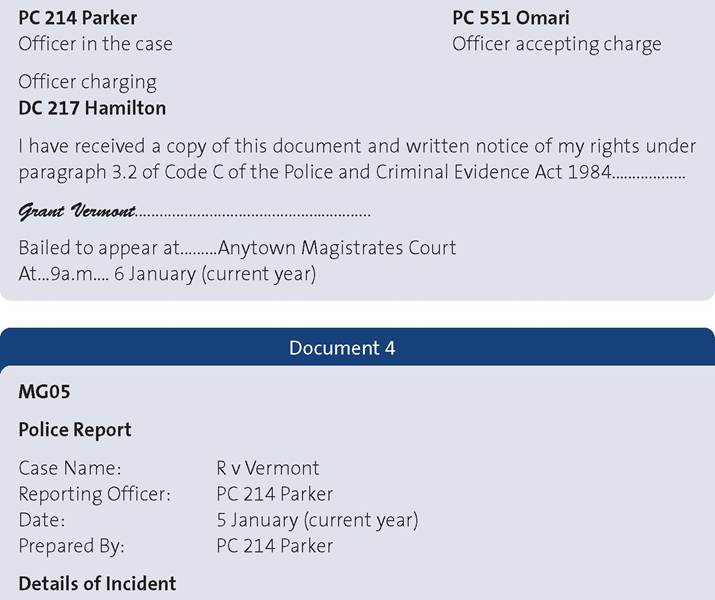
On the 4th day of January at approximately 10.30pm PC Omari and I responded to an emergency call made by the manager of the Moonrise Guest House Anytown. We arrived at the Guest House at approximately 10.45pm. At this time there was already an ambulance crew and paramedics at the Guest House attending to an injured women who we now know to be Mrs June Vermont. We met with the manager, a Mr Callum Proustin. Mr Proustin reported that a guest had been injured by a suspect who was believed to be the victim's husband. The suspect had fled before our arrival. Mr Proustin explained that he was on night duty when a gentleman came to the Guest House at approximately 10.15pm. The gentleman, whom he described as being approximately 6ft 5 inches tall with red hair and a beard and black- rimmed glasses, appeared agitated. The suspect was wearing a green hooded sweatshirt and blue jeans. He asked to see his wife. Mr Proustin asked for the gentleman's name and the name of his wife so that he could check the guest register. However, the gentleman simply ran upstairs and began knocking on rooms on the first floor of the guest house shouting, the following words, to the best of Mr Proustin's recollection: “June, I know you are here. I need to talk to you, I am begging you, please don't do this, you will ruin us”. Mr Proustin followed the gentleman upstairs and says that he found the door of room 101 open and that it had clearly been forced open as there was damage to the doorframe. When he entered he found Mrs June Vermont lying on the floor covered in blood. He could not see the man (believed to be Mr Vermont) in the room. He was able to recall that furniture had been thrown across the room and that the curtains had been ripped from the railings. Mrs Vermont appeared to be unconscious and Mr Proustin checked Mrs Vermont's pulse before running back down to the reception area to call for an ambulance. It was at this point that Mr Proustin discovered that a cash register at the reception front desk was open. Mr Proustin reported that £500 was missing from the cash register.
Actions Taken
PC Omari took a full statement from Mr Proustin while I drove to the hospital that Mrs June Vermont had been taken to by the ambulance crew. I was able to interview Mrs Vermont at Anytown NHS Hospital. I was told by the nurse attending to Mrs Vermont that she had suffered knife wounds to her right chest and right arm and that she also had some facial bruising. Her injuries were not life threatening but would leave some permanent scarring. At 12.05am I was permitted to speak with Mrs Vermont who was now conscious. I took a witness statement from her. I was able to observe Mrs Vermont's injuries during this time. I returned to the Moonrise Guest House at approximately 1.00am where a forensic team and detectives were conducting a full search and crime scene analysis. I asked if any weapon had been found, possibly a knife, given Mrs Vermont's injuries. I was told no weapons had been found in the room or at the guesthouse. A warrant was eventually obtained for Mr Vermont's arrest and PC Omari and I went to arrest him and he was found by us at the matrimonial home, 41 Tennyson Avenue, Anytown, Landshire at 1.30am. He did not resist arrest but gave the following reply: “she did it to herself”. The premises were searched under section 32 of PACE 1984 but no weapon was found but a green hooded sweatshirt with blood stains was found at the premises. Mr Vermont was taken to Anytown police station and interviewed at 2.30am after all forensic analysis and searches had been completed. He was charged at 4.15am and bailed to appear the following morning at Anytown Magistrates' Court. Fingerprint and other DNA evidence (blood) were taken from Mr Vermont during his detention.
Evidence and Potentially Disclosable Material
Forensic evidence - Fingerprints and blood
Clothing - Green hooded sweatshirt with blood stains Photographic Evidence - Suite 101 Moonrise Guest House Photographic Evidence - Injuries sustained by Mrs June Vermont Mobile Telephone - Belonging to Mr Grant Vermont
Witness Statement of Mr Simon Callum Proustin
Investigating Officer Certification: To the best of my knowledge and belief, no information has been withheld from disclosure, which would assist the accused in the preparation of the defence case, including the making of a bail application.
Disclosure Officer's Certification: I certify that any relevant unused material has been recorded and retained in accordance with the CPIA 1996 Code of Practice (as amended) and that such material as is non-sensitive is shown on the schedule above (where applicable) and that to the best of my knowledge and belief the item [mobile telephone records of Mr Grant Vernon and witness statement of Mr Simon Montiana] in the schedule might reasonably undermine the prosecution case, or assist the defence with the early preparation of their case or at a bail hearing because it corroborates part of the defendant’s case.
Investigating Officer’s Name: PC Lerovian Parker
Signature: Lerovian Parker
Disclosure Officer’s Name: PC Margaret Delaware
Signature: Margaret Delaware
5.7.2 Exercise 2 (Specific Disclosure)
In this exercise you will continue in the role of defence advocate and be asked to make an application for specific disclosure. The application is made by following the procedure in CrimPR Part 15.5. This rule provides that once the defence has filed a defence statement in the Crown Court, it may apply for further disclosure from the prosecution, but any application must:
a) Describe the material that the defendant wants the prosecutor to disclose;
b) Explain why the defendant thinks there is reasonable cause to believe that
i. The prosecutor has that material, and
ii. It is material that the Criminal Procedure and Investigations Act 1996 requires the prosecutor to disclose; and
c) Ask for a hearing, if the defendant wants one, and explain why it is needed.
The Criminal Procedure and Investigations Act 1996 is therefore important to this application as it is the main legislation governing disclosure and an advocate should ensure that he/she is familiar with its provisions.
Document 5
Memorandum B - Prosecution
From: Assiah Proctor (Supervising Solicitor)
Date: 12 March (year)
You will recall applying for a bail application for the client Mr Grant Vernon which was fortunately successful. I have received advance disclosure from the Crown Prosecution Service (CPS) that includes the witness statements of their key prosecution witnesses. However, their MG05 form (see document4) shows that they also had a witness statement from a Mr Simon Montiana. I requested and have now received a copy of this witness statement. Reading the contents, I believe that the CPS may have further documents that are relevant to this case, namely any documents regarding the company owned by our client, June Vermont and Mr Montiana. In particular, I believe there may be documents that incriminate Mrs Vermont by showing that she has falsified documents relating to the company. This is important evidence as it may damage her credibility as a witness.
We served a Defence Statement on our client's behalf in accordance with the time limits set out in the CPIA, s. 12.
A Plea and Trial Preparation Hearing ('PTPH') has been fixed for tomorrow. I have already served an application for specific disclosure on the CPS and have followed the procedure in CrimPR Part 15.5. This application is due to be heard tomorrow too. Could you attend to make representations on our client's behalf to obtain an order for specific disclosure please?
You will need to read the case file and also consider CrimPR Part 15.5 and the Attorney-General's Guidelines on Disclosure (Attorney-General's Office, December 2013) para 6. You may also find the following legislation helpful:
1. Criminal Procedure and Investigations Act 1996, s. 3, s. 7A, s. 8 and s. 23.
2. Criminal Procedure and Investigations Act Code of Practice 2015, para 5.1-5.8.
You may also find the following case helpful:
1. R v H and C [2004] UKHL 3 [14].
Document 6
MG09
List of Prosecution Witnesses
1. PC Christopher Omari
2. PC Lerovian Parker
3. Mr Callum Proustin
4. Mrs June Vermont
Document 7
MG11
Key Witness Statements
1. Mr Callum Proustin
2. Mrs June Vermont
See s. 9 witness statements attached
WITNESS STATEMENT
(CJ Act 1967, s. 9; MC Act 1980, s. 5A(3)(a) and s. 5B; MC Rules 1981, r. 70)
| STATEMENT OF: | Callum Proustin |
| AGE OF WITNESS: | Over 18 |
| ADDRESS: | Supplied |
| OCCUPATION: | Hotel Manager |
This statement (consisting of 2 pages signed by me) is true to the best of my knowledge and belief and I make it knowing that if it is introduced in evidence then it would be an offence if I have wilfully stated in it anything that I know to be false or do not believe to be true.
DATED: 4 January (current year) Signed: Callum Proustin
I am the Manager of the Moonrise Guest House, Anytown, Landshire. On 4 January (current year) I was working in the guesthouse and had started my shift at 8.00pm. The guesthouse had 50% occupancy that evening and a new guest, Mrs June Vernon, had checked into the guesthouse at approximately 8.30pm on that day.
At approximately 10pm that evening, a gentleman who I now know to be Mr Grant Vermont, entered the guesthouse and approached me. I greeted him and asked if he wanted to make a reservation. He appeared to be agitated and kept looking around the reception area as if he was expecting to see someone. He asked where the guestrooms were located and I told him that they were on the first floor. He asked if his wife was staying at the guesthouse. I said that I could not give details of the names of our guests but that if he gave me his name and details of who he was looking for and could confirm that they were expecting him, then I could telephone through to their room. He responded by saying “forget it!” and ran upstairs before I could stop him. I quickly went into our restaurant, which, is located next to the reception area and asked a member of staff, Sue Burnley, to take over on the reception desk. I then ran after the gentleman. At first, I could not see him as the corridor divides into two separate corridors where the guestrooms are located. I then heard a noise, which sounded like somebody kicking a door and this was followed by the sound of a woman screaming. I followed the sound and came to room 101.
Room 101 is occupied by Mrs June Vermont. The door was open but with signs of damage to the lock and the door frame. I found Mrs Vermont lying on the floor in a pool of blood in the middle of the room. I could also see that furniture had been disturbed, a table lamp overturned, and curtains pulled from the curtain rail. I called her name, but she did not appear to be conscious. I ran back downstairs to the reception area and asked Sue to call the police. I then ran outside to see if I could see where the man had gone but no one was outside. The police arrived at around 10.30pm.
I would describe the gentleman in question as a white male in his mid-thirties with dark short curly hair and a beard and glasses wearing a green hooded sweatshirt. He was approximately 6ft tall and he was wearing blue jeans and trainers.
I am willing to come to court to give evidence.
WITNESS STATEMENT
(CJ Act 1967, s. 9; MC Act 1980, s. 5A(3)(a) and s. 5B; MC Rules 1981, r. 70)
| STATEMENT OF: | June Vermont |
| AGE OF WITNESS: | Over 18 |
| ADDRESS: | Supplied |
| OCCUPATION: | Company Director |
This statement (consisting of 2 pages signed by me) is true to the best of my knowledge and belief and I make it knowing that if it is introduced in evidence then it would be an offence if I have wilfully stated in it anything that I know to be false or do not believe to be true.
DATED: 4 January (current year) Signed: June Vermont I left the matrimonial home at 41 Tennyson Avenue, Anytown on the afternoon of 4 January after we had a heated argument during which I accused my husband, Grant Vermont of defrauding large sums of money from our company. I had just returned from a meeting with our accountants who had discovered irregular accounting entries in relation to an investment fund that that I owned with my husband and a third partner, Mr Simon Montiana called ‘Global Ethical Trading'. My husband denied that he had been involved in any wrongdoing but said that he suspected Simon. I said that I did not believe him because Simon was unlikely to do anything of that nature as he is the most honest person that I know.
My husband accused me of always sticking up for Simon and demanded to know if we were having an affair. This is something that my husband has accused me of in the past. The allegation is untrue, my husband is a very jealous man with a temper and I was worried that the argument could turn violent now that he was accusing me of infidelity. I went upstairs to the bedroom and started to pack an overnight bag. I told my husband that I was going to stay at a hotel for the night as we were both upset and it would help to calm things between us and we could talk the next day. I then ran out of the house and drove to the Moonrise Guest House.
I arrived at about 8.00pm and checked into my room. My husband and I have used this local guesthouse in the past when we have had guests and needed somewhere for them to stay. At about 9.00pm my husband rang me on my mobile phone to ask me where I was. I said that I was safe and at a local hotel. He must have guessed from this conversation that I was at the Moonrise. He said he wanted to come to talk to me but I told him to leave me alone as I needed time and space to think. I told him that I would call him in the morning. I then got ready to go to bed. I remember being woken by a noise in the corridor of someone shouting my name. I got out of bed and at this point I realised it was my husband in the corridor. I shouted at him to go away. I was angry that he had ignored my request to be left alone. I realise now that this was a mistake because it alerted him to what room I was in. He started kicking at the door a number of times and I was worried he might wake the other guests and so I let him in. However, I immediately backed away from him as he was carrying a knife. He said, “I have spoken to Simon and he has admitted the affair you liar” and he then started stabbing me. That is all that I remember before I passed out. I am convinced that if my husband had not been disturbed by other people coming to see what all the commotion was about, he would have killed me - there was so much rage in his eyes.
I am willing to come to court to give evidence.
| r | Document 8 |
Unused Material
1. Mr Simon Montiana
See s. 9 witness statement attached
WITNESS STATEMENT
(CJ Act 1967, s. 9; MC Act 1980, s. 5A(3)(a) and s. 5B; MC Rules 1981, r. 70)
STATEMENT OF:
Simon Montiana
AGE OF WITNESS:
Over 18
ADDRESS:
Supplied
OCCUPATION:
Company Director
This statement (consisting of 2 pages signed by me) is true to the best of my knowledge and belief and I make it knowing that if it is introduced in evidence then it would be an offence if I have wilfully stated in it anything that I know to be false or do not believe to be true.
DATED: 5 January (current year)
Signed: Simon Montiana
I have known June and Grant Vermont for over 20 years, we were all at university together. About 10 years ago, I started an investment company with them called ‘Global Ethical Trading'. The company traded in ethical stocks and shares. Previously I had been working as a stockbroker and June and Grant had both worked in the City for insurance companies. We felt we had spotted a gap in the market, and we wanted an investment fund that was easily accessible and attractive to young professionals starting their career who wanted better returns on their investments than the average pension fund. In truth, the fund had been underperforming for the last 5 years.
June and Grant had also been having problems in their relationship for the past two years and June and I had started an affair approximately six months ago and she was planning to leave her husband. We had talked about how we would tell Grant. June decided that we should first try to sort out the company, possibly attempt to sell it as a going concern to another investment company owned by a friend she knew. She seemed confident that she could persuade the accountant to hide some of the losses and value the company for more than it was worth. I was not happy about being part of this kind of fraudulent deception and told her as much. I felt that I was seeing another side to June that I had not seen before and that I did not like. I told her that I thought that we should
end our relationship. I told her this during a dinner date with her on the evening of 3rd January.
I did not hear from either Grant or June until I received a telephone call on 5 January from PC Parker asking to interview me and explaining that June was in hospital and that Grant had been charged with her attempted murder.
I don't know whether any of the allegations are true. All I can say about Grant and June is that they have a destructive relationship and it is very hard sometimes to tell who is lying and who is telling the truth. I do know that June had prepared some false accounts for the company that she wanted me to look at as she mentioned this over dinner. I am surprised the police did not find this when they searched her apartment.
I am willing to come to court to give evidence.
5.7.3 Exercise 3 (Hearsay and Character Evidence)
The final exercise in this chapter relates to an application to admit hearsay and character evidence. This time you will take on the role of prosecution advocate. You should read the relevant sections of this chapter on character and hearsay to refresh your memory before attempting the exercise. Remember that there are limitations placed on the admission of both types of evidence. Even if the evidence would be admissible under the relevant provisions of the Criminal Justice Act 2003, the judge has an discretion to exclude the evidence. In the case of hearsay evidence, the judge also has an inclusionary discretion to be found under s. 114(1)(d).
Document 9
MEMORANDUM C - PROSECUTION
From Crown Prosecution Service
To: Prosecution Advocate
Date: 12 March (current year)
Many thanks for taking this case on once again.
A Plea and Trial Preparation Hearing ('PTPH') has been fixed for tomorrow. The defence has already served an application for specific disclosure on us and plan to seek specific disclosure under CrimPR Part 15.5.
We intend to make a counter application to admit hearsay and character evidence. One of the prosecution witnesses (Mr Callum Proustin) is unable to attend the trial as he is leaving the country to take up new employment and we would like to admit his witness statement as hearsay evidence under the Criminal Justice Act 2003 s. 116 (2) (c) and CrimPR Part 20. We have served a witness summons on him to compel him to attend court, but we suspect he will not attend. We could, I guess also look into the possibility of him giving his evidence by video link. I think this is permissible under the Criminal Justice Act 2003, s. 51.
We also plan to adduce the criminal convictions of a witness that the defence may call, Mr Simon Montiana. We intend to produce this under the provisions of the Criminal Justice Act 2003, s. 100 (1) (b) and CrimPR Part 21. We would like to use the evidence of Mr Montiana's previous convictions to discredit him during cross-examination.
Could you attend to make representations to admit these two pieces of evidence please?
You may find the following cases helpful:
R v Castillo [1996] 1 Cr App R 438
R v Gyima (Edward) [2007] EWCA Crim 429
Riat and Others v R [2012] EWCA Crim 1509
Brewster and Cromwell v R [2010] EWCA Crim 1194
You may find the following legislation helpful:
Criminal Justice Act 2003, ss. 51, 98, s. 100(1)(b), s. 100(3), s. 112, s. 116(2)(c)
| r | 1 Document 10 |
Details of Witnesses’ Non-Availability
1. Mr Callum Proustin
Details
Mr Proustin will be moving to New Zealand on 1st April this year to take up employment as a manager at Dreamland Hotels in Dunedin.
| r 1 Document 11 | ||
| T MG16 | 1 | |
| Previous Convictions | ||
| Division | Station | |
ACRO Criminal Records Office
Previous Convictions in respect of Simon Montiana
Date of Birth: 2/08/1988
PNC No MS 4652
| 2 Date | 3 Court | 4 Offences | 5 Result |
| 1/6/2010 | Anytown Crown Court | Fraud (Insurance) | One year Sentence (suspended) |
| 4/10/2020 | Anytown Magistrates’ Court | Speeding | Disqualified six months |
When you have completed all three exercises, go to Part C to find suggested approaches and solutions to all three exercises.
Self-Reflection Checklist
| What three important things have you learnt from this chapter? | 1 | 2 | 3 |
| Set out three additional steps that you need to take to learn the skills in this chapter in more detail | 1 | 2 | 3 |