CARRYING CAPACITY
While the concept of a limit to economic and population growth is seldom found in recent economic or political texts, it is still alive in ecology and environmental science where, rather than being discussed in terms of limits to growth, ecological sustainability is discussed in terms of carrying capacity and ecological footprints.
The idea of carrying capacity comes from animal husbandry and ecology. It refers to:
the maximum number of a species that can be supported indefinitely by a particular habitat, allowing for seasonal and random changes, without degradation of the environment and without diminishing carrying capacity in the future. (Hardin 1977)
Resources can be renewable, conditionally renewable, fixed or nonrenewable. Resources such as water, timber and food can be renewable if not overused. Resources such as fish and soil are conditionally renewable, that is, these resources are currently being overused in some cases and therefore are close to not being renewable. Resources such as land are fixed in quantity and once used for one purpose, often cannot be used for another. Then there are non-renewable resources such as fossil fuels and minerals (ECOTEC-UK 2001: 2-3).
Global human carrying capacity is generally calculated by choosing one of the limiting resources - land, energy, biota - and estimating how much there is of it in the world and how many people that it will support.
Garrett Hardin (1977) promoted the use of the concept for human populations, noting that 'carrying capacity is a time-bound, posterity- oriented concept'. He pointed out that when animals exceed the carrying capacity of their habitat the environment is rapidly degraded and the animals 'become skinny and feeble; they succumb easily to diseases. The normal instincts of the species become ineffectual as starving animals struggle with one another for individual survival'.
Hardin (1986) later argued that although carrying capacity could not be accurately determined and there were inevitably differences of opinion about it, the concept should nevertheless be taken seriously because exceeding carrying capacity results in 'serious and, more often than not, irreversible' consequences, that is, irreversible 'on the time scale of human history':
Because transgression is so serious a matter, the conservative approach is to stay well below the best estimate of carrying capacity. Such a policy may well be viewed by profit-motivated people as a waste of resources, but this complaint has no more legitimacy than complaints against an engineer's conservative estimate of the carrying capacity of a bridge. Even if our concern is mere profit, in the long run the greatest economic gain comes from taking safety factors and carrying capacities seriously.
Cultural carrying capacity
For people, carrying capacity goes beyond merely populations and the resources necessary to feed them.
Humans require quality foods beyond subsistence, clothing that is more than just functional, comfortable housing, transportation, heating, and other items that constitute a reasonable standard of living. Hardin (1986) referred to this as 'cultural carrying capacity'. While many more people could be supported by the Earth if they subsisted on a minimum of food and not extras, this would be neither desirable, nor a socially stable situation (Richard 2002).
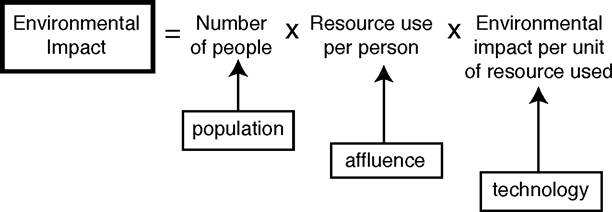
The impact of humans on the environment, as noted by Paul Ehrlich and John Holdren (1971: 1212-7), is a combination of population, resource use per person (affluence) and environmental damage per unit of resource used (technology) (see figure 1.1 on the next page).
Figure 1.1 The factors determining environmental impact
Because humans are consuming more resources per person each year, the 'world is being required to accommodate not just more people, but effectively "larger" people...' (Catton quoted in Rees 1996).
The planet not only has to provide a life-support system for its human population but also has to support our industrial metabolism, which in turn requires natural resources as inputs and produces outputs that must go back into the environment. William Rees (1996) cites rising daily energy consumption as an example: in 1790 the average American used 11 000 kcal of energy compared with 210 000 kcal used by the average person in 1980, some 20 times more. Rees defines human carrying capacity as:the maximum rates of resource harvesting and waste generation (the maximum load) that can be sustained indefinitely without progressively impairing the productivity and functional integrity of relevant ecosystems wherever the latter may be located. The size of the corresponding population would be a function of technological sophistication and mean per capita material standards.
Technological solutions
The resources required to produce a reasonable standard of living have varied throughout human history. Economists still argue that technological change and international trade will ensure that there are always enough resources to meet cultural or human carrying capacity. They argue that humanity can in fact increase carrying capacity through technological innovation, for example, by increasing the food that can be obtained from a given area of land through the use of synthetic fertilisers. If a resource runs out, people will find another way of meeting their needs. In other words, 'necessity is the mother of invention'. Technology can change the amount and type of resources that are required to produce a reasonable standard of living.
But the technologies that extend carrying capacity often come at a price. For example, the agri-chemicals used to increase crop yields have significant environmental impacts. Our ability to continue to increase the carrying capacity of the planet may therefore be limited - and there seems to be evidence that such limits are already being reached (see below).
Modern advocates of the concept of carrying capacity still argue against economic growth:Our dominant culture continues to celebrate expansion in spite of its heavy toll on people and nature. In fact, we desperately try to ignore that much of today's income stems from liquidating our social and natural assets. We fool ourselves into believing that we can disregard ecological limits indefinitely. (Chambers et al. 2000: 47)
Rees (1996) argues that when technology makes resource use more efficient, it may encourage greater use rather than result in less use. For example, as energy use became more efficient, more energy, not less, was used because we used it for more things. Technological changes that enhance productivity often result in increased exploitation of natural resources. For example, modern fishing technologies enable catches to be increased and depletion of fish stocks to be accelerated (see chapter 14).
Biological diversity
One of the consequences of exceeding human carrying capacity is the loss of biological diversity. Biological diversity (or biodiversity) refers to the variety of ecosystems and species of plants and animals that is found in nature. There are three levels at which biodiversity is important: the gene, the species and the ecosystem. Jeffrey McNeely and his colleagues (1990: 17) describe these levels:
Genetic diversity is the sum total of genetic information, contained in the genes of individual plants, animals and microorganisms that inhabit the earth. Species diversity refers to the variety of living organisms on earth and has been variously estimated to be between 5 and 50 million or more, though only about 1.4 million have actually been described. Ecosystem diversity relates to the variety of habitats, biotic communities, and ecological processes in the biosphere, as well as the tremendous diversity within ecosystems in terms of habitat differences and variety of ecological processes.
When people talk about preserving biodiversity they generally mean that a full and diverse range of plant and animal species should be maintained.
It has been argued that current human activities are causing the mass extinction of species at a rate never before experienced. Several species become extinct each day, while scientists estimate that the extinction rate in pre-human times was just a few species per thousand years. In the past, technologies were relatively harmless, and population patterns and cultural customs and taboos prevented overexploitation, so species were less likely to be under threat.The rate of extinction of native mammal species in Australia today is particularly high compared with other countries. As in other countries, extinction has been caused by the removal of forests and bushland for agriculture, forestry and urban development; competition from introduced and cultivated plants and animals; and pollution of and changes to waterways. The state of species worldwide is shown in table 1.1.
Table 1.1 N umbers of extinct and threatened species in 2004
| Species extinct | Total number described | Species threatened | Percentage of species threatened | |
| Birds | 133 | 9917 | 1213 | 12 |
| Plants | 110 | 187 655 | 8321 | 3 |
| Mammals | 77 | 5416 | 1101 | 20 |
| Insects | 60 | 15000 | 559 | 0.06 |
| Amphibians | 35 | 5743 | 1856 | 32 |
| Reptiles | 22 | 8163 | 304 | 4 |
| Crustaceans | 8 | 40 000 | 429 | 1 |
| Fish | 28 500 | 800 | 3 |
Source (Baillie et al.
2004: 7; Worldwatch Institute 2005)
Environmentalists argue that the destruction and modification of habitats that results from economic activity is threatening the ability of life forms to evolve and therefore to survive through adaptation. They differentiate between conservation, which means maintaining the ability of species to evolve, and preservation, which provides only for the maintenance of individuals or groups of species, not for their evolutionary change. Preservation considers the setting aside of representative samples of biodiversity to be all that is required (Harris 1991: 8).