Human rights are entitlements based on morality, justice and fairness which, collectively, the nations of the world have agreed all people ought to have.
They include the rights to life, liberty, health and wellbeing. Human rights apply to every human being throughout their life, no matter where they live or what their religion, occupation, race, colour, age or gender.
(The gender bias found in some of the language used in the early human rights declarations and covenants should be seen only as an artefact of the times in which the rights were drafted.) Human rights are regarded as essential to human dignity and are inalienable, which means they cannot be taken away, sold, or given away.Some rights are non-derogable, which means that they cannot be limited in any way, even in times of national emergency or war. Nonderogable rights include the right to life, the right to be free from slavery and the right to be free from torture. Other rights can only be limited or denied for reasons that have to do with the greater welfare of the community or the protection of others' human rights. Such limitations are detailed in human rights treaties, and no other limits are allowed. In other words, rights should always have priority over the preferences and desires of others, and governments have a duty to 'respect, protect and promote them' (Merrills 1996: 25-7; Rayner 2005a). Human rights are supposed to have absolute priority over any political lobbying or economic trade-off.
The Universal Declaration of Human Rights was adopted by the United Nations General Assembly in 1948, after World War II. Before the war it had been thought that rights were a matter for national governments to decide and implement, but the atrocities perpetrated by the Nazis during the war showed that this could leave millions of people without even the most fundamental rights. The United Nations was formed in 1945 in an effort to avoid future wars and to enable nations to sort out their differences in an international forum.
The UN Charter affirmed 'faith in fundamental human rights, in the dignity and worth of the human person, in the equal rights of men and women and of nations large and small', and paved the way for the establishment of an international Commission on Human Rights (Bailey 2005).The Universal Declaration (UDHR 1948) was compiled as a 'relatively short, inspirational and energising document' that could be easily understood by anyone. Being a declaration it was not binding on the countries which signed it, as a treaty would be, but nevertheless it was a significant statement of moral and political principles that has formed the basis of human rights treaties and national constitutions since. It has become part of international customary law. As customary law, all countries are bound by it, whether or not they have agreed to it (Bailey 2005).
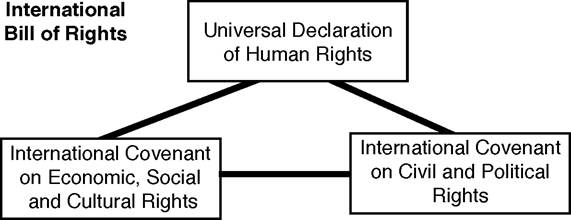
The Universal Declaration was later reinforced by the International Covenant on Economic, Social and Cultural Rights and the International Covenant on Civil and Political Rights. These covenants, adopted by the UN in 1966, elaborate the rights in the Universal Declaration and are binding on the states that have signed them. Ratified or approved by over 130 nations, they came into force in 1976. The Universal Declaration was reaffirmed in 1993 by more than 150 nations at the World Conference on Human Rights in Vienna (Gleeson 2005). The Universal Declaration of Human Rights together with the two International Covenants make up the International Bill of Human Rights (see figure 5.1 below).
Figure 5.1 International Bill of Rights
The International Covenant on Civil and Political Rights (CCPR 1966) includes the rights to freedom of thought, conscience and religion; freedom of association and peaceful assembly; the assumption of innocence until proven guilty at a fair trial; freedom from arbitrary arrest or detention; freedom from torture and cruel, inhuman and degrading treatment; freedom of movement to and from one's home nation; and freedom from slavery or forced labour. Countries which have signed up to it guarantee that every citizen will have these rights protected without discrimination and that anyone who feels that this is not the case is able to go to court to remedy the situation.
Anyone who is unable to get redress for a breach of rights in their own country can complain to the UN's Human Rights Committee, which was established in 1977 to monitor whether governments are complying with their obligations under the Covenant (Rayner 2005b).The International Covenant on Economic, Social and Cultural Rights (CESCR 1966) includes rights to an adequate standard of living, health, education, social security, work in proper working conditions for fair wages, participation in cultural life, and the benefits of social progress. These are rights that place an obligation on governments to adopt policies to ensure that individuals and groups are equally able to develop to their full potential. Because such policies cost money that a government may not have, the Covenant does not demand that these rights be guaranteed immediately but progressively, depending on the resources governments have available to achieve them. Nevertheless, governments are expected to spend money on ensuring the fulfilment of these obligations ahead of other non-rights-based objectives (Boyle 1996: 46). Governments have to report on their progress in this to the Committee on Economic, Social and Cultural rights but, unlike under the CCPR, 'there is no mechanism for individuals to make complaints about the breach of these rights' (Rayner 2005b).
The International Bill of Rights therefore 'defines in law the limits of authority that can be imposed on individuals, as well as the basic necessities required by them, so that all individual people, in every place, and at all times, can retain their human dignity' (Gosden 2000: 37; 2001). These rights 'protect the vulnerable and marginalized from being exploited or otherwise made to suffer under the self-interested politics of the powerful' (Hancock 2003: 2). The rights in the Bill of Rights were declared by the World Conference on Human Rights in 1968 to be indivisible, and by the UN General Assembly in 1984 and 1986 to be interrelated.
This means the various rights are related to each other, complementary to each other and reinforce each other and cannot be separated off from each other (Trindade 1998: 120). The right to health is most obviously indivisible and interrelated to the right to life.There are now many human rights conventions, treaties and instruments at global and regional levels. Other international human rights conventions include:
• Convention on the Prevention and Punishment of the Crime of Genocide (entry into force: 1951)
• Convention against Torture (entry into force: 1984)
• Convention on the Elimination of All Forms of Racial Discrimination (entry into force: 1969)
• Convention on the Elimination of All Forms of Discrimination Against Women (entry into force: 1981)
• Convention on the Rights of the Child (entry into force: 1989).
Various regions have also established human rights agreements, including:
• European Convention on Human Rights, 1950
• American Convention on Human Rights, 1969
• African Charter of Human and Peoples' Rights, 1981.
Many nations have also incorporated human rights into their constitutions. 'Respect for human rights is becoming a universal principle of good government' (Rayner 2005a).