MITIGATION BANKING
Mitigation and conservation banking are aimed at maintaining the environmental status quo while economic growth and development occur, and at minimising costs rather than maximising environmental benefits.
Gains made to the environment in one area allow degradation in another area rather than benefiting the overall environment.Outcomes
Mitigation banking seems like a way of being able to have development and environmental protection at the same time. It 'promised a way to have your K-mart and your wetland, too... Your highway will disrupt the habitat of an endangered bird? No sweat, just move the bird to a new ecosystem built conveniently out of the way'. The problem is that it doesn't work (Roberts 1993: 1890).
In 2001 a National Research Council study (BEST et al. 2001: 3) found that mitigation was not preventing loss of wetlands. Between 1993 and 2000 alone, 24 000 acres (9700 hectares) of wetlands in the USA were permitted to be filled on the condition that 42 000 acres (17 000 hectares) of mitigation take place. However, these mitigation projects were sometimes not undertaken and those that were often did not meet permit conditions:
.. in many cases, even though permit conditions may have been satisfied, required compensation actions were poorly designed or carelessly implemented. In other cases, the location of the mitigation site within the watershed could not provide the necessary hydrological conditions and hence the desired plant and animal communities, including buffers and uplands, necessary to achieve the desired wetland functions.
At some sites, compliance criteria were being met, but the hydrological variability that is a defining feature of a wetland had not been established... Compliance criteria sometimes specified plant species that the site conditions could not support or required plantings that were unnecessary or inappropriate.
(BEST et al. 2001: 6)So although the ratio of destroyed wetlands to compensatory wetlands is around 100:178, only 134 of each 178 hectares actually goes ahead as a mitigation project and only 77-104 hectares comply with the criteria set by the Corps of Engineers. Of these, 'only about 19 ha would be judged functionally equivalent to appropriate reference sites'. So despite wetland mitigation, there is significant net loss of wetland function (Zedler 2004: 94).
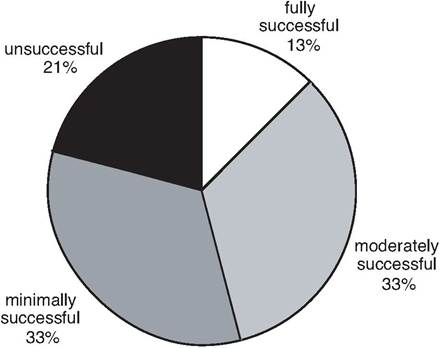
Another study by the Washington State Department of Ecology (Johnson et al. 2002) found that only three compensatory wetland-mitigation projects out of 24 (at 31 sites) were fully successful (see figure 14.1).
Figure 14.1 Success of 24 wetland offset projects
In the case of conservation banks, no study has been done into whether they work or not. This is a crucial question given that there are over 1200 endangered and threatened species in the USA alone (Fox amp; Nino- Murcia 2005: 1005-6).
The claim by advocates of mitigation and conservation banking that the larger areas of mitigation made possible by mitigation banks - as opposed to mitigation by individual developers - are more environmentally beneficial is called into question by environmental groups. The US-based Sierra Club (2005) argues that such assertions are not supported by science: 'bigger is not always better when it comes to many species of plants and animals'.
Net losses
The problem with preservation as a compensatory mechanism is that no new wetland is created, so that allowing the destruction of one wetland in return for the preservation of another means a net loss of wetland. According to the 1995 official guidelines, preservation is only supposed to be used as compensatory mitigation in exceptional circumstances, but the 2001 guidelines clear the way for preservation to be used on its own for mitigation banks (ELI 2002c). The US Environmental Law Institute (ELI 2002a) found preservation to be commonly used by mitigation banks.
Forty-four per cent of mitigation banks that provided ELI with information included preservation as part of their offerings, and 5 per cent only did preservation.Restoration or enhancement may also result in net loss of wetlands. If a 5-hectare wetland is destroyed and a mitigation bank restores a 10- hectare existing wetland - by getting rid of an invasive species with the use of herbicides, for example - has there been a gain of 5 hectares or a loss of 5 hectares? Joy Zedler (2004: 95), professor of botany and Aldo Leopold Chair in Restoration Ecology at the University of Wisconsin, argues:
Even if the mitigator modifies the mitigation site's topography and installs native species, there would still be a net loss in wetland area... Some functions performed by the 5 ha that are filled and the 10 ha that are treated with herbicide might be lost. Only if the 10 ha that were remodelled could be made functional enough to make up for all the processes of the 5 ha fill site and the 10 ha before remodelling could wetland functions be sustained by this trade-off.
In the case of conservation banks, 94 per cent are based on preservation of habitat so there is inevitably a loss in total habitat (Fox amp; Nino-Murcia 2005: 1005). Even if conservation banking credits are based on the number of species protected, if some of an endangered species are incidentally killed in the process of development and the developer pays for the conservation of the same number elsewhere, there will still be a net loss of members of that species.
In the case of the biodiversity banks in New South Wales, the habitat for one species may be destroyed in return for the 'management' of existing habitat for another species somewhere else. Although the policy is supposed to end the 'tyranny of small decisions' that lead to 'a downward spiral of continuing incremental biodiversity loss' (DEC 2005: 6), it seems that it will contribute to it. New habitat is not being created and habitat on private land is only being conserved at the expense of habitat elsewhere.
Regional needs
Because wetlands perform functions for a particular location it is preferable that existing wetlands be maintained and that where mitigation occurs it be close by so that the same functions are maintained in the same area. Those functions (see box 14.1) cannot be replaced by having them performed elsewhere, sometimes at a considerable distance. Yet mitigation banks are sometimes not even in the same watershed as the wetland being destroyed (Fleischer 2005; Zinn 1997).
The 2001 Regulatory Guidance from the US Corps of Engineers does not require mitigation to be close to where the damage is done. In fact, it even 'promotes mitigation of wetland impacts with non-wetland habitats' in some areas (ELI 2002c). Similarly, although the guidelines for conservation banks express a preference for them to be sited adjacent to existing habitat, less than half of them are (Fox amp; Nino-Murcia 2005: 1005).
Box 14.1 Functions performed by wetlands
• water purification
• flood storage, conveyance and abatement
• sediment trapping
• wildlife habitat
- wide variety of plants and animals
- rare and endangered species
- migratory birds
- commercially valuable fish
• groundwater recharge
• groundwater discharge
• pollution control, including nutrient and waste retention
• diminish droughts
• stabilise shorelines and prevent erosion
• recreation
• aesthetic values
Sources (BEST et al 2001: 1; ELI 2002b: 7; Zinn 1997) Although mitigation banks are praised because they can be coordinated with regional environmental plans, this seldom happens. The ELI found that 'less than one percent of all banking instruments specifically reference consistency with a watershed management plan' and only two states require mitigation banks to 'be planned in a watershed context'. Most US states do not even have formal siting criteria for mitigation banks (ELI 2002a). Sites are selected on the basis of availability and price rather than ecological importance or regional significance.
Rather than mitigation sites being defined by regional watershed plans - that is, 'watershed needs and functioning' determining 'the positioning and design or mitigation projects' - mitigation determines the configuration of watersheds (Zedler 2004: 97).Profit vs conservation
Problems associated with creating, enhancing and restoring wetlands habitats or streams are exacerbated by the fact that mitigation banks are usually driven by profit, rather than scientific or environmental goals, and owners are seldom willing to spend the time and money trying to get it right (ELI 2002a; Roberts 1993). The conflict between economic and environmental goals inherent in profit-motivated mitigation banks leads to compromises and short cuts:
Studies that have evaluated mitigation projects have shown that the type of habitat to be created or restored is often determined not on the basis of the ecological need or the habitat lost, but on the basis of cost, ease of construction, aesthetics, and provision of non-habitat functions. (Rowinski 1993)
An early study in the USA found that 'the only wetland type that is increasing in acreage in the country - is open water pond with a fringe of wetland vegetation' because that is the type that is easiest and cheapest to create. This type of wetland mitigation is allowed even in places where it does not naturally occur (Roberts 1993; Zedler 2004: 95). Other common types of wetland favoured by mitigation banks include shrub, marsh or tidal wetlands because they 'require less planning, management, and expense than other types of wetlands, such as bottomland hardwood forests' or those with peat soils that rely on groundwater or rainfall. This means that some types of wetlands are being increasingly lost as a result of mitigation banking (Zinn 1997).
Similarly, stream mitigation banks favour the restoration of rural streams, even though developers tend to destroy urban streams. Urban streams are more expensive to restore and because they are subject to rapid-flow urban run-off are also more difficult to maintain.
Larger rivers also cost more to restore because they are wider and cover a greater area, have a larger floodplain, and are in areas of higher population density: These conditions have led to a situation where, like brook trout and other sensitive fish species, stream mitigation bankers appear to be migrating to the headwaters where they are more apt to find the last refugia of natural hydrology, far from the hazards of potential landowner conflict and the devastating advance of suburbia. (Gillespie 2005)Conservation and mitigation banks actually tend to facilitate the creation of barren areas. Because rural land is cheaper than urban or suburban land, conservation efforts tend to be concentrated in rural areas while urban areas become more developed. This means that urban areas progressively lose every pocket of nature (Mills 2004: 544).
If trades are confined to areas of similar ecosystem types to avoid the problems resulting from working out equivalencies, trades become too restricted and the market will not work: 'A robust market with a large trading volume would require little or no market restriction and a simple currency to allow for low transaction costs' (Mills 2004: 548). This is a clear example of how the compromises necessary to ensure a viable market are often made at the expense of the environment.
Monitoring and enforcement
Certification, verification and monitoring are particular problems for conservation markets because of the difficulty of measuring biodiversity. Thus, wetland offsets have historically been defined in terms of acreage rather than function and 'the area of wetland type is often used as a proxy for wetland functions'. Most wetland mitigation banks still define credits according to acreage (ELI 2002a; Meadows 2005).
The use of simple measurements like acreage for wetlands or linear measurements for streams has 'the major advantage of keeping trades simple, reducing transaction costs, and ensuring that all parties understand the transaction that is taking place'. Simple measurements are necessary to ensure that markets work. Comprehensive measurements that take account of various biological criteria such as 'habitat quality, species, conservation values and benefits' are expensive to work out and raise more questions than they answer in terms of equivalencies for trading purposes (Mills 2004: 547).
Wetland mitigation banks are seldom monitored for the full time it takes for either restored or created wetlands to reach complete functional performance, which may be 20 years or more. 'Habitat for swamp dwelling animals that require a closed tree canopy could take decades to develop, unless mature trees are already present or are planted' (SWS 2005). The ELI found that enforcement of compliance conditions is poor in the USA. What monitoring takes place is often fairly superficial and does not include assessment of function.
Fourteen per cent of wetland banks do not even have specified monitoring and maintenance provisions; 'over a third of the instruments for wetland mitigation banks fail to specify required performance standards'; and 'only a little over half of the banks with performance standards incorporate hydrologic criteria and very few include standards for water quality, soils, wildlife habitat, or other criteria...' Functional assessment is even rarer. Often all that is required is a specified level of plant cover, even though the existence and survival of the right vegetation is not sufficient to indicate whether the wetland is functioning as it should (ELI 2002a; SWS 2005; Wilkinson et al. 2002: 6; Zedler 2004: 95).
Perpetuating bad practices
Mitigation banks facilitate poor development practices because they allow developers to destroy and degrade wetlands and endangered species habitats simply by paying for conservation elsewhere. The Sierra Club (2005) points out that: 'Mitigation banks are likely to facilitate developments in existing wetlands by promising restorations that may never be successfully completed and will not replace, much less increase, wetland functions'. The concern is that with such an option increasingly available, the pressure on developers to pick appropriate development sites and avoid or minimise the environmental damage they cause will be reduced (Zinn 1997).
In the case of the proposed NSW biodiversity bank, the choice of avoidance or compensation is to be left to the developer within the amber-light areas. PENGO (2002: 2), the coalition of peak Australian environmental groups, argues that offset schemes 'use habitat destruction or pollution of the environment as a quot;driverquot; for environmental conservation and improvement'. They 'do not accept that this will lead to positive environmental protection and the reversal of environmental degradation'.
PENGO (2002: 5-10) notes that landowners have a duty of care to manage vegetation on their land and the fact that they do this should not be traded off against 'further land degradation'. This may well provide an incentive for landowners to let the conservation value of their land be degraded - through lack of care and poor management - so as to be eligible for claiming payment for undertaking normal, accepted land management practices as offsets for damage elsewhere. Similarly, conservation actions that are supposed to be core business for local governments - such as catchment maintenance, improvement and rectification - may be used as offsets for environmental damage elsewhere.
In Western Australia, where environmental offsets - but not mitigation banks - have been used as an environmental management tool since the 1980s, the Environmental Protection Authority (WAEPA 2005: 1) has critically observed that environmental offsets are perceived as 'being used to make otherwise quot;unacceptablequot; adverse environmental impacts quot;acceptablequot; within government':
[The EPA] is aware that some environmental offsets, proposed in the guise of sustainability tools, are sometimes over-riding the protection and conservation of our State's most valuable environmental assets. Over time, the cumulative effects of this type of decisionmaking would contribute to a gradual decline in both the quality and quantity of the State's priority environmental assets. The EPA is of the view that this approach is neither sustainable nor focused on protecting the environment.