Population Dynamics
In nature populations are in continuous flux and their patterns of distribution and abundance result from a dynamic balance between factors that add species to populations, and factors that remove species from populations.
The dynamic population processes underlying distribution and abundance are the subject of ecology population dynamics, which is concerned with the factors influencing the expansion, decline, or maintenance of populations.
General changes in population size are due to four phenomena: fertility, mortality, immigration and emigration of species.
The distinction is made between the absolute and specific fertility. The first one is characterized by the total number of born species. For example, if in a reindeer population of 16,000 animals, 2,000 deer appeared during the year, this number also expresses the absolute fertility. The specific one is calculated as the average change in the number of species per specific time interval (in this case, it is one newborn per 8 members of the population for the year).
The size of the fertility depends on many factors. Great importance is given to the proportion of species capable to reproduction at a given period that is determined by the ratio of sexes and age groups.
Mortality in populations also depends on many factors: the genetically programmed life expectancy of species, their genetic and physiological usefulness, the impact of unfavorable physical conditions of the environment, the impact of predators, parasites, diseases, etc. These factors are different at different stages of the life cycle of each generation.
Emigration: It is one way movement of species out of the population. This movement is permanent and causes spread of a species to new areas. Emigration under natural conditions occurs when there is overcrowding in the population and is generally regarded as an adaptive behaviour that regulates the population on a particular site and prevents over-exploitation of the habitat.
This type of dispersal offers new opportunity to the species of a population to interbreed with those of the other population leading to more genetic heterozygosity and adaptability.
Immigration: This is one way movement of species into the population. It leads to rise in density of population. It may result in decreased mortality among the immigrants or decreased reproductive capacity of the species.
There are two fundamentally different aspects of population dynamics: modification and regulation.
Modification is a random deviation of numbers resulting from a variety of factors not related to population density.
Regulation is the return of population after deviation to the initial state, which occurs under the influence of factors determined by population density.
Modifying factors, causing changes in the number of populations, do not themselves experience the impact of these changes. Thus their action is onesided. These factors include all the abiotic influences of the environment on organisms, the quality and quantity of their food, etc. Favorable weather conditions can cause a massive outbreak of species reproduction and overpopulation of the territory occupied by it, as, for example, in the case of herd locusts. The negative impact of modifying factors, on the contrary, reduces the population size sometimes to its complete disappearance.
Regulatory factors do not simply change the population size, but smooth out its fluctuations, bringing after regular deviation from the optimum to the previous level. This happens because the effect of their impact is more stronger if population density is higher. The regulatory forces are interspecific and intraspecific interactions of organisms.
The study of factors that affect growth, stability and decline of populations is population dynamics. All populations undergo three distinct phases of their life cycle:
> growth;
> stability;
> decline.
Population growth occurs when available resources exceed the number of species able to exploit them.
Reproduction is rapid, and death rates arelow, producing net increase in the population size. Population stability is often proceeded by «crash» since the growing population eventually outstrips its available resources. Stability is usually the longest phase of population’s life cycle. Decline is the decrease in the number of species in population, and eventually leads to population extinction. Nearly all populations will tend to grow exponentially as long as there are resources available. Most populations have the potential to expand at an exponential rate, since reproduction is generally a multiplicative process. Two of the most basic factors that affect the rate of population growth are the birth rate, and the death rate. The intrinsic rate of increase is the birth rate minus the death rate.
Two modes of population growth (fig. 6).
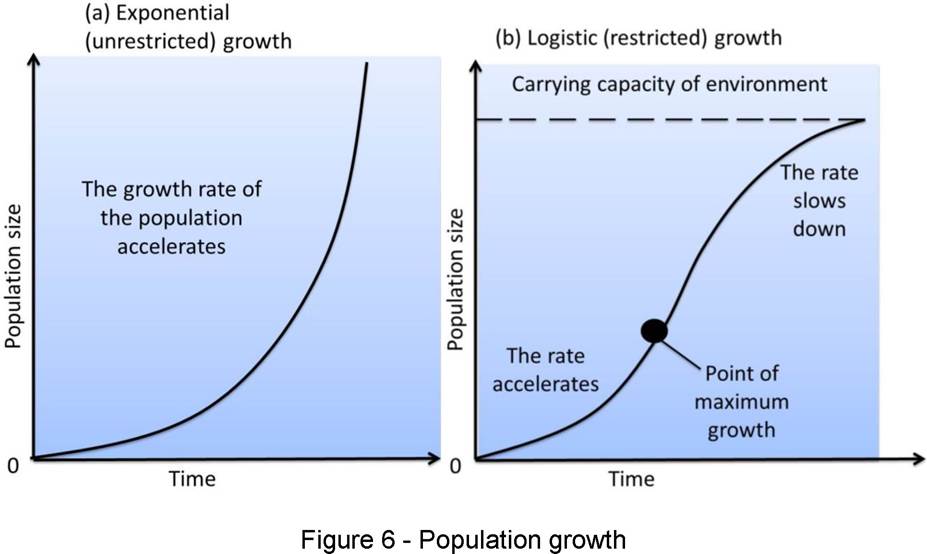
The Exponential curve (also known as a J-curve) occurs when there is no limit to population size. The Logistic curve (also known as an S-curve) shows the effect of a limiting factor (in this case the carrying capacity of the environment).
The environment is the ultimate cause of population stabilization. Two categories of factors are commonly used: physical environment and biological environment. Three subdivisions of the biological environment are competition, predation, and symbiosis. Physical environment factors include food, shelter, water supply, space availability, and (for plants) soil and light. One of these factors may severely limit population size, even if the others are not as constrained. The Law of the Minimum states that population growth is limited by the resource in the shortest supply. Extinction is the elimination of all individuals in a group. Local extinction is the loss of all individuals in a population. Species extinction occurs when all members of a species and its component populations go extinct. Scientists estimate that 99 % of all species that ever existed are now extinct.
The ultimate cause of decline and extinction is environmental change. Changes in one of the physical factors of the environment may cause the decline and extinction; likewise the fossil record indicates that some extinctions are caused by migration of a competitor. Dramatic declines in human population happen periodically in response to an infectious disease. Bubonic plague infections killed half of Europe's population between 1346 and 1350, later plagues until 1700 killed one quarter of the European populace. Smallpox and other diseases decimated indigenous populations in North and South America. Human populations have continued to increase, due to use of technology that has disrupted natural populations. Destabilization of populations leads to possible outcomes: - population growth as previous limits are removed; - population decline as new limits are imposed. Agriculture and animal domestication are examples of population increase of favored organisms. In England alone more than 300,000 cats are put to sleep per year, yet before their domestication, the wild cat ancestors were rare and probably occupied only a small area in the Middle East.Answer these questions:
1. List ecological age groups of animals population.
2. What are the herds?
3. What are the basic patterns of distribution of the population?
4. How may a species respond to climate change?
5. How might biological and physical aspects of the environment interact to influence a species' geographic distribution?
6. What is the density of population?
7. What is the natality of population?