Radiation safety
Radiation has always been a natural part of our environment. Natural radioactive sources in the soil, water and air contribute to our exposure to ionizing radiation, as well as man-made sources resulting from mining and use of naturally radioactive materials in power generation, nuclear medicine, consumer products, military and industrial applications.
Where does radiation exposure come from (fig. 10)?
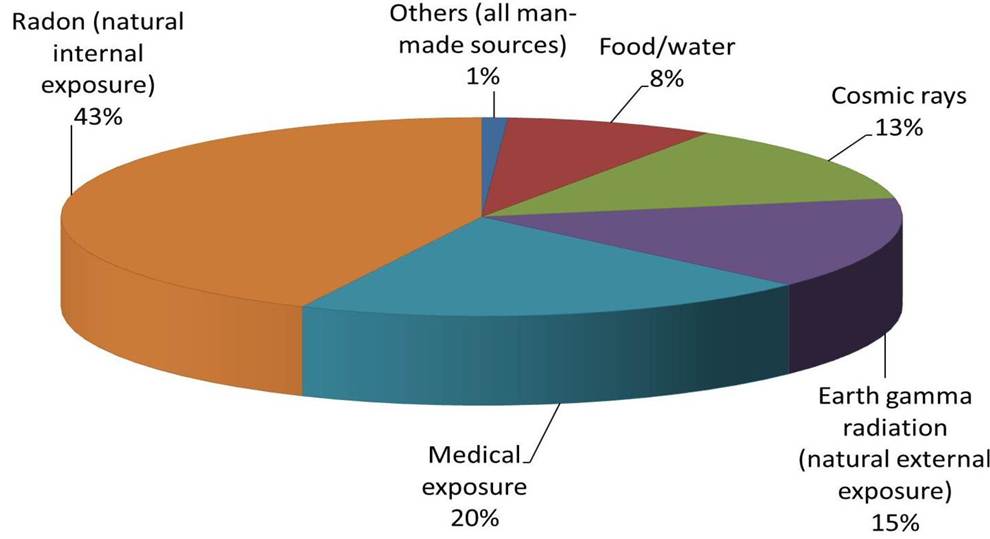
Figure 10 - Sources and distribution of average radiation exposure to the world population
The scale and types of radiological and nuclear emergencies may range from an isolated occupational or medical over-exposure of a person, to a major catastrophe with global dimensions.
Throughout the world, but particularly in technologically advanced countries, there are a large number of nuclear installations, the regulatory bodies for which require the development and maintenance of site specific emergency preparedness and response plans. There are also many other types of facilities and activities that involve the use of radiation or radioactive material for agricultural, industrial, medical, scientific and other purposes. Such facilities and activities include, for example, the production, use, import and export of radiation sources; the transport of radioactive material; the decommissioning of facilities; or satellites carrying radioactive material. The response to a nuclear or radiological emergency may involve many national organizations (e.g. the operating organization and response organizations at the local, regional and national levels) as well as international organizations. Therefore, the response to a nuclear or radiological emergency has to be well coordinated.
For strengthening coordination in response to radiation emergencies the international organizations with relevant responsibilities have formed IACRNE, where International Atomic Energy Agency (IAEA) is the prime coordinating agency.
Functional links have been established between agencies to ensure continuous communication prior to, during, and after emergencies and the arrangements are described in the Joint Radiation Emergency Management Plan of the International Organizations (EPR- JPLAN 2013).The IACRNE was established in September 1986 in the aftermath of the Chernobyl accident. Members of IACRNE develop, maintain and co-sponsor the Joint Radiation Emergency Management Plan of the International Organizations — the Joint Plan. The Joint Plan describes a common understanding of how each organization acts during a response and in making preparedness arrangements. The IAEA provides the secretariat for the IACRNE and coordinates the development and maintenance of the Joint Plan.
The IAEA established the IEC in 2005 in response to an increased use of nuclear applications coupled with heightened concerns over the malicious use of nuclear or radioactive materials. While emergency response capabilities have existed within the IAEA since the conclusion of the Convention on Early Notification of a Nuclear Accident and the Convention on Assistance in the Case of a Nuclear Accident or Radiological Emergency, the decision to create an integrated Centre was taken to provide round-the-clock assistance to Member States in dealing with nuclear and radiological events, including security-related threats, by coordinating the efforts, contributions and actions of experts within the IAEA, Member States and international organizations. The IEC is also the custodian of the IAEA's Incident and Emergency System (IES).
The work of the Centre focuses on four areas: IES Preparedness; IES Operations; Member States preparedness; and emergency communications and outreach.
Any nuclear or radiological emergency requires effective response commensurate with the level of actual, potential or perceived hazard. This can be accomplished through the adoption of an event/emergency classification composed of sets of conditions that trigger a certain level of response (tab.
3).Table 3
Classification of nuclear and radiological events
| General emergency | Events resulting in an actual, or substantial risk of release of radioactive material or radiation exposure warranting taking precautionary urgent protective actions, urgent protective actions, early protective actions and other response actions on the site and off the site. |
| Site area emergency | Events resulting in a major decrease in nuclear safety warranting taking protective actions and other response actions on the site and in the vicinity of the site but not sufficient to meet criteria for ‘general emergency'. |
| Facility emergency | Events resulting in a significant decrease in nuclear or radiation safety at the facility warranting taking protective actions and other response actions at the facility and on the site but not warranting taking protective actions off the site. |
| Alert | Events resulting in an actual or potential decrease of nuclear or radiation safety at the facility warranting taking actions to assess and mitigate, as necessary, the potential consequences at the facility. |
| Other events | Any other event in a facility that may trigger public concerns and media interest |
| Radiological emergency | Any event which is of actual, potential or perceived radiological significance warranting protective actions and other response action at any location and is not a nuclear emergency |
There are 5 types of radiation exposure on person.
1. External irradiation during the passage of a radioactive cloud. In this situation a person is separated from danger, at least by air. The best way to protect against external radiation exposure should be materials containing heavy chemical elements, for example, lead metal, lead paints, leaded rubber, barite plaster, etc.
The tree is represented by hydrocarbons, consisting of atoms of light elements, so sufficiently effective protection can be achieved with a large thickness of wooden floors. These circumstances should be taken into account when choosing a specific shelter.2. Internal exposure by inhalation of radioactive aerosols (inhalation hazard). The origin of aerosol is the contents of a radioactive cloud or radioactive dust raised from the ground. Getting through the respiratory tract inside the body, radioactive radiation directly affects the internal organs of a person. Internal irradiation is always many times more dangerous than external irradiation. Measures and means of protection for this type of exposure will be those that will not allow radioactive aerosols to penetrate the respiratory tract.
3. Contact exposure due to radioactive contamination of skin and clothing. In sense it refers to external exposures, measures and means of protection are understandable and easily representable.
4. External irradiation caused by radioactive contamination of the ground surface, buildings, structures. The greatest attention is required to situations in which radioactive materials falling out of the cloud are spreading through secondary processes (by wind or running water, smothering in the ground, etc.).
5. Internal irradiation as a result of consumption of contaminated food and water. It is important to protect water and foodstuffs from getting into them radioactive isotopes. Sources of water (wells, springs, etc.) should be covered with dense lids, and if there is no confidence in the quality of protection or it is impossible in principle, the water should be carefully filtered. Food products must be pre-sealed, and if it is plant food grown in the contaminated zone, or it is meat of herbivores from the same zone, etc., effective monitoring can provide effective safety and competent processing of products.
The actions of population depend on the time until the moment of radiation exposure and the situation.
Prior to the moment of the possible radiation damage more than 1 day:
1. Prepare documents, money, valuables, food, clothing, personal protective equipment, necessary items for evacuation.
2. Receive or prepare at home the medical means of protection and prevention of radiation damage.
3. Prepare and put home under security.
4. Make evacuation documents
5. Evacuate beyond the 30-kilometer zone (by private transport or organized).
6. Perform the duties of a member of the civil defense formation in accordance with official duties or instructions.
Prior to the moment of the possible radiation damage from 1 day to 1 hour:
1. Prepare personal protective equipment and apply if necessary.
2. Receive an individual first-aid kit or prepare medical means of protection and prevention of radiation damage independently.
3. Perform iodine prophylaxis, combine with it the prevention of
strontium-90 damage.
4. Evacuate beyond the 30-kilometer zone.
5. If you stay in the zone of possible radiation damage, then stay indoors, seal it, hide food and water.
Prior to the moment of possible radiation damage less than 1 hour:
1. Prepare personal protective equipment and apply if necessary.
2. Receive an individual first-aid kit or prepare medical means of protection and prevention of radiation damage.
3. Perform iodine prophylaxis, combine with it the prevention of
strontium-90 damage.
4. Take 6 tablets of cystamine.
5. Use the means of collective protection.
6. Stay indoors, seal it, hide food and water.
You are in the area of radiation damage:
1. Use personal protective equipment.
2. Perform iodine prophylaxis, combine with it the prevention of strontium-90 damage.
3. Take 6 tablets of cystamine, and after 6 hours and need to remain in the area of radiation damage take 6 more tablets.
4. If necessary, take an anti-emetic.
5. Use the shelter (especially in the period of radioactive fallout).
6. Stay indoors, seal it, hide food and water.
After leaving the zone of radiation damage:
1. Remove the outer clothing (cloak) and, standing with your back to the wind, shake it out and hang it on a rope or crossbar. Place radioactive dust from the top down or poke it with a stick.
2. Remove dirt from shoes and wipe with cloth or brush.
3. Rinse clothing and linen for washing in running water.
4. Remove and hand over to the firing point PPE (if necessary, bury it in the ground).
5. Remove the gloves.
6. Wash your hands thoroughly with soap and water, and clean your nails well.
7. Wash your face so that water does not get into eyes, nose, mouth.
8. Rinse mouth, throat, and eyes with clean water.
9. At the first opportunity have full sanitary treatment and dosimetric control.
10. In living area vacuum clean or dust furniture and do wet cleaning.