Segments of Environment
The environment comprises of the following four segments:
(i) Atmosphere
(ii) Hydrosphere
(iii) Lithosphere
(iv) Biosphere
2.5.1 Atmosphere
The cover of air that envelops the earth is known as the atmosphere.
It is responsible for sustaining life on earth. It protects the earth from the harmful ultraviolet rays coming from the sun. It contains life-supporting gases like oxygen for human beings and animals and carbon dioxide for plants to help in carrying out the process of photosynthesis. The presence of nitrogen, oxygen and carbon dioxide is of great importance, as these gases keep on cycling in nature between organisms and the atmosphere through various cycles such as the carbon cycle, nitrogen cycle, water cycle etc. During the past 300 years or so, due to agricultural and industrial revolutions, human beings are responsible for dumping waste materials in the atmosphere which are creating problems for the survival of life on the earth. For a detailed discussion on atmosphere, see Chapter 3.2.5.2 Hydrosphere
It covers more than two-thirds of the earth’s surface either as oceans (salt water) or as fresh water and includes seas, rivers, oceans, lakes, ponds etc. The oceans account for about 95% of earth’s water supply. This water is unfit for consumption due to its high salt content. The polar ice caps and glaciers account for about 2% of the remaining water. Fresh potable water is available only to the extent of about 1% in rivers, lakes and as ground water.
Water has a high value of latent heat and it is this property that moderates the temperature of the biosphere. It is a universal solvent. The solubility of oxygen in water is responsible for the survival of aquatic life. Though there is loss of water by evaporation but its amount remains constant. This is because there is continuous circulation of water involving water bodies and natural processes which use water (see water cycle sec.
2.8.1.1). Due to rapid industrialization, human beings are discharging waste materials into water bodies like seas, oceans, rivers etc. This has created serious problems for the survival of life not only on the land but also in water. For a detailed discussion on hydrosphere, see chapters 5 and 6.2.5.3 Lithosphere
The upper most layer up to 400 km of the earth's surface is called lithosphere. It is the region which interacts with hydrosphere, atmosphere and biosphere (see biosphere in sec. 2.5.4). About three-fourth of the surface of lithosphere is covered by water. The earth comprises of three layers viz. crust, mantle and outer and inner core {see Fig.2.1). The core is the central fluid sphere having a diameter of about 2500 km. It is composed of mainly nickel and iron. The mantle extends about 2900-3000 km above the core and is also in the molten state. The crust is the outermost solid portion of the earth. It is about 8-40 km above the mantle. The surface of the earth is covered with the soil and it is the most important part of lithosphere from the point of view of environment.
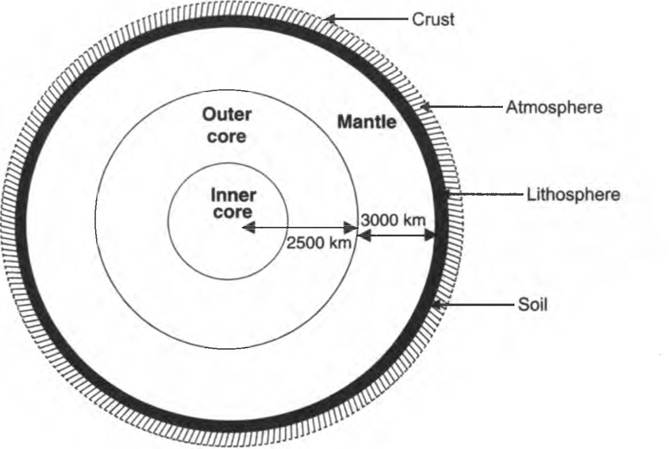
Fig. 2.1: Layers of Earth
The lithosphere is helpful in the metabolic processes of organisms by (i) providing most of the necessary minerals and (ii) forming soil needed by plants. For detailed discussion, see sec. 2.8.
2.5.4 Biosphere
Biosphere is that region where lithosphere, hydrosphere and atmosphere- all are present and where life (or living organisms) can exist. It is defined as the thin layer of soil, rock, water and air that surround the earth, along with the living organisms for which it provides support. The biosphere extends from about 11,000 m above the sea level to about 9,000 m below the sea level. A biosphere can be represented as shown below in Fig. 2.2.
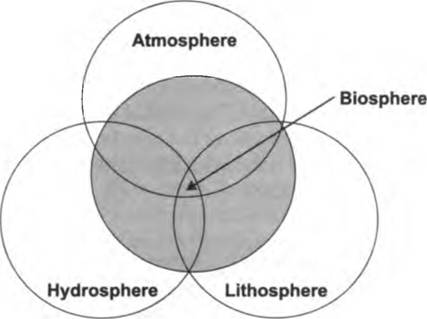
Fig. 2.2: Representation of the biosphere (shaded portion)
As seen in the Fig.
2.2, biosphere is the area of contact between the three components viz, atmosphere, hydrosphere and lithosphere. It is extremely important for life, as it is here that the entire life is contained and basic processes of life, the photosynthesis and respiration occur. The living organisms are confined to biosphere that receives solar radiation during the day. As already stated, biosphere extends from the floor of the ocean (some 11,000 m below the surface of the earth) to the top of the highest mountain (or about 9,000 m above the sea level). The most densely populated region is just above and below the sea level. The life in biosphere exists mostly between 600 m below the surface of the ocean and about 6000 m above the sea level. The energy required by the living organisms in the biosphere comes from the sun and the nutrients necessary for living organisms come from air, water and soil.Biosphere is endowed with the necessary conditions that are essential to support life. Some of these conditions are:
• Availability of air
• Availability of water
• Availability of area or interface between the earth’s crust, hydrosphere and atmosphere
• Availability of suitable temperature
• Supply of energy or radiation from the sun
• Availability of nutrients
The availability of nutrients in the biosphere in terms of macronutrients and micronutrients are given in Table 2.1.
Table 2.1 Availabilities of nutrients in biosphere
| Type of nutrient | Element | Source |
| Macronutrients | Carbon | Atmosphere |
| Hydrogen | Hydrosphere | |
| Oxygen | Atmosphere | |
| Nitrogen | Atmosphere and soil | |
| Phosphorous | Lithosphere | |
| Calcium | Lithosphere | |
| Chlorine | Lithosphere | |
| Copper | Lithosphere | |
| Iron | Lithosphere | |
| Magnesium | bgcolor=white>Lithosphere||
| Sulphur | Lithosphere | |
| Sodium | Lithosphere | |
| Potassium | Lithosphere | |
| Micronutrients or trace elements | Aluminium | Lithosphere |
| Boron | Lithosphere | |
| Bromine | Lithosphere | |
| Zinc | Lithosphere | |
| Cobalt | Lithosphere | |
| Iodine | Lithosphere | |
| Chromium | Lithosphere |
2.5.4.1 Biomes
Biosphere is divided into various regions called biomes.
Each biome is characterized by its climate, vegetation, type of soil and animal life. No two biomes are alike. The boundary of a biome is determined by the abundance of plants and animals found in each of them; these in turn are dependent on factors like temperature and precipitation or moisture. Table 2.2 gives various biomes in lithosphere along with their main features.Table 2.2 Different biomes in lithosphere
| Name of Biome | Region | Flora and Fauna |
| Tundra | Northern region adjoining the ice bound poles | Absence of trees; only shrubs are present. Flora includes lichen and mosses. |
| Taiga (Boreal forest) | North Europe, Asia and North America (Moderate temperature than that in tundra) | Vegetation includes coniferous evergreens-mostly spruce, pine and firs. The fauna includes small birds, hawks, fur bearing carnivores, Siberian tiger, wolves etc. |
| Temperate Deciduous Forest | Parts of Central and Southern Europe, North America, China, Japan, New Zealand etc. Temperature is moderate and abundant rainfall. These are the agricultural areas of the earth. | Flora - trees like peech, oak, maple and cherry etc. Fauna - the familiar vertebrates and invertebrates |
| Tropical Rain Forest | Tropical areas of higher rainfall in the equatorial region. Temperature is high. | About 40% of the world’s plants and animal species exist. Broad-leaved evergreen plants |
| Savannah | Extensive in Africa (Tropical region) | Grasses, scattered trees and shrubs. Fauna includes antelopes, buffaloes, zebras, elephants and rhinoceros, lions, cheetah etc. |
| Grass Lands | North America, Midwest and Ukraine Temperate tonditions, low rainfall. | Vegetation- grasses, Fauna include large herbivores like bison, antelope, cattle, rodents, wolves and birds |
| Desert | Continental interiors, low rainfall and low humidity | Flora like cacti, euphorbia etc. Fauna- reptiles, mammals and birds. |
The hydrosphere (or the aquatic systems) is also divided into distinct life zones, which are not called biomes but are very similar, in that these are regions of distinct animal life and plants. The differences in these aquatic zones are due to salinity, levels of dissolved nutrients, temperature and depth of sun light penetration.
2.6