Sources of Marine Pollution
The water bodies, viz., rivers, seas and oceans are used by mankind as a dustbin for dumping all types of waste materials. These include industrial wastes, heavy metals, agro chemicals, mine tailings, urban and rural sewage, farm and forest run-offs; these wastes include non-biodegradable components, which are the major cause of problems.
Even radioactive wastes are dumped into the seas. Infact human activities are basically responsible for marine pollution. The marine pollution is caused by the following:(i) Dumping of hazardous materials
(ii) Oilpollution
(iii) Pollutionbyradioactivematerials
7.2.1 Hazardous Materials
These have been discussed in secs. 5.4.12 and 6.4.2.9.
7.2.2 Oil Pollution
This is a major cause of marine pollution. At present, the annual consumption of refined petroleum products all over the world is more than 50 billion barrels (about 1600 billion gallons). Such consumption is associated with some losses which can be accidental or intentional and are responsible for marine pollution. It is estimated that the total annual influx of petroleum oil into the oceans is more than 250 million gallons.
The discharge of petroleum oil or its products into the oceans occurs at various stages in the petroleum industry. These include the following:
• Extraction or isolation of crude oil (petroleum) from underground sources which can be below the surface of earth or oceans.
• Transportation - The crude oil is transported through pipelines or oil tankers. Leakage may occur in both the modes of transportation. Major marine pollution occurs during transportation in huge oil tankers, by sea, which may spill oil in the oceans or in case these tankers meet with an accident there may be disastrous oil pollution.
• Refining of petroleum oil in various refineries.
• Manufacture of petrochemicals which are made from various fractions of petroleum refining.
The oil tankers are cleaned periodically with water and the washings discharged into the seas. Approximately, 3 million tonnes of oil is discharged annually by this process.
For more details see sec. 6.4.2.5.
It is estimated that out of all marine pollution by petroleum oil, about 200 million gallons of oil come into seas annually from natural seepage of the annual discharge of petroleum into the seas, oil spills account for about 8-9 percent while oil drilling and extraction contribute about 3-4 percent.
7.2.2.1 CompositionofCrudePetroleum
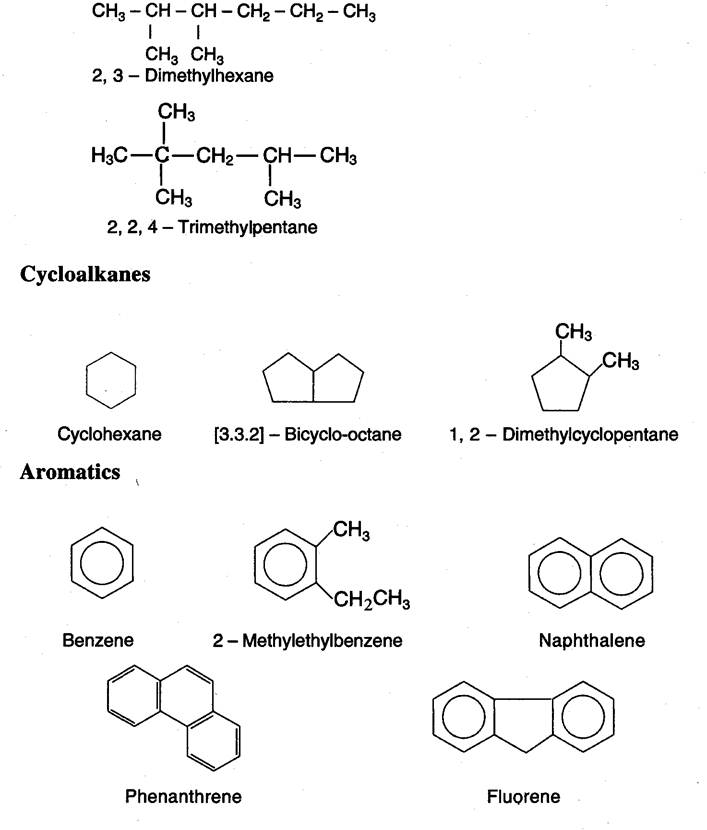
The composition of crude petroleum varies with occurrence. However, it is a complex mixture containing hundreds of compounds. These compounds include alkanes (paraffins) (about 25%), cycloalkanes (cycloparaffins) (about 20%), aromatics (about 5%) and naphthalene. Besides these, the petroleum also contains compounds containing oxygen, nitrogen and sulphur. Some typical examples of various types of compounds that occur in crude petroleum oil are given below:
Alkanes 
7.2.2.2 Some Major Oil Tanker Accidents
Massive marine pollution in the seas is caused by oil tanker accidents. Following are some of the major oil tanker accidents in the seas.
• In 1967, a Liberian tanker, Torry Canyon got wrecked on the Ollard Rock near Land end, England resulting in the discharge of about 100,000 tonnes of oil into the sea. The spill of oil contaminated more than 200 km of Comich coast line in England. This oil spill affected even France.
• In 1969, in the United States, offshore oil blew out the coast of Santa Barbara resulting in the discharge of oil at the rate of 1,000 gallons per hour spreading about 10, 000 metric tonnes of oil over the surface of water.
• In 1973, the oil tanker, M.V. Cosmos Pioneer broke into two near Porbunder in Gujarat, India, due to rough weather, releasing about 18,000 tonnes of light diesel oil in the Gujarat coast.
• In 1974, an American oil tanker, Transhuron' collided the atolls of the Kilton Island in the Laccadives sea discharging about 5000 tonnes of furnace oil on the beaches.
• In 1976, the oil tanker ‘Urquiola’ met with an accident near the Spanish coasts La Covuna and discharged about 100,000 tonnes of crude oil.
• In 1989, an oil spill was reported near the Alaska coast. The oil tanker, Exxon Vaaldez crashed on Prince William sound in Alaska discharging 11 million gallons of oil into Alaska’s waters.
• In 1992, a super tanker met with an accident near the Northwestern Coast of Spain.
• In 1991, during GulfWar about 300 million gallons of oil in the Persian Gulf were discharged in the water. The oil spill hit the Saudi shores.
The National Academy of Sciences, Washington has estimated that about 8-9 million metric tonnes of oil enters the ocean annually.
7.2.2.3 Effects of Oil Pollution
Given below are some of the adverse effects of oil pollution.
(i) The oily surface markedly reduce the rate of oxygen uptake by water.
(H) Oily slit decreases markedly the penetration of light; this retards photosynthesis in aquatic plants.
(iii) Lichens and algae along the shore lines are destroyed.
(iv) Fishery is hampered.
(v) Soluble aromatics present in oil affect the aquatic organisms. Some of the aromatic compounds are carcinogenic and affect plant metabolism.
(vi) The aromatic compounds in oil are very harmful to mankind. These produce irritation, anesthesia and damage liver and kidneys.
(vii)Birds are particularly vulnerable to damage from oil spills in the oceans. Hundreds and thousands of birds die due to the effects of oil.
7.2.2.4 Control of Oil Pollution in Seas
A number of procedures are available to clean up the mess created by oil spills in the oceans. However, the best course is to avoid oil spills by taking adequate measures. Some of the methods to control the spreading of the oil are given below:
(i) Skimming : The heavy oil fraction floating on the surface of the sea are best removed by skimming operation.
This is the simplest and the best method. This method should be used in the shortest possible time after the spilling has taken place, otherwise the wind will spread the oil spills over a very large surface and then the skimming becomes very difficult.(ii) Use of Absorbents: Some suitable absorbing materials like polyurethane, saw dust, chopped straw are spread on the surface of oil and then skimmed off.
(iii) Burning of Oil Slick: This method though useful causes extensive air pollution and may also cause thermal pollution.
(iv) Chemical Additives: These can be used to solidify oil from water surface and then the solid material is easily skimmed.
(v) Micro - organisms: The most effective method to clean up oil pollution is by using certain oil - eating bacteria. The oil - eating microbes were used in cleaning up oil spills in the waters of the state of Texas, U.S.A.
7.2.3 Pollution by Radioactive Materials
Radioactive pollutants enter the water bodies (especially seas and oceans) from various sources, some of which are given below:
(i) Mining and processing of ores to produce unstable radioactive substances.
(ii) Nuclear Power Plants
(iii)Nuclear Reactors
(iv) Nuclear Weapons
(v) Use of Radioactive isotopes in medical, industrial and research applications.
(vi) Testing of nuclear weapons in air, under water give radioactive fallout.
7.2.3.1 TypesofRadionuclides
Nuclear weapon testing produces, Sr90, a long-lived component of radioactive fallout. It is chemically similar to calcium and accompanies calcium in soil, plants and animals and finally finds its way via food chain into humans in bones and teeth. The presence of Sr90 in bones is responsible for disorders in blood - cell formation and causes anemia and more serious disorders.
Nuclear power plants generate liquid wastes (low level radioactivity), liquid and gaseous wastes from fuel elements, fission products and heat. The discharge of radioactive wastes in air and water bodies causes problems in the long run.
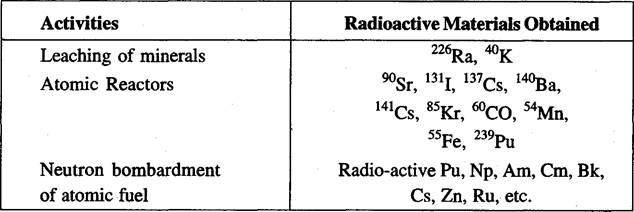
Table 7.1 Hsts some of the radioactive materials discharged from various activities.Table 7.1 Radioactive Materials Discharged
7.2.3.2 Effects OfRadionuclides
The level of radionudides found in water is measured in units of pico curies (=10 12 curie = 3.7 x 10^3 disintegrations per second). The permissible limit is 3 pico curies. Following are given some of the bad effects due to radioactive pollutants in water.
(i) They cause serious skin cancer, carcinoma, melanoma, breast cancer, leukemia, breakage of DNA and cataracts.
(ii) They cause the so-called radiation sickness, which is characterized by nausea, vomiting, diarrhoea, anorexia, epilation, lethargy and weakness.
(iii) They cause genetic disorders, gene mutations and blood abnormalities.
(iv) The radionuclides present in water get accumulated in soil sediments, water and aquatic ecosystem.
7.3