Sources of Soil Pollution
The main sources of soil pollution are as follows:
• Industrial Wastes
• Urban and Domestic Wastes
• RadioactivePollutants
• Agrochemicals
• Chemical and metallic pollutants
• Biological agents
• Acidrain
9.2.1 IndustrialWastes
Industrial wastes are the major cause of soil or land pollution.
These wastes are discharged from textile industry, paper and pulp industry, leather tanning industry, petrochemical industry, food processing industry, soap and detergents industry, dairy industry, metal processing industries, drugs, glass, cement and engineering industries. It is estimated that about 50% of the raw materials become waste products in industry. These pollutants pollute not only land or soil but also water bodies (For details see sec. 6.4).With the advancement of new technology, new types of industrial wastes are produced and discharged on to the land. These waste products are tipped on soil, increasing the extent of soil pollution. The furnaces of industries like thermal and electric power plants produce ‘fly ash’ i.e., unbumt blackish substance which severely pollute air, water and soil.
The pollution of soil affects and alters the chemical and biological properties of soil. These pollutants enter the food chain from the soil, disturb the biochemical processes and seriously affect the living organisms.
Industrial sludges are more dangerous than industrial solid wastes. The industrial sludges vary enormously in composition and include boiler scales which contain calcium carbonate and flue gas sludge. This flue gas desulphurization sludge results when limestone or calcium hydroxide slurries are used to trap sulphur dioxide from gases discharged in coal fired power plants. These wastes also contain toxic volatile elements like arsenic, selenium, mercury, lead and cadmium.
9.2.2 Urban and Domestic Wastes ?
The urban and domestic wastes combined are referred to as refuse.
This j comprises of garbage and waste materials like plastics, glass, metallic containers, ∣fibres, papers and a number of discarded products. It is estimated that in UK and India each, about 15 million tonnes of domestic wastes are disposed off into the land and in USA about 4,00,000 tonnes of solid waste is produced daily. The situation is so alarming that the land fills in use for more than 25 years cannot take any more refuse.
The urban and domestic wastes are more harmful since most of these cannot be easily degraded. Certain items like paints, varnishes and oils etc. create more soil pollution problems. The leaches from the dumping sites and sewage along with industrial effluent are extremely harmful and dangerous. These leaches contain poisonous gases along with partially decomposed materials from food remains, vegetables, toxic chemicals and pathogenic bacteria which can be very harmful and may cause various diseases. These are responsible not only for soil pollution but also for pollution of water bodies.
A practice that is followed in some countries for disposal of urban and domestic wastes is its incineration but this procedure is very expensive.
9.2.3 Radioactive Pollutants
The main sources of radioactive pollutants in soil are as given below:
(i) Radioactive fall - out resulting from testing of nuclear weapons. Considerable amounts of fission products, particularly C-14, Sr -90,1131, Cs-137, etc. are dispersed in the atmosphere as a result of nuclear weapon testing. These nuclides spread all over the globe and ultimately settle on earth’s surface as radioactive fall - out, from where these find their way into the food chain. Most of the nations of the world are in favour of complete Nuclear Test Ban Treaty. However, so far only few countries have signed this treaty.
(ii) Radio-isotopes - These are used in research, industry and medicine and are also generated by the operation of nuclear reactors for generation of power and the nuclear fuel processing plants. (For more details see sec.
1.5.2)∙. Nuclear reactors produce waste containing Ruthenium - 106, Iodine-131, Barium-140, Lanthenium-140, Caesium - 144, Promethium - 444, along with Strontium - 90 and Caesium - 137. All the nucleotides get ultimately deposited in the soil.(iii) Natural Radioactive Nuclides - The earth’s crust contains some radioactive nuclides like U - 238, Th - 234, Ra - 226 which continually emit radiation. The food crops grown in the soil and the drinking water percolating through the soil also contain some radioactive nuclides like Potassium - 40, Carbon - 14 and Rn - 222. These enter the body Ihroughfoodchain.
(iv) Accidents in Nuclear Reactors - These are, of course, rare but if take place, they become the major cause of emission of radio isotopes or nucleolides into the air and the land. Typical disastrous nuclear accidents are the Three Mile Island nuclear plant accident (USA, 1979) and Chemobyl disaster (USSR, 1986).
9.2.4 Agrochemicals
The agrochemicals like fertilizers, pesticides (insecticides, fungicides and herbicides) etc. are commonly used for agricultural crops. These і agrochemicals particularly pesticides (which are very harmful and are not j
biodegradable) find their way into food chain to be consumed by humans and j
animals and cause a number of health hazards. (For more details, see sec. 4.4.6).
9.2.5 Chemical and Metallic Pollutants
The chemical and metallic pollutants result from a large number of industries including textiles, pesticides, paints, dyes, soap, synthetic detergents, tanneries, drugs, batteries, cement, asbestos, rubber, petroleum, paper and pulp, steel, glass, electroplating and metal extraction and processing industries (For details see sec. 4.4.1, 4.4.2 and 4.4.3).
A number of trace elements such as Fe, Co, Ni, Cu, Zn, Ba, Pb, V, Mn, Ni, As, Hg, Mo and Si are added to the soil in one form or the other. Synthetic chemicals and fertilizers are a source of trace metals which are added to the soil. For example, As, Pb, Cd are the common trace metals in rock phosphate and also occur in super phosphate fertilizers.
Sources of some metallic pollutants and their effects are discussed in sec. 4.4.3).I 9.2.6 Biological Agents
The biological agents are responsible for the contamination of soil and crops. I These include pathogenic organisms which occur naturally in contaminated soil
l or are discharged into the soil by excreta of birds, animals and humans. In addition to this, faulty sanitation, municipal garbage, waste water are also responsible for the discharge Ofbiological agents into the soil. Intestinal parasites :i cause the most serious soil pollution.
9.2.7 Acid Rain
; We know that air contains SO2 and NO2 as pollutants (see sec. 4.3.2 and
4.3.3). Sulphur dioxide present in the air undergoes catalytic and photolytic oxidation to form SO3 which reacts with moisture present in the atmosphere to produce sulphuric acid (H2SO4).
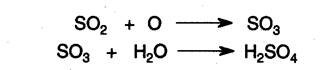
The NO2 present in the atmosphere reacts with rain water or moisture in the presence of O2 or O3 and produces nitric acid (HN03).

H2SO4 and HNO3 formed as above come down the atmosphere in the form of acid rain. This damages the crops and plants and makes the soil acidic which is harmful for subsequent crops. For more details see sec. 4.5.1.
9.3