Structure and Functioning of Ear
Ear consist of three parts- outer, middle and inner out of which only the outer part is visible. The outer ear collects sound waves and these waves then pass through auditory canal to the tympanic membrane (or eardrum) which vibrates, see Fig 11.2 (a).
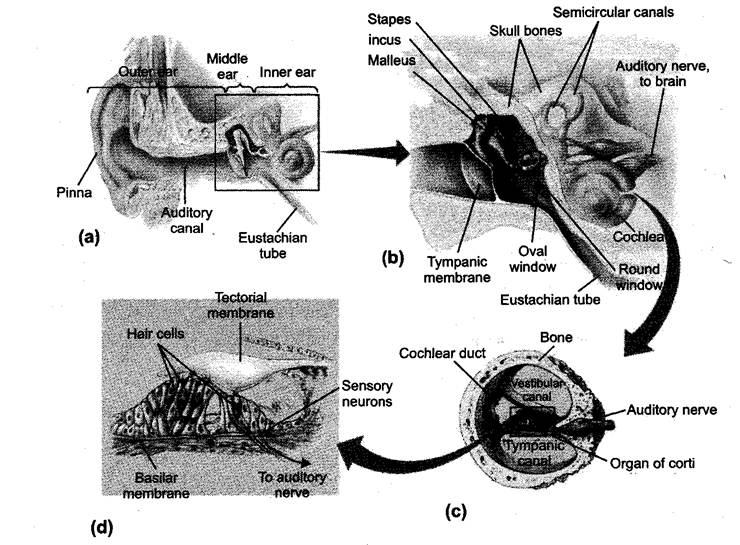
Fig. 11.2: Human Ear and its Parts
These vibrations are then transferred to cochlea by three small bones called ossicles which are shown in Fig 11.2(b). The vibrations then travel in the fluid of cochlea and cause vibration of tectorial membrane Fig 11.2(c). In the inner ear, the organ of corti runs along the entire length of the basilar membrane. The vibration of basilar membrane causes distortion of hair cells which generate a characteristic pattern of impulses in the nerve cells associated with each hair cell. The nerve impulses are sent to brain along the auditory nerve which interprets the sound Fig 11.2 (d).
Normal hearing depends upon the proper functioning of three parts of ear. If the outer ear does not function properly, then conductive hearing loss is there. When the auditory nerves are damaged, then neural hearing loss occurs. The sensory hearing loss is caused by the damage of inner ear (or cochlea) and it is mostly the loss associated with noise.
An explosion of 140 dB can cause permanent deafness because it destroys the hair cells which do not regenerate. Loud and persistent sounds can cause premature degeneration of organ of corti. Recent studies suggest that continuous long-term exposure to noise levels as high as 55 dB can permanently damage hearing. Such noise levels are very common in mining and construction industries, factories etc.
11.6